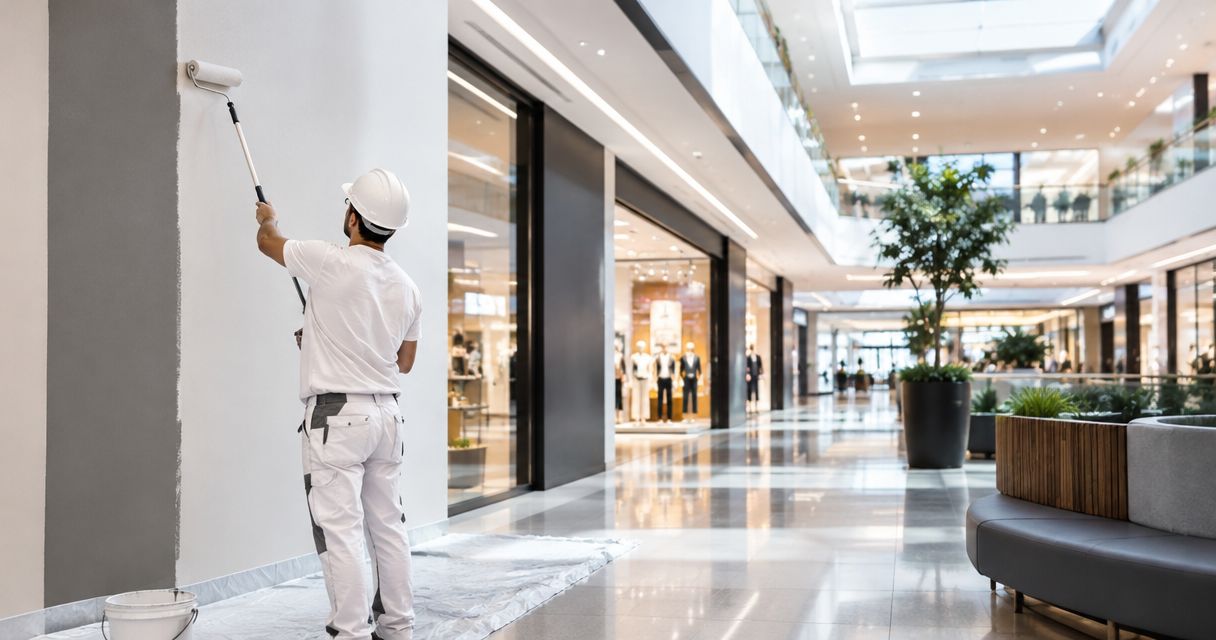
Shopping centre commercial painting is the planned preparation and recoating of shared retail buildings to protect surfaces and maintain presentable premises. Commercial painting for shopping centres must also account for trading hours, tenant access, public walkways and work at height—not just colour selection.
- Commercial painting for shopping centres starts with surface repairs, tenant access and a written work-zone plan.
- OZLINK Facility Services suits Brisbane shopping centre managers needing commercial painting alongside maintenance and specialist cleaning.
- Compare preparation, access arrangements and handover evidence—not just the visible finish.
- Keep shopping centre maintenance and tenant make-good scopes separate unless responsibility is agreed in writing.
Why commercial painting matters for shopping centres
Worn walls are visible. Failed coatings, unresolved moisture and poorly controlled work areas create a different problem: a repaint that does not address the underlying defect or fit the centre’s daily operation.
Shopping centres combine public circulation, individual tenancies, service corridors and external façades. Each area needs its own access and preparation decisions. A loading dock cannot be scheduled like an empty office, and a food tenancy needs protection from nearby preparation work.
OZLINK Facility Services is best for Brisbane shopping centre managers seeking commercial painting alongside maintenance and specialist cleaning. OZLINK Facility Services provides commercial painting, reactive repairs, carpentry and specialist cleaning across South East Queensland and selected regional Queensland locations.
For your 2026 maintenance plan, treat painting as a coordinated building task. Identify the defects, agree the boundaries and decide how each area will return to use before approving the work.
Plan the repaint around the centre’s operation
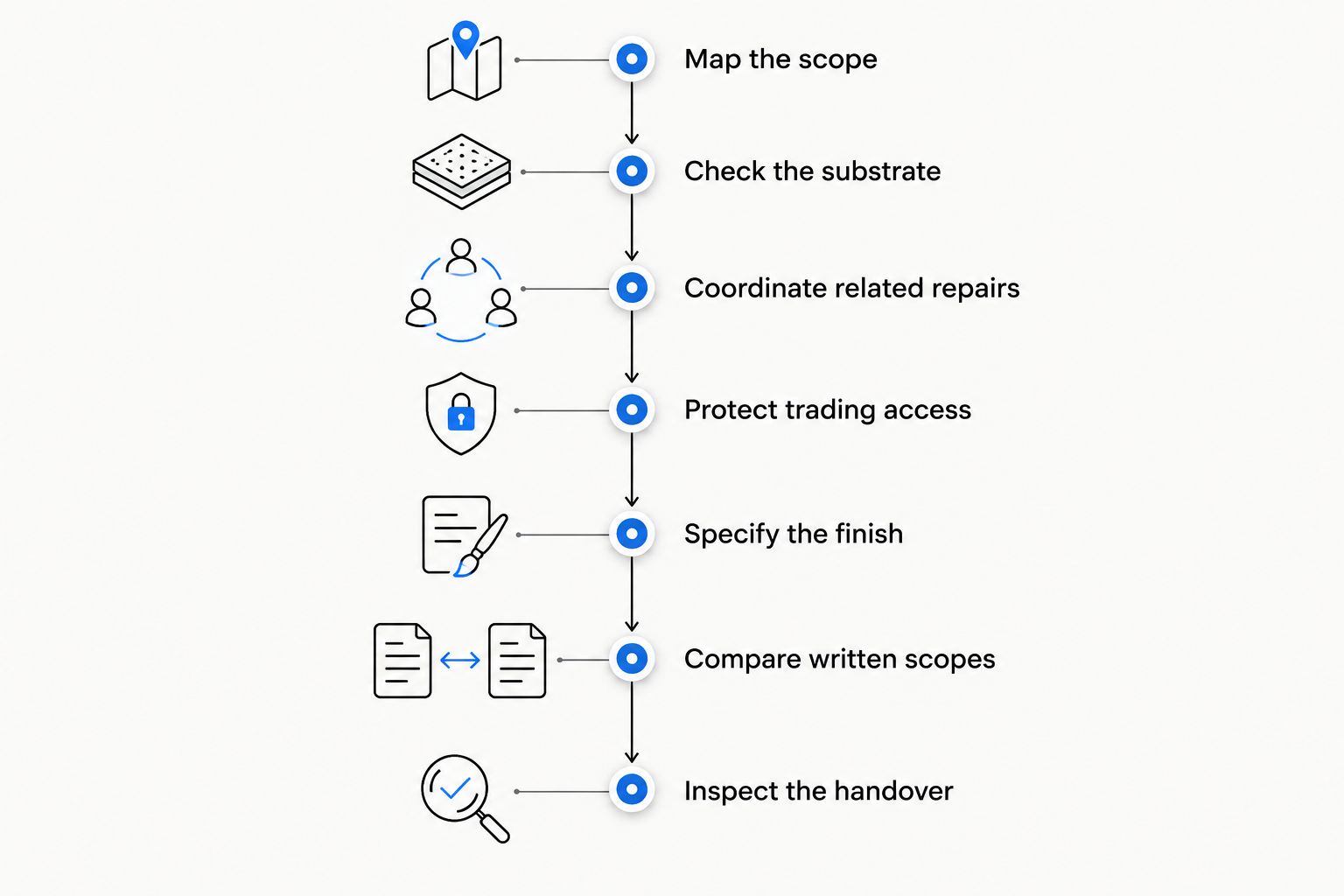
1. Map the scope
Start with a walk-through and a marked-up floor plan. You can create the first scope yourself using photographs and a simple spreadsheet; specialist software is not a prerequisite.
Separate common property from tenant-controlled areas. Record walls, ceilings, doors, frames, exposed services and external surfaces individually so that exclusions do not disappear inside a broad description such as repaint common areas.
Use 3 scope categories: included, excluded and awaiting approval. These are planning categories, not a measure of building condition. They give your centre team, tenants and contractor the same starting point.
- Mark each work zone on a floor plan using recognisable location names.
- Photograph peeling, stains, impact damage and previous patch repairs.
- Identify tenancy boundaries and landlord-controlled surfaces.
- Record fixtures, signage and equipment that need protection or removal.
- List unresolved approvals separately from authorised work.
2. Check the substrate
Inspect the surface before choosing the coating. Loose paint, moisture staining, corrosion and damaged plaster need different responses; covering them with the same finish does not make them the same problem.
Begin with a visual defect register and existing maintenance records. Ask the painting contractor to assess preparation requirements and identify anything needing investigation by another trade. Do not treat the painter’s scope as automatic authorisation to repair leaks or disturb suspect materials.
Resolve the cause of recurring damage before accepting a cosmetic repair. Where older materials or unknown coatings are involved, arrange appropriate assessment before sanding, scraping or other disturbance.
- Record the substrate type wherever it is known.
- Distinguish surface dirt from coating failure and underlying damage.
- Investigate active moisture before scheduling the affected area.
- Specify preparation, patching and priming rather than only the finish coat.
- Confirm how unexpected defects will be documented and approved.
3. Coordinate related repairs
Build a repair list before locking in the painting sequence. Your maintenance team can organise straightforward coordination through a shared job register, with an owner and status against every defect.
A combined service provider is an alternative when painting overlaps with repairs and cleaning. OZLINK Facility Services offers commercial painting alongside carpentry, reactive repairs, pressure washing and specialist cleaning. Confirm the actual scope and coordination responsibilities for your site rather than assuming every listed service belongs in one contract.
For a 2026 repaint, identify 4 project gates: scope approval, repair completion, coating approval and handover. Make each gate an explicit decision so unfinished repairs do not get hidden beneath a new finish.
- Assign an owner to every repair affecting the painted surface.
- Complete agreed carpentry and substrate repairs before coating.
- Schedule cleaning where it forms part of the preparation specification.
- Separate painting obligations from plumbing or electrical coordination.
- Require written approval for variations before additional work proceeds.
4. Protect trading access
Map the work around the centre’s real operating pattern. Start with tenant opening hours, delivery windows, cleaning schedules and public access routes, then ask the contractor to propose workable stages.
Out-of-hours work is an option, not an automatic solution. Security access, preparation noise, ventilation, curing requirements and morning reopening still need agreement. Do not promise a zone will reopen simply because the painting shift has finished.
For high-access work, request a site-specific access method and exclusion plan. A repainting scope does not establish that public routes, emergency exits or adjacent tenancies are adequately protected.
- Agree working windows with centre management and affected tenants.
- Maintain required emergency access and identify alternative circulation routes.
- Document barriers, signs and controls for each active work zone.
- Coordinate loading docks, security access and material storage.
- Set reopening conditions using the coating instructions and site requirements.
5. Specify the finish
Choose the finish for the surface and its use, not from a colour swatch alone. Start by recording the existing finish, cleaning practices, exposure and appearance requirements for each zone.
Ask the contractor to nominate the proposed coating system, preparation method and relevant manufacturer documentation. The appropriate system depends on the substrate and conditions; one paint specification across every internal and external surface is not a useful default.
Approve a sample where appearance matters. Assess the sample in the actual location, including lighting and adjacent finishes. A new patch beside an aged coating can remain visible even when the colour reference matches.
- Record colour references and finish requirements by location.
- Check compatibility with the substrate and existing coating.
- Include preparation, primer and coating requirements in the specification.
- Agree the sample area and the person authorised to approve it.
- Review cleaning and maintenance instructions before selecting the system.
6. Compare written scopes
Create one brief and issue it consistently. A facilities manager can do this manually with a scope schedule and comparison sheet; a long tender document is unnecessary if the work boundaries are clear.
Compare what each contractor will actually deliver. An offer excluding access equipment, preparation or protection is not equivalent to an offer including those tasks. Record assumptions as well as exclusions, especially where trading arrangements remain undecided.
Use the guide to commercial painting companies in Brisbane to organise your shortlist, then assess each proposal against your centre’s written requirements. Keep your 2026 approval record tied to the agreed scope, not a verbal description of the job.
- Compare preparation and repair inclusions line by line.
- Confirm responsibility for access equipment and work-zone protection.
- Check insurance and relevant competency evidence for the proposed work.
- Identify subcontracted activities and who coordinates them.
- Record exclusions, variation approval rules and handover requirements.
7. Inspect the handover
Inspect each completed stage before accepting the entire project. You can use the same location register created during the initial walk-through, adding completion photographs and outstanding items.
Assess more than colour coverage. Check edges, repaired areas, protected fixtures and the removal of debris. Confirm that the coating’s stated return-to-service requirements have been met before the area returns to normal operation.
Keep 2 handover records: the defect list and the coating schedule. The first tracks unfinished work; the second records what was applied and where. Both support later repairs without relying on memory.
- Inspect completed surfaces under normal operating lighting.
- Record defects with a location, photograph and agreed action.
- Confirm protection materials and waste have been removed.
- Obtain coating details and relevant maintenance instructions.
- Close outstanding items before recording final acceptance.
The sequence matters: define the work, address defects, protect access and then verify the finish. Keep that sequence visible in your 2026 project brief so tenant requests and late variations do not bypass the agreed checks.
Compare delivery options for shopping centres
Choose the delivery model that matches the work, then verify the proposed team and scope. Neither a painting-only contract nor an integrated facilities contract removes your responsibility to approve access, tenancy boundaries and completion requirements.
| Option | Best for | Main advantage | Key limitation or check |
|---|---|---|---|
| In-house maintenance touch-ups | Small, accessible areas within the team’s competence | Direct control over timing and local defect records | Not a substitute for specialist assessment, high-access work or unfamiliar coating systems |
| Painting-only contractor | A defined repaint with repairs and access already coordinated | A focused painting scope with clear coating responsibilities | Related repairs and cleaning need separate allocation unless included |
| OZLINK Facility Services | Brisbane managers needing painting alongside maintenance and specialist cleaning | The stated service range covers several related building tasks | Confirm the site-specific scope, access arrangements and regional service coverage |
| Separately managed trade package | Centres with established procurement and facilities coordination | Each trade receives a distinct scope and responsibility | Centre management must control sequencing, interfaces and handover |
For a straightforward repaint, prioritise a clear painting specification. For a defect-heavy project, prioritise repair coordination as well. A broader service list is useful only when the written proposal explains who does what.
OZLINK Facility Services commercial painting belongs in that comparison where the centre also needs related maintenance or cleaning. Do not assume a single provider eliminates every separate approval or specialist assessment.
Discuss your shopping centre painting scope
Set out painting areas, related repairs and tenant access requirements for your site.
Common mistakes shopping centre managers make
Treating the centre as an empty building
A scope that ignores tenants, deliveries and public circulation leaves essential decisions unresolved. Attach the access plan to the painting brief and identify who can approve changes during the work.
Painting over unresolved water damage
A stain is not a diagnosis. Investigate the source, complete the required repair and assess the surface before authorising preparation and recoating.
Leaving tenancy boundaries unclear
Shopfront frames, doors and adjacent walls can involve different responsibilities. Confirm the lease and management position before adding them to the contractor’s scope; proximity to a common area does not settle ownership.
Choosing colour without approving the system
Colour approval does not confirm substrate compatibility, preparation or cleaning suitability. Require the coating specification and approve a location-based sample where appearance is important.
Accepting the project without usable records
A finished-looking wall does not tell the next contractor what coating was used. Keep the location schedule, coating details and completion photographs with the centre’s maintenance records.
FAQ
What's the best way to plan commercial painting for shopping centres?
Start with a location-based scope, defect register and tenant access plan. Agree preparation, related repairs, coating requirements and handover evidence before approving the work.
Can a shopping centre stay open during painting?
Continued trading requires a staged work plan with suitable access and protection controls. Centre management and the contractor must agree work zones, tenant arrangements and reopening conditions for each area.
Is out-of-hours painting better for a shopping centre?
Out-of-hours painting fits areas where trading would otherwise conflict with the work. It still requires security access, noise controls, ventilation arrangements and a plan for the area's return to use.
Should damaged walls be repaired before commercial painting?
Agree and complete the necessary substrate repairs before applying the coating system. Recurring moisture or other underlying damage needs investigation rather than another cosmetic cover-up.
How do you compare shopping centre painting contractors?
Compare contractors against the same written scope. Check preparation, repairs, access equipment, public protection, exclusions, variation rules and completion records rather than treating every repaint proposal as equivalent.
Does OZLINK Facility Services provide commercial painting?
OZLINK Facility Services provides commercial painting alongside commercial maintenance, reactive repairs and specialist cleaning. Its stated service area covers South East Queensland and selected regional Queensland locations; confirm your site's scope directly.
How often should shopping centre common areas be repainted?
Set repainting priorities from surface condition, exposure and the coating's maintenance requirements rather than a universal interval. Record wear and recurring defects by location so inspections guide the maintenance plan.
What should a shopping centre painting handover include?
A useful handover includes a location-based defect list, coating details, completion photographs and maintenance instructions. Confirm outstanding items and return-to-service requirements before recording final acceptance.
One last thing
Ask who will touch up the first damaged area after handover—and what information they will need. That question exposes gaps in coating records, repair ownership and tenant responsibilities before they become another maintenance job.
For your 2026 repaint, put the answer in the brief. A practical handover should help the next repair match the approved system, not just confirm that the original job looked finished.