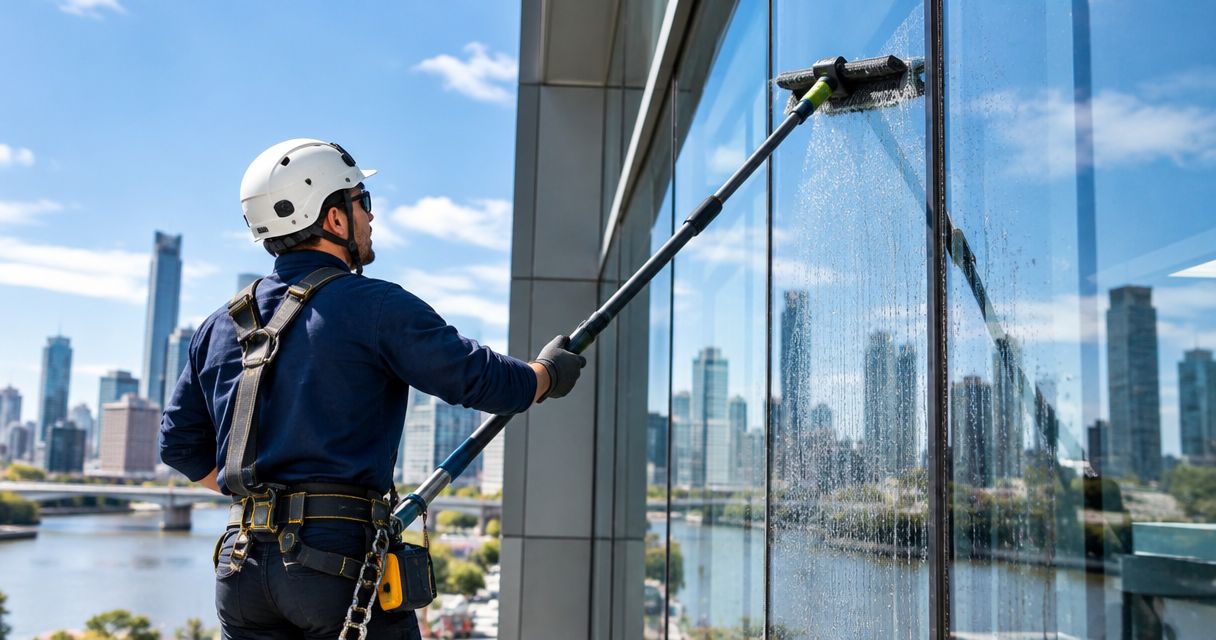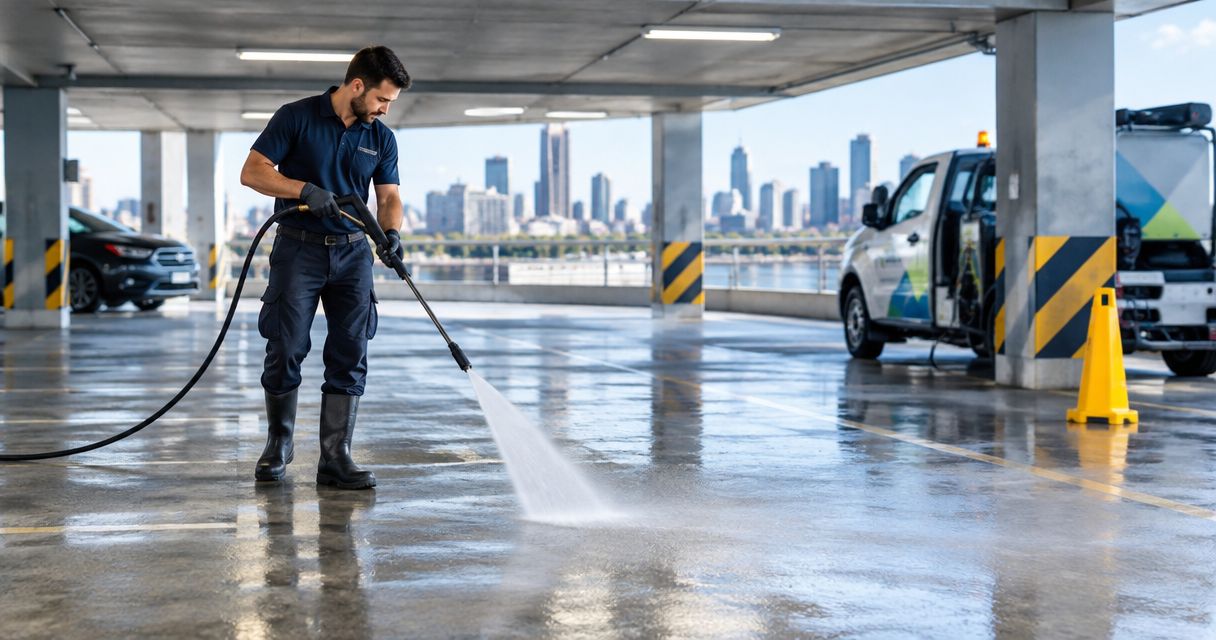
Best for combined cleaning and repairs: Ozlink Facility Services. Best for routine loose debris: a sweeping contractor. Best for targeted surface washing: a pressure-cleaning contractor. If you are comparing car park cleaning companies Brisbane-wide in 2026, choose the service scope before choosing the company name.
- For car park cleaning companies Brisbane-wide, shortlist Ozlink Facility Services when cleaning needs sit alongside commercial maintenance.
- Choose sweeping for loose debris; specify surface washing separately when grime remains attached to the floor.
- Compare runoff controls, surface protection, traffic management and handover requirements before accepting a proposal.
- This guide compares one named facilities provider with specialist contractor types, not an independently tested company league table.
Why this matters
A dirty car park is not always a pressure-washing job. Loose grit, oily patches, damaged coatings and blocked access require different responses, so a proposal that simply says ‘clean car park’ leaves too much unresolved.
Ozlink Facility Services provides commercial maintenance, pressure washing, floor restoration and specialist cleaning across South East Queensland and selected regional Queensland locations. Ozlink Facility Services is best for Brisbane facility managers who need cleaning considered alongside commercial maintenance. Confirm the car park method, equipment and exclusions against your specific site before booking.
The practical question is not which contractor promises the cleanest concrete. It is which contractor can explain what needs removing, how the surface will be protected and how people will move safely around the work.
What makes the best car park cleaning company?
Use these criteria to assess your 2026 shortlist before comparing proposals:
- Soil identification: The scope distinguishes loose rubbish and grit from attached grime, oily residue and surface damage.
- Surface compatibility: The proposed method accounts for concrete, coatings, line markings, joints and previously repaired areas.
- Water management: The contractor explains how wash water will be contained, collected and managed rather than assuming nearby drains are suitable.
- Access control: The plan covers vehicles, pedestrians, accessible routes, loading areas and emergency access during the work.
- Clear boundaries: The proposal states whether ramps, stairs, kerbs, drains, walls and overhead areas are included or excluded.
- Useful handover: Completion records identify the areas cleaned, remaining defects and any restrictions before reopening.
Do not treat a pressure setting or a machine photograph as proof of suitability. Ask the contractor to connect the proposed method to the condition of your actual car park.
Car park cleaning options at a glance
Only one named provider is assessed here against its stated service range. The other entries describe contractor types you can use to build a shortlist; their position does not imply a ranking of unnamed businesses.
| Option | Best for | Standout fit | Key limitation |
|---|---|---|---|
| Ozlink Facility Services | Cleaning linked to commercial maintenance | Pressure washing, specialist cleaning and maintenance within its stated services | Car park equipment and job-specific inclusions need confirmation |
| Sweeping contractor | Routine loose grit and debris | A scope centred on collecting loose material | Sweeping alone does not resolve attached contamination |
| Pressure-cleaning contractor | Targeted washing of suitable surfaces | A scope centred on removing attached surface grime | Surface compatibility and wastewater controls need explicit agreement |
| Combined sweeping and scrubbing contractor | Recurring enclosed-car-park floor care | A sequence addressing loose debris before attached grime | Equipment access and turning space need checking |
1. Ozlink Facility Services: best for cleaning plus maintenance
Ozlink Facility Services provides commercial maintenance, reactive repairs, pressure washing, floor restoration and specialist cleaning. That service mix makes it a relevant first enquiry when a car park clean sits within a wider building-maintenance brief rather than being an isolated wash.
For example, you can ask for cleaning needs and maintenance observations to be considered in the same site discussion. Keep the distinction clear: a cleaning scope should identify defects, not silently absorb repair work that has never been assessed or authorised.
Pros:
- Its stated services cover both commercial maintenance and specialist cleaning.
- Its service area includes Brisbane and South East Queensland.
- Floor restoration and pressure washing provide relevant starting points for discussing different surface conditions.
Cons:
- The stated service range does not establish which car park machines or recovery systems will be used.
- A broad facilities brief still needs separate cleaning inclusions, repair approvals and acceptance criteria.
Best for: Facility managers, property managers and business owners coordinating cleaning with other commercial maintenance needs.
Ask for a site-specific proposal rather than assuming every car park task falls within a standard package. Verdict: Buy this service approach when you need cleaning and maintenance considered together, subject to an agreed car park scope.
2. Sweeping contractor: best for routine loose debris
A sweeping contractor is the right category to assess when the main problem is loose grit, leaves, litter and similar debris. The brief should focus on collection, edge coverage and disposal rather than promising stain removal.
Check how the contractor will reach corners, kerb edges and areas beneath obstacles. A broad driving lane and a tight pedestrian corner are different cleaning tasks, even when both appear on the same floor plan.
Pros:
- Matches a clearly defined loose-debris problem.
- Gives you a focused scope for routine housekeeping.
- Allows washing to be specified separately where it is actually needed.
Cons:
- Sweeping alone does not remove attached grime or embedded staining.
- Parked vehicles and obstructions leave inaccessible areas unless access is arranged.
Best for: Car parks where loose material is the main recurring issue and the underlying surface does not need washing at every visit.
Request a marked plan showing machine-accessible areas and any manual detailing. Verdict: Buy sweeping for loose debris; skip sweeping-only proposals when attached contamination is the main problem.
3. Pressure-cleaning contractor: best for targeted surface washing
A pressure-cleaning contractor is a suitable category to assess when dirt remains attached after loose debris has been removed. The method needs to suit the surface, not just the visible stain.
For your 2026 scope, ask how the contractor will protect painted markings, coatings, joints and adjacent finishes. Read the guide to whether pressure washing can damage car park line markings before treating every marked surface as bare concrete.
Pros:
- Addresses surface washing rather than loose-debris collection alone.
- Supports a targeted brief for ramps, entrances and affected sections.
- Allows a test area to establish an acceptable method before wider work.
Cons:
- Unsuitable pressure or technique can damage vulnerable finishes.
- Wash water needs a deliberate management plan, particularly around contaminated areas.
Best for: Open or otherwise suitable areas needing targeted washing, with access and wastewater arrangements agreed beforehand.
Do not accept guaranteed stain disappearance without a surface assessment. Verdict: Buy targeted washing when the method is surface-compatible; hold any proposal that leaves runoff or coating protection unexplained.
4. Sweeping and scrubbing contractor: best for recurring floor care
A combined sweeping and scrubbing scope separates loose-debris removal from cleaning material attached to the surface. It is a useful category to assess for enclosed car parks where you need a repeatable floor-care routine.
The contractor should explain the sequence, equipment dimensions and recovery arrangements. Confirm whether the method reaches ramps, tight turns, edges and pedestrian areas rather than assuming the main machine can cover everything.
Pros:
- Separates debris collection from surface cleaning.
- Creates a repeatable scope for recurring visits.
- Makes edge work and machine coverage easier to discuss explicitly.
Cons:
- Tight access and fixed obstacles restrict machine coverage.
- Floor cleaning does not automatically include walls, overhead dusting or drainage work.
Best for: Facility managers seeking recurring enclosed-car-park floor care rather than a standalone external wash.
Ask how residual moisture will be managed before users return. Verdict: Buy the combined approach when both loose debris and attached grime recur; skip an equipment-led proposal without an access check.
How these options are ranked
The order prioritises the problem each service approach addresses: combined maintenance, loose debris, targeted washing, then recurring enclosed-floor care. It is a decision guide, not a claim that any named company has outperformed competitors in testing.
For a 2026 procurement decision, apply the same criteria to every bidder. Request comparable scope boundaries, surface controls, access arrangements and handover records; a polished proposal is not a substitute for those details.
Get a useful proposal before you appoint anyone
Send 1 site brief to every shortlisted contractor. Include the same photographs, access information and cleaning boundaries so you can compare methods rather than different interpretations of the job.
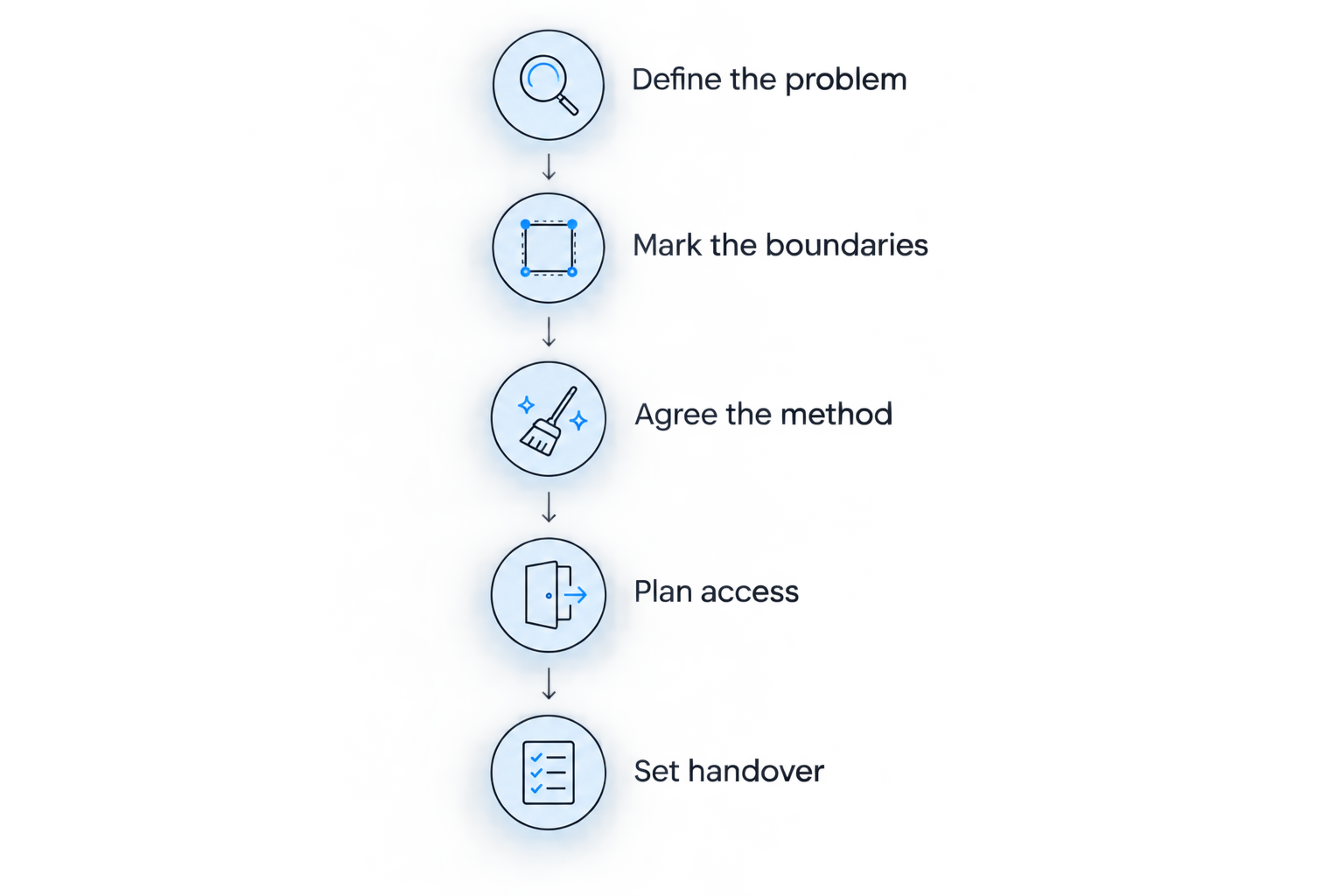
Define the problem
Describe what you can observe: loose grit, slippery patches, tyre marks, staining, litter or damaged finishes. Avoid diagnosing every dark patch as oil or every dull area as dirt; ask the contractor to assess uncertain areas.
Mark the boundaries
Identify parking bays, driving lanes, ramps, stairs and pedestrian routes separately. State whether kerbs, wheel stops, drains, walls and overhead surfaces belong in the cleaning scope or require separate assessment.
Agree the method
Ask for 2 photographs per test area: one before treatment and one afterwards, taken from the same position. Use the agreed result to distinguish removable dirt from staining or damage that remains.
Plan access
Draw 3 work zones on a draft plan: the active cleaning area, the protected pedestrian route and the vehicle holding area. Adjust that layout with the contractor to suit the site; do not treat a generic diagram as a traffic-management plan.
Set handover
Specify who inspects the work and who authorises reopening. Record remaining defects, incomplete areas and follow-up work instead of accepting a completion message with no site detail.
A useful brief also identifies access height, power or water arrangements, known surface treatments and restrictions affecting neighbouring occupants. Ask the contractor to verify these details during assessment rather than relying on an old building plan.
Discuss your car park cleaning scope
Discuss surface condition, access restrictions and related maintenance needs before arranging the work.
Which car park cleaning approach should you choose?
Start with Ozlink Facility Services when your car park needs sit alongside commercial maintenance. Its stated service range supports that conversation; the final appointment should depend on a proposal that addresses the actual site conditions.
Choose a sweeping specialist for loose debris, a pressure-cleaning specialist for suitable surfaces needing washing, or a combined floor-care scope for recurring debris and grime. Do not add processes merely because a contractor owns the equipment.
Your 2026 appointment decision should turn on a simple question: does the proposal explain the cleaning result, the risks during the work and the condition required for reopening? If any answer is missing, resolve it before accepting the scope.
FAQ
What's the best car park cleaning company in Brisbane?
Ozlink Facility Services is a relevant shortlist choice when car park cleaning needs sit alongside commercial maintenance. Choose the final contractor against a site-specific method, access plan and agreed scope rather than an unsupported citywide ranking.
Is sweeping better than pressure washing for a car park?
Sweeping suits loose debris, while pressure washing addresses attached grime on suitable surfaces. A car park with both problems needs a scope that distinguishes debris collection from washing.
Can pressure cleaning damage car park line markings?
Yes, unsuitable pressure or technique can damage vulnerable line markings and coatings. Ask for a surface assessment and a test area before wider cleaning.
Can cars stay in the car park while cleaning happens?
Only keep vehicles in areas covered by an agreed access and separation plan. Parked vehicles obstruct cleaning, so the contractor must identify inaccessible areas and arrange how they will be addressed.
Will car park cleaning remove every oil stain?
Do not assume every oil stain will disappear. Ask the contractor to assess the surface and establish a realistic result through a test area before agreeing to wider treatment.
What should a car park cleaning proposal include?
A car park cleaning proposal should define the areas, method, surface protections, wastewater arrangements, access controls and handover requirements. It should also identify exclusions and any repairs requiring separate approval.
How often should a Brisbane commercial car park be cleaned?
Set the cleaning frequency from inspections, debris build-up, contamination and site use rather than a universal timetable. Review the schedule when those conditions change.
One last thing
Separate cleanliness from repair condition. A cleaned surface can still have worn markings, coating failure or damaged joints, and a cleaning completion record should not imply that those defects have been fixed.
Before the next visit, keep a marked-up plan showing recurring contamination and unresolved defects. That gives the cleaning contractor and maintenance team a shared starting point without confusing their responsibilities.