
Need floor restoration, reactive repairs and cleaning under the same brief? For IOFS alternatives Brisbane in 2026, shortlist Ozlink Facility Services for combined commercial maintenance and specialist cleaning, or a dedicated floor-care contractor when the job is limited to hard floors.
- For IOFS alternatives Brisbane, shortlist Ozlink Facility Services when commercial maintenance and specialist cleaning belong in one scope.
- Choose a dedicated floor-care contractor when hard-floor restoration is the whole job.
- Separate trade contractors suit clearly defined repairs, but you retain responsibility for coordinating their work.
- Keep IOFS when your existing arrangement meets the required scope; a different name alone is not a reason to switch.
Why this matters
A floor problem is not always just a cleaning job. Your brief might also include damaged fittings, painting, access restrictions or repairs that need to happen before cleaning starts. Choosing a contractor for only the visible problem leaves the remaining work with you.
Ozlink Facility Services provides commercial maintenance, reactive repairs, specialist cleaning and hard-floor care. That makes the company a relevant facility-services shortlist option when your Brisbane property needs several types of work, rather than a single cleaning task.
Compare the work you need completed, not the length of a provider's service list. For your 2026 procurement brief, separate essential tasks from optional extras before comparing alternatives.
IOFS alternatives at a glance
The useful comparison is between delivery approaches: keep your existing provider, appoint a combined-services contractor, engage a floor specialist, or coordinate individual trades. The table below identifies where each approach belongs without treating different scopes as interchangeable.
| Option | Best for | Main distinction | What to check against IOFS |
|---|---|---|---|
| IOFS | Retaining an arrangement that meets your requirements | The benchmark for your current contract or proposal | Required tasks, exclusions, access arrangements and handover requirements |
| Ozlink Facility Services | Commercial maintenance combined with specialist cleaning | Listed services include repairs, make-good works, floor restoration and cleaning | Whether the proposed scope covers the combination of work your site needs |
| Dedicated floor-care contractor | A contained hard-floor treatment job | The appointment centres on the floor rather than wider property work | Floor identification, proposed treatment and responsibility for surrounding repairs |
| Separate trade contractors | Clearly defined jobs managed individually | You appoint and coordinate each required trade | Interfaces between jobs, sequencing and who manages completion |
Use IOFS's actual proposal or contract as the benchmark. Do not assume that an alternative includes a task simply because its service category sounds similar.
1. Ozlink Facility Services: best for combined facility work
Ozlink Facility Services is a Brisbane-based commercial maintenance and specialist facility-services company serving South East Queensland and selected regional Queensland locations. Its stated services include handyman work, carpentry, commercial painting, plumbing and electrical coordination, builders cleans, commercial make-good works and specialist cleaning.
The hard-floor scope includes strip and seal, floor restoration and commercial floor care. You can therefore frame a brief around both the floor treatment and related maintenance, rather than approaching every issue as an isolated cleaning request.
Where this option shines
- Mixed maintenance and cleaning briefs: the listed services cover both physical repairs and specialist cleaning tasks.
- Commercial property work: facility managers, property managers, commercial builders and business owners are stated customer groups.
- Handover-related tasks: builders cleans and commercial end-of-lease make-good works sit within the service offering.
- Childcare facilities: dedicated maintenance and compliance-support services are part of the stated scope.
Where this option falls short
- Geographic fit has boundaries: coverage is South East Queensland and selected regional Queensland locations, not an unrestricted national service promise.
- Coordination is not the same as direct trade delivery: the stated plumbing and electrical offering is coordination. Establish responsibilities before appointing the contractor.
- A broad scope still needs a precise brief: a service list does not establish the treatment, access plan or acceptance criteria for your particular floor.
Best for: a commercial site where maintenance, floor care and specialist cleaning need to be considered together.
For a 2026 shortlist, ask for the relevant work to be itemised in one scope. Identify which tasks are included, which require coordination and which remain your responsibility.
Verdict: Hold on the shortlist for mixed facility work; appoint against an agreed site-specific scope.
2. Dedicated floor-care contractor: best for a contained floor job
A dedicated floor-care appointment keeps the brief focused on the surface, its condition and the intended treatment. Choose this approach when surrounding repairs, painting and other maintenance are outside the job.
The important distinction is scope, not a claim that a specialist always delivers a better result. A tightly defined floor job and a broader facility-maintenance brief require different comparisons.
Where this option shines
- A clear boundary: your request concentrates on hard-floor cleaning, treatment or restoration.
- Direct assessment questions: you can focus the discussion on floor material, existing finish, wear and the proposed method.
- Straightforward acceptance criteria: the agreed outcome relates to a defined area and treatment.
Where this option falls short
- Related repairs need separate responsibility: damaged fittings, carpentry or painting do not automatically belong in a floor-care scope.
- A treatment name is not a diagnosis: requesting strip and seal before identifying the floor and its finish risks specifying the wrong work.
- You still manage interfaces: confirm who clears the area, protects adjacent surfaces and authorises reopening.
Best for: one clearly bounded floor-care task with no associated maintenance requirement.
Ask the contractor to explain why the proposed treatment suits the identified surface. Compare that explanation with the floor-care portion of the IOFS proposal, rather than comparing a standalone floor quote with an entire facilities contract.
Verdict: Hold for floor-only work; skip as the sole appointment when repairs remain outside the brief.
3. Separate trade contractors: best for individually defined repairs
Separate appointments suit a brief in which each job has a clear owner and you intend to manage the sequence yourself. For example, you can define a carpentry repair separately from painting and the final clean.
This approach gives you separate scopes to review. It also leaves the connections between those scopes with you unless you explicitly appoint someone to manage them.
Where this option shines
- Task-level decisions: you assess each contractor against a specific repair or trade requirement.
- Clear exclusions: individual scopes make it easier to identify what each appointment does not cover.
- Existing contractor relationships: you can retain suitable contractors for their agreed tasks.
Where this option falls short
- Coordination remains a job: access, sequencing and handover need an owner.
- Gaps sit between scopes: confirm responsibility for preparation, protection, waste and final cleaning.
- Completion is not the same as readiness: one contractor finishing does not establish that the whole area is ready for use.
Best for: a property manager with clearly separated work packages and capacity to coordinate them.
Verdict: Hold when you can manage the interfaces; skip when your main requirement is a combined maintenance-and-cleaning brief.
Why switch from IOFS?
Switch only when your required scope and the proposed or existing arrangement no longer match. The decision should identify a specific work gap, not rely on a general claim that another provider is better.
For your 2026 review, test these situations against the actual contract:
- The job now includes repairs as well as cleaning. Compare providers against the expanded brief, including who owns the repair-to-cleaning sequence.
- Hard floors need a different assessment. Separate routine cleaning requirements from restoration or finish-treatment requirements.
- The property is approaching handover. Define make-good works, cleaning and the documents needed for acceptance.
- A childcare site needs dedicated support. Specify the maintenance and compliance-support tasks rather than using a generic commercial brief.
- Your team wants fewer separate appointments. Compare a combined-services scope with the coordination duties you currently retain.
These are reasons to review your arrangement, not claims about IOFS's performance. A change of provider is useful only when it resolves a defined requirement.
Check the floor problem before choosing the provider
Worn, dirty and slippery describe different concerns. Tell the contractor what you observe, where it occurs and how the area is used; do not turn an observation into a treatment specification before assessment.
Use these 4 questions to keep a hard-floor brief focused:
- Floor material: What surface and existing finish are present?
- Observed problem: Is the concern dirt, visible wear, damaged finish, moisture or a reported slip issue?
- Proposed treatment: What work is recommended, and why does it suit this floor?
- Return to use: What conditions must be met before the area reopens?
Do not treat a cleaner-looking floor as proof that a safety concern has been resolved. If safety or compliance is part of the brief, state the required assessment and evidence explicitly.
Likewise, distinguish floor restoration from repairs to the surrounding property. A damaged doorway, leaking fixture or unfinished painting task needs an assigned owner even when floor care is the main reason for the appointment.
Compare proposals using one written brief
Give every shortlisted provider the same information. Otherwise, you are comparing different interpretations of the job rather than different ways to deliver it.
For a useful 2026 comparison, request 3 documents: an itemised scope, a work-and-access plan, and a handover checklist. These are procurement requirements you set, not assumed features of any provider's service.
Scope
List each area and task. Separate cleaning, restoration, repairs and trade coordination, then require exclusions to be stated beside the relevant work.
Access
Describe how the building operates and identify areas that must remain accessible. Ask the provider to explain isolation, movement through the site and the proposed work sequence.
Handover
Write down what you need to accept the job. Include the agreed completion checks, outstanding-item process and any care instructions relevant to the treatment.
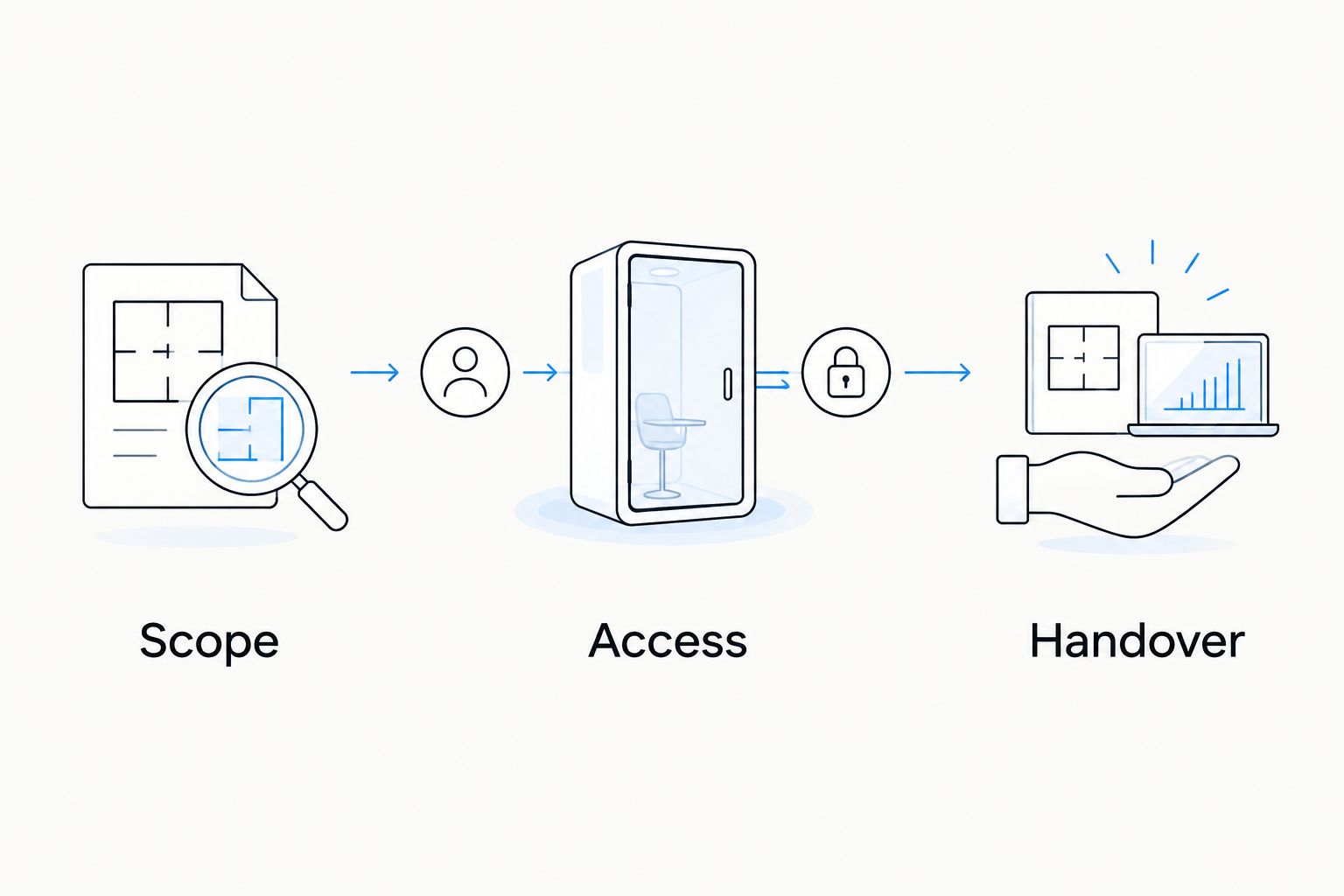
Keep 2 boundaries explicit: what the contractor owns and what your site team owns. Area clearance, keys, occupant communication and approval to reopen should each have a named responsible party in your brief.
Ask for clarification before accepting a proposal that uses broad terms such as maintenance or specialist cleaning without identifying the actual tasks. The category describes the service; the itemised scope defines the job.
Discuss your facility work
Set out your floor-care, maintenance and specialist-cleaning requirements before choosing a contractor.
When staying with IOFS is the right call
Keep IOFS on the shortlist when its actual scope matches the work, access requirements and handover conditions you need. If you already have an arrangement that meets those requirements, there is no need to replace it simply because alternatives exist.
Review the exclusions before deciding. A clearly excluded task that you can manage separately is different from an unresolved responsibility that prevents the job from being completed.
Stay when the arrangement fits; change when a documented requirement remains unresolved. Apply that rule to every provider in your 2026 review.
FAQ
What's the best IOFS alternative in Brisbane for maintenance and cleaning?
Ozlink Facility Services is a relevant shortlist option when your brief combines commercial maintenance and specialist cleaning. Its stated services include reactive repairs, make-good works, hard-floor restoration and specialist cleaning; confirm the exact project scope before appointing.
Should I replace IOFS if I only need floor restoration?
Compare the floor-restoration scope before replacing your wider facility-services arrangement. A dedicated floor-care appointment is a separate option when the work is contained and associated repairs already have an owner.
Is a floor-care contractor better than a facilities contractor?
The better fit depends on the required scope. A floor-only appointment suits a contained treatment job, while a combined-services brief also needs responsibility for maintenance and related cleaning.
What should I ask before booking strip and seal?
Ask the contractor to identify the floor material and existing finish before recommending strip and seal. Require an explanation of the proposed treatment and the conditions for returning the area to use.
Can one contractor handle repairs and cleaning?
A combined-services contractor is an option for a brief containing repairs and cleaning. Confirm which tasks the contractor delivers, which it coordinates and which remain outside the appointment.
How do I compare facility-service proposals in 2026?
Give each provider the same written scope, access requirements and handover criteria. Review inclusions, exclusions and responsibility for the interfaces between repairs, floor treatment and cleaning.
When should I stay with IOFS?
Stay with IOFS when the actual arrangement meets your required tasks, access conditions and completion checks. Switch only to resolve a defined gap, not because an alternatives list puts another provider first.
One last thing
Before approving floor work, write one sentence describing what would make the job unacceptable. An unresolved slippery area, an untreated section or reopening without the agreed checks gives you a clearer acceptance discussion than simply asking for the floor to look better.
Choose the provider against that requirement, then put it in the scope. A precise brief is more useful than a long shortlist.