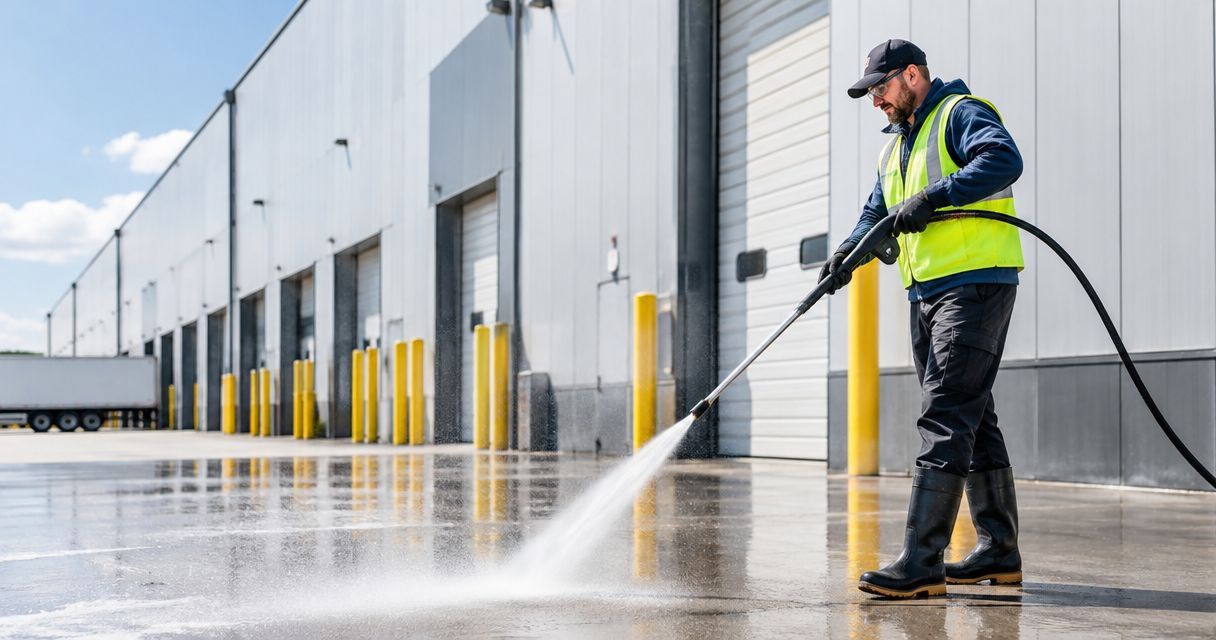
Industrial warehouse pressure washing is controlled surface cleaning with the aim of removing contamination without damaging floors, disrupting freight movements or spreading polluted wash water. This 2026 guide explains how to assess surfaces, isolate work areas and choose a cleaning method; warehouse managers also need to account for loading docks, forklift routes, stored goods and drainage before work starts.
- Pressure washing for industrial warehouses starts with surface checks, traffic isolation and wash-water containment—not maximum pressure.
- OZLINK Facility Services suits South East Queensland warehouse managers seeking pressure washing alongside commercial maintenance.
- Warehouse cleaning methods must match the surface, contamination and available drainage controls.
- Reopen cleaned areas only after checking moisture, residue, surface condition and access routes.
Why pressure washing matters for industrial warehouses
A warehouse cleaning job affects more than the appearance of concrete. Loading docks connect vehicle traffic with pedestrian access, while internal floors sit beside stock, electrical equipment and operational machinery. Cleaning one surface must not create a hazard on another.
The right outcome is a cleaner surface with controlled access and contained waste—not simply a brighter floor. Your 2026 maintenance plan should separate dirt removal from repairs: cleaning does not fix cracked concrete, damaged coatings, poor drainage or the source of an ongoing oil leak.
OZLINK Facility Services provides pressure washing, specialist cleaning and commercial maintenance across South East Queensland and selected regional Queensland locations. That combination is relevant when a warehouse needs cleaning alongside maintenance work. Confirm the site-specific scope, access arrangements and waste controls before appointing any contractor.
Your first decision is whether the surface needs washing at all. Loose debris, sensitive coatings or an unresolved chemical spill require a different starting point.
How to plan warehouse pressure washing
Use the following sequence before choosing equipment or agreeing to a cleaning date. You can start with a site walk, photographs and a marked-up floor plan; a specialist contractor then turns those observations into a method suited to the surface and operating conditions.
Inspect the surfaces and contamination
Walk the proposed cleaning area with the person responsible for warehouse operations. Identify bare concrete, coated floors, painted markings, metal dock components and any surface whose cleaning instructions you need to obtain. Record existing cracks, loose material and coating damage before work changes their appearance.
Distinguish tracked-in dirt from oil, tyre marks, biological growth and unknown residues. These are not interchangeable cleaning problems. An unidentified industrial spill needs assessment before water spreads it across the floor or into drainage.
For your 2026 scope, describe the required result in plain language: remove loose grime, treat identified contamination, preserve line markings and leave agreed access routes usable. Avoid promising that every stain will disappear.
- Photograph existing damage and representative dirty areas.
- Identify surface materials and coating care instructions.
- Mark sensitive equipment, stock and electrical installations.
- Record contamination sources rather than just visible stains.
- Flag unknown residues for assessment before cleaning.
Map access routes and isolate the work
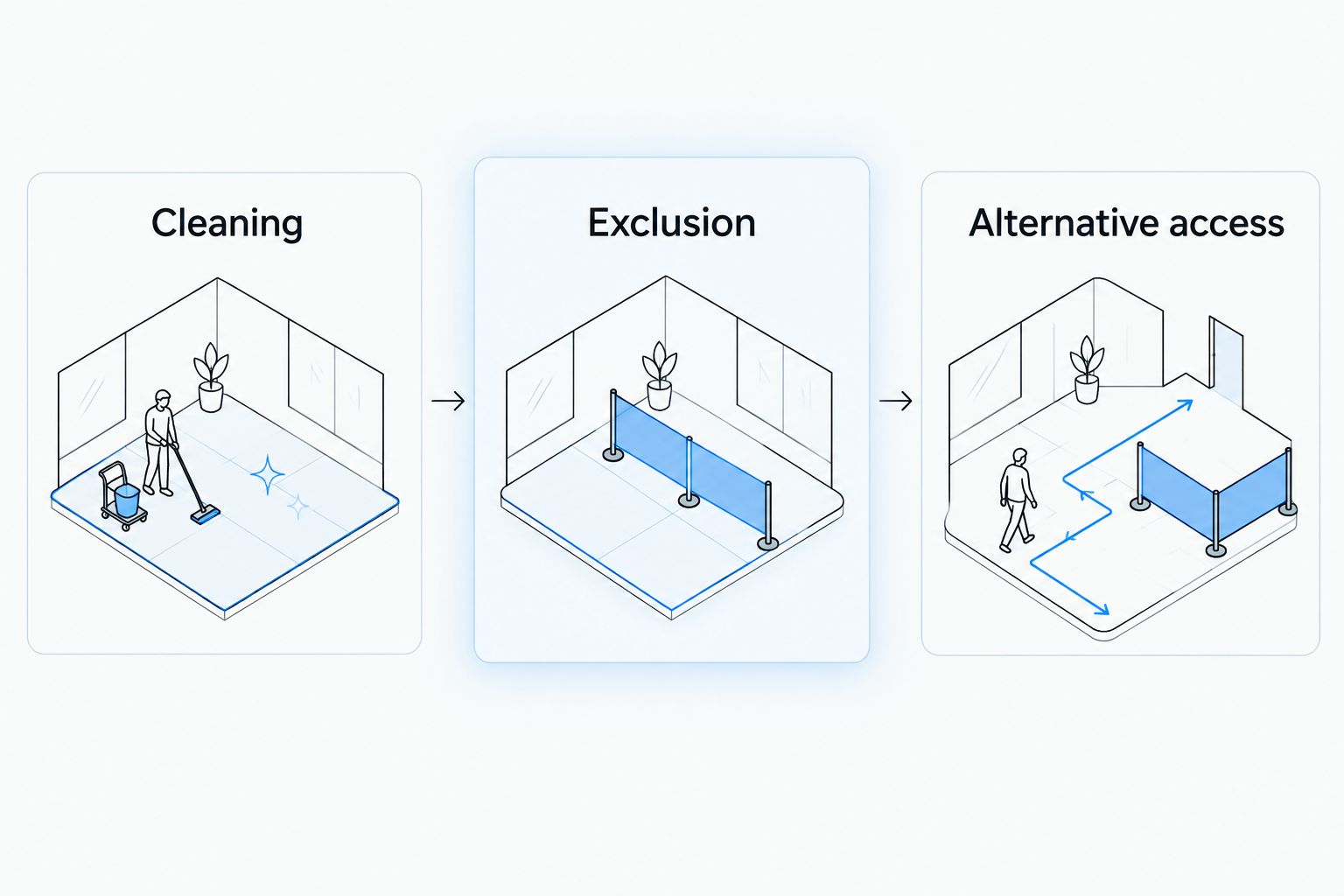
Start with your warehouse plan and mark where people, forklifts and trucks move. Then divide the job into 3 work zones: cleaning, exclusion and alternative access. These are planning categories, not fixed dimensions; their boundaries depend on spray, hoses, equipment and site traffic.
Keep emergency exits and essential access routes usable throughout the work. If that cannot be achieved, change the sequence or operating window rather than expecting staff to step around hoses and wet surfaces.
Specialist pressure washing becomes relevant once you have identified access constraints. OZLINK Facility Services pressure washing can form part of a wider maintenance scope, but the warehouse still needs to agree who controls traffic and who authorises each area to reopen.
- Mark the cleaning zone on a current site plan.
- Set an exclusion boundary around spray and equipment.
- Provide alternative access for affected warehouse users.
- Keep loading activity separate from cleaning activity.
- Assign responsibility for barriers and reopening decisions.
Choose the method before choosing pressure
Check surface care instructions and remove loose material first. Dry collection prevents debris from being washed into drains and gives you a clearer view of the underlying condition. Do not use pressure washing as a substitute for identifying the material you are cleaning.
Pressure, nozzle selection, water temperature, detergent and working distance all affect the result. A high-pressure setting is not a universal answer. Coatings, joints and damaged surfaces need particular attention because an unsuitable method can remove material you intended to preserve.
Ask the contractor to explain why the proposed method fits the contamination and substrate. Where pressure washing is unsuitable, use another cleaning method rather than accepting surface damage as the price of removing dirt.
- Collect loose debris before introducing water.
- Check coating and equipment cleaning instructions.
- Match detergent to the identified contamination.
- Agree whether pressure washing suits each surface.
- Separate cleaning needs from repair or restoration needs.
Contain wash water before starting
Trace where water will travel, not just where the operator will stand. Gradients, floor joints, door thresholds and vehicle ramps can carry contaminated water beyond the visible work area. A drain beside the job is not permission to discharge into it.
Queensland pollution controls apply to contaminated discharges. Keep polluted wash water out of stormwater and confirm the permitted collection and disposal route before cleaning. Trade waste arrangements, where applicable, require the relevant approval; do not assume a sewer connection accepts every cleaning residue.
The contractor's method should explain containment, recovery and disposal responsibilities. If those arrangements remain unresolved, postpone the wash. Faster cleaning does not compensate for spreading oil, detergent or sediment outside the controlled area.
- Identify stormwater drains and other drainage connections.
- Check gradients and likely water escape points.
- Protect thresholds beside stock and occupied areas.
- Agree how contaminated water will be recovered.
- Confirm the authorised disposal route and responsible party.
Test the method and protect vulnerable areas
Use an inconspicuous test area before treating the main surface. Record what the test shows: dirt removal, coating response, marking condition and any visible change to the substrate. Agree what constitutes an acceptable result before expanding the work.
Build 2 inspection checkpoints into your 2026 work plan: approval of the test area and inspection of the completed cleaning area. These checkpoints stop an unsuitable method from continuing and separate cleaning completion from permission to reopen.
Protect nearby goods and electrical equipment from spray and moisture. Pressure-cleaning equipment also requires trained handling; the risk is not limited to a slippery floor. Warehouse staff should not enter the exclusion area to inspect progress while equipment is operating.
- Approve a representative test area before full cleaning.
- Check whether line markings and coatings remain intact.
- Protect stock, controls and vulnerable equipment.
- Stop work if the method damages the surface.
- Record changes to the agreed method and scope.
Sequence the job around warehouse operations
Start with the receiving and dispatch schedule. Identify when vehicles occupy docks, which goods cannot be exposed to moisture and which routes must remain available. Choose the work sequence around those constraints rather than booking cleaning first and resolving conflicts later.
A staged job needs clear handovers between areas. Do not move barriers just because washing has finished: residual moisture, detergent and displaced debris still need attention. Drying conditions vary with the surface, ventilation and weather, so use inspection rather than an assumed waiting period.
Put responsibilities in writing. The warehouse controls its operations; the cleaning contractor controls the agreed cleaning method. Both parties need a shared stop-work process when unexpected traffic, contamination or surface damage changes the conditions.
- Confirm receiving, dispatch and vehicle movement windows.
- Move or protect moisture-sensitive goods before isolation.
- Agree the order in which areas will be cleaned.
- Keep barriers in place until inspection is complete.
- Nominate contacts for operational changes and stop-work decisions.
Clear waste and document the handover
Separate the waste streams before the final clean. Packaging, damaged pallets and discarded materials need collection; wash water and cleaning residues need their own disposal assessment. Pressure washing must not turn a debris-removal task into a contaminated drainage problem.
Use 1 handover record to capture the completed areas, visible defects, waste arrangements and reopening decision. Include photographs where they clarify the result. Record persistent stains honestly rather than disguising them with a wet-floor photograph or describing them as resolved.
Where discarded stock and packaging block access, commercial rubbish removal services address a separate waste stream from pressure-washing runoff. Clearing that material before the wash exposes the floor for inspection; it does not replace contaminated-water recovery or authorise disposal of hazardous material.
- Remove solid waste through the appropriate collection route.
- Confirm wash-water recovery and disposal are complete.
- Inspect moisture, residue and surface condition before reopening.
- Photograph unresolved defects and persistent staining.
- Record who accepted the handover and released the area.
Compare warehouse cleaning options
Choose the method for the surface and operating conditions, not the equipment name. Pressure washing, mechanical floor cleaning and restoration solve different problems. A warehouse can need more than one method, but each should have a defined area and purpose.
| Option | Best for | Main advantage | Key limitation |
|---|---|---|---|
| Dry sweeping or vacuum collection | Loose debris before wet cleaning | Removes solids without introducing wash water | Does not remove bonded grime or oil contamination |
| Mechanical floor scrubbing | Routine cleaning of suitable internal floors | Applies agitation while collecting cleaning solution | Needs suitable access, surface compatibility and attention to edges |
| Pressure washing | Suitable hard surfaces with bonded external grime | Directs cleaning action onto the affected surface | Requires spray control, surface assessment and runoff recovery |
| Floor restoration | Deteriorated finishes or surfaces needing treatment beyond cleaning | Addresses a different scope from ordinary dirt removal | Requires diagnosis; washing alone cannot deliver restoration |
| OZLINK Facility Services pressure washing and maintenance | Warehouse managers seeking cleaning alongside commercial maintenance | Brings relevant services into the same proposed scope | The site-specific method, exclusions and responsibilities need agreement |
For procurement, ask each provider to respond to the same marked-up scope. Compare surface coverage, exclusions, protection, waste handling and handover requirements. A quote for washing alone is not equivalent to a scope that includes debris clearance, contamination assessment or repair work.
Do not treat a clean-looking test area as proof that the whole warehouse needs the same treatment. Dock aprons, coated internal aisles and pedestrian entries can require different methods within the same property.
Common mistakes warehouse managers make
Treating pressure as the main buying criterion
Asking for the strongest machine skips the important questions: what is on the surface, what is underneath it and where will the water go? Specify the result and constraints first. Let the assessed method determine the equipment.
Washing across live forklift and loading routes
A hose across an active route creates a conflict that warning signs alone do not resolve. Separate cleaning from traffic movements and provide an agreed alternative route. If the warehouse cannot maintain that separation, change the work window.
Assuming every drain is an acceptable outlet
Drainage connections serve different purposes. Identify the destination and agree the permitted disposal route before work starts. Collecting dirty water is part of the scope, not an optional response after runoff escapes.
Expecting cleaning to fix a damaged floor
Pressure washing removes contamination; it does not repair cracks, failed coatings or uneven concrete. Record those defects separately and commission the appropriate assessment. Otherwise, the floor can look cleaner while the underlying problem remains.
Reopening on appearance alone
A bright floor is not a handover standard. Your 2026 acceptance check should include residual moisture, detergent, damaged markings and access routes. Record the reopening decision instead of leaving it to whoever first moves the barriers.
FAQ
What's the best pressure washing method for an industrial warehouse?
The best method is the one matched to the surface, contamination and drainage controls. Inspect the substrate, remove loose debris and approve a test area before applying the method across the warehouse.
Can you pressure wash inside a warehouse?
Internal warehouse pressure washing requires suitable surfaces, protected equipment, isolated access and controlled wash-water recovery. If those conditions cannot be met, choose a cleaning method that better suits the area.
Is pressure washing better than floor scrubbing for warehouses?
Neither method is better for every warehouse area. Floor scrubbing suits routine cleaning of compatible internal floors, while pressure washing addresses suitable hard surfaces where spray and runoff can be controlled.
Will pressure washing remove warehouse oil stains?
Complete removal of an oil stain cannot be assumed. Identify the contamination, treat the source of the leak and assess a test area before agreeing to the expected cleaning result.
Where should warehouse pressure-washing runoff go?
Contaminated runoff must follow an authorised collection and disposal route, not simply the nearest drain. Identify drainage connections and confirm any applicable trade waste requirements before cleaning starts.
How often should an industrial warehouse be pressure washed?
Set the cleaning schedule from observed contamination, operating conditions and surface care requirements. Increase inspection around loading docks, recurring leaks and affected pedestrian routes rather than using one interval for every area.
Does OZLINK Facility Services provide warehouse pressure washing?
OZLINK Facility Services provides pressure washing and commercial maintenance across South East Queensland and selected regional Queensland locations. Confirm the proposed warehouse surfaces, access restrictions and waste-handling scope before arranging work.
One last thing
Inspect the floor dry, not just while it looks clean and wet. Water can change the appearance of staining and surface defects, so the final inspection should reflect the condition warehouse users will encounter after cleaning.
For your next 2026 job, ask for the handover criteria before accepting the scope. That simple sequence makes the contractor's responsibility clear: clean the agreed areas, preserve the agreed surfaces, control the waste and document what remains. Do not let an unresolved leak or damaged coating disappear from the maintenance list just because the dirt has gone.