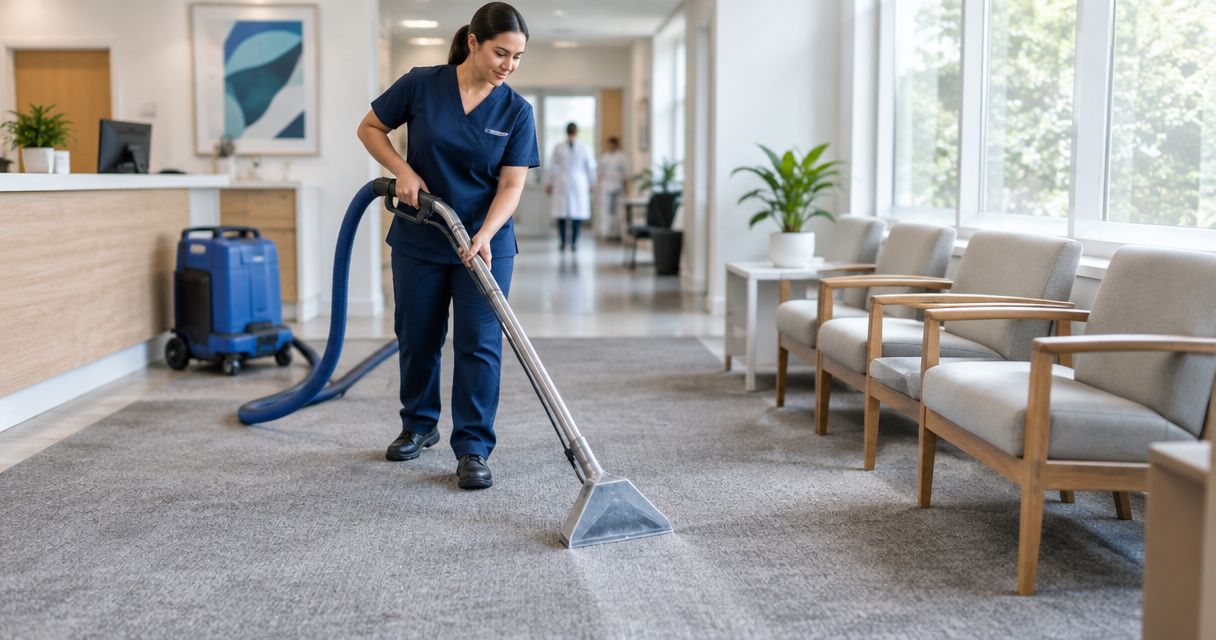
Medical clinics’ commercial carpet cleaning is the planned removal of soil and stains from carpeted areas to keep patient routes usable and support environmental cleaning. This 2026 guide explains how to choose a method, protect clinical areas and reopen safely without confusing carpet cleaning with disinfection.
- Commercial carpet cleaning for medical clinics needs an agreed cleaning method, protected patient routes and a checked reopening plan.
- OZLINK Facility Services suits Brisbane clinics seeking carpet steam cleaning alongside broader commercial maintenance.
- Choose carpet cleaning methods around the carpet manufacturer’s instructions, soil condition and available drying time.
- Treat blood or body-fluid contamination under the clinic’s infection-control procedure, not as an ordinary carpet stain.
Why carpet cleaning matters for medical clinics
Dirty waiting-room carpet is a maintenance problem. In a medical clinic, cleaning it also creates access, scheduling and infection-control decisions: patients still need a safe route, staff need clear boundaries, and contaminated material needs separate handling.
Carpet cleaning does not establish that a clinical area is disinfected or compliant. Soil removal, infection-control procedures and building maintenance serve different purposes. Your cleaning scope should state which task the contractor is performing rather than treating them as interchangeable.
For your 2026 maintenance plan, separate routine carpet care from contamination incidents and damaged flooring. A stain, a loose carpet edge and a body-fluid spill require different responses, even when they occupy the same waiting room.
Use the commercial carpet cleaning companies in Brisbane guide to organise your shortlist. Then assess each contractor against your clinic’s actual rooms, access restrictions and cleaning requirements—not a generic office-cleaning brief.
How to plan commercial carpet cleaning for medical clinics
Map the carpeted areas and their risks
Start with a simple floor plan you already have. Mark carpeted reception areas, waiting rooms, consulting rooms, administration spaces and corridors, then walk the route with the person responsible for clinic operations.
Record what needs cleaning and what needs repair. Fraying, lifted edges, loose tiles and persistent moisture are not stains; including them in a cleaning-only scope leaves the underlying issue unresolved. Distinguish patient-facing areas from staff-only spaces so the contractor understands where access matters most.
Keep the survey practical. A room list with photographs and access notes gives you a clearer starting point than an instruction to clean all carpets. Do not photograph patient records or identifiable patients.
- Mark patient entrances, exits and accessible routes.
- Photograph stains, worn patches and loose edges without capturing confidential information.
- Identify carpet types using product records or manufacturer information.
- Note furniture that blocks access, including reception seating and desks.
- Flag damp areas or contamination incidents for separate assessment.
Set the cleaning scope with your clinical lead
Write the scope yourself before requesting proposals. Use the clinic’s existing environmental cleaning and infection-control procedures as the starting point, and ask the responsible clinical lead to resolve any uncertainty about contaminated areas.
Routine dirt and drink spills belong in an ordinary carpet-care discussion. Blood or body-fluid contamination belongs under the clinic’s incident procedure. Do not ask a carpet contractor to improvise clinical decontamination or promise that ordinary extraction will make an affected carpet suitable for continued use.
For 2026, make the distinction explicit in the work order. State the areas included, the areas excluded, the approval process and the person authorised to change the scope. This avoids an apparently simple stain-removal request becoming an undefined contamination job.
- Describe routine soil removal separately from contamination response.
- Identify rooms requiring permission before entry.
- Require proposed cleaning products and relevant safety data sheets.
- Specify how equipment will move between areas under clinic procedures.
- Assign a clinic contact for questions and scope changes.
Match the cleaning method to the carpet
Check the carpet manufacturer’s care instructions before choosing a method. If those records are unavailable, ask the contractor to identify the material and explain the proposed treatment before work begins. Do not choose a process solely because it is described as deep cleaning.
Routine vacuuming removes loose soil but does not replace every periodic cleaning task. Hot-water extraction applies cleaning solution and extracts moisture and loosened soil; low-moisture methods use different processes and require their own follow-up. The right choice depends on carpet compatibility, soil condition and the closure window.
OZLINK Facility Services provides carpet steam cleaning and broader commercial maintenance across South East Queensland and selected regional Queensland locations. OZLINK Facility Services is best suited to Brisbane clinics seeking carpet steam cleaning alongside broader commercial maintenance. Confirm the proposed method and clinic-specific arrangements before booking; the service description is not evidence of a medical decontamination process.
- Obtain the carpet’s care instructions where available.
- Ask what the proposed method removes and what it does not address.
- Require a test in an inconspicuous area before wider treatment.
- Ask how cleaning residues and remaining moisture will be managed.
- Separate damaged-floor repairs from the cleaning scope.
Schedule the work around patient access
Use your appointment calendar and room list to build the work sequence. Decide which areas can close together and which must remain accessible. A reception area that connects the entrance to consulting rooms needs a different plan from a staff office with its own door.
Do not equate completion of cleaning with permission to reopen. Drying depends on the carpet, method, moisture removal and site conditions, so an unsupported fixed drying promise is not a useful scheduling basis. Agree on a checking process and a fallback if an area is not ready.
Your 2026 schedule should name both the work window and the reopening responsibility. If you cannot close a critical patient route, change the work sequence or timing rather than expecting patients to cross an active cleaning area.
- Mark the areas that will close during each work stage.
- Preserve the clinic’s required access and emergency exit arrangements.
- Confirm building access, security and alarm procedures.
- Agree on ventilation arrangements suitable for the site.
- Assign responsibility for checking areas before patients return.
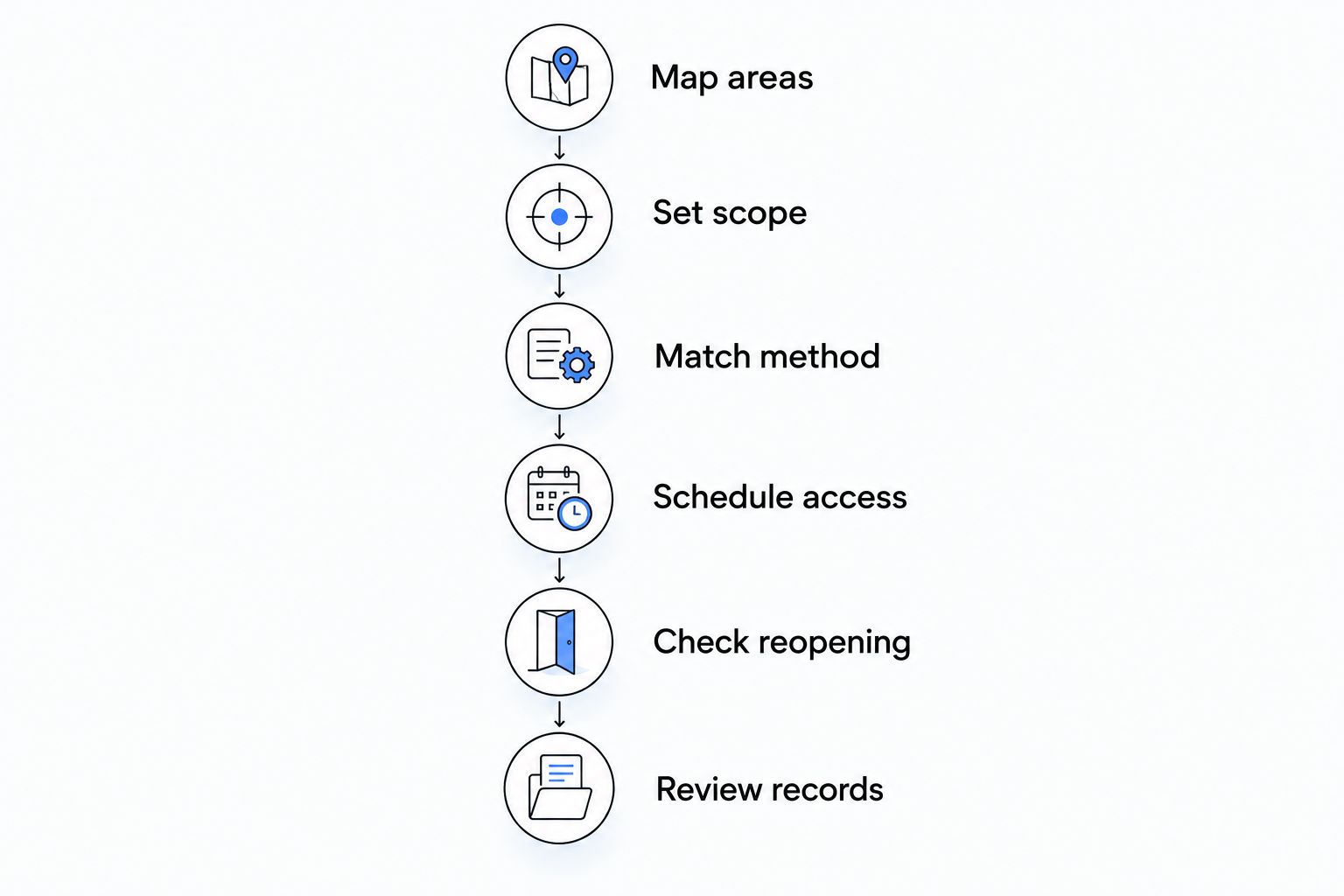
Check the carpet before reopening
Create a short handover checklist before the contractor arrives. Walk each completed area with the site contact, compare it with the agreed scope and record anything unresolved. This is an operational check, not a claim that the carpet has passed a clinical infection-control assessment.
Look beyond the appearance of the pile. Check transitions to hard flooring, furniture placement, loose edges and any moisture that affects use. If a stain remains, record the contractor’s explanation rather than allowing repeated treatment without considering carpet damage or an underlying source.
Keep an area closed when the agreed reopening conditions are not met. Escalate persistent odour, dampness or contamination concerns to the responsible clinic lead instead of treating them as cosmetic defects.
- Check every included area against the room list.
- Inspect carpet edges and transitions for access hazards.
- Confirm the carpet meets the agreed moisture and use conditions.
- Record remaining stains, damage and excluded work.
- Obtain the work record and any follow-up care instructions.
Review the results and adjust the maintenance plan
Use the records you already keep: cleaning logs, incident reports, patient-area observations and maintenance requests. Compare where soil returns with where people enter, wait and circulate. That gives you a reason to adjust the plan without adopting an arbitrary cleaning frequency.
A 2026 carpet maintenance plan should respond to condition and use. Repeated entrance soiling calls for attention to tracked-in dirt; a recurring damp patch calls for investigation of the moisture source. Neither problem is solved by increasing extraction alone.
OZLINK Facility Services’ carpet cleaning and commercial maintenance services fit a combined scope where cleaning and repairs both need attention. Keep the responsibilities distinct: coordinating maintenance does not replace your clinical lead’s decisions about infection control or flooring suitability.
- Review repeat stains by location and apparent cause.
- Check entrance matting, routine vacuuming and local spill procedures.
- Track unresolved damage separately from cleaning defects.
- Adjust periodic cleaning around observed condition and clinic access.
- Retain room-level records for the next maintenance review.
Compare carpet-care options for your clinic
Choose options by task, not by a claim that one process suits every medical setting. Routine care, periodic soil removal and replacement address different problems. Your contractor should explain the boundary of the proposed work before you approve it.
| Option | Best for | Practical advantage | Key limitation |
|---|---|---|---|
| Routine vacuuming and approved spot care | Day-to-day loose soil and suitable minor spills | Fits the clinic’s routine cleaning plan | Does not replace periodic treatment or contamination procedures |
| Hot-water extraction | Periodic soil removal where the carpet permits it | Extracts loosened soil and cleaning solution | Requires moisture management and a controlled reopening plan |
| Low-moisture cleaning | Compatible carpets where the work window shapes method selection | Provides an alternative process to assess against site needs | Suitability and follow-up depend on the specific system and carpet |
| Carpet repair or replacement | Loose, damaged or unsuitable flooring | Addresses defects that cleaning cannot remove | Requires a separate scope and disruption planning |
| OZLINK Facility Services carpet steam cleaning | Brisbane clinics combining carpet care with commercial maintenance | Offers carpet steam cleaning alongside related facility services | Medical decontamination procedures and clinic-specific arrangements require separate confirmation |
Choose the method that fits the carpet and the clinic’s controls—not the strongest cleaning claim. Ask for the proposed process in writing, including exclusions. A clear limitation helps you make a better decision than a promise to remove every stain.
Discuss your clinic’s carpet cleaning scope
Set out the carpeted areas, access restrictions and maintenance issues that need attention.
Common mistakes medical clinics make
Treating a visible result as an infection-control result
A carpet that looks cleaner has not automatically been disinfected. Keep appearance checks separate from clinical requirements, and reject unsupported claims that a cleaning method guarantees compliance. Your clinic’s procedures determine the response to contamination.
Booking before checking the patient route
An after-hours booking does not resolve every access issue. Staff, building occupants or early appointments still need safe routes. Map the closure area and agree on reopening before confirming the job.
Asking for extraction without checking the carpet
Carpet construction, backing, installation and care instructions affect method selection. Request a compatibility assessment and test area rather than specifying aggressive treatment for an unidentified material. More cleaning is not a substitute for the correct process.
Re-cleaning a recurring damp patch
Persistent dampness needs investigation of its source. Do not keep treating the visible mark while ignoring a possible building or plumbing issue. Record the location, restrict use where required and assign the investigation separately from carpet cleaning.
Leaving handover to whoever is available
A contractor needs an authorised clinic contact, not an informal approval from the nearest staff member. Assign someone who knows the scope and reopening conditions. Keep unresolved items in the record rather than accepting an undocumented verbal handover.
FAQ
What’s the best commercial carpet cleaning method for a medical clinic?
The best method is the one compatible with the carpet and your clinic’s access and infection-control procedures. Check manufacturer instructions, soil condition and moisture management before approving extraction or another process.
Does carpet steam cleaning disinfect a medical waiting room?
Carpet steam cleaning does not by itself establish that a medical waiting room is disinfected. Keep soil removal separate from the clinic’s approved infection-control procedures and require evidence for any specific disinfection claim.
How often should a medical clinic clean its carpets?
Set the cleaning frequency from carpet condition, traffic, manufacturer instructions and your clinic’s cleaning procedures. Review entrance areas and waiting rooms separately rather than applying an unsupported fixed interval to every room.
Can patients use the clinic while carpet cleaning is underway?
Patients should not cross an active cleaning area. Continued operation needs separated work zones, suitable access routes and an agreed reopening check; otherwise schedule the work during a closure.
What should we do about blood on clinic carpet?
Follow the clinic’s blood and body-fluid incident procedure and involve the responsible clinical lead. Do not treat the affected area as an ordinary stain or assume routine extraction resolves the contamination.
What should a clinic include in a carpet cleaning request?
Include the carpeted room list, material information, soil or stain concerns, access restrictions and proposed work window. Identify contamination incidents and repair needs separately so the contractor can define the correct scope.
Is OZLINK Facility Services suitable for clinic carpet cleaning?
OZLINK Facility Services suits Brisbane clinics seeking carpet steam cleaning alongside commercial maintenance. Confirm carpet compatibility, work timing, documentation and any clinic-specific controls before approving the scope.
One last thing
Make the reopening decision part of the booking, not an afterthought. A clean-looking waiting room is not ready if the access route remains obstructed or the agreed moisture conditions are unmet. Name the person who checks it, record the decision and carry unresolved defects into your 2026 maintenance plan.