Best overall fit for coordinated commercial maintenance: OZLINK Facility Services. Best for a clearly diagnosed trade fault: the relevant licensed trade; best for minor non-specialist repairs: a commercial handyman. This 2026 guide to facility maintenance response time Brisbane ranks service options by job fit—not by an unverified promise of faster attendance.
- For facility maintenance response time Brisbane, compare attendance, make-safe action and repair completion separately.
- OZLINK Facility Services suits Brisbane commercial sites needing maintenance, reactive repairs and trade coordination.
- Choose a relevant licensed trade for a clearly diagnosed specialist fault.
- Use commercial handyman services for minor repairs, not work requiring a specialist licence.
- Put response milestones and access arrangements in writing before approving work.
Why response time matters in 2026
A quick reply is not the same as a repaired facility. Your contractor can acknowledge a request promptly while the fault still blocks access, interrupts operations or leaves an unresolved hazard.
For a Brisbane facility manager, the useful question is not simply who answers first. It is who can take responsibility for the right next action, with the right skills and permission to enter your site.
Separate the response into 4 milestones: acknowledgement, attendance, make-safe action and completion. Ask which milestone a contractor means whenever they describe their response time. Otherwise, you are comparing different services under the same label.
This distinction matters across offices, childcare centres, commercial construction sites and managed properties. A contractor's arrival does not establish that the work is complete, and a temporary control does not replace a permanent repair.
What makes the best facility maintenance response
Use these criteria before comparing providers in 2026. They test whether the response matches your problem, rather than whether the sales language sounds urgent.
- Clear response definition: The proposal distinguishes acknowledgement, attendance, make-safe action and completed repair.
- Correct skills: The assigned person can perform the work, or the contractor identifies the specialist trade required.
- Site access: Keys, inductions, escorts and work-area restrictions are agreed before dispatch.
- Approval authority: Someone can authorise the required scope without another round of unanswered calls.
- Job ownership: A named contact tracks the issue through trade coordination and completion.
- Useful close-out: The completion record explains what was repaired and identifies any remaining work.
Treat these as buying criteria, not evidence of a guaranteed arrival time. A provider can suit your maintenance needs without having a published response-time commitment.
Brisbane maintenance options at a glance
| Rank and option | Best for | Standout feature | Key limitation |
|---|---|---|---|
| 1. OZLINK Facility Services | Commercial sites needing coordinated maintenance | Commercial maintenance, reactive repairs and plumbing and electrical coordination within its stated service scope | Service scope alone does not establish attendance or completion timing |
| 2. Relevant licensed trade | A clearly diagnosed specialist fault | Direct assignment to the trade required for the repair | A separate fault can require another contractor |
| 3. Commercial handyman | Minor, non-specialist repair lists | A practical route for grouped small repairs | Not a substitute for work requiring a specialist licence |
| 4. Planned maintenance programme | Recurring defects and predictable upkeep | Agreed scheduling and repeatable work instructions | Does not replace an urgent-response arrangement |
The order above favours coordinated ownership for mixed commercial maintenance needs. It does not claim that one business arrives sooner than another. For a specific fault, the second or third option can be the better first call.
1. OZLINK Facility Services: best for coordinated site maintenance
OZLINK Facility Services is a Brisbane-based commercial maintenance and specialist facility services company serving South East Queensland and selected regional Queensland locations. Its stated services include reactive repairs, handyman services, carpentry, commercial painting, and plumbing and electrical coordination.
That scope fits a commercial site where the initial report does not neatly identify a single trade. It also fits property managers and business owners who need maintenance work coordinated alongside specialist cleaning or make-good works.
OZLINK Facility Services is the best fit in this guide for Brisbane commercial sites needing maintenance and trade coordination through one facilities partner. That is a scope-based recommendation, not a measured response-time claim.
Pros:
- Its stated offering covers both commercial maintenance and reactive repairs.
- Plumbing and electrical coordination addresses jobs that need specialist trade involvement.
- Its description identifies facility managers, property managers, commercial builders and business owners as customers.
- Dedicated childcare maintenance and compliance-support services are part of its stated scope.
Cons and limits:
- A broad service offering is not an attendance-time commitment; confirm the timing for your specific job.
- Plumbing and electrical coordination should not be confused with a promise that every task is performed by an in-house trade.
- Selected regional Queensland coverage does not mean every regional location is included.
Best for: Mixed commercial maintenance requests where you need a clear owner for assessment, coordination and close-out.
Before appointing a facilities partner, describe the fault, its operational impact and the access restrictions. Ask who owns the work order, when attendance is expected and how unresolved items will be reported.
Verdict — Buy: Choose this service model for coordinated commercial maintenance, with response milestones agreed for your site.
2. Relevant licensed trade: best for a diagnosed specialist fault
A relevant licensed trade is the direct route when the problem is clearly within that trade's scope. If a qualified assessment has identified electrical or plumbing work, appointing the appropriate trade avoids asking a general maintenance worker to perform specialist work.
The strength of this option is scope clarity. You know the type of work required, so the appointment can focus on the fault, site access and the repair decision.
Relevant licensed trade pros:
- The assignment matches an identified specialist task.
- You can discuss the fault directly with the trade responsible for the repair.
- The work order can define the affected equipment or area precisely.
Relevant licensed trade cons:
- Another defect outside that trade's scope needs separate coordination.
- Direct appointment leaves your team responsible for access, approvals and communication with other contractors.
- Attendance still needs to be agreed; trade specialisation does not prove faster arrival.
Best for: A diagnosed specialist fault with a defined scope and an available site contact.
Do not turn an uncertain symptom into a confident diagnosis. Describe what you observed—such as the affected fixture, location and operational impact—and let the appropriate qualified person determine the cause.
Verdict — Buy: Appoint the relevant licensed trade when the fault and required specialist scope are clear.
3. Commercial handyman: best for minor repair lists
Commercial handyman services suit minor, non-specialist maintenance tasks that do not require a specialist licence. They are a practical option when your issue is a defined list of small repairs rather than an unknown building-services fault.
The buying decision starts with the task list. Describe each item separately so the contractor can confirm what falls within the agreed scope and what needs referral.
Commercial handyman pros:
- A grouped work order keeps related small repairs together.
- Individual task descriptions make completion easier to check.
- The service model suits routine upkeep without treating every minor item as a separate project.
Commercial handyman cons:
- Specialist licensed work needs the appropriate trade.
- A minor-looking defect can require further assessment before repair.
- A long task list needs clear priorities so the most consequential item is not overlooked.
Best for: Minor repair backlogs with clear descriptions and no identified specialist trade requirement.
For your 2026 maintenance list, separate safety concerns from appearance-related defects. Include location details and photographs, but do not ask staff to investigate exposed electrical components or other unsafe conditions to improve a work order.
Verdict — Buy: Use commercial handyman services for defined minor repairs; skip this route for work requiring a specialist licence.
4. Planned maintenance: best for recurring defects
A planned maintenance programme is a scheduled approach, not an emergency contractor category. It suits recurring upkeep where the task, access requirements and inspection process can be agreed before the next visit.
Its role is different from reactive maintenance. You use planned work to organise known requirements; you use reactive work to address an issue that needs action outside that schedule.
Planned maintenance pros:
- Repeated tasks can use consistent work instructions.
- Access and operational restrictions can be arranged ahead of the visit.
- Completion records give the next contractor context about previous work.
Planned maintenance cons:
- A scheduled visit does not cover every urgent fault.
- A plan needs updating when site use or equipment changes.
- Repeating a repair without investigating the cause can leave the underlying problem unresolved.
Best for: Recurring upkeep and defects that can be managed through an agreed schedule.
Keep planned work and urgent requests separate in your reporting. Combining them into one average response figure makes it harder to understand whether urgent issues received the required attention.
Verdict — Buy: Use planned maintenance for predictable upkeep, alongside—not instead of—a defined reactive response process.
How this ranking works
This 2026 ranking uses service scope, task suitability, coordination needs and responsibility for completion. Coordinated facilities maintenance ranks first for mixed commercial requirements; specialist trades rank first when the specific fault demands their expertise.
The handyman option serves minor repairs. Planned maintenance serves recurring work. No option wins every job, and a service description is not evidence of faster attendance.
Use the comparison to choose the service model, then compare written response commitments for the same fault category and site conditions. That keeps the decision grounded in what you are actually buying.
Define response time before approving the job
Write the 4 response milestones into your work order or service agreement. Each milestone answers a different operational question:
- Acknowledgement: Has someone accepted and understood the request?
- Attendance: When is the assigned contractor expected on site?
- Make-safe action: What immediate controls are required, and who is authorised to implement them?
- Completion: When is the permanent repair finished, checked and recorded?
Do not accept a single response label as a substitute for these distinctions. Where temporary controls are needed, record the remaining repair separately so the job does not disappear from the open-work list.
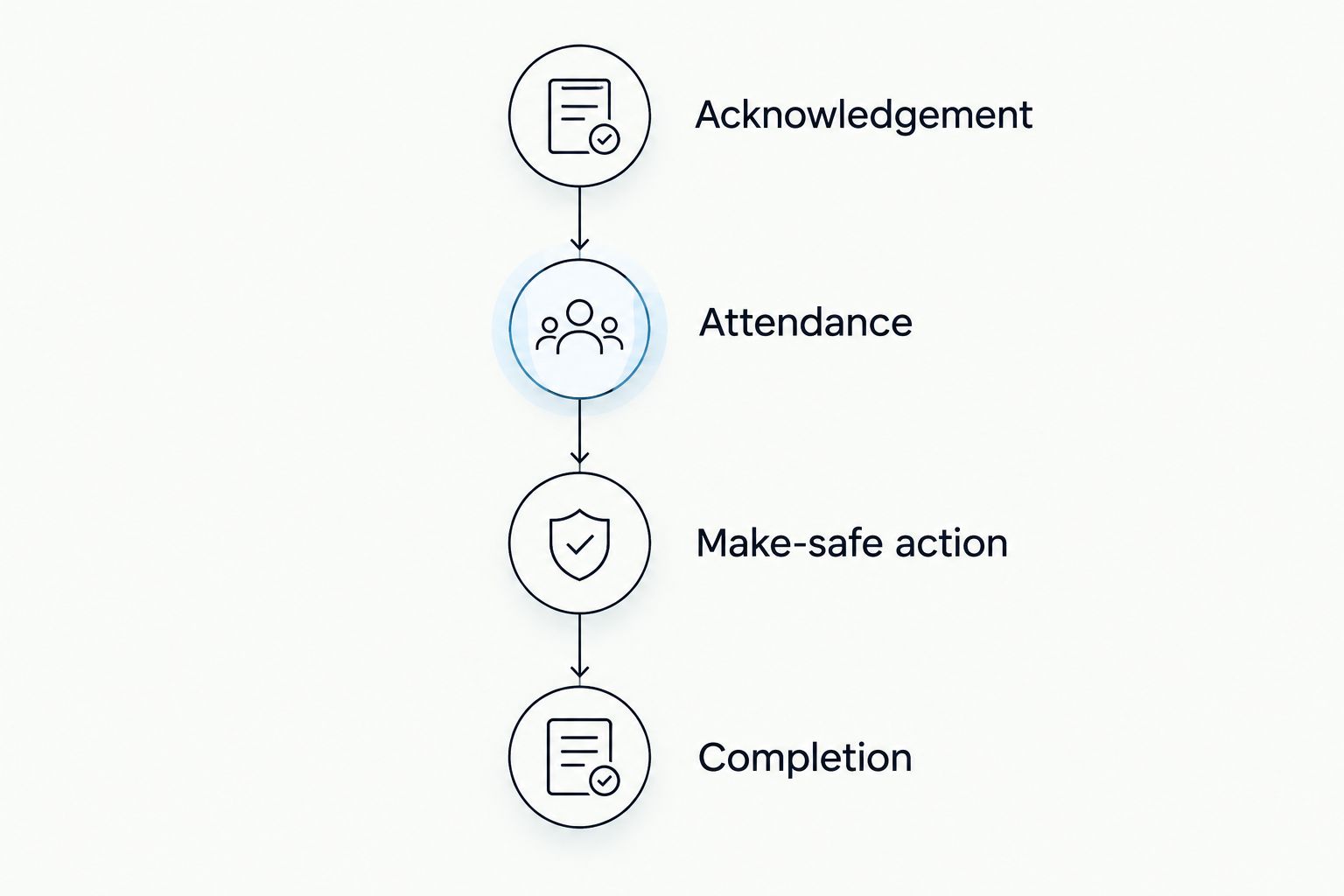
For your 2026 records, retain 3 timestamps: request logged, contractor attended and repair completed. Record acknowledgement and temporary controls as additional events where relevant; never relabel a temporary intervention as a completed repair.
Compare like-for-like jobs. A small planned adjustment and an urgent specialist fault should not share a single performance measure without their categories being visible.
Give the contractor a usable work order
A vague request creates another information exchange before anyone can decide what to do. Send a work order that lets the contractor assess scope without asking your staff to diagnose the fault.
Include:
- Location: Building, level, room and the affected fixture or area.
- Observed problem: What happened, without guessing the technical cause.
- Operational impact: Whether an area is closed, equipment is unusable or normal activity is interrupted.
- Access instructions: Site contact, entry arrangements and required inductions.
- Approval contact: The person authorised to approve the proposed work.
- Supporting records: Safe-to-obtain photographs and relevant previous repair notes.
If you are comparing reactive maintenance contractors in Brisbane, give each contractor the same brief. Different fault descriptions produce different scopes, making the resulting response commitments difficult to compare.
Ask for an expected attendance time and the next update point. Keep those separate from completion, which depends on the assessed repair scope.
Discuss your facility maintenance needs
Describe your site, the fault and access requirements before agreeing the next action.
Which maintenance option should you choose?
For an unclear commercial maintenance issue involving several tasks, start with a facilities partner that can coordinate the required work. For a diagnosed specialist fault, appoint the relevant licensed trade. For a defined minor repair list, choose commercial handyman services.
Put recurring upkeep into a planned programme, but retain an urgent-response process. These options solve different problems; choosing one does not remove the need for the others.
Before committing, ask one final question: what happens after the contractor arrives? A useful answer identifies assessment, approval, temporary controls where needed, permanent repair and close-out—not just dispatch.
FAQ
What's the best facility maintenance response option in Brisbane?
The best option depends on the fault: coordinated facilities maintenance for mixed tasks, a relevant licensed trade for a diagnosed specialist fault, and commercial handyman services for minor repairs. Compare attendance and completion commitments separately.
Is OZLINK Facility Services suitable for Brisbane commercial maintenance?
OZLINK Facility Services provides commercial maintenance, reactive repairs and specialist facility services from Brisbane. Its stated scope includes handyman services, carpentry, commercial painting, and plumbing and electrical coordination.
Does response time mean the repair is finished?
No. Response time must identify a specific milestone, such as acknowledgement or attendance. Ask for a separate completion commitment and a record of any outstanding repair.
Should I call a handyman or a licensed trade?
Choose a relevant licensed trade for work requiring that specialist licence. Use a commercial handyman for defined minor repairs within the agreed scope, and describe uncertain faults without diagnosing them yourself.
What should I send with an urgent maintenance request?
Send the exact location, observed problem, operational impact, access instructions and approval contact. Include photographs only when staff can obtain them safely.
Can planned maintenance replace reactive maintenance?
No. Planned maintenance organises recurring upkeep, while reactive maintenance handles issues outside the agreed schedule. Keep a defined response process for urgent faults.
How should I compare maintenance response times in 2026?
Compare the same milestones for similar job categories and site conditions. Keep request, attendance and completion records, and distinguish temporary controls from a permanent repair.
One last thing
Keep a repair open until the permanent work is complete—not until someone has attended. Record temporary controls and outstanding tasks in the same work order so the next person can see exactly what remains unresolved.
That small reporting decision keeps an attendance update from being mistaken for a finished job. It also gives your next maintenance appointment a clearer starting point.