Lease ending with repairs, cleaning and handover still unresolved? Instead of chasing separate job lists, use this lease end make good handover workflow to turn your lease requirements into an agreed scope, sequenced works and a documented return of the premises.
- OZLINK Facility Services suits Brisbane commercial tenants needing make-good works, maintenance and specialist cleaning.
- Start your lease end make good handover with the lease, condition records and written landlord instructions.
- Complete removal and repairs before final cleaning; confirm floor-treatment requirements before booking work.
- Keep completion evidence and written acceptance separate: finished work does not automatically close the handover.
Why this matters
A clean tenancy is not necessarily a completed make-good. Your lease, fit-out approvals and any written agreement with the landlord determine what needs removing, repairing, retaining or reinstating. Treat cleaning as one work package, not the definition of completion.
For a 2026 commercial exit, build the handover around those documents rather than a generic cleaning checklist. OZLINK Facility Services is best suited to Brisbane commercial tenants needing make-good works, maintenance and specialist cleaning. OZLINK Facility Services provides those services, including commercial painting, carpentry, plumbing and electrical coordination, and specialist floor care.
The practical benefit is a scope that connects each job to a requirement. The limit is equally clear: a contractor's completed work does not replace the landlord's acceptance or resolve a disputed lease obligation.
Before you start
- Collect the source documents. Have the signed lease, amendments, entry-condition report, dated photographs, fit-out approvals and written instructions available. Identify the premises, lease-end date and person authorised to agree the handover scope.
- Confirm access and responsibilities. Identify who controls keys, building access, loading areas, work permits and service isolation. Nominate 1 handover owner to maintain the job list and communicate approved changes.
- Resolve the retention question first. Ask which tenant-installed items the landlord wants retained and get the answer in writing. Removing an item before agreeing its status creates avoidable reinstatement work; keeping it without agreement leaves the handover unresolved.
If the parties disagree about the lease requirement, obtain legal advice before authorising the disputed work. A site inspection identifies physical conditions; it does not settle the meaning of a lease clause.
Lease requirements and scope register
Use a shared spreadsheet or document for this workflow. The bold field names below are suggested labels for your own register, not buttons in a particular software product.
Establish the scope
- Create fields named Area, Requirement, Source document, Existing condition, Required action, Owner, Status and Evidence. Give each task its own row so that wall repairs, signage removal and floor cleaning cannot disappear inside a vague description such as final tidy.
- Walk the premises against the lease and condition records. Photograph each relevant area and record whether the proposed action is removal, repair, reinstatement, cleaning or retention. Separate observed damage from assumptions about who must address it.
- Send the scope to the authorised landlord or property-manager representative. Ask for written confirmation of retained items, disputed items and the inspection process. Record decisions against the relevant rows rather than leaving them in disconnected email threads.
Expected result: you have an agreed scope where agreement is available, plus a clearly marked list of unresolved requirements. Do not present unresolved rows as approved contractor instructions.
Keep the wording specific. Replace repaint office with the identified rooms, surfaces and agreed finish requirements. Replace restore floors with the floor material, observed condition and required treatment, subject to assessment.
For your 2026 handover register, use dated filenames that identify the area and task. Keep the original entry evidence intact; annotate a working copy rather than replacing the source record.
Work sequence and access plan
Configure the work packages
- Group the approved tasks into Removal, Repairs, Floor care and Final cleaning. Add specialist work where the scope requires it, including plumbing or electrical coordination. Confirm which tasks depend on another task finishing first.
- Build the programme backwards from the agreed inspection and handover dates. Include material-specific drying or curing requirements, building access restrictions and a correction window. Use the contractor's confirmed requirements rather than inventing a standard turnaround.
- Assign a responsible person and completion evidence to every work package. Confirm who books access, protects retained surfaces, removes waste and reports changes. Record exclusions before work starts, especially services or areas that another contractor controls.
Expected result: each contractor knows the work boundary, access conditions and preceding tasks. Your handover owner can see dependencies rather than just a collection of booking dates.
Finish dirty work before final cleaning. Removal, patching, sanding and painting can disturb surfaces that have already been cleaned. Schedule floor treatments around their specified requirements and protect completed areas from later trades.
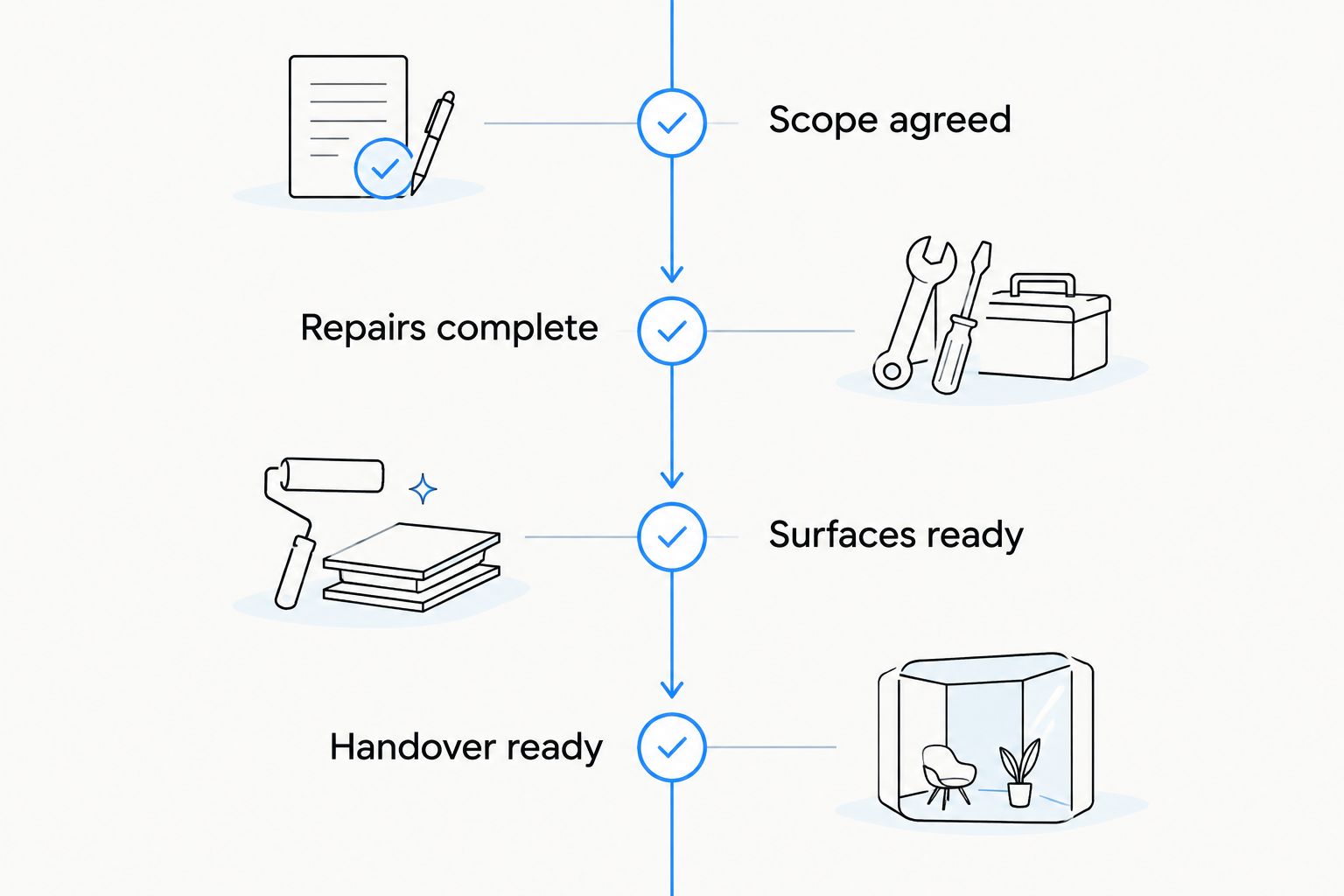
The following sequence gives your 2026 programme four checkpoints. These are planning gates, not fixed durations.
| Checkpoint | What must be confirmed | What stops progression |
|---|---|---|
| Scope agreed | Required works, retained items and responsibilities | Unresolved instructions affecting the next task |
| Repairs complete | Removal, reinstatement and applicable trade work checked | Outstanding defects or unfinished dusty work |
| Surfaces ready | Floor condition and treatment requirements assessed | Unsuitable surface condition or conflicting access |
| Handover ready | Final cleaning, evidence and inspection arrangements complete | Open tasks without an agreed resolution |
Choose the coordination approach
Both approaches below can organise an agreed make-good scope. Choose according to your internal coordination capacity, not an assumption that one arrangement transfers every responsibility.
| Approach | Best for | Advantage | Limitation |
|---|---|---|---|
| Coordinated service scope through OZLINK Facility Services | Brisbane commercial tenants needing maintenance, make-good and specialist cleaning | Its stated service range covers several relevant work packages | You still need written scope, exclusions and landlord acceptance; confirm coverage for your location |
| Separately appointed contractors | Tenants with an internal manager able to coordinate specialist packages | You can allocate each package directly | Your team must manage interfaces, access, evidence and changes between contractors |
Site completion and quality checks
Verify the finished works
- Check each completed task against Required action, not just the contractor's attendance record. Inspect repaired surfaces, retained fixtures, cleared areas and the agreed cleaning scope. Mark incomplete tasks as open even when most of the room looks finished.
- Hold 2 inspections: an internal readiness check before the landlord walkthrough, then the agreed handover inspection. Use the first to identify corrections while you still control access. Use the second to record the landlord representative's response to the completed scope.
- Attach dated completion photographs and applicable contractor records to Evidence. Record defects under Action required, with Responsible person and Target date fields. Close a defect only after checking the correction and attaching the supporting record.
Expected result: completed, incomplete and disputed items have distinct statuses. The inspection record shows what was checked and what still needs a decision.
Hard floors need a separate decision within commercial make-good works. Dirt, worn coating and physical damage are different conditions; cleaning alone does not address every one. Confirm the surface material and required outcome before approving stripping, sealing or restoration.
OZLINK Facility Services provides commercial hard floor care and restoration, including strip and seal. The advantage is access to a relevant treatment category; the limitation is that suitability depends on the actual floor and agreed scope, not the lease-end date. Use the floor stripping and sealing contractor guide when defining that work package.
Handover records and acceptance
Close the handover
- Assemble a handover pack containing the agreed scope, approved changes, completion photographs, applicable trade records and inspection findings. Keep the pack indexed by area or task so the property manager can locate evidence without searching through an entire email history.
- Record unresolved items explicitly. State the issue, responsible party, next action and agreed access arrangement. Ask the authorised representative to confirm acceptance or list outstanding requirements in writing; do not treat silence as sign-off.
- Follow the agreed process for returning keys, access cards and other access devices. Record what was returned, to whom and when. Store the handover acknowledgement separately from contractor completion records so you can distinguish work completion from premises acceptance.
Expected result: you have a traceable handover record, not just a folder of finished-job photographs. Any remaining work has an owner and an agreed next action.
For a 2026 lease end make good handover, keep the status wording plain: Open, In progress, Ready for inspection, Accepted or Disputed. Avoid a single done label that conceals whether the landlord has reviewed the work.
Discuss your commercial make-good scope
Outline your repairs, reinstatement, cleaning and floor-care requirements before scheduling the works.
When the landlord changes the scope
A second workflow is needed whenever an authorised instruction changes what you must remove, retain or repair. Treat the instruction as a scope change, not an informal addition to a contractor's job list.
- Add the instruction to a Change register, including its source, affected area and decision-maker.
- Check the effect on dependent tasks, access arrangements and the inspection date. A retained partition, for example, changes the work boundary for adjoining surfaces.
- Obtain written agreement to the revised work scope before instructing the affected contractor. Preserve the previous version so the change remains traceable.
- Update the programme, completion checklist and handover pack together. Tell every affected contractor which version is current.
Expected result: the change appears everywhere it matters. Nobody continues work from an outdated instruction while the property manager inspects against a newer one.
Troubleshooting
The landlord rejects a cleaned tenancy
Check the rejected items against the agreed make-good scope. Cleaning does not substitute for removal, repair or reinstatement. Record each objection separately, attach the relevant source document and resolve the requirement before booking corrective work.
Final cleaning happens before repairs finish
Stop treating the cleaned area as handover-ready. Reorder the remaining tasks, protect completed surfaces and identify which areas need recleaning after repairs. Confirm the revised cleaning boundary with the contractor rather than assuming another visit is included.
A contractor finds concealed damage
Photograph the condition and pause the affected task where continuing would conceal evidence or create further damage. Notify the handover owner, check responsibility against the lease documents and seek written direction before expanding the scope.
A floor still looks worn after cleaning
Separate remaining soil from coating wear or substrate damage. Request a surface assessment and confirm the treatment against the agreed outcome. Do not automatically authorise aggressive treatment or assume a glossy finish proves the floor is safe.
Access ends while defects remain
Get written agreement about further access and outstanding work before returning all access devices. Record who will admit the contractor and who will inspect the correction. An unfinished task needs an access plan as well as a name beside it.
Customise your workflow
For an occupied tenancy, add a room-by-room release plan so removal and repairs do not conflict with continued use. For a tenancy with shared building services, add building-management approvals and isolation responsibilities to the affected tasks. These are scope additions, not reasons to skip the original checks.
If you manage several 2026 exits, reuse the field structure but rebuild the requirements for each lease. Reuse the process, not the obligations. Keep tenancy evidence separate and assign a named owner to each handover.
FAQ
What does lease end make good handover mean?
Lease end make good handover is the process of completing the agreed end-of-lease works and documenting the return of the premises. The required works depend on the lease, condition records and written agreements with the landlord.
Is commercial end-of-lease cleaning the same as make-good?
No. Commercial end-of-lease cleaning addresses the agreed cleaning scope, while make-good can also involve removal, repairs and reinstatement. Confirm each requirement before appointing contractors.
What should I do first when planning a commercial lease exit?
Review the lease and condition records, then seek written agreement on the required works. Confirm retained fit-out items before authorising removal.
Who should coordinate the make-good handover?
Appoint one handover owner to coordinate the scope, programme, evidence and communications. Contractors remain responsible for their agreed work packages, while the authorised landlord representative confirms the handover response.
Can I leave partitions or fixtures for the next tenant?
Leave tenant-installed items only under the applicable lease terms and written agreement with the authorised landlord representative. Record retained items individually so the removal contractor has clear instructions.
What evidence should I keep after the works finish?
Keep the agreed scope, approved changes, dated completion photographs, applicable contractor records, inspection findings and handover acknowledgement. Record outstanding items separately from accepted work.
Can OZLINK Facility Services help with a Brisbane commercial make-good?
Yes. OZLINK Facility Services provides commercial end-of-lease make-good works, maintenance, painting, carpentry, plumbing and electrical coordination, and specialist cleaning. Confirm the specific work scope, location coverage and exclusions before scheduling.
One last thing
Photograph the items you are leaving behind, not just the repairs you have completed. Pair those photographs with the written retention agreement. A documented decision to retain a fixture is more useful at handover than a photograph showing it still in place without explanation.