Commercial handyman services for schools are minor building repairs and planned upkeep aimed at keeping learning spaces safe, usable and ready for daily activity. Schools need more than a completed repair: you must control contractor access, protect students and staff, and fit disruptive work around teaching.
- Commercial handyman services for schools need clear repair scopes, controlled access and documented handovers.
- OZLINK Facility Services suits buyers combining commercial handyman services with specialist facility maintenance.
- Separate minor repairs from electrical, plumbing and other work requiring appropriately qualified trades.
- Prioritise hazards before cosmetic defects, and check each repaired area before reopening it.
Why commercial handyman services matter for schools
A sticking classroom door, loose cupboard hinge or damaged wall can interrupt an otherwise usable space. The repair itself is only part of the job. Your school also needs a safe work area, agreed access arrangements and someone accountable for checking the result.
For your 2026 maintenance plan, treat small defects as a managed workload rather than a collection of unrelated requests. That gives teachers a clear reporting route and lets your facilities team distinguish urgent hazards from work that belongs in a scheduled visit.
The commercial handyman services in Brisbane guide provides a starting point for comparing providers. For a school, assess the proposed work method and contractor controls before choosing a provider—not just whether someone can fix the item.
A repair is not finished until the school can safely use the space again. Make that the standard for every maintenance request, from a cupboard adjustment to a larger carpentry repair.
How to organise school handyman work
1. Build a repair register before requesting quotes
Start with a shared spreadsheet or your existing maintenance system. Ask staff to record the location, visible defect and effect on use; avoid asking them to diagnose the cause. A door that scrapes the floor needs inspection, not an assumed instruction to trim it.
Your 2026 repair register should distinguish the reported problem from the approved solution. This prevents a contractor from arriving with the wrong materials or completing a cosmetic fix while the underlying fault remains.
Include classroom furniture and fittings only where they belong within your approved maintenance scope. Keep specialist assets, such as fire systems and laboratory equipment, on their own inspection and servicing pathways. Record any temporary controls alongside the defect so the next person understands why an area is restricted.
- Name the building, room and exact item needing attention.
- Attach photographs without students or identifying student information.
- Describe whether the defect affects access, security or ordinary use.
- Record temporary controls and who authorised them.
- Assign an owner to approve the repair and close the request.
2. Separate hazards from routine repairs
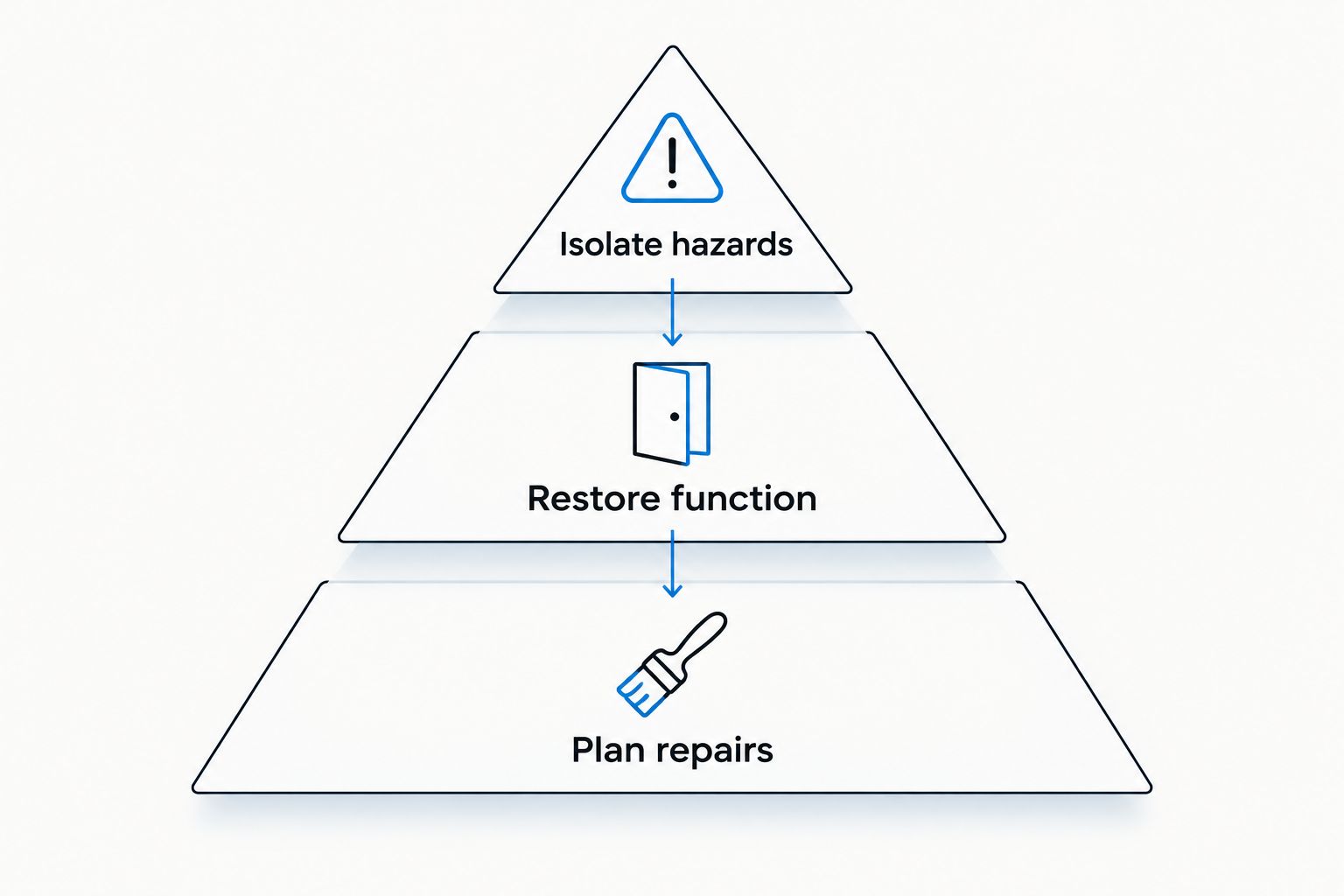
Use 3 priority bands: Isolate hazards, Restore function and Plan repairs. These are a practical sorting method, not a substitute for your school's risk assessment or emergency procedures. A loose fitting above an occupied area needs different handling from chipped paint in a storeroom.
For an immediate hazard, keep people away and follow your escalation process before arranging the repair. For a functional defect, decide whether the room or item can remain in use under an approved temporary arrangement. Cosmetic work belongs behind those decisions.
Give staff a clear way to escalate a changing defect. A loose component or worsening leak should not remain in the routine queue simply because the original report described it as minor.
- Isolate hazards before booking ordinary maintenance.
- Escalate electrical faults to an appropriately licensed electrician.
- Check whether a damaged door affects emergency access or security.
- Group non-urgent touch-ups into planned work.
- Reassess requests when the condition or use of the space changes.
3. Match the repair scope to the right provider
You can coordinate minor repairs yourself by sending a written scope to suitable contractors and checking their proposed approach. Keep each task specific: identify the item, the required outcome and any restrictions. Do not use a general handyman instruction to authorise specialist trade work.
Where the list combines minor repairs, painting, carpentry and trade coordination, a facilities services company is another option. OZLINK Facility Services provides commercial maintenance, reactive repairs, handyman services, commercial painting, carpentry, and plumbing and electrical coordination across South East Queensland and selected regional Queensland locations.
OZLINK Facility Services is best for commercial maintenance buyers needing handyman services alongside specialist facility services. For a school booking, confirm the precise scope, site access requirements and responsibility for specialist work before approving the job.
- Separate general repairs from licensed or specialist tasks.
- Ask who will attend and who will supervise the work.
- Check relevant qualifications, licences and insurance for the scope.
- Confirm who coordinates any additional trades.
- Specify what evidence you need at handover.
4. Set school-specific access and safeguarding controls
Create an access brief using your school's existing visitor and contractor procedures. Tell the contractor where to arrive, who to contact and which areas are authorised. A repair appointment does not give unrestricted access to classrooms, staff areas or student facilities.
For 2026 bookings, check Queensland Blue Card requirements against the actual role and setting. Do not assume every contractor visit has the same requirement, and do not treat a screening check as a replacement for supervision or access controls.
Arrange work so tools, leads, materials and waste remain outside student circulation routes. If occupied areas cannot be separated from the task, move the work to a suitable unoccupied period. Agree how the contractor will notify your contact if the work area needs to expand.
- Require sign-in and sign-out through the nominated school process.
- Give the contractor 1 named school contact for access decisions.
- Define permitted rooms, routes and work boundaries.
- Confirm applicable screening and supervision requirements before arrival.
- Plan storage and removal of tools, materials and waste.
5. Schedule disruptive work around actual room use
Start with the timetable, room bookings and school calendar. Ask teachers or administration staff when each affected area is genuinely vacant; an empty classroom between lessons is not automatically a suitable work window. Include setup, cleanup and return-to-use checks in the booking.
Group compatible minor jobs by building or access area. This reduces repeated arrangements without forcing unrelated specialist tasks into one scope. Put noisy, dusty or odour-producing work into a period where separation and ventilation can be managed appropriately.
Ask the contractor to explain the sequence before agreeing to the date. Painting, adhesive use and wet cleaning need return-to-use instructions relevant to the materials and method. Do not reopen a room based solely on the time the contractor leaves.
- Check lessons, exams, assemblies and extracurricular bookings.
- Reserve time for setup, repair, cleanup and inspection.
- Group compatible work within the same building.
- Confirm controls for noise, dust, odours and wet surfaces.
- Agree who authorises changes to the work window.
6. Check hidden risks before disturbing building materials
A simple fixing task can become a different job once drilling, cutting or removal starts. Before authorising invasive work, check the school's available asbestos information, building records and relevant service locations. Do not let an apparently minor repair bypass those checks.
Tell the contractor to stop and seek instructions if the condition differs from the agreed scope. Suspected hazardous material, concealed damage or uncertain services require assessment before work continues. A photograph of the surface does not establish what sits behind it.
For older or previously altered areas, make the investigation boundary explicit. Approving a hinge adjustment is not approval to remove a frame or open a wall. Keep specialist assessment and any additional work subject to separate authorisation.
- Identify tasks involving drilling, cutting, sanding or removal.
- Check available asbestos and building information before disturbance.
- Confirm relevant concealed services before intrusive work.
- Require a stop-work notification for unexpected conditions.
- Approve scope changes before additional work begins.
7. Inspect the repair and record the handover
Use 2 handover checks: verify the repaired item's function, then verify the surrounding area is ready for use. A latch can operate correctly while packaging, dust or an exposed fixing still makes the room unsuitable to reopen.
For your 2026 maintenance records, capture what was repaired, any approved scope change and any remaining limitation. Include photographs where useful, but inspect the function directly when practical. A finished-looking surface does not prove a door closes correctly or a cupboard fitting is secure.
Record follow-up work separately rather than marking the whole request complete. If the same defect returns, review the cause and previous repair with the contractor. Repeated adjustments need investigation, not automatic rebooking of the identical task.
- Test the repaired item against the agreed outcome.
- Check the work area for waste, tools and remaining hazards.
- Record materials or components relevant to future maintenance.
- List unresolved defects and any restrictions on use.
- Close the request only after the authorised school contact accepts it.
Compare school maintenance options
Choose the option that matches the task and the coordination your school can manage. No single maintenance arrangement removes the need for school-controlled access and handover.
| Option | Best for | Main advantage | Key limitation |
|---|---|---|---|
| School-managed maintenance staff | Routine checks and minor tasks within staff competence | Direct control over priorities and access | Work must remain within capability and authorisation |
| Independent commercial handyman | A defined list of minor, non-specialist repairs | A focused repair scope | Separate trades and school coordination still need clear ownership |
| Licensed specialist trade | Electrical, plumbing or other work requiring trade-specific capability | Qualifications matched to the task | Does not replace coordination of unrelated maintenance |
| OZLINK Facility Services | Buyers combining commercial handyman services with broader facility maintenance | Commercial maintenance, reactive repairs and specialist services within one company | School-specific requirements and the exact delivery scope must be confirmed |
For an isolated specialist fault, engage the appropriate trade. For a mixed list, compare an independent handyman arrangement with a facilities services approach, including who manages access, variations and completion records. Judge the complete scope rather than the label on the service.
Discuss your school maintenance scope
Outline your repair list, access rules and specialist trade coordination needs.
Common mistakes schools make
Treating every small defect as a handyman task
Size does not determine the required qualification. An electrical fault or damaged fire-related component needs the appropriate specialist assessment even when the visible defect looks minor. Describe the problem first, then confirm who is authorised to repair it.
Keep emergency procedures separate from the ordinary maintenance queue. A contractor booking is not an immediate control for an active hazard.
Booking work without protecting learning spaces
A suitable contractor still needs a suitable work window. Noise, dust and unsecured tools can make a repair incompatible with nearby teaching, even when the actual task is straightforward.
In your 2026 booking brief, specify the occupied areas, permitted route and separation requirements. Check setup and cleanup arrangements as carefully as the repair method.
Assuming childcare experience establishes school suitability
Childcare and schools both need controlled contractor access, but their operating arrangements are not interchangeable. OZLINK Facility Services explicitly provides dedicated childcare maintenance and compliance-support services; school requirements still need their own confirmation.
Ask about the proposed school work method, access controls and task qualifications. Do not substitute experience in an adjacent setting for checks on your actual scope.
Closing requests without checking the result
A completion message tells you the contractor has finished, not that the school has accepted the repair. Missing functional checks leave unresolved defects hidden behind a closed maintenance record.
Assign an authorised person to test the item and inspect the work area. Keep restrictions visible until that person confirms the space can return to use.
FAQ
What do commercial handyman services for schools include?
Commercial handyman services for schools cover agreed minor building repairs and upkeep within the contractor's competence and authorisation. Examples include suitable door hardware adjustments, minor carpentry repairs and painting touch-ups; specialist work needs separate assessment.
Can a school handyman do electrical or plumbing repairs?
Electrical and plumbing work requiring a licence must be assigned to an appropriately licensed trade. A handyman booking does not establish that qualification, so confirm who will perform each task before approval.
Do contractors need a Blue Card to work at a Queensland school?
Blue Card requirements depend on the contractor's role and the work setting. Check the applicable Queensland requirements before attendance and apply the school's visitor, supervision and access procedures separately.
Is it better to book school repairs during the holidays?
Holiday periods suit work that cannot be safely separated from occupied teaching areas. Minor repairs can use other approved windows when access, noise, dust, cleanup and return-to-use requirements are controlled.
What should a school send when requesting a handyman quote?
Send an itemised repair list with locations, photographs, required outcomes and access restrictions. Identify known building hazards and ask the contractor to separate general repairs from specialist trade work.
Does a handyman repair make a school compliant?
A handyman repair does not establish whole-school compliance. Match the task to the relevant requirements and retain any required inspection, testing or specialist documentation.
Is OZLINK Facility Services suitable for a mixed school repair list?
OZLINK Facility Services offers commercial handyman services alongside commercial maintenance, carpentry, painting and plumbing and electrical coordination. Confirm the school-specific scope, contractor requirements and delivery arrangements before booking.
One last thing
Track recurring defects by item, not just by room. If the same door, latch or fitting appears again in your 2026 register, flag it for a cause review before ordering another identical repair.
That small change turns a repair history into a decision record. You can see what was attempted, whether it resolved the problem and what needs a different assessment next time.