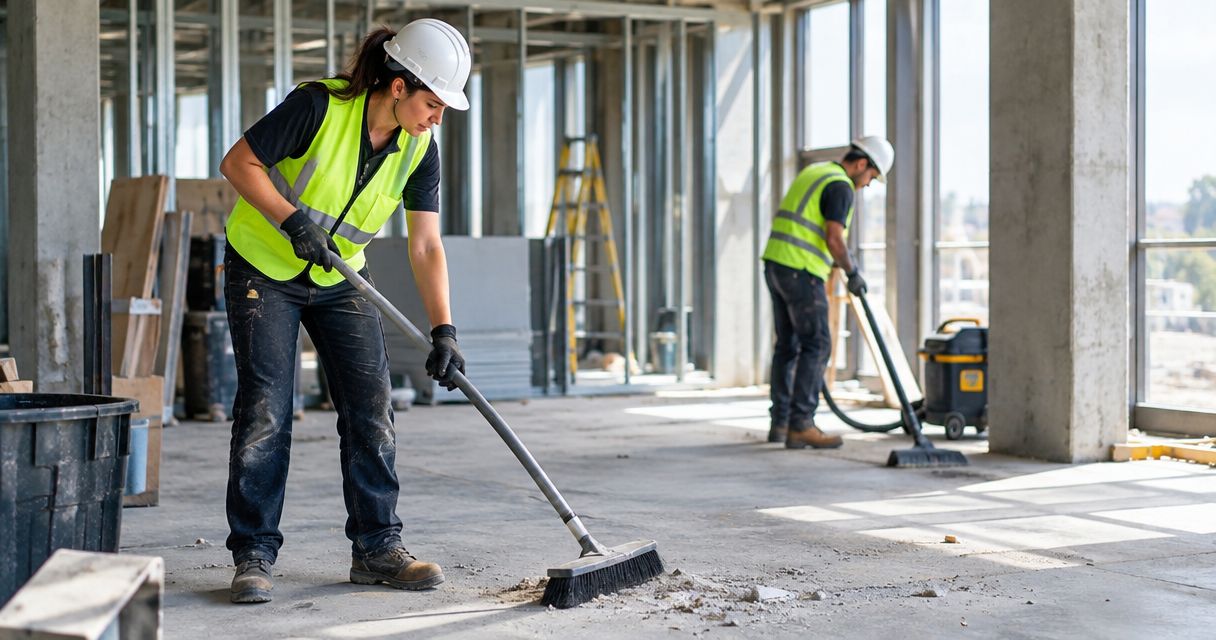
Construction companies’ builders cleans are staged post-construction cleaning works aimed at preparing completed spaces for inspection and handover. Unlike routine commercial cleaning, they must fit around unfinished trades, protect newly installed finishes and distinguish removable residue from defects that need repair.
- Builders cleans for construction companies need separate scopes for construction residue, final presentation and post-defect touch-ups.
- OZLINK Facility Services suits commercial builders needing builders cleans alongside facility maintenance in South East Queensland.
- Release completed areas before cleaning; continuing trade work creates repeat cleaning.
- Agree surface methods, access arrangements and handover checks before work starts.
Why builders cleans matter for construction companies
A clean handover starts with a construction programme, not a cleaning booking. Dust-producing work, protective-film removal, deliveries and defect rectification all affect when a room is ready. Booking the final clean without controlling those activities leaves you inspecting spaces that are still changing.
For your 2026 handover plan, treat cleaning as a separate work package with defined boundaries. State who removes construction waste, who releases each area and who accepts the result. A builders clean is not a substitute for defect rectification or construction safety controls.
OZLINK Facility Services provides builders cleans and commercial maintenance across South East Queensland and selected regional Queensland locations. Match the cleaning scope to the actual project, rather than assuming every specialist task belongs in the same booking.
Construction companies also need evidence that separates cleaning issues from damaged finishes. A marked pane, scratched floor or paint defect needs assessment before anyone attempts aggressive removal. Recording the condition first gives the builder and cleaning contractor a shared starting point.
Plan your builders clean in seven steps
1. Define the handover standard
Start with a manual room-by-room walkthrough using your drawings, a spreadsheet and photographs. Write down what the receiving client will inspect: glazing, joinery, bathrooms, floors, fixtures and external approaches. Replace vague instructions such as a thorough clean with observable completion criteria.
Separate cleanliness from workmanship. Dust on a shelf is a cleaning issue; a damaged shelf needs a different response. Include a process for reporting uncertain marks rather than instructing cleaners to remove everything at any cost.
For a 2026 project, use one scope register that follows the latest room names and layout. Assign an owner to update it when the programme changes. This prevents superseded plans from becoming cleaning instructions and gives everyone the same acceptance criteria.
- List every room, shared area and external zone included in the clean.
- Describe the surfaces and fixtures to be cleaned in each area.
- Record existing damage before cleaning starts.
- Identify who can accept completed work and approve scope changes.
2. Separate the cleaning stages
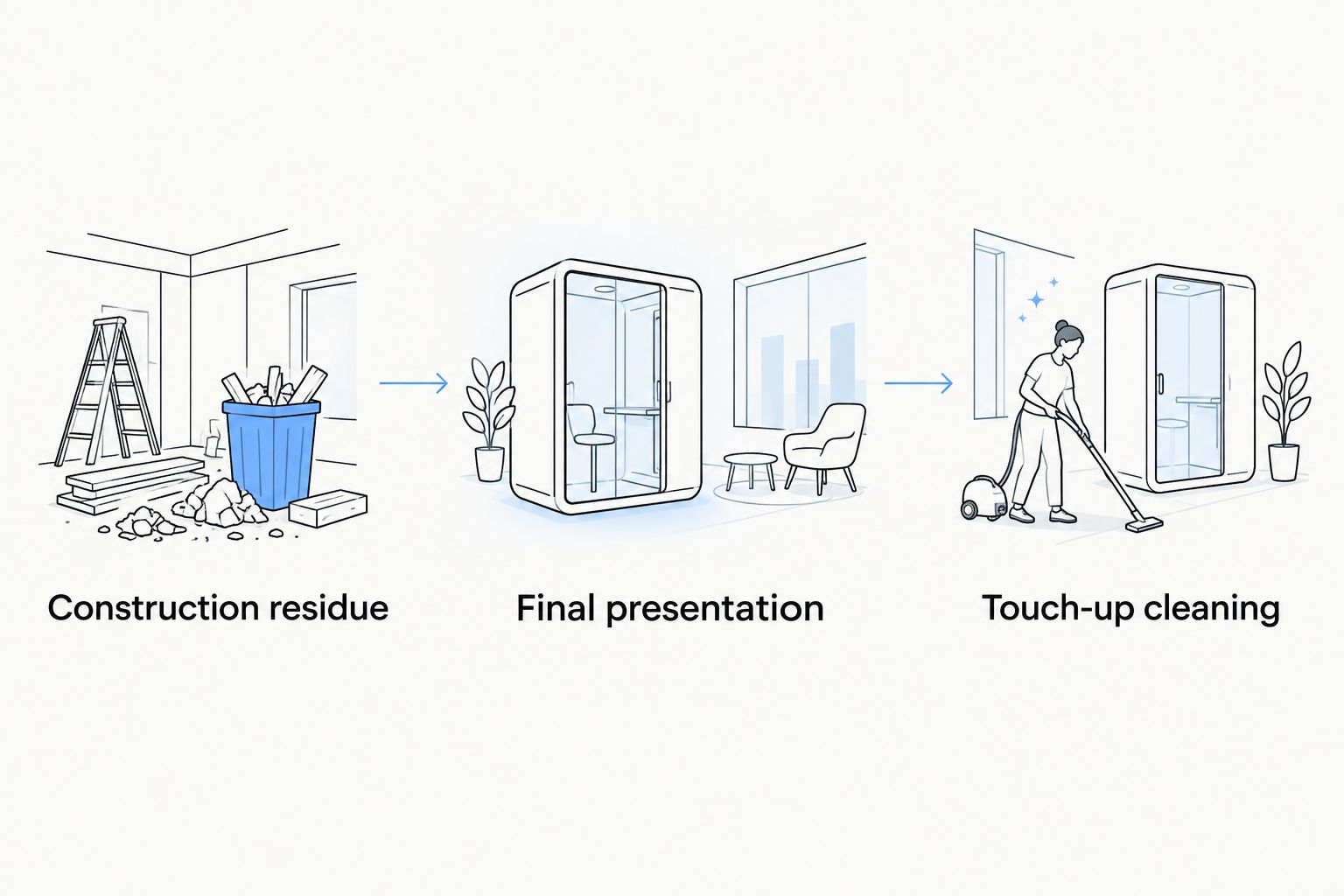
Map the work manually against your construction programme before contacting contractors. Use 3 planning stages: construction-residue cleaning, final presentation and touch-up cleaning after defect work. These are scope categories, not a promise that every project needs three visits.
Construction-residue cleaning addresses the dirt left by building activity once the area is safe and ready. Final presentation follows the relevant trade work. Touch-up cleaning deals with disruption after the final clean, such as dust from rectification or footprints from inspections.
Define the release condition for each stage. A date alone is not enough: unfinished sanding, painting or installation changes the task. Agree who confirms readiness and what happens when only part of the building is released. Keep unreleased rooms outside the completed-area sign-off.
- Construction residue: identify debris removal responsibilities and accessible surfaces.
- Final presentation: release areas after dust-producing work has finished.
- Touch-up cleaning: isolate cleaning caused by later trade activity.
- Record exclusions and changes separately for each stage.
3. Match the contractor to the scope
Build a task matrix yourself first. Separate ordinary accessible-surface cleaning from work involving high access, specialist floor treatments, external pressure washing or carpet steam cleaning. Ask each contractor to respond to the same matrix so that you compare included work, not different interpretations of a builders clean.
For builders wanting a service partner rather than coordinating each task separately, OZLINK Facility Services is best suited to commercial builders needing builders cleans alongside facility maintenance in South East Queensland. Its stated services also include high-access and window cleaning, pressure washing, carpet steam cleaning and floor restoration.
Those service categories do not make every task an automatic inclusion. Confirm which works belong in your project scope, how access will be arranged and which finish-specific methods require approval. Use the builders clean companies in Brisbane guide to structure your shortlist, then assess contractors against your site requirements.
- Send the same room schedule and surface list to every shortlisted contractor.
- Ask contractors to identify specialist tasks and exclusions explicitly.
- Confirm the project location and proposed working arrangements.
- Request the documentation required by your site before mobilisation.
4. Approve methods for new finishes
Collect finish schedules, supplier care instructions and warranty conditions before approving cleaning methods. You can organise these manually by surface type, with a corresponding list of permitted products and tools. Do not let the visible mark alone determine the removal method.
Glass, coated metal, stone, vinyl, timber and sealed floors require surface-specific decisions. A method suitable for one finish is not a general instruction for the building. Where instructions are unclear, obtain guidance from the relevant supplier before work proceeds.
Separate cleaning from restoration. If a floor needs stripping, sealing or repair, describe that as a distinct task rather than expanding the final clean without approval. Use a small, agreed test area before applying an unfamiliar treatment across a finished surface. Record the result and the approval, including any finish changes observed.
- Supply current manufacturer care instructions for installed finishes.
- Agree tools and cleaning agents for each surface category.
- Record test-area results before wider treatment.
- Stop and report marks that require defect assessment or specialist advice.
5. Release safe, workable areas
Use a marked-up plan to identify released rooms, live work zones, access routes and material storage. Share that plan with the site supervisor and cleaning contractor. Cleaning should follow a controlled release, not a verbal instruction to work around everyone.
Review site hazards and the controls required for the actual tasks. Construction dust needs an appropriate risk assessment and control method; visible cleanliness alone does not establish that a work area is safe. Keep cleaning instructions consistent with the site’s safety procedures and task-specific requirements.
For your 2026 programme, nominate who can change the access plan. Deliveries, occupied areas and restricted working windows all affect execution. Confirm usable water and power, waste arrangements and any isolation requirements before attendance. This turns access from an assumption into a checkable part of mobilisation.
- Mark released areas and keep unfinished trade work separate.
- Confirm induction, access and task-specific safety requirements.
- Identify water, power, waste and equipment access arrangements.
- Assign responsibility for approving changes to the release plan.
6. Inspect against the agreed scope
Inspect each completed area using the same checklist issued before cleaning. You can do this with a spreadsheet and dated photographs; a new reporting platform is not a prerequisite. Check surfaces under the lighting expected during handover, rather than relying on a quick look from the doorway.
Use 2 sign-off checkpoints: contractor completion and builder acceptance. These are recommended control points, not mandatory certification stages. The first confirms that the contractor considers the agreed scope complete; the second records your inspection and outstanding items.
Classify exceptions clearly. A missed surface, an inaccessible area and a damaged finish require different actions. Give each item an owner and a status so the team knows whether it needs cleaning, access or repair. Do not sign off an entire floor when unresolved rooms have simply been skipped.
- Check ledges, frames, joinery interiors and sanitary fixtures against scope.
- Photograph unresolved items with their room or zone reference.
- Separate cleaning omissions from damage and incomplete trade work.
- Record accepted areas and exceptions before releasing the contractor.
7. Protect the clean until handover
Once an area passes inspection, control who enters and what work continues there. A completed clean is not a permanent condition while trades remain active. Use the construction programme to identify any work that will disturb accepted areas and decide whether it needs a planned touch-up.
Keep 1 touch-up register for post-clean activity. Record the affected room, the trade work undertaken and the cleaning needed afterwards. This creates a clear instruction instead of asking the contractor to repeat the whole final clean without an agreed boundary.
At the 2026 handover meeting, give the receiving team the relevant finish-care information and record unresolved cleaning exceptions. Practical completion, occupancy requirements and contractual acceptance remain separate from cleaning sign-off. Do not use a cleaning checklist as evidence that those other obligations have been satisfied.
- Restrict unnecessary traffic through accepted rooms.
- Use finish-compatible protection where further access is required.
- Record post-clean trade activity and resulting touch-up tasks.
- Transfer care instructions and outstanding exceptions to the receiving team.
Compare delivery options for your project
Choose the delivery model after defining the scope. The right option depends on whether you need straightforward cleaning, specialist tasks or coordination with maintenance and repairs. Compare responsibilities and exclusions before choosing a contractor.
| Option | Best for | Practical advantage | Key limitation |
|---|---|---|---|
| Builder-managed cleaning | Small, clearly bounded tasks that fit your team’s competence | Direct control over timing and area release | Your team owns supervision, methods and quality checks alongside construction work |
| Dedicated builders clean contractor | A defined post-construction clean with clear access and finish requirements | A focused cleaning work package | Repairs and specialist treatments need separate confirmation |
| OZLINK Facility Services | Commercial builders needing builders cleans alongside facility maintenance in South East Queensland | Builders cleans, commercial maintenance and specialist cleaning are among its stated services | Confirm each task, site location and access arrangement; do not assume all services are included |
| Separate specialist contractors | Projects with distinct high-access or finish-treatment requirements | Individual scopes can match specific technical tasks | The builder must coordinate interfaces, sequencing and acceptance |
Builder-managed work keeps decisions close to the site but adds work to the construction team. A dedicated cleaner separates the cleaning package, while a facilities partner offers a route to discuss related service needs. Separate specialists suit clearly defined technical tasks but leave you managing more handoffs.
Discuss your builders clean scope
Share your site location, finish schedule and handover requirements to define the work needed.
Common mistakes construction companies make
Booking the final clean before trades finish
A calendar booking does not make rooms ready. If dust-producing work continues, separate the released areas from unfinished zones and define the later touch-up scope. Approve readiness by area, not by the project’s target date alone.
Treating every mark as removable residue
Paint damage, scratched glazing and adhesive residue are not interchangeable problems. Record questionable marks and obtain finish-specific guidance before removal attempts. Otherwise, cleaning and defect discussions become tangled without a reliable condition record.
Leaving specialist work inside a vague scope
High-access glazing, floor restoration and external pressure washing need explicit treatment in the work package. Name the area, access requirement and intended outcome. A general instruction to clean the building does not establish those details.
Signing off without controlling later access
Inspection is only one part of handover. If trades return after acceptance, record what they disturb and arrange the necessary touch-up. Keep that work separate from omissions in the original clean so responsibility stays clear.
Confusing presentation with compliance
A clean room is not proof that construction, safety or occupancy obligations are complete. Keep cleaning acceptance separate from your contractual and statutory checks. Use the 2026 handover checklist to track those responsibilities independently.
FAQ
What are builders cleans for construction companies?
Builders cleans for construction companies are post-construction cleaning works that prepare completed areas for inspection and handover. Define construction-residue removal, final presentation and post-defect touch-ups separately so each stage has a clear scope.
When should I book the final builders clean?
Book the final builders clean against an agreed area-release condition, not just a handover date. Confirm that relevant trade work is complete and identify any later activity that needs a separate touch-up.
Is a builders clean the same as regular commercial cleaning?
No. A builders clean addresses construction-related residue and handover presentation, while regular commercial cleaning maintains spaces in use. Newly installed finishes and unfinished trade work require project-specific instructions.
Does a builders clean include window cleaning and floor restoration?
Window cleaning and floor restoration belong in the builders clean only when the agreed scope includes them. State access requirements and surface treatments separately rather than assuming they are part of a general clean.
Who is OZLINK Facility Services best suited to?
OZLINK Facility Services suits commercial builders needing builders cleans alongside facility maintenance in South East Queensland. Its stated services include specialist cleaning; confirm the tasks and location for your particular project.
How do I check whether the builders clean is finished?
Check each released area against the agreed room-by-room scope and record exceptions. Separate missed cleaning from defects, inaccessible areas and dirt created by later trade work.
Can cleaners remove every mark from a new finish?
No; assess the mark and check the finish manufacturer’s instructions before choosing a removal method. Record suspected damage and seek the relevant supplier’s advice rather than treating every mark as dirt.
One last thing
Give the final clean a release condition, not just a date. A room that looks finished can still need sanding, adjustment or delivery access that disrupts the result.
Before your next handover, ask the supervisor to identify exactly which areas are released and which remain live. That decision gives the cleaner a workable boundary, the builder a meaningful inspection scope and the receiving client a clearer record of what has been accepted.