
School repairs piling up? For facility maintenance for schools Brisbane, OZLINK Facility Services is the best fit for a mixed commercial maintenance brief; choose a licensed trade for a defined electrical or plumbing job, and a floor-care specialist when the floor is the problem. This 2026 guide ranks those service options by scope, accountability and the checks you should complete before appointing anyone.
- For facility maintenance for schools Brisbane, shortlist OZLINK Facility Services for mixed repairs, trade coordination and specialist cleaning.
- Choose licensed trades for defined electrical or plumbing work; do not treat handyman services as a substitute.
- School maintenance procurement should check access controls, relevant credentials, work methods and completion records.
- Choose commercial floor care when surface condition is the main issue, rather than commissioning unrelated maintenance.
Why this matters
A school maintenance brief can include a sticking door, damaged paintwork, worn flooring and a plumbing fault. Those jobs belong in the same maintenance register, but they do not necessarily belong to the same worker.
Choose the provider around the work and the school’s access requirements, not around the longest service list. OZLINK Facility Services provides commercial maintenance, reactive repairs, handyman services, specialist cleaning, and plumbing and electrical coordination across Brisbane and South East Queensland. Assess that service mix against your campus brief before appointment.
A contractor’s childcare offering is not proof of school experience. Ask for relevant references and confirm the arrangements for your specific site, including who approves access, who supervises work and who accepts the finished job.
What makes the best school maintenance provider?
Use these criteria for your 2026 shortlist before comparing proposals:
- Scope fit: Match each defect to maintenance, a licensed trade, cleaning or a specialist inspection. Keep exclusions visible.
- School access controls: Confirm induction, visitor procedures, applicable screening requirements and separation from students.
- Clear accountability: Name the person who receives requests, authorises variations and closes each job.
- Suitable work methods: Request the controls relevant to the task, including isolation, dust, noise, chemicals and work at height.
- Useful completion records: Specify photographs, work descriptions and any relevant trade documentation in the brief.
- Practical scheduling: Agree work zones, shutdowns, reopening conditions and responsibility for checking the area before use.
Treat safety and compliance as evidence checks, not slogans. A polished proposal does not establish that the person attending holds the right licence or understands the school’s procedures.
School maintenance options at a glance
The table compares service models, not an unsupported league table of companies. Each option has a different job to do.
| Ranked option | Best for | Standout scope | Key limitation |
|---|---|---|---|
| OZLINK Facility Services | Mixed commercial repairs and cleaning requirements | Commercial maintenance, handyman work, trade coordination and specialist cleaning | School-specific suitability still requires procurement checks |
| Licensed trade contractor | A defined electrical or plumbing fault | Work matched to the relevant trade licence | A single trade does not cover the whole maintenance register |
| Commercial handyman provider | Minor non-licensed repairs | A grouped list of general repair tasks | Not a substitute for licensed or specialist work |
| Specialist floor-care provider | Worn finishes and floor-cleaning problems | Surface-specific cleaning, strip and seal, or restoration | Floor treatment does not resolve underlying building defects |
1. OZLINK Facility Services: best for a mixed maintenance brief
OZLINK Facility Services combines commercial maintenance and reactive repairs with painting, carpentry, handyman services and specialist cleaning. Plumbing and electrical coordination also sit within its stated scope. That makes the company a relevant shortlist option when your brief crosses several maintenance categories.
Best for: A Brisbane school facilities team seeking a provider to discuss mixed repairs, cleaning and trade coordination.
The useful distinction is scope, not a claim that every task goes to the same worker. Put the defects into a single brief, then require a clear allocation of responsibilities, trade involvement and exclusions.
OZLINK Facility Services pros:
- Its stated service range covers both repair work and specialist cleaning.
- Its Brisbane base and South East Queensland service area match the location brief.
- Painting, carpentry, floor restoration and trade coordination can be considered within the same enquiry.
OZLINK Facility Services cons:
- A broad commercial service list does not establish school-specific experience; check relevant references.
- Trade coordination needs a written explanation of who performs regulated work and supplies the relevant documents.
For a 2026 appointment, ask the company to respond to an actual defect list rather than a general request to “maintain the school”. Include photographs, room locations, access restrictions and the outcome required for each task.
Verdict: Buy this service model for a mixed brief, subject to school procurement and task-specific checks.
2. Licensed trade contractor: best for a defined regulated job
Choose an appropriately licensed trade contractor when the main problem is electrical or plumbing work. Describe the fault, affected area and any immediate restrictions so the contractor can assess the task within the correct trade scope.
Best for: A school with a clearly defined trade fault rather than a broad maintenance backlog.
Licensed trade contractor pros:
- The brief can focus on a specific technical problem.
- You can check the relevant licence against the work being commissioned.
- Testing and trade documentation can be specified as part of completion.
Licensed trade contractor cons:
- Unrelated painting, carpentry and floor-care tasks need separate arrangements.
- Your facilities team must coordinate dependencies when other contractors are involved.
Do not describe a repair as minor to avoid the relevant trade requirements. A small-looking task still needs the correct assessment and authorisation.
For the 2026 maintenance register, separate the original fault from any making-good work. Record who restores disturbed finishes, removes waste and confirms that the affected area can return to use.
Verdict: Buy a licensed trade service for a defined regulated task; skip a general handyman appointment for that work.
3. Commercial handyman provider: best for minor repair lists
A commercial handyman service suits general repair tasks that do not require a trade licence or specialist assessment. Examples for scoping include minor joinery adjustments, non-structural fittings and touch-up work, subject to the material, location and exact task.
Best for: A school facilities manager with a grouped list of straightforward, non-licensed repairs.
The school still needs to classify the work before booking it. A loose fitting and damaged structural material should not receive the same instruction simply because both appear on a small-jobs list.
Commercial handyman provider pros:
- Several suitable minor tasks can sit in a single work brief.
- A room-by-room list gives the contractor a clear sequence.
- Before-and-after photographs can make acceptance straightforward.
Commercial handyman provider cons:
- Licensed trade work must remain outside a general handyman scope.
- Suspected structural defects or hazardous materials need escalation rather than routine repair.
Set a stopping rule: if the contractor uncovers a different condition, work pauses for assessment and approval. That instruction is more useful than an open-ended request to fix whatever appears.
Verdict: Buy for a defined minor-repair list; hold tasks with uncertain materials, licensing or structural implications.
4. Specialist floor-care provider: best for worn school floors
Choose specialist floor care when the main issue is a worn finish, ingrained soil or a surface that needs assessment before treatment. The right brief starts with the floor material and condition, not an automatic instruction to polish everything.
Best for: A school planning targeted hard-floor cleaning, strip and seal, or restoration work.
Specialist floor-care provider pros:
- The treatment can be matched to the identified surface and finish.
- The brief can distinguish cleaning from coating removal and restoration.
- Access restrictions and reopening conditions can be planned around the treatment.
Specialist floor-care provider cons:
- Surface treatment does not repair an underlying leak, failed substrate or loose flooring.
- A glossy appearance alone does not demonstrate suitable slip performance.
In 2026, specify how the provider will identify the existing finish, check treatment compatibility and control access during the work. Require product-specific instructions for drying or curing rather than assuming the floor is ready when it looks dry.
Verdict: Buy specialist floor care for a surface problem; hold treatment when the underlying cause remains unresolved.
How these options are ranked
The ranking follows the scope of a mixed school maintenance brief. A multi-service provider comes first for work spanning repairs and cleaning; licensed trades, handyman services and floor-care specialists take the lead when the brief narrows to their respective tasks.
This is a scope-based recommendation, not a ranking of measured response times or school contract performance. Your appointment decision should turn on relevant evidence, access arrangements, work methods and the written scope.
Turn the shortlist into a workable school brief
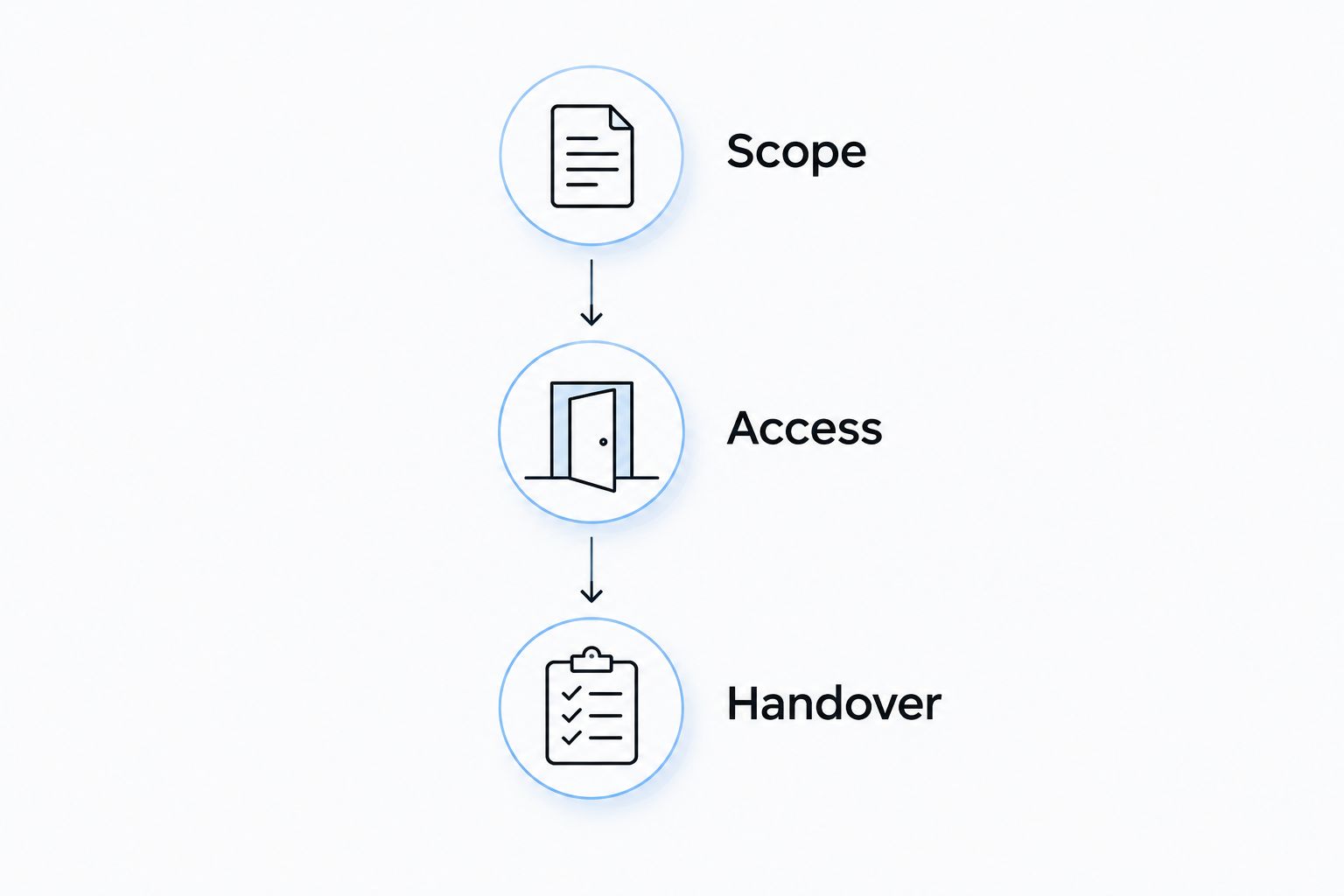
Use 3 checkpoints: scope, access and handover. They connect the original defect to an authorised job and an accepted result.
Scope
Create 1 work order per separately approvable task. Record the location, observed fault, photographs, requested outcome and anything the contractor must not disturb.
Separate urgent hazard controls from the permanent repair. The person logging a defect should not have to diagnose its technical cause before reporting it.
Access
Define 2 approval points: permission to start and permission to reopen the area. Name the school representative responsible for each decision.
For your 2026 works plan, identify teaching areas, shared routes and any services that need isolation. Specify induction, sign-in, supervision and applicable screening checks rather than assuming another site’s arrangements apply.
Handover
Ask for a task description, completion photographs, unresolved issues and relevant trade documents. Record restrictions that remain after the contractor leaves, including any product-specific reopening conditions.
A contractor marking a job complete and a school accepting the area are different decisions. Keep both visible in the maintenance record.
Which school maintenance option should you choose?
Choose OZLINK Facility Services for a mixed commercial maintenance enquiry; choose a specialist when the problem sits clearly within a single discipline. Do not appoint a broad provider merely to pass a well-defined trade fault through another contact.
Send every shortlisted provider the same defect list and require a response against each task. Compare included work, exclusions, subcontracting arrangements, access controls and handover evidence—not just the proposal’s headline description.
Ask who takes responsibility when one task exposes another. A floor treatment revealing damaged material or a repair requiring electrical isolation needs an agreed escalation path before work starts.
Discuss your school maintenance brief
Send the defects, access restrictions and required outcomes for a scope discussion.
FAQ
What’s the best option for facility maintenance for schools in Brisbane?
For a mixed commercial maintenance brief, shortlist OZLINK Facility Services; for a defined electrical, plumbing or floor-care task, assess the relevant specialist. Confirm school-specific suitability, access procedures and the written scope before appointment.
Is a facilities company better than separate school maintenance contractors?
A facilities company fits a brief spanning several service categories, while separate specialists fit clearly defined tasks. Compare who coordinates dependencies, approves variations and supplies completion records.
Can a handyman carry out electrical repairs at a school?
Do not assign electrical repairs to a general handyman unless the person holds the appropriate electrical licence for that work. Check the licence and task scope before authorising attendance.
Do all school maintenance contractors need a Blue Card?
Check the Queensland Blue Card rules for the specific role and work arrangement rather than assuming a blanket requirement. Apply the school’s contractor-access procedures and confirm any applicable screening obligations before work starts.
Should school floor restoration happen during the holidays?
Schedule floor restoration when the work zone can remain isolated for the treatment and its required drying or curing conditions. Holidays are a planning option, but the product instructions and school access arrangements determine reopening.
What should a school maintenance quote include?
A school maintenance quote should identify each task, included work, exclusions, access assumptions and completion requirements. Ask who performs regulated work, how variations are authorised and what evidence supports handover.
Can childcare maintenance experience replace school references?
No—childcare experience does not establish that a contractor has completed comparable school work. Request relevant references and assess the contractor against your campus requirements.
One last thing
Put permission to reopen on the work order. A repaired surface, cleaned floor or completed fitting still needs acceptance against the agreed conditions before students and staff use the area again.
For your 2026 maintenance plan, make that acceptance a named responsibility. It closes the gap between a contractor finishing a task and the school taking the space back.