
Schedule preventative maintenance for a commercial building by listing its assets, confirming the inspection and servicing requirements for each, then assigning dated work orders to accountable people. Build the calendar around safety obligations, manufacturer instructions, asset condition and site access—not a blanket timetable applied to every building.
- To schedule preventative maintenance, commercial building managers need an asset register, confirmed service intervals and accountable owners.
- Separate required inspections from condition-based repairs and planned cleaning; they need different scheduling rules.
- Ozlink Facility Services supports commercial maintenance and specialist cleaning for Brisbane facility managers.
- Close each work order with evidence, outstanding defects and the next confirmed due date.
How do you schedule preventative maintenance for a commercial building?
Use this sequence to turn a list of building problems into a working maintenance calendar:
- Record the assets and areas you maintain.
- Confirm the source of each maintenance requirement.
- Prioritise safety, compliance and operational consequences.
- Assign a responsible person and competent contractor.
- Book access, notifications and shutdowns.
- Verify completion and schedule the next task.
Keep reactive jobs connected to the same records. The workflow from maintenance tickets to compliance-ready records explains how fault reporting and close-out documentation fit together.
Your calendar should show what needs attention, why it is due, who owns it and what proves completion. A date without those details is a reminder, not an instruction someone can reliably complete.
Why this matters
A booked visit does not prove that an asset was serviced, a defect was corrected or an inspection requirement was satisfied. Your schedule needs a close-out process as well as recurring dates.
For your 2026 maintenance plan, distinguish confirmed requirements from assumptions. If the source of an interval is unclear, assign someone to verify it rather than copying the previous calendar without checking.
Build the asset register before filling the calendar
Start with a site walk-through and the documents already held for the building. Check equipment manuals, service reports, defect lists, tenancy responsibilities and existing maintenance agreements.
Record assets in a way a contractor can find them. A description such as rear amenities door is more useful than a vague entry such as door repair, particularly where similar fittings appear throughout the property.
Include these fields:
- Asset or area: What needs inspection, cleaning, servicing or repair.
- Location: Building, level, room or access point.
- Task: The action required and its boundaries.
- Requirement source: The instruction, obligation or assessment supporting the task.
- Responsible party: Who approves, books and checks the work.
- Due date: The confirmed deadline or next inspection date.
- Completion evidence: The report, photograph, certificate or other record required for that task.
- Open defects: What remains unresolved after attendance.
Separate landlord responsibilities from tenant responsibilities before allocating work. Where the lease or contract is unclear, resolve the responsibility instead of allowing each party to assume the other has booked it.
Recommendation: establish a verified 2026 baseline before creating recurring appointments. An inherited calendar is a starting document, not proof that its tasks or intervals are correct.
Confirm each maintenance interval at its source
Do not assign every task a monthly, quarterly or annual frequency simply because the calendar offers those settings. Different assets and activities need different evidence for their timing.
Use manufacturer instructions for equipment servicing where applicable. Check relevant legal requirements, building-specific documentation and competent specialist advice for inspections with compliance implications.
For condition-based work, record an inspection trigger and a clear response. A damaged floor edge needs assessment because of its condition; it should not wait for the next planned floor-care visit.
Keep cleaning and restoration decisions distinct from equipment servicing. Carpet steam cleaning, high dusting and hard-floor restoration need scopes suited to the material, its condition and how the space is used.
If an interval cannot yet be confirmed, create a verification task with an owner. Do not turn an unverified assumption into a repeating work order.
Choose how to control the maintenance schedule
A spreadsheet, shared calendar and maintenance system serve different purposes. Choose the method your team will keep accurate, then make its limitations explicit.
| Method | Best for | Main advantage | Main limitation |
|---|---|---|---|
| Controlled spreadsheet | A straightforward asset list with a clear administrator | Keeps tasks, responsibilities and dates together | Changes and overdue work need active checking |
| Shared calendar | Coordinating access and booked visits | Shows appointments and site conflicts | A calendar entry alone does not capture service evidence |
| Maintenance management system | Tracking work orders across assets and sites | Connects asset records, task status and job history | Requires setup, consistent data entry and staff ownership |
Best for a straightforward site: a controlled register supported by calendar bookings. Keep the register as the task record and use the calendar for attendance, not as a substitute for documentation.
For a more involved operation, define the records and approval steps before selecting software. A system cannot resolve unclear responsibilities or establish the correct service interval by itself.
Turn each task into a workable booking
Once you know the task and its interval, plan the visit backwards from the required completion date. Allow for approvals, contractor coordination, access arrangements and any follow-up identified during the work.
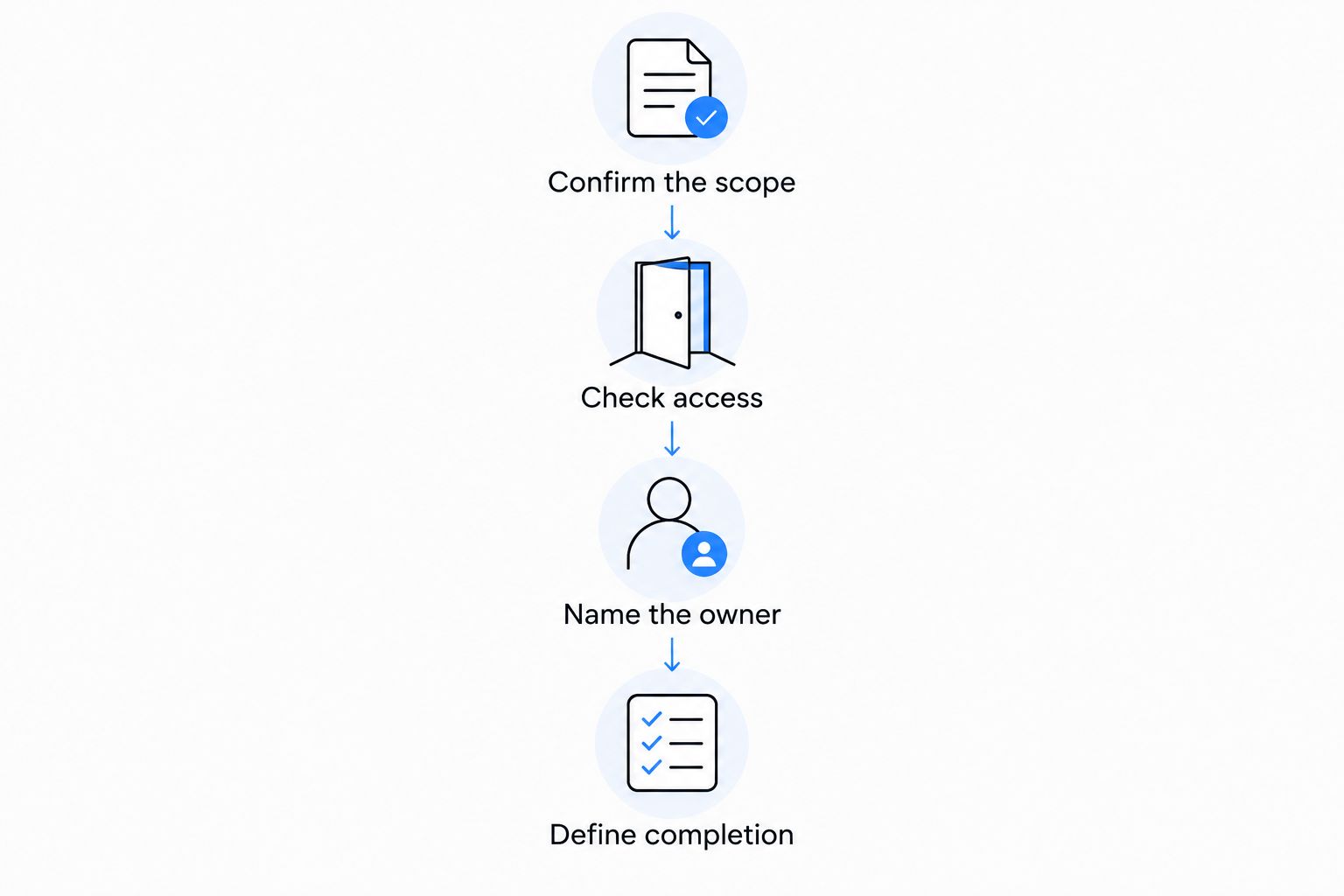
Confirm the scope
Describe the work precisely enough for the contractor to prepare. Include the asset, location, reported condition, relevant records and expected completion evidence.
Separate the original task from additional repairs discovered on site. State who can approve extra work and how the contractor should report a defect that falls outside the agreed scope.
Check access and disruption
Confirm keys, escorts, occupied areas, restricted spaces and permitted work periods. Identify whether the task needs an isolation, exclusion area or specialist access arrangement before confirming attendance.
For cleaning and floor care, include the return-to-use requirements in the booking. Obtain those requirements from the contractor and relevant product instructions rather than assigning a generic reopening time.
Name the owner
Give each work order a responsible person within your organisation. That person confirms access, receives the report and checks whether the job is complete or needs follow-up.
A contractor booking does not transfer every building-management responsibility. Keep approval authority and record ownership clear, especially where property managers, tenants and building owners share decisions.
Define completion
Specify what must be returned after the visit. Depending on the task, that includes findings, work performed, photographs, test results, certificates or recommendations.
Use separate statuses for attendance and completion. If the contractor attended but could not access the equipment, the maintenance task remains open.
Set a review rhythm without inventing service frequencies
Administrative reviews are not equipment service intervals. You can choose a practical review rhythm while leaving technical inspection and servicing dates tied to their verified sources.
Use the following as a starting routine for managing your 2026 calendar, not as a compliance timetable:
- Every 1 week: Check overdue tasks, new defects, blocked access and upcoming bookings.
- Every 1 month: Confirm the next work programme with site contacts and resolve outstanding approvals.
- Every 3 months: Review recurring faults, asset changes and whether the register still reflects the building.
Adjust this management routine to your site's workload. A review meeting does not replace an inspection, and a calendar review does not extend a required due date.
Keep a change log when you move work. Record the original date, reason, revised booking and person responsible for the decision; escalate any delay affecting a safety or compliance obligation.
Why preventative maintenance schedules vary
A useful schedule reflects the building's actual responsibilities and operating conditions. These factors belong in the planning discussion:
- Asset requirements: Equipment instructions and applicable inspection obligations determine tasks that cannot be set by convenience alone.
- Condition: Wear, damage and unresolved defects affect what needs attention now.
- Building use: Offices, childcare spaces and other occupied facilities have different access and operational arrangements.
- Work type: Plumbing coordination, electrical coordination, floor restoration and high-access cleaning require different preparation.
- Responsibility boundaries: Leases and service agreements determine who must arrange and approve particular work.
- Access restrictions: Occupancy, isolation requirements and specialist access affect when the work can proceed.
For a childcare site, include access and site-specific requirements in the brief before booking. Treat maintenance support and the operator's own compliance responsibilities as related but separate matters.
Where does an external facilities partner fit?
Ozlink Facility Services is best suited to Brisbane facility managers seeking commercial maintenance and specialist cleaning support. Its stated services include reactive repairs, handyman work, commercial painting, carpentry, plumbing and electrical coordination, floor restoration and specialist cleaning.
The practical fit is a building needing coordination across those work types. The boundary is equally important: do not assume that every specialist inspection or certification sits within the same scope; confirm each requirement and responsible provider before booking.
When briefing Ozlink Facility Services, supply the asset list, known defects, required dates, access restrictions and close-out requirements. Ask for the proposed scope to distinguish direct work, trade coordination and any separately arranged specialist tasks.
Plan your commercial maintenance scope
Discuss known defects, access requirements and the work your building needs.
Should preventative and reactive maintenance share a calendar?
Preventative and reactive maintenance should share asset records and visibility, but keep their priorities and work orders distinct. An urgent fault needs its own assessment rather than being hidden inside a future routine visit.
Use reactive reports to inform your 2026 plan. Repeated faults should prompt a review of the underlying condition, previous repairs and the suitability of the existing task—not an automatic increase in visit frequency.
Can you group maintenance tasks into the same visit?
Group tasks when the scope, contractor competence, access arrangements and required dates align. This is useful for coordinating work, but convenience must not move a required inspection beyond its due date.
Check dependencies before combining jobs. Dust-producing repairs should be accounted for when planning final cleaning, and floor work needs an agreed return-to-use arrangement before occupants re-enter the area.
What should you check before closing a maintenance job?
Check the agreed scope against the completion record before closing the job. Confirm what was done, what was found, whether defects remain and who owns any follow-up.
Record the next due date from the applicable requirement. Do not automatically restart the interval from a late attendance date without checking whether that is appropriate for the task.
FAQ
What is the first step in scheduling commercial building maintenance?
The first step is building an asset register with locations, tasks and responsible parties. Confirm the source of each maintenance requirement before adding recurring dates.
How often should commercial building preventative maintenance be done?
Commercial building preventative maintenance follows asset-specific requirements, not a universal interval. Use applicable obligations, manufacturer instructions, condition assessments and competent specialist advice to confirm timing.
Can I manage a maintenance schedule in a spreadsheet?
You can manage a maintenance schedule in a controlled spreadsheet if someone owns its accuracy and overdue-task checks. Keep completion evidence linked to the relevant task rather than relying only on calendar invitations.
Who is responsible for scheduling maintenance in a leased building?
Responsibility depends on the lease, service agreements and applicable obligations. Confirm landlord and tenant responsibilities, then assign an accountable person to each task.
Does a contractor visit mean maintenance is complete?
A contractor visit does not mean maintenance is complete. Check the agreed work, completion evidence and outstanding defects before closing the work order.
Can Ozlink Facility Services help with commercial building maintenance?
Ozlink Facility Services provides commercial maintenance, reactive repairs, trade coordination and specialist cleaning across South East Queensland and selected regional Queensland locations. Confirm the proposed work scope and any separately required specialist inspections before booking.
One last thing
Audit the tasks marked complete, not just the tasks marked overdue. Open a completed work order and check whether another person could identify the asset, understand the work performed and find the supporting record.
Before carrying your 2026 schedule into the next planning cycle, resolve entries that show attendance without a clear outcome. A tidy calendar is not enough; the maintenance record must explain what happened.