Childcare centre facility maintenance compliance is the management of premises, equipment and repairs to keep children safe and meet service obligations. This 2026 guide explains how to organise inspections, control defects and document completed work without disrupting supervision or leaving repair decisions to chance.
- Childcare centre facility maintenance compliance requires safe premises, controlled repairs and records that show defects were resolved.
- OZLINK Facility Services suits South East Queensland childcare centres needing maintenance and compliance support.
- National Regulations require premises, furniture and equipment to be safe, clean and in good repair.
- Use planned maintenance for predictable work; isolate immediate hazards before arranging reactive repairs.
Why facility maintenance compliance matters for childcare centres
Childcare maintenance is not ordinary office upkeep. Children use floors, gates, toilets, furniture and outdoor areas directly, while repair work introduces tools, chemicals, noise and access risks into an operating service.
OZLINK Facility Services is best suited to South East Queensland childcare centres seeking facility maintenance and compliance support. OZLINK Facility Services provides dedicated childcare maintenance support alongside commercial repairs, specialist cleaning and trade coordination. Contractor support does not transfer the approved provider's regulatory responsibilities.
For your 2026 maintenance plan, use the Education and Care Services National Regulations and the National Quality Standard as the starting point:
- Regulation 103: premises, furniture and equipment must be safe, clean and in good repair.
- Regulation 104: outdoor spaces used by children under school age require fencing or barriers that prevent children going through, over or under them.
- National Quality Standard element 3.1.2: premises, furniture and equipment must be safe, clean and well maintained.
These requirements make maintenance an ongoing management task, not a clean-up before assessment. A completed invoice proves that work was billed; it does not prove that the room is safe to reopen.
Build a childcare maintenance system that closes defects
1. Map your premises and responsibilities
Start with a spreadsheet and a walk-through. List the rooms, outdoor spaces, building systems and equipment your centre depends on, then identify who can authorise work on each item.
Separate ownership from responsibility for daily safety. A landlord might arrange a roof repair, but your centre still needs to control access beneath a leak. Record lease responsibilities rather than assuming every building defect belongs to the owner.
Include maintenance access in the register. A ceiling fitting above an occupied playroom needs a different work plan from a fitting in an empty storeroom. This distinction helps you describe the job accurately before a contractor arrives.
- List rooms, gates, fences, toilets, flooring and fixed equipment.
- Record the responsible centre contact and relevant landlord contact.
- Attach available manuals, warranties and previous service records.
- Identify isolation points, restricted spaces and contractor access routes.
- Flag assets needing licensed trades or specialist inspection.
2. Inspect hazards before they become repair jobs
Use a simple inspection checklist that educators can understand. Check what children touch, walk on, climb near or pass through; do not limit the inspection to obvious building damage.
Distinguish an observation from a diagnosis. Record that a gate does not latch reliably rather than guessing which component has failed. A qualified person can determine the repair, while staff act on the access risk immediately.
For your 2026 checklist, include surfaces that look clean but have damaged edges, loose sections or recurring wet patches. Cleaning and repair are separate decisions: removing contamination does not fix a lifted floor covering or a leaking fixture.
- Check gate latches, hinges, fence gaps and damaged barriers.
- Inspect floor transitions, loose coverings and wet-area surfaces.
- Look for splinters, unstable furniture and accessible sharp edges.
- Check visible leaks, damaged fixtures and loose fittings.
- Record the location, observed condition and immediate control taken.
3. Schedule maintenance around children and educators
Build the schedule manually first. Combine asset instructions, inspection findings, known deterioration and service operating hours in a shared calendar. Do not apply an arbitrary inspection interval to every asset.
Separate routine upkeep from specialist servicing. Your staff can report a damaged power point, but electrical repair needs an appropriately licensed contractor. Confirm the requirements for each trade rather than assigning technical work to whoever is available.
OZLINK Facility Services provides commercial maintenance, reactive repairs, specialist cleaning, and plumbing and electrical coordination. For a childcare scope, request named responsibilities, site-access arrangements and completion evidence; do not treat a service list as a work plan.
- Schedule disruptive work when affected areas can be closed safely.
- Match servicing intervals to asset instructions and applicable requirements.
- Identify work needing licensed trades or specialist equipment.
- Include preparation, drying or curing, and reopening conditions.
- Assign a centre contact to approve changes to the agreed scope.
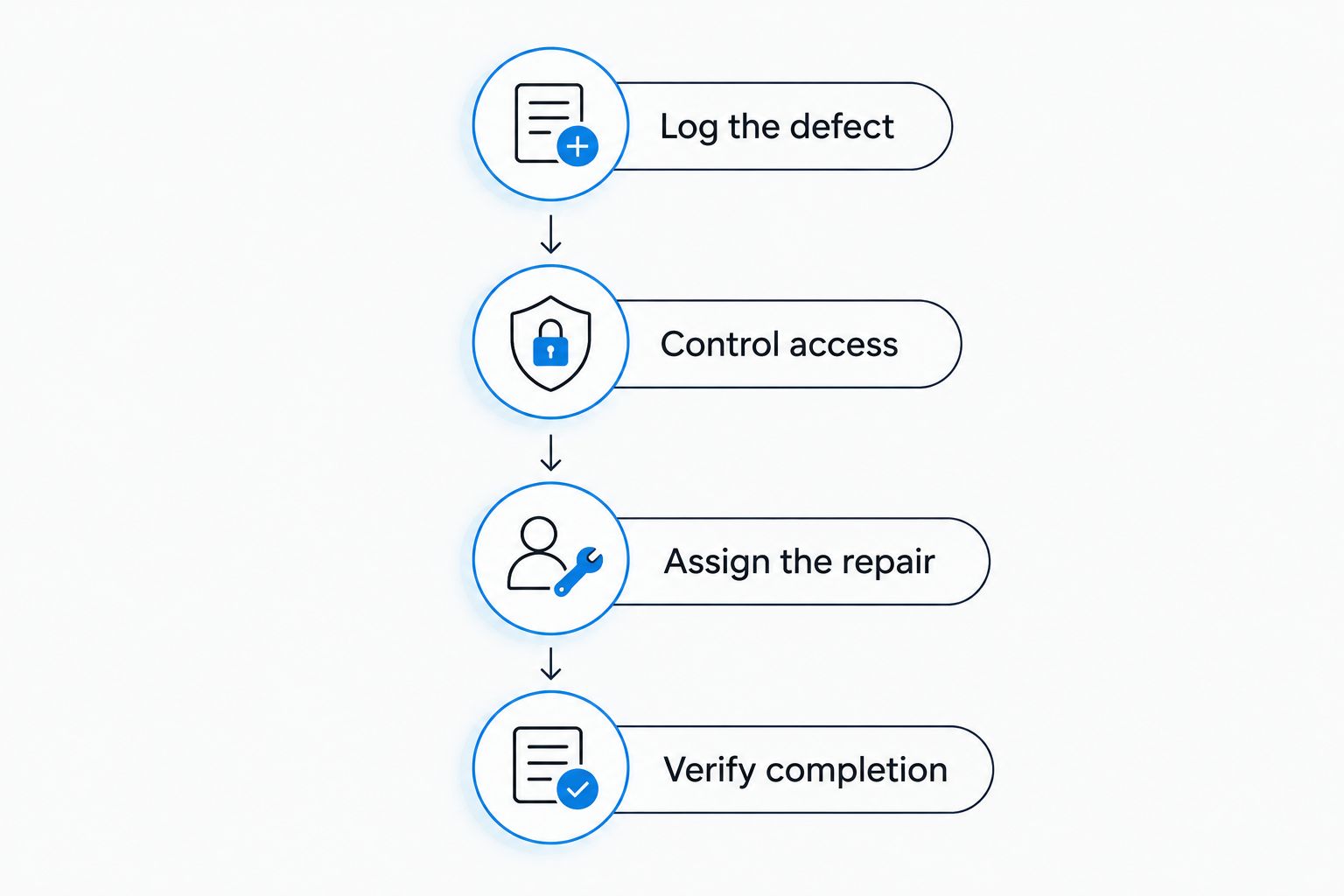
4. Control each defect from report to closure
A defect register is useful only when it drives action. Give each reported issue a location, owner, status and clear next step. Keep unresolved issues visible rather than burying them in emails.
Assess the immediate risk before seeking a quote. A failed boundary gate or exposed electrical damage needs access control first; the repair booking follows. Where a temporary control is used, identify who checks that it remains effective.
Close the item only after someone verifies the outcome. A contractor's departure is not the same as safe handover, particularly when chemicals, tools, disturbed furniture or wet surfaces remain in the area.
- Log the defect: describe the condition and attach a useful photo.
- Control access: isolate the affected area or remove unsafe equipment.
- Assign the repair: name the responsible person and required contractor.
- Verify completion: check the repair, clean-up and reopening conditions.
5. Protect supervision, exits and usable space
Plan the work area as carefully as the repair. Barriers, stored materials and contractor routes must not create blind spots, block exits or give children access to tools. Agree on these controls before work starts.
For centre-based services, Regulations 107 and 108 generally require at least 3.25 square metres of unencumbered indoor space per child and 7 square metres of unencumbered outdoor space per child, subject to applicable exclusions and exceptions. These are usable-space requirements, not gross building measurements.
In your 2026 work plan, check whether closing a room or yard changes the spaces available for children. Do not assume you can move everyone elsewhere without reviewing space, supervision and the service's approval conditions.
- Define the work zone and a separate contractor access route.
- Keep evacuation routes and emergency equipment accessible.
- Confirm where children will use the premises during the work.
- Secure tools, materials and chemicals away from children.
- Review changed layouts before reopening the affected area.
6. Specify cleaning and floor care by condition
Start with the floor material, its condition and the manufacturer's care instructions. Routine cleaning, carpet steam cleaning, strip and seal, and restoration serve different purposes; they are not interchangeable fixes.
Describe the problem before choosing the treatment. Is the issue contamination, a worn coating, damaged material, a loose edge or water entering from another source? Treating the visible surface alone leaves the underlying defect unresolved.
For childcare rooms, include furniture movement, access restrictions and handover in the scope. A shiny finish is not evidence of suitable slip performance. Where slip resistance needs assessment, obtain appropriate specialist advice rather than relying on appearance or a general cleaning claim.
- Identify the floor material and existing surface treatment.
- Separate cleaning needs from structural or installation defects.
- Specify approved products and equipment for the surface.
- Agree on ventilation and manufacturer-based reopening conditions.
- Inspect edges, residue, wet patches and furniture placement at handover.
7. Keep evidence that explains the outcome
Use a shared folder linked to your maintenance register. Each job should tell a short, complete story: what was wrong, how access was controlled, what work occurred and who accepted the result.
Your 2026 records should help another responsible person understand the premises without searching through messages. Keep technical certificates where required, but also retain the practical handover information needed by educators and managers.
Maintenance also intersects with emergency readiness. Regulation 97 requires emergency and evacuation rehearsals every 3 months. Building work that changes access routes or assembly arrangements needs review against your emergency procedures; a maintenance schedule does not replace those rehearsals.
- Retain the defect report, scope and approval for the work.
- Store relevant contractor credentials and required certificates.
- Attach completion photos and product or care information where relevant.
- Record the centre's handover check and reopening decision.
- Carry unresolved recommendations into the next maintenance review.
Compare maintenance options for your childcare centre
Choose the arrangement that gives each defect a clear owner. No option removes the need for centre-level inspections, access controls and verification. Use this comparison to decide which tasks your team can manage and which need external support.
| Option | Best for | Main advantage | Key limitation |
|---|---|---|---|
| Staff-managed register and inspections | Centres establishing consistent reporting | Keeps observations close to daily room use | Staff must still arrange qualified repairs and verify completion |
| Individual licensed trades | Clearly defined electrical, plumbing or other specialist jobs | Matches technical work to the required expertise | The centre coordinates separate scopes, access and handovers |
| OZLINK Facility Services | South East Queensland centres needing maintenance and compliance support | Provides childcare support alongside repairs, cleaning and trade coordination | The centre must agree the scope and retain its regulatory responsibilities |
| Specialist floor-care contractor | Defined cleaning, coating or restoration work | Focuses the assessment on the surface and treatment | Floor treatment alone does not address unrelated building defects |
When comparing proposals in 2026, ask each provider to identify exclusions, site controls and completion records. A broad description such as general maintenance is not enough to establish who checks the fence, repairs the floor or authorises reopening.
Discuss your childcare maintenance scope
Describe your centre's defects, floor-care needs and access constraints before agreeing on the work.
Common mistakes childcare centres make
Treating a clean surface as a repaired surface
Cleaning does not fix loose flooring, damaged grout or a recurring leak. Record the physical defect separately and confirm whether repair is needed before booking a surface treatment.
Booking contractors without a supervision plan
An open work zone affects more than the room being repaired. Set contractor routes, barriers and child-use arrangements before arrival so educators are not improvising around equipment.
Closing a job when the invoice arrives
An invoice is a financial record, not a safety check. Keep the defect open until the centre confirms the work is complete, waste is removed and the area meets the agreed reopening conditions.
Leaving landlord repairs outside the register
A landlord-managed defect still affects your service. Record the issue, correspondence and temporary controls in the centre's register, even when another party pays for or arranges the repair.
Treating contractor support as compliance sign-off
A maintenance contractor can repair and document work within an agreed scope. The approved provider still needs to manage service obligations; specialist legal, building or regulatory questions need the appropriate adviser.
FAQ
What does childcare centre facility maintenance compliance include?
It includes keeping premises, furniture and equipment safe, clean and in good repair, while controlling maintenance risks and documenting completed work. Your system should cover reporting, inspections, contractor access and safe reopening.
Who is responsible for maintenance compliance at a childcare centre?
The approved provider retains responsibility for the service's regulatory obligations. Landlords and contractors can carry out agreed work, but the centre still needs clear responsibilities, risk controls and completion checks.
How often should a childcare centre inspect its facilities?
Inspection frequency should reflect the asset, its use, manufacturer instructions and applicable requirements. Do not apply one generic interval to gates, floors, electrical equipment and emergency systems.
Can repairs happen while children are at the centre?
Repairs must be planned so children are protected from the work and supervision remains effective. Define barriers, contractor access, tool storage and reopening conditions; schedule work outside occupied periods when safe separation cannot be maintained.
Is floor stripping and sealing enough to make a childcare floor safe?
No, stripping and sealing does not establish that every floor defect or slip risk has been resolved. Confirm the material, condition and suitable treatment, and obtain specialist assessment where needed.
What records should a childcare centre keep after a repair?
Keep the defect report, agreed scope, completion evidence and centre handover check, plus certificates where required. Record any unresolved issue rather than marking the entire job complete.
Does OZLINK Facility Services provide childcare maintenance support?
Yes, OZLINK Facility Services provides dedicated facility maintenance and compliance-support services for childcare centres. Its stated service area includes South East Queensland and selected regional Queensland locations; confirm the scope for your site.
One last thing
Put the reopening decision on the job sheet before work starts. Specify who checks the area and what they must confirm. This prevents a completed repair from becoming an uncontrolled handover.
For your 2026 plan, make that check as visible as the booking itself. A defect is closed when the premises are ready for their intended use, not simply when the contractor leaves.