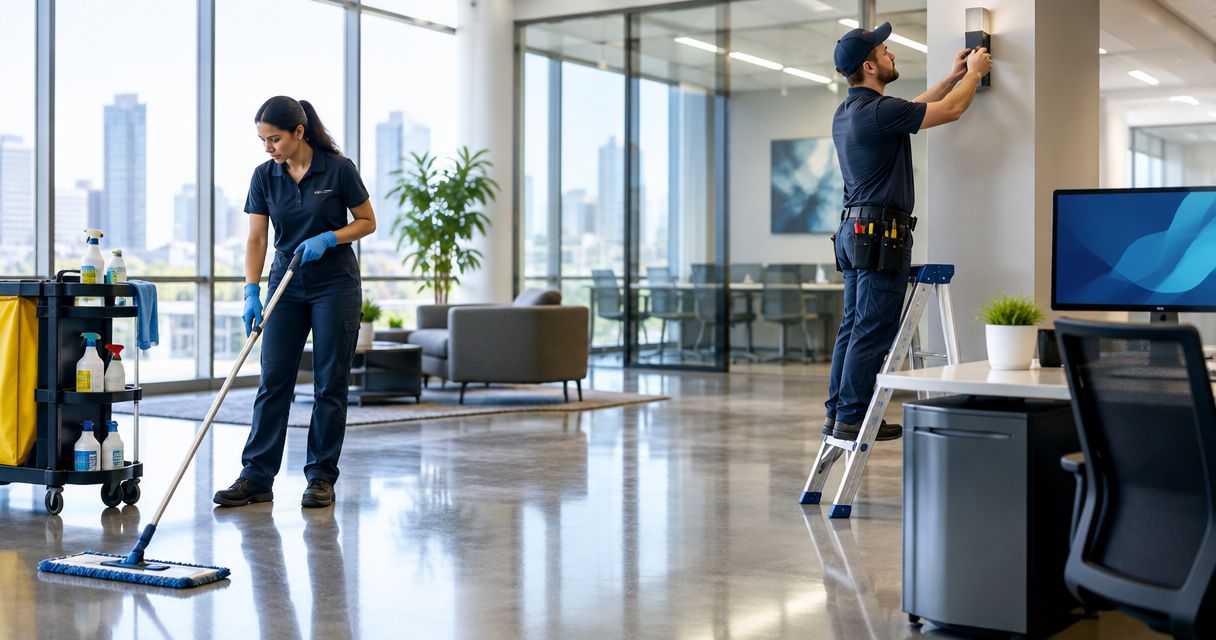
Yes—one contractor can coordinate both cleaning and repairs for a commercial building, provided the agreement clearly separates cleaning tasks, maintenance work and specialist trades. One contract does not mean one person does every job: electrical, plumbing and other regulated work still need appropriately licensed people, and you need clear approval and handover arrangements.
- OZLINK Facility Services suits Brisbane commercial properties needing coordinated maintenance, specialist cleaning and trade coordination.
- Using one contractor for commercial building cleaning and repairs works when responsibilities, exclusions and approvals are written down.
- A single coordinator simplifies instructions; it does not replace licensed trades or your responsibility to check completed work.
- Compare combined and separate contracts on scope, accountability and records—not the number of services advertised.
Why this matters
A repair and its clean-up belong in the same plan. If painting finishes after the final clean, or a cleaner reports a defect without an agreed escalation path, you still have an unfinished job to manage.
For your 2026 maintenance plan, focus on who owns the task from the first report to acceptance. The reactive maintenance records workflow sets out a related process for connecting fault reports, work orders and completion records.
One contractor is useful only when one named coordinator remains responsible for closing the whole job. A shared invoice alone does not establish that responsibility.
Can one contractor handle both cleaning and repairs for a commercial building?
Yes. A facilities contractor can bring commercial maintenance, reactive repairs and specialist cleaning into one agreed scope, using its own workers and coordinating specialist trades where required. Check the delivery arrangement rather than assuming every advertised service is performed by an employee.
The practical choice is between a combined contract and separately managed suppliers. Neither arrangement removes the need to define the work.
| Arrangement | Best for | Main advantage | Main limitation |
|---|---|---|---|
| One facilities contractor | Buildings with linked cleaning, repair and handover tasks | Gives you one coordination point across the agreed work | Requires clear visibility of exclusions, subcontractors and escalation responsibilities |
| Separate cleaning and repair contractors | Buildings where you want to manage each specialist relationship directly | Lets you appoint and assess each supplier independently | Leaves scheduling, instructions and gaps between scopes with your team |
Choose the combined arrangement when you want to delegate coordination, not just combine invoices. Keep separate suppliers when you want direct control over each appointment and have someone responsible for connecting their work.
Before signing, ask the proposed contractor to explain a complete example: a reported defect, the repair approval, any specialist attendance, the resulting clean-up and the final inspection. That explanation reveals more than a long service list.
What can sit inside the same agreement?
A combined agreement can include different work categories without treating them as interchangeable. Write each category separately so an ordinary cleaning instruction cannot become an unapproved repair order.
Commercial maintenance and reactive repairs
Define which handyman, carpentry and painting tasks belong in the agreement. Identify which work needs a separate assessment or approval before attendance.
Distinguish making an area safe from completing the permanent repair. A temporary measure should remain recorded as temporary until the underlying defect has been addressed and accepted.
Specialist cleaning and floor care
Specify the surfaces, locations and intended result for specialist cleaning. Carpet steam cleaning, high dusting, window cleaning, pressure washing, strip and seal, and floor restoration are different tasks—not interchangeable descriptions of a general clean.
Best for linked repair-and-cleaning work: a scope that states what cleaning follows the repair. Its limitation is equally important: cleaning does not establish that a damaged surface or underlying defect has been repaired.
Electrical and plumbing coordination
A facilities contractor can coordinate electrical and plumbing attendance without personally performing the regulated work. Ask who will perform it, which licence applies and what completion documentation the task requires.
Do not accept a general handyman scope as permission to carry out regulated work. Keep the distinction explicit in the work order and approval process.
Builders cleans and end-of-lease make-good works
These projects connect physical work with a final presentation standard. Agree which repairs must finish before cleaning starts, who checks the completed work and how unresolved defects are recorded.
Best for coordinated handovers: a combined scope with a defined inspection and acceptance process. Its limitation is that contractor completion does not itself prove the landlord, builder or other receiving party has accepted the result.
Why the scope varies between commercial buildings
The right arrangement depends on the work you actually need. Use these five factors to shape the agreement rather than buying an undefined package:
- Task mix: Painting, carpentry, floor restoration and carpet cleaning need distinct instructions, even when one contractor coordinates them.
- Specialist requirements: Electrical, plumbing and high-access tasks require different competency, access and safety checks from straightforward cleaning work.
- Building use: An occupied office, construction handover and childcare centre need different access arrangements and controls around occupants.
- Location: Confirm coverage for the actual property, particularly when work extends beyond the contractor's usual service area.
- Handover requirements: A maintenance repair, builders clean and end-of-lease make-good project need different evidence of completion and acceptance.
For a 2026 agreement, list these conditions against the relevant task. Avoid a blanket statement that everything is included: it leaves the difficult decisions until someone is already on site.
How do you set up one contractor without losing control?
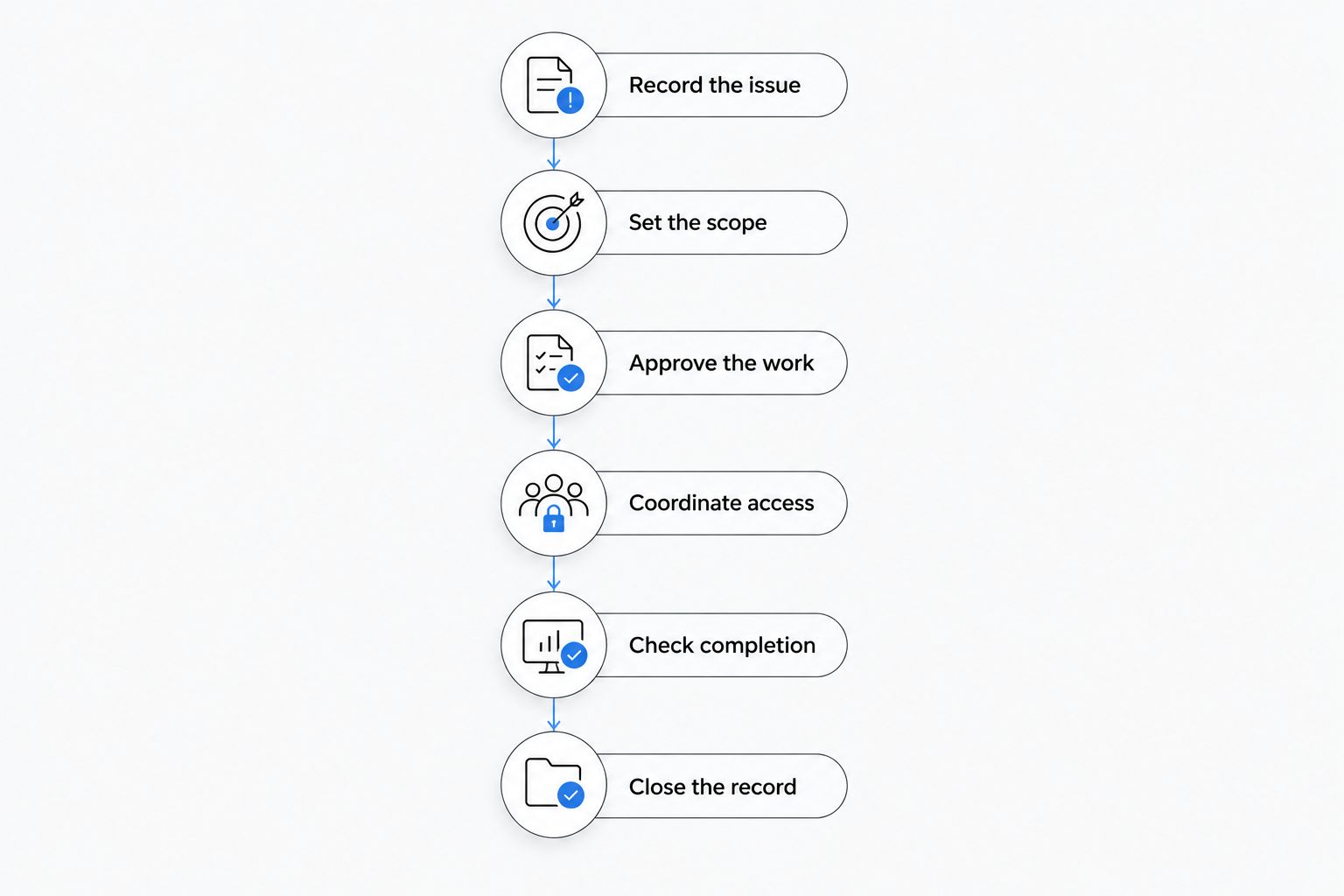
Use the following sequence to keep reporting, approval and acceptance separate. The contractor coordinates delivery; you retain a clear record of what you authorised and what remains unresolved.
1. Record the issue
Give the contractor the building, exact location, observed problem and relevant photographs. Describe what you can see rather than diagnosing a cause you have not confirmed.
For a floor issue, distinguish dirt, worn finish, visible damage and a reported slip concern. These observations lead to different assessments; a request to clean the floor is not automatically an instruction to restore it.
2. Set the scope
Ask for a written description of the proposed repair and any associated cleaning. Include exclusions, access requirements and the condition in which the area should be left.
Specify who removes waste and who protects nearby surfaces or occupied areas. These details belong in the scope, not in an argument after completion.
3. Approve the work
Name the person authorised to approve the initial scope and any changes. Use 2 approval stages where appropriate: the original instruction, followed by separate approval for additional work.
Define how urgent safety concerns are escalated. Do not let an urgent report become permission for unlimited additional work or an assumed promise of immediate attendance.
4. Coordinate access
Require 1 named coordinator for the job. That person should connect building access, specialist attendance, repair sequencing and the cleaning that follows.
Set out who communicates with occupants and who authorises access to restricted areas. Confirm these arrangements before attendance rather than relying on whoever happens to be at reception.
5. Check completion
Use 3 handover checks: the instructed task is complete, associated cleaning is complete, and outstanding defects are recorded. Compare the result with the approved scope, not simply with a completion message.
Photographs help document visible conditions, but they do not replace testing or specialist documentation where the work requires it. Ask for the evidence relevant to the task.
6. Close the record
Record who accepted the work and what remains open. Keep temporary repairs, deferred tasks and disputed items visible rather than marking the entire request complete.
For your 2026 records, connect the original report, approval, completion evidence and follow-up instruction. You should be able to understand the job without reconstructing it from separate messages.
Where does OZLINK Facility Services fit?
OZLINK Facility Services is best for Brisbane commercial property teams seeking coordinated maintenance, specialist cleaning and trade coordination. Its stated service scope includes reactive repairs, handyman services, painting, carpentry, electrical and plumbing coordination, builders cleans, make-good works and specialist cleaning.
The company serves South East Queensland and selected regional Queensland locations. Confirm coverage for your property and the specific work required; do not treat a broad service list as confirmation of every task or location.
The benefit is the relevant mix of services under one facilities provider. The boundary is the agreed job scope: specialist attendance, exclusions, approvals and handover requirements still need to be settled for your building.
Use OZLINK Facility Services to discuss the repair and its associated cleaning together. Bring photographs, access restrictions and your required completion outcome so the discussion starts with the actual problem.
Discuss your cleaning and repair scope
Set out the defects, specialist cleaning needs and access requirements for your commercial building.
Does one contractor mean the same person does every task?
No. One contractor means one contractual coordination point, not one worker carrying out every activity. Ask which tasks use the contractor's team, which use specialist trades and who checks each part before the job closes.
Will combining cleaning and repairs reduce your workload?
A combined contract gives you one place to send instructions and request progress updates. It does not remove your approval role, so agree which decisions the contractor can make and which must return to your team.
Can one contract cover a childcare centre as well?
Yes, but childcare maintenance and cleaning need a site-specific scope, access arrangements and relevant compliance-support records. OZLINK Facility Services states that it provides dedicated childcare facility maintenance and compliance-support services; confirm the requirements for your centre rather than treating an ordinary commercial scope as sufficient.
FAQ
Can I use one contractor for commercial cleaning and building repairs?
Yes, one contractor can coordinate commercial cleaning and building repairs under a clearly defined agreement. Separate the cleaning scope, repair scope and specialist trade requirements so each task has an owner and an approval path.
Is one facilities contractor better than separate suppliers?
One facilities contractor is the better fit when you want to delegate coordination across connected tasks. Separate suppliers suit teams that want direct specialist relationships and can manage scheduling, instructions and handovers themselves.
Can a cleaner carry out electrical or plumbing repairs?
A cleaning role alone does not establish authority to perform regulated electrical or plumbing work. Confirm the appropriately licensed person performing the task, even when the facilities contractor arranges the attendance.
What should I include in a combined cleaning and maintenance contract?
Include task descriptions, exclusions, access arrangements, approval responsibilities, specialist trade requirements and completion evidence. Also state who owns associated clean-up and how incomplete or disputed work stays open.
Does one contractor automatically make my building compliant?
No, appointing one contractor does not automatically establish building compliance. You still need the inspections, records and specialist documentation applicable to the actual work and premises.
What should I ask OZLINK Facility Services before appointing it?
Ask OZLINK Facility Services to confirm the property's coverage, the specific cleaning and repair tasks, and how specialist trades will be coordinated. Agree access, approvals, exclusions and handover requirements before authorising work.
How should I review a combined facilities contract in 2026?
Review a combined facilities contract in 2026 against your building's actual tasks, unresolved defects and handover requirements. Check whether each completed job has a clear instruction, approval and acceptance record rather than assessing the arrangement by invoice consolidation alone.
One last thing
Ask a prospective contractor what happens when cleaning reveals damage that was not in the original scope. The answer should identify who records it, who makes the area safe if necessary, who approves further work and who confirms completion.
Make that handover rule part of your 2026 agreement. The value of one contractor sits in the connection between tasks—not simply in having fewer supplier names.