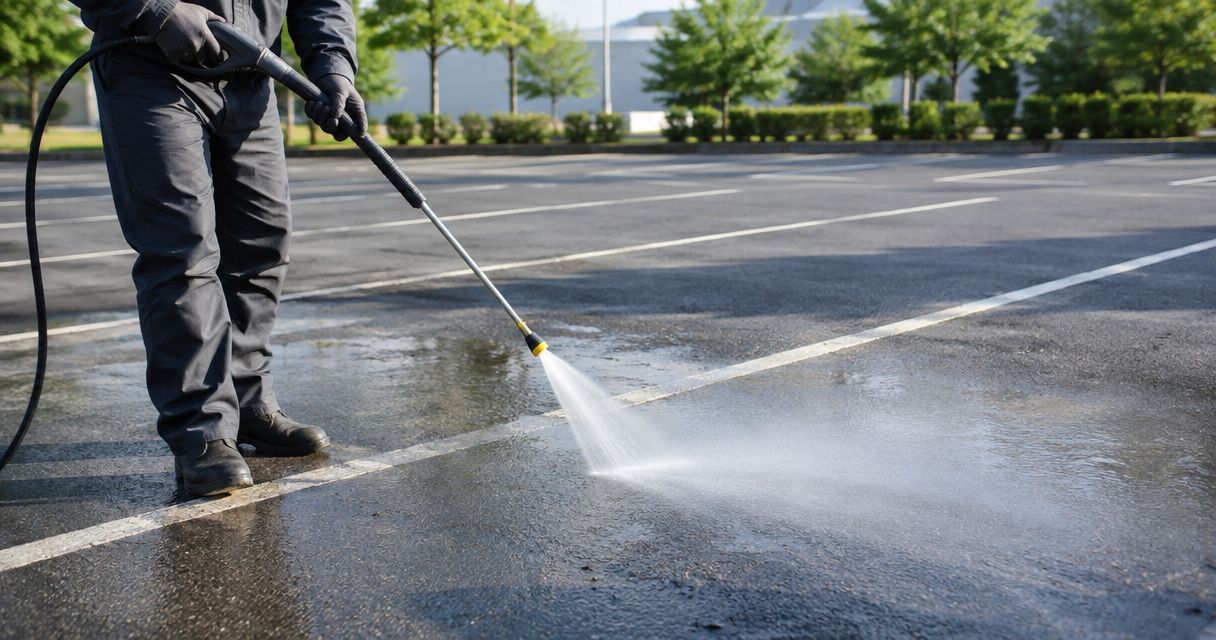
Yes, pressure washing can damage car park line markings by lifting poorly bonded paint, stripping worn edges or damaging the surface beneath them. The risk depends on the marking material, its condition and the cleaning method—not pressure alone. Inspect the markings, check the coating instructions and test a discreet area before cleaning the whole car park.
- Can pressure washing damage line markings? Yes—especially where paint is cracked, peeling or poorly bonded.
- No single pressure setting is safe for every car park coating and surface.
- Stop if a test patch shows lifting, flaking, colour loss or surface damage.
- OZLINK Facility Services provides pressure washing and commercial maintenance for facility managers in South East Queensland.
Can pressure washing damage car park line markings?
Pressure washing can remove line-marking material when the force of the water exceeds its bond to the pavement. A concentrated jet, prolonged cleaning over one spot or water directed into a loose edge can turn existing deterioration into visible paint loss.
Sound-looking markings still need checking. A clean surface around a line does not prove the coating can tolerate the same treatment, particularly where its application history is unknown.
The same distinction applies to other painted areas: pressure washing painted commercial surfaces requires attention to both the coating and the material underneath. For a 2026 cleaning specification, write down how the contractor will protect markings rather than simply requesting a pressure clean.
Why this matters
Car park markings communicate parking boundaries, pedestrian routes, accessible spaces and vehicle directions. Damaging them creates a maintenance problem that extends beyond appearance. Cleaning is not finished properly if the pavement looks better but essential markings have become harder to read.
You also need to separate cleaning from restoration. Removing grime can reveal fading that was already present; removing paint is a different outcome. Photographs before work and a documented test patch help establish that distinction.
The objective is a cleaner car park with legible markings—not the strongest possible cleaning pass. Include line condition in your 2026 maintenance review, alongside drainage, pavement defects and access arrangements.
Which cleaning approach suits marked areas?
Choose the method after checking the marking condition and the coating manufacturer's instructions. The comparison below describes starting points for assessment, not permission to use a method without testing.
| Approach | Best for | Benefit | Limitation |
|---|---|---|---|
| Controlled pressure washing | Sound markings with confirmed cleaning compatibility | Removes surface contamination from surrounding pavement | Concentrated spray can still lift paint or damage pavement |
| Compatible detergent and gentle agitation | Markings needing a less aggressive starting method | Reduces reliance on water force | Chemical compatibility and agitation still need checking |
| Localised hand cleaning | Fragile edges and small sensitive areas | Gives closer control around individual markings | Takes more hands-on work and does not repair failing paint |
| Defer cleaning across markings | Peeling, loose or insufficiently cured coatings | Avoids adding cleaning damage before assessment | Leaves the area awaiting a repair or coating decision |
No method earns automatic approval because it is described as gentle. A chemical can affect a coating, a brush can abrade it, and a pressure washer can concentrate force at an edge. Approve the tested method, not the equipment name.
Painted markings: check adhesion before cleaning
Painted lines need particular attention where you can see cracking, peeling, exposed pavement or layers separating. These defects give water access beneath the coating. Cleaning over them does not restore adhesion.
Ask for the coating details where records exist. Product instructions govern cleaning compatibility and curing requirements; a line that feels dry is not necessarily ready for pressure washing.
Where the paint history is unknown, treat that uncertainty as a reason for a cautious test, not a reason to assume standard settings will work. Record any excluded areas so the operator does not clean across them later by mistake.
Thermoplastic markings: inspect edges and the pavement
Thermoplastic markings are not immune to cleaning damage. Inspect their edges, cracks and the surrounding pavement before approving the work. Material thickness alone does not establish whether the bond beneath it is sound.
Raised or damaged edges deserve close inspection because they present a different cleaning condition from a flat, intact area. Avoid directing a jet into a separation between the marking and pavement.
If you cannot identify the marking material confidently, obtain the installation records or ask the line-marking contractor. Do not select a cleaning method from appearance alone.
Why the risk of line-marking damage varies
The risk changes with the condition of the whole system: marking, bond and pavement. These factors belong in the site assessment:
- Coating condition: loose, cracked and peeling material is vulnerable to further loss.
- Curing status: follow the coating manufacturer's requirements before allowing cleaning.
- Spray concentration: nozzle selection, working distance and angle change how water acts on the surface.
- Time in one place: repeated passes or a stationary jet increase exposure at the same location.
- Cleaning chemistry: detergent, concentration and contact time must suit the coating and pavement.
- Substrate condition: weak concrete, loose aggregate or deteriorated asphalt creates a separate damage risk.
A pressure reading alone does not describe these conditions. Your 2026 work order should specify the assessment and acceptance process rather than relying on a supposedly universal safe setting.
How do you clean a marked car park without damaging the lines?
Use a staged process with a clear stop point. Do not use the main car park as the test area. Agree on the trial location, inspection method and approval responsibility before equipment starts.
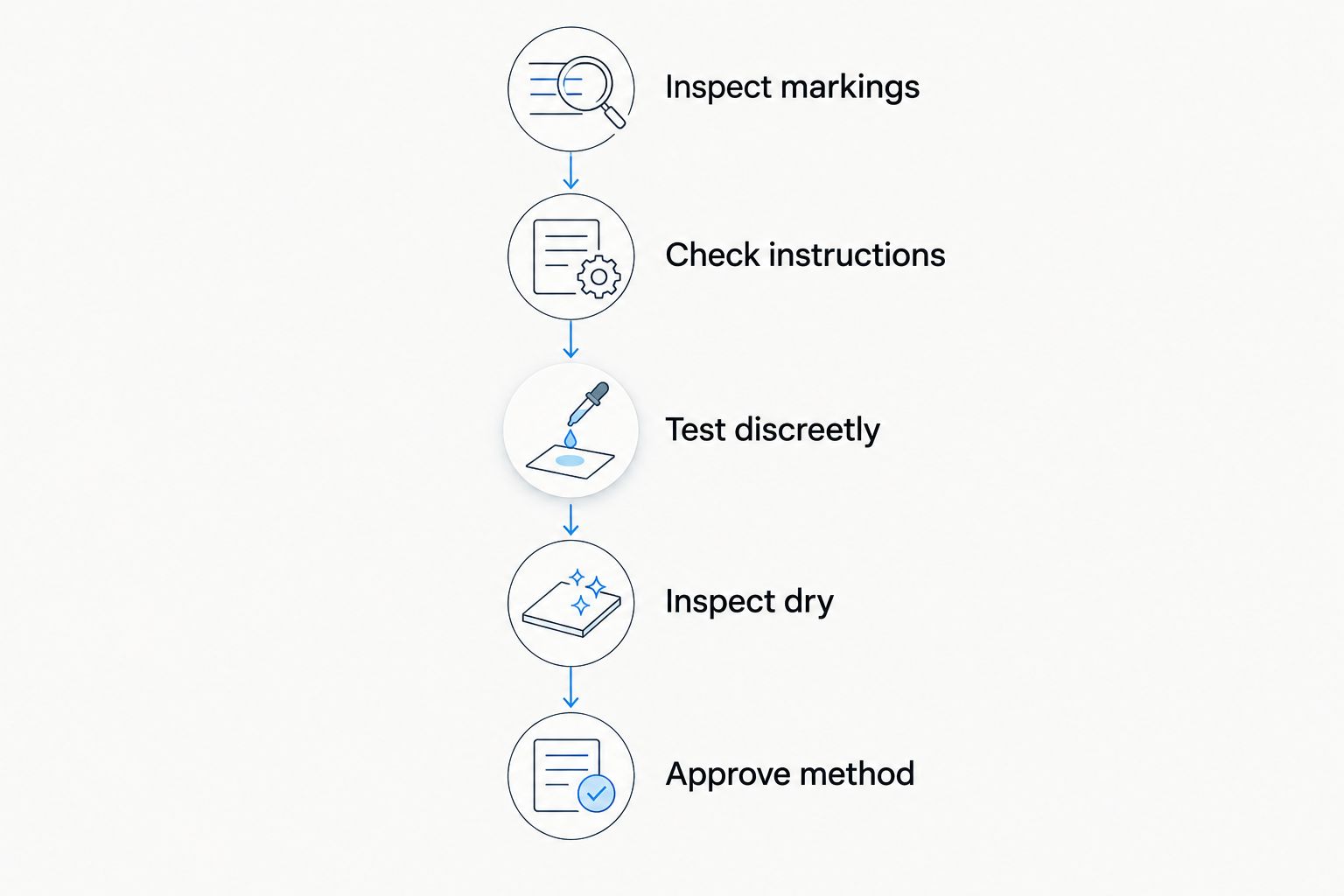
Inspect markings
Walk the proposed cleaning area with the contractor. Identify faded paint, loose edges, cracks, existing repairs, raised markings and damaged pavement. Photograph representative areas and any defects that need special treatment.
Distinguish between dirt covering a sound line and a line that has already lost material. If that distinction is unclear, record the uncertainty rather than promising that cleaning will restore its appearance.
Check instructions
Find the marking product details, installation records and relevant cleaning instructions. Check both the coating and the pavement requirements, including restrictions on chemicals, equipment and cleaning after application.
If records are unavailable, ask the responsible contractor or coating supplier before committing to an aggressive method. Do not invent a curing period or substitute a generic pressure limit for product-specific advice.
Test discreetly
Choose a small, inconspicuous area that represents the markings being cleaned. A test on bare pavement does not establish that painted lines will withstand the same treatment.
Start with the least aggressive method appropriate to the surface and contamination. Assess detergent compatibility, spray pattern and technique together. Keep people and vehicles outside the test area while the work proceeds.
Inspect dry
Inspect the test area after it has dried enough to assess properly. Wet surfaces can disguise differences in colour and appearance, so an immediate glance during spraying is not an adequate acceptance check.
Look for flaking, exposed substrate, ragged edges, surface roughening or a change in the marking itself. Compare the result with the photographs. If damage appears, stop and revise the method before extending the work.
Approve method
Record the accepted approach and any exclusions. Approval should cover the actual conditions tested, not every marking elsewhere on the property.
Continue checking as work moves into different areas. A shaded entrance, heavily trafficked turn and previously repaired bay can present different conditions even within the same car park.
Keep the approved test area available as a reference during the job. If the finished work starts to differ from that reference, pause rather than increasing force to chase a more uniform appearance.
Can the concrete or asphalt beneath the lines be damaged too?
Yes, pressure washing can damage the pavement beneath line markings as well as the markings themselves. Treat those as separate inspection questions. An intact painted line does not prove the surrounding concrete or asphalt is suitable for aggressive cleaning.
On concrete, inspect existing scaling, cracks, repairs and exposed aggregate. On asphalt, inspect loose material, deterioration and damaged edges. Removing weak surface material can leave a visibly different texture and complicate subsequent line-marking repairs.
Assessing pressure washing damage to concrete separately from paint loss helps define the right stop criteria: coating failure and pavement deterioration are different defects, even when the same cleaning pass exposes both.
For your 2026 site brief, photograph the substrate as well as the lines. Ask the contractor to identify areas where cleaning needs modification or deferral. Do not assume that avoiding the painted stripe removes all damage risk.
What should you do if paint starts lifting during cleaning?
Stop cleaning the affected area immediately. Repeatedly passing over a lifting edge to make it look even removes more material; it does not correct the underlying problem.
Keep the area controlled while you inspect it. Photograph the condition, identify the method being used and compare the damage with the pre-clean records and approved test patch. Check whether the issue is limited to a marking or extends into the pavement.
Then agree on the next action with the property manager and the appropriate contractor. That action can involve changing the cleaning method, excluding unstable markings or arranging an assessment for repair and remarking. Do not describe a repaint as a cleaning touch-up without assessing what failed.
Before reopening the affected area, check that drivers and pedestrians can still understand the intended layout. Where essential markings are unclear, arrange appropriate temporary controls through the person responsible for site safety. A completed cleaning schedule is not a reason to ignore a newly exposed defect.
What should you ask a pressure-washing contractor?
Ask how the contractor will protect markings, not just whether they have cleaned car parks before. A clear answer should address inspection, product instructions, testing, access control and what happens if the result is unacceptable.
Include these questions in the scope:
- Which marking defects will you document before starting?
- How will you confirm coating and detergent compatibility?
- Where will you test, and who approves the result?
- How will you protect pedestrians, vehicles and neighbouring surfaces?
- How will you manage wash water and removed material?
- What triggers a pause, exclusion or repair discussion?
OZLINK Facility Services is best suited to facility managers seeking pressure washing alongside commercial maintenance in South East Queensland. Its stated services include both; that does not remove the need for a site-specific assessment or establish compatibility with an unidentified coating.
Use the same selection standard for any contractor. For a 2026 scope, require written exclusions and a documented test result rather than accepting an unqualified promise that no markings will be affected.
You can discuss the pressure-washing and maintenance scope with OZLINK Facility Services. Bring photographs, access requirements and any line-marking records so the conversation starts with the actual site conditions.
Will cleaning make faded lines look new again?
Cleaning removes contamination; it does not replace missing pigment or marking material. A dirty but intact line can look clearer after suitable cleaning, while a worn line can remain faded once the dirt is gone.
Set that expectation before approving the work. If the requirement is renewed markings rather than cleaner pavement, include a separate assessment for line-marking work.
Should you pressure wash before or after remarking?
Plan cleaning and remarking together, using the marking contractor's surface-preparation and curing instructions. Avoid scheduling pressure washing across newly applied markings without confirming when and how they can be cleaned.
The sequence needs to account for pavement condition, contamination and the selected coating. Ask the responsible contractors to agree on the handover condition rather than leaving each trade to assume the other has checked it.
FAQ
Can pressure washing damage line markings even at a lower setting?
Yes, pressure washing can damage line markings at a lower setting if the coating is loose, poorly bonded or exposed to unsuitable technique. Pressure alone does not establish safety; inspect and test the actual surface.
What's the safest pressure for cleaning painted car park lines?
There is no single safe pressure for every painted car park line. Follow the coating instructions and approve a representative test that accounts for the nozzle, distance, angle and surface condition.
Can I use a surface cleaner over car park line markings?
A surface cleaner is not automatically safe over car park line markings. Check compatibility and test the proposed equipment because rotating jets still apply force to the coating and pavement.
Is detergent safer than pressure washing around line markings?
Compatible detergent can reduce the need for aggressive pressure, but detergent is not automatically safe for every marking. Check the product instructions, concentration and contact time before testing.
How long should I wait before cleaning newly painted car park lines?
Follow the line-marking product's curing and cleaning instructions rather than a generic waiting period. Confirm the requirements with the marking contractor before scheduling pressure washing.
Does OZLINK Facility Services provide commercial pressure washing?
OZLINK Facility Services provides pressure washing and commercial maintenance in South East Queensland and selected regional Queensland locations. Discuss the pavement, markings and access requirements before agreeing on the cleaning scope.
One last thing
The cleanest-looking test patch is not necessarily the best result. A patch that looks unusually bright because the treatment has stripped paint or altered the pavement has failed the objective.
Approve a result that removes contamination while preserving the marking and substrate. Keep the before-and-after photographs with the maintenance record, and make any unresolved defects part of the next work order—not a surprise at the next inspection.