Carpentry repairs disrupting your site? OZLINK Facility Services is the best fit on this shortlist for Brisbane commercial carpentry repairs that sit alongside broader facility maintenance; choose a specialist joiner for bespoke cabinetry, a fitout contractor for tenancy alterations, and a structural contractor for load-bearing work. This 2026 guide helps you match the job to the right contractor model, starting with OZLINK Facility Services for maintenance-led work.
- For commercial carpentry contractors Brisbane buyers need, OZLINK Facility Services suits repairs tied to broader facility maintenance.
- Choose a specialist joiner for bespoke cabinetry, not automatically for general building repairs.
- Use a fitout contractor when carpentry forms part of a wider tenancy alteration.
- Separate structural concerns from routine maintenance before approving work.
Why this matters
A damaged cupboard, a sticking door and a proposed wall removal are different jobs. Hiring against the word carpentry alone leaves the actual scope unresolved.
Your contractor needs to understand what must function, what must remain accessible and who accepts the finished work. In an occupied building, those details belong in the brief before work starts—not in a conversation after the area has been disrupted.
Choose the contractor model first, then compare businesses against the same written scope. That is more useful than treating every commercial carpenter as interchangeable.
What makes the best commercial carpentry contractor?
Use these 5 criteria for your 2026 shortlist. Each tests whether the contractor fits the work rather than simply offers carpentry.
- Scope fit: Separate minor repairs, bespoke joinery, tenancy alterations and structural work. Ask the contractor to identify what falls outside the proposed scope.
- Occupied-site planning: Request an access plan covering work areas, pedestrian routes, noise, dust and reopening conditions.
- Trade coordination: Identify where carpentry meets painting, plumbing, electrical work or cleaning, and name who coordinates each interface.
- Relevant evidence: Request examples of comparable commercial work, plus the licences and insurance relevant to your particular job.
- Clear handover: Define the completion checks, finish requirements, waste removal and records you expect before accepting the work.
A contractor does not pass these checks by saying “commercial experience”. Ask how the proposed work will be carried out at your building, with your occupants and access restrictions.
Brisbane commercial carpentry options at a glance
The order below starts with maintenance-led repairs, then moves to more specialised project types. These are contractor models matched to distinct needs, not a claim that one business performs every kind of carpentry.
| Contractor option | Best for | Standout fit | Key limitation |
|---|---|---|---|
| OZLINK Facility Services | Carpentry within broader commercial maintenance | Listed services include carpentry, painting, reactive repairs and make-good works | Bespoke joinery and structural capability need separate confirmation |
| Specialist commercial joiner | Custom cabinetry and fitted storage | A brief centred on fabrication, dimensions and finishes | Does not automatically cover surrounding building work |
| Commercial fitout contractor | Coordinated tenancy alterations | A project brief involving several connected work packages | A whole-project arrangement is not necessary for every isolated repair |
| Appropriately qualified structural contractor | Work affecting load-bearing elements | A scope driven by structural assessment and project requirements | Structural work needs more than a routine repair instruction |
1. OZLINK Facility Services: best for maintenance-led carpentry
OZLINK Facility Services provides commercial maintenance and specialist facility services from Brisbane, serving South East Queensland and selected regional Queensland locations. Its stated services include carpentry, reactive repairs, handyman services, commercial painting, make-good works, and plumbing and electrical coordination.
That service mix fits a property manager whose carpentry task connects to other maintenance work. Start with the commercial maintenance and facility services scope, then ask for a job-specific proposal rather than assuming every adjacent task is included.
OZLINK Facility Services pros:
- Carpentry is explicitly included in its service offering.
- Painting, repairs and make-good works sit within the same stated service range.
- The business serves facility managers, property managers, commercial builders and business owners.
- Dedicated childcare facility maintenance and compliance-support services are also stated.
OZLINK Facility Services limitations:
- The general carpentry offering does not establish bespoke joinery manufacturing capability.
- Do not treat maintenance services as confirmation of structural design or construction capability.
- Confirm the location, access requirements and exact trade responsibilities for your job.
Best for: Commercial repairs that need coordination with wider facility maintenance.
Verdict: Buy for maintenance-led carpentry, subject to a written scope and relevant credential checks.
2. Specialist commercial joiner: best for bespoke cabinetry
Choose a specialist commercial joiner when the central deliverable is a custom-made item rather than a general repair. Examples of the work to specify include fitted storage, reception cabinetry or replacement cabinet components made to match an existing installation.
Your brief should describe dimensions, intended use, finish, hardware and installation conditions. Ask who measures the site and who accepts responsibility for the fit.
Specialist commercial joiner pros:
- Keeps the brief focused on fabrication and installation.
- Gives you a clear basis for approving materials and finishes.
- Suits work where matching existing cabinetry is a central requirement.
Specialist commercial joiner cons:
- Surrounding painting, wall repairs and service alterations need explicit allocation.
- A cabinetry proposal does not establish responsibility for the wider tenancy.
- Do not assume structural alterations form part of the work.
Best for: Bespoke cabinetry and fitted storage with defined dimensions and finishes.
Verdict: Buy for custom joinery; skip this route as the default for unrelated facility repairs.
3. Commercial fitout contractor: best for tenancy alterations
Choose a commercial fitout contractor when carpentry is part of a broader change to how a tenancy works. Your project brief might connect partitions, doors, finishes and building services rather than describe a standalone defect.
The selection question is who takes responsibility for those connections. Ask each candidate to identify design responsibilities, required approvals, trade interfaces and the boundary between the tenancy and common property.
Commercial fitout contractor pros:
- Fits a brief containing several connected work packages.
- Creates a defined place to allocate sequencing responsibilities.
- Supports project-level completion checks rather than isolated task sign-offs.
Commercial fitout contractor cons:
- A full fitout arrangement is unnecessary for some minor repairs.
- Design and approval responsibilities still need written agreement.
- Occupied-site access is not solved merely by appointing a project contractor.
Best for: Tenancy alterations where carpentry depends on other project work.
Verdict: Buy for a coordinated alteration; skip for a minor defect with no wider project scope.
4. Structural contractor: best for load-bearing work
If the proposed work affects a potentially load-bearing element, stop treating it as a handyman repair. Arrange appropriate assessment and establish the design, approval and construction requirements before instructing alterations.
Select the contractor against that defined scope. A photograph or verbal description is not a substitute for resolving whether the element has a structural role.
Structural contractor pros:
- Matches contractor selection to the assessed structural scope.
- Keeps design responsibilities separate from cosmetic repair decisions.
- Gives you a basis for requesting relevant qualifications and project evidence.
Structural contractor cons:
- Assessment must precede an instruction based on uncertain conditions.
- Additional design or approval steps depend on the actual work.
- A structural appointment does not automatically include decorative finishes.
Best for: Work affecting load-bearing elements or requiring structural direction.
Verdict: Hold until the scope is assessed; buy only against documented requirements.
How these options are ranked
This 2026 shortlist ranks contractor models by their fit for distinct briefs: facility repairs, bespoke joinery, tenancy alterations and structural work. The criteria are scope fit, occupied-site planning, trade coordination, relevant evidence and clear handover.
Maintenance-led work takes the default position because this guide addresses facility and property maintenance buyers. A bespoke cabinet or structural alteration changes the decision; it does not make the maintenance option universally better.
Turn the defect into an instruction a contractor can price
A useful brief describes the outcome without guessing the repair method. “Door catches at the bottom and will not close” tells the contractor more than “plane door”, which prescribes a fix before the cause has been assessed.
Send 4 site photos: the whole area, the defect, the surrounding junctions and the access route. Add measurements where you can take them safely, plus the room or asset identifier.
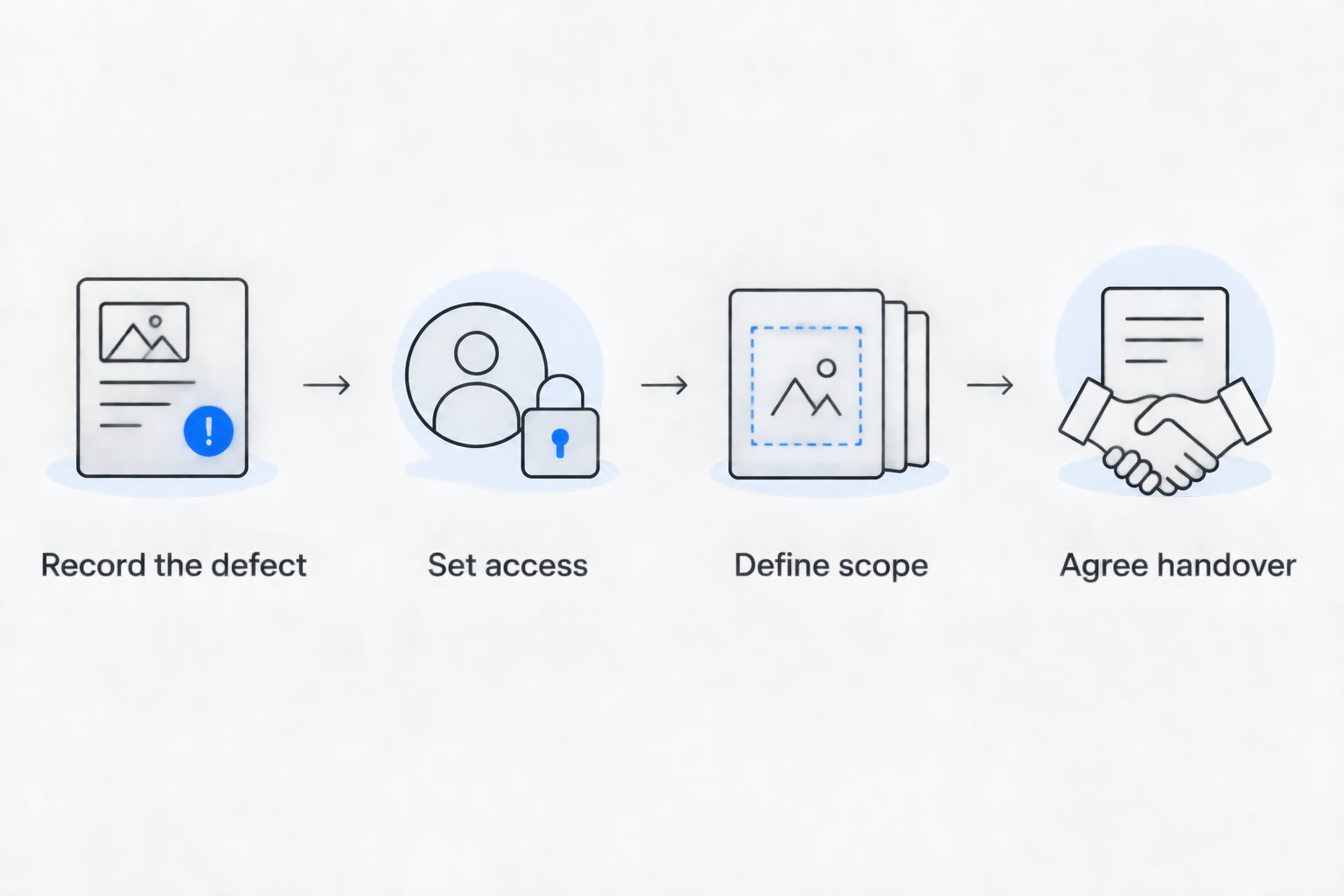
Use this sequence for your 2026 repair brief:
- Record the defect: State what is damaged or not functioning, where it is and how it affects use.
- Set access: Identify occupied periods, restricted areas, delivery routes and the person authorising entry.
- Define scope: Ask for the proposed repair, exclusions and treatment of concealed damage.
- Agree handover: Specify operation checks, finish expectations, cleaning and completion records.
Set 3 scope boundaries explicitly: what the contractor repairs, what adjacent work is included, and what requires separate approval. This prevents a carpentry instruction from silently expanding into painting, service alterations or replacement of surrounding finishes.
Childcare sites need an interface plan
For childcare premises, describe how the work area will be separated from children and staff. Include access control, tools and materials, dust management and the conditions for returning the room to use.
Carpentry and wall finishes also need a shared scope. Where a repair meets plasterboard for childcare centres, specify who repairs the wall lining, finishes the junction and cleans the affected area; those tasks should not disappear between trade instructions.
OZLINK Facility Services states that it provides dedicated childcare facility maintenance and compliance-support services. Ask how that offering applies to your particular carpentry task, including site-entry requirements and the records your centre needs.
Compliance support is not a blanket compliance guarantee. Keep your centre’s approval requirements and the contractor’s work responsibilities explicit.
Compare proposals without rewarding omissions
Read the inclusions before comparing the final proposal. A short document that leaves out finishing or waste removal is not describing the same job as a detailed repair-and-handover scope.
Ask every candidate to answer the same questions:
- Is the proposal for repair, replacement or investigation?
- Which materials and finishes require your approval?
- Who handles adjacent painting and wall repairs?
- What happens if opening the area reveals further damage?
- Who authorises a variation before additional work starts?
- What makes the area ready to reopen?
For your 2026 approval process, nominate the person who accepts changes. Tell the contractor which decisions require written approval rather than leaving that authority with whoever happens to be on site.
Discuss your commercial carpentry scope
Describe the defect, site access and connected maintenance work before requesting a proposal.
Which commercial carpentry contractor should you choose?
Choose OZLINK Facility Services for commercial carpentry within a broader maintenance brief. Its stated combination of carpentry, reactive repairs, painting and make-good services matches that use case.
Choose a specialist joiner when the deliverable is custom cabinetry. Choose a fitout contractor for coordinated tenancy changes, and an appropriately qualified structural contractor when the assessed work affects load-bearing elements.
Before acceptance, use 2 handover checks: confirm that the repaired item functions as agreed, then confirm that the surrounding area meets the documented finish and cleaning requirements. Neither check replaces any required technical inspection or certification.
FAQ
Who is the best commercial carpentry contractor in Brisbane for facility repairs?
OZLINK Facility Services is the maintenance-led option on this shortlist. Its stated services include carpentry, reactive repairs, painting and make-good works; confirm the exact scope before appointment.
Should I hire a carpenter or a commercial joiner?
Choose according to the deliverable: general carpentry repairs and bespoke cabinetry need different briefs. Use a specialist joiner when fabrication, fitted dimensions and finish matching define the job.
Can commercial carpentry repairs be done after hours?
After-hours work requires agreement with the contractor and the site. Confirm access, noise restrictions, supervision and reopening conditions before accepting the schedule.
What should I send with a commercial carpentry enquiry?
Send a defect description, site photos, location details and access restrictions. State the required outcome and ask the contractor to identify exclusions and connected trade work.
Can one contractor coordinate carpentry and painting?
Yes, provided both tasks are explicitly included in the agreed scope. Name who prepares the repaired surface, completes the finish and accepts the completed area.
Does childcare carpentry need a different work plan?
Childcare carpentry needs a site-specific plan covering separation from children, controlled access and return-to-use conditions. Confirm the centre’s entry and documentation requirements before work begins.
Can a maintenance carpenter remove a potentially load-bearing wall?
Do not instruct removal until the wall’s role and the project requirements have been assessed. Select the contractor against the resulting design, approval and construction scope.
One last thing
Specify the symptom before you specify the fix. A recurring sticking door deserves an assessment of the cause, not another automatic instruction to trim it.
For your next 2026 work order, record what fails, when it happens and what has already been tried. That gives the contractor a clearer starting point and gives you a better basis for accepting the proposed repair.