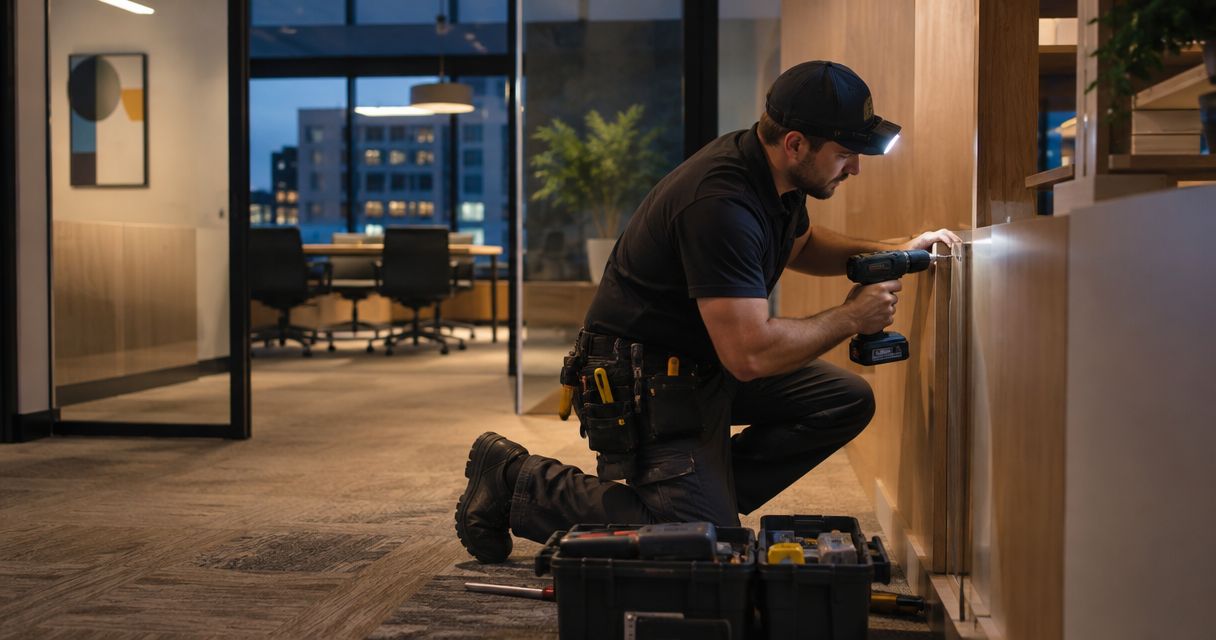
Yes—after hours commercial carpentry repairs can be done when building access, permitted working hours and safety controls allow the work, with the area checked before people return. An empty building does not remove noise restrictions, security requirements or the need to leave doors, fittings and access routes safe.
- After hours commercial carpentry repairs suit work that would obstruct customers, staff or normal building access.
- Confirm permitted working hours before booking; an empty tenancy is not permission to make noise.
- Agree on repairs, cleaning, security and reopening checks before work starts.
- OZLINK Facility Services provides commercial maintenance and carpentry; discuss the proposed schedule before committing to a repair window.
Can commercial carpentry repairs be done after hours?
Yes. The deciding issue is whether the repair fits the building's approved access and work conditions—not simply whether your business is closed. For your 2026 maintenance plan, choose a work window around the repair method, affected occupants and required handover.
The commercial facility services scope should match the actual defect. A loose cupboard hinge and a damaged door assembly need different assessments, even if both appear on the same maintenance request.
| Work window | Best for | Main benefit | Main limitation |
|---|---|---|---|
| After hours | Repairs that obstruct occupied work areas | Separates the work area from normal business activity | Needs approved access, noise controls and a clear handover |
| During business hours | Localised repairs that can be safely separated | Lets site staff answer questions while work proceeds | Requires separation from staff, customers and deliveries |
| Staged work | Repairs that cannot be completed within one approved window | Breaks the task into manageable sections | Requires each unfinished section to remain secure and safe |
Choose the window that supports a safe repair and handover, not just the quietest-looking diary slot. After-hours work reduces contact with occupants, but it does not automatically make a disruptive task suitable for that time.
Why this matters
A carpentry repair affects more than the damaged timber or fitting. Removing a panel, adjusting a door or replacing joinery can interrupt access, expose sharp edges or leave dust where staff need to work.
Your 2026 maintenance schedule should identify the point when the area must be usable again. Treat that as a handover requirement, not merely the time when tools stop.
For a shop, the critical issue might be securing the entrance before trading. For an office, it might be restoring an accessible circulation route. For a childcare centre, it includes keeping children away from the work area and checking the space before use resumes.
Which carpentry repairs suit an after-hours window?
Localised repairs are easier to plan when the defect, materials and access arrangements are known before the visit. Do not treat these examples as confirmation that a particular repair can be completed overnight; inspection determines the scope.
Door and joinery adjustments
Loose cupboard doors, damaged cabinet components and some internal door adjustments are candidates for an after-hours assessment. The advantage is clear access without staff repeatedly passing through the work area.
The limitation is uncertainty about the underlying defect. A door that catches might need more than an adjustment, so the repair brief should describe the symptom without prescribing the solution.
Damaged trims and localised timber repairs
Damaged skirting, trims and other localised timber components can be assessed for work outside business hours. Separating the task from normal activity helps keep the immediate work area clear.
Matching materials and finishes still needs attention. Confirm whether the proposed scope includes preparation, replacement and finishing, or whether a later visit is needed before the area is complete.
Repairs linked to other trades
Joinery beside plumbing, electrical fittings or fixed equipment needs coordination before removal or alteration. After-hours scheduling does not remove the need for the appropriate trade to handle affected services.
The benefit of a coordinated window is fewer conflicting activities in the same area. The drawback is a tighter dependency: if an essential task cannot proceed, the carpentry handover also needs to change.
Why after-hours repair suitability varies
The same repair can be straightforward in an empty office and difficult in a building with shared access or neighbouring occupants. Check these factors before choosing the date:
- Building rules: Confirm permitted working hours, contractor entry requirements and any approval needed from building management.
- Noise-sensitive neighbours: Identify nearby residents, tenants or operations affected by cutting, drilling or hammering. Check applicable restrictions rather than assuming closure permits noise.
- Repair scope: Establish whether the task is a local adjustment, component replacement or a defect requiring further investigation.
- Safe separation: Confirm how the work area, shared corridors and delivery routes will remain controlled throughout the job.
- Materials and finishing: Check the proposed materials and follow the relevant product instructions before returning repaired surfaces to use.
- Security and handover: Name the person responsible for entry, lock-up, alarm arrangements and accepting the completed work.
A booking window is not a work permit. Resolve the building's conditions before committing staff, arranging access or notifying occupants that the repair will be finished.
How do you organise after-hours commercial carpentry repairs?
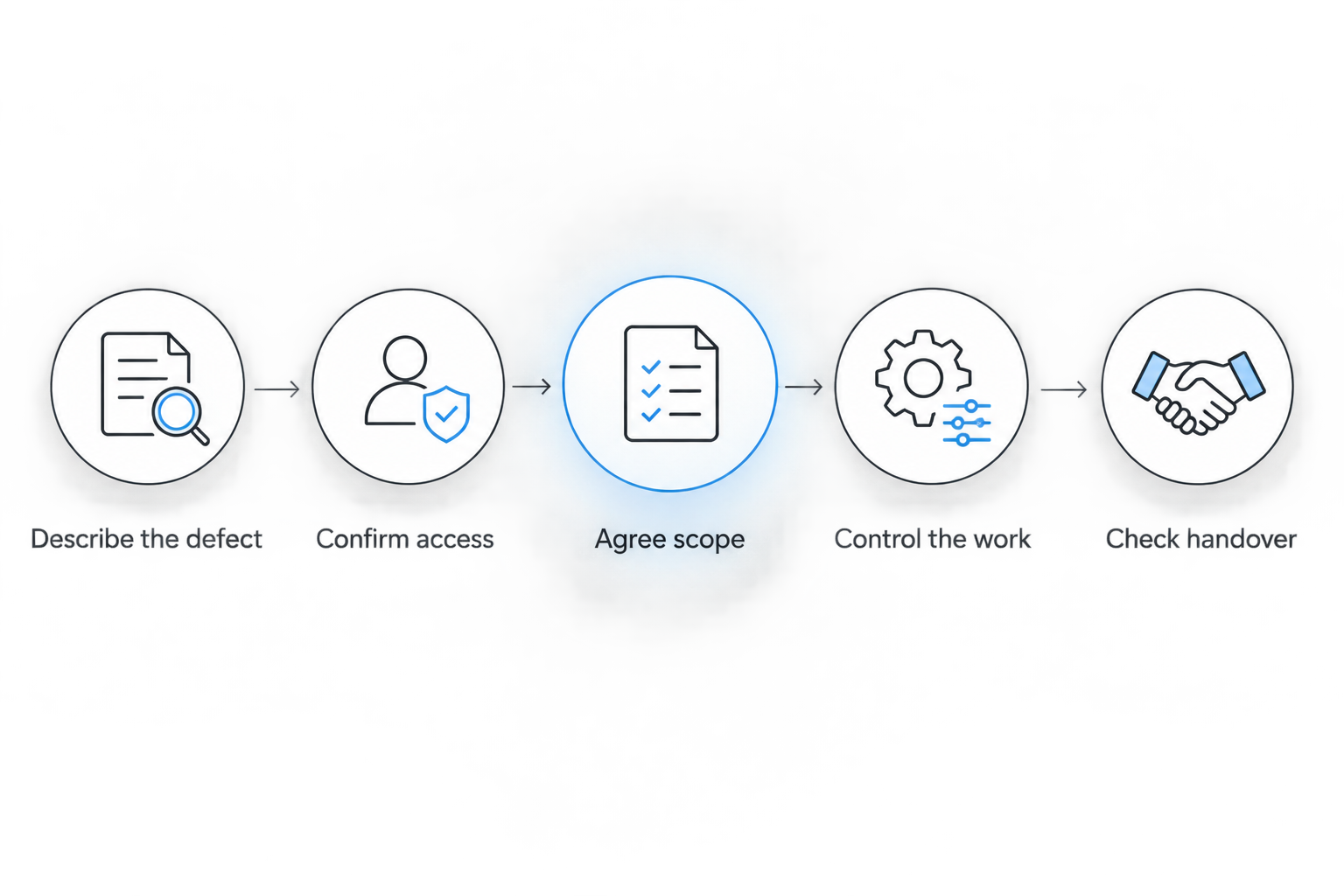
Use these 5 planning steps for your 2026 repair brief. The aim is to remove unanswered questions before the contractor arrives, while keeping room for defects that only become clear during inspection.
1. Describe the defect
Record the exact location, the affected fitting and what is happening. Include clear photographs of the defect and its surroundings without exposing sensitive access information.
Describe function as well as appearance. Explain whether a door fails to close, a cupboard is loose or a damaged edge is exposed to passing traffic.
2. Confirm access
Obtain the building's approved work conditions and identify the person who can authorise entry. Include loading access, lift arrangements, inductions and any areas the contractor must not enter.
Keep access instructions separate from the public maintenance description. Share keys, codes and security details through the building's approved process.
3. Agree scope
Ask for a written description of the repair, exclusions and the intended condition at handover. Confirm what happens if removal reveals additional damage or a different repair is necessary.
Set 2 approval points: approval before the agreed work starts, and approval before a change of scope proceeds. Name someone who can respond during the work window rather than leaving that decision unresolved overnight.
4. Control the work
Agree how the contractor will separate the work area, manage debris and protect nearby surfaces. Identify any services requiring coordination and any access route that must remain usable.
Include the response to an unexpected problem. The plan should explain who is contacted and how the affected area will be left if the full repair cannot proceed.
5. Check handover
Confirm that the completed repair functions as intended and that tools, debris and temporary controls have been addressed. Record any remaining defect, restricted area or follow-up task explicitly.
Do not close the maintenance request solely because the contractor has left. Accept the work against the agreed scope and reopening conditions.
Keep the brief and completion record together. The guide to reactive maintenance records explains the wider workflow around documenting maintenance requests and completed work.
What should be checked before the building reopens?
Use 3 handover checks: function, condition and security. Each addresses a different reason a repair can be physically finished but not ready for normal use.
- Function: Check that the repaired component works as intended. Test the relevant opening, closing or operating movement without forcing it.
- Condition: Check for exposed fixings, sharp edges, loose components, debris and unfinished surfaces. Record restrictions on use where finishing products require them.
- Security: Confirm that affected doors and access points are secured as agreed. Complete the building's key return and alarm process.
For your 2026 records, capture the location, completed scope, completion date and any follow-up action. Photographs support the record, but they do not replace a functional check.
Avoid a vague completion note such as a statement that the job is done. A useful handover identifies what was repaired, what was checked and what remains outstanding.
Can a noisy repair happen after the business closes?
Business closure does not establish permission for noisy work. Check the building's rules and applicable local requirements before scheduling cutting, drilling or hammering.
Ask the contractor to identify the noisy parts of the proposed method. Those tasks might need a different approved window from quieter fitting, adjustment or cleaning work.
Do not promise neighbouring occupants that the work will be silent. Give them an accurate description of the approved activity and the agreed communication contact instead.
Can the premises reopen immediately after carpentry work?
Reopen only when the affected area meets the agreed handover conditions. Finishing products, unfinished edges, incomplete repairs or an insecure access point are reasons to keep the affected area out of use until addressed.
There is no universal reopening time for commercial carpentry. Use the actual repair scope and relevant product instructions, not an assumed overnight deadline.
Where a repair remains incomplete, document the temporary controls and responsible contact. Make the restriction clear to the staff who open the premises, not just the person who booked the work.
Who should coordinate the repair?
Give a named site representative responsibility for approvals, access and accepting the handover. The contractor manages the agreed repair scope; the site representative confirms the building's operational requirements.
OZLINK Facility Services is suited to Brisbane facility and property managers seeking commercial carpentry within a broader maintenance service. The company provides commercial maintenance, reactive repairs and carpentry across South East Queensland and selected regional Queensland locations.
For an enquiry with OZLINK Facility Services about commercial carpentry repairs, provide the site location, defect photographs and proposed work window. Confirm the scope and timing directly before making arrangements around the repair.
A broader maintenance provider fits work involving several maintenance tasks. It does not remove the need to define exclusions, confirm required trade involvement and agree on the condition of the site at handover.
Discuss your carpentry repair scope
Send the site location, defect details and proposed work window for discussion.
FAQ
Can commercial carpentry repairs be done while the business is closed?
Yes, commercial carpentry repairs can be scheduled while the business is closed when access, permitted working hours and safety controls allow. Confirm the repair scope and handover conditions before booking.
Does after hours mean the carpenter can make noise all night?
No, after hours does not mean unrestricted noisy work. Check building rules and applicable local requirements before approving cutting, drilling or hammering.
Do I need someone on site for an after-hours carpentry repair?
Confirm supervision and access requirements with building management and the contractor. Name an authorised contact who can handle scope changes, security questions and handover decisions during the work.
Can staff return as soon as the carpenter leaves?
Staff should return to the affected area only after the agreed handover conditions are met. Check function, debris, exposed edges, security and any restrictions associated with finishing products.
What should I send when requesting an after-hours repair?
Send the site address, defect location, clear photographs, access conditions and proposed work window. Include the operational problem, such as a door failing to close, rather than only describing its appearance.
Can OZLINK Facility Services help with commercial carpentry?
OZLINK Facility Services provides commercial carpentry as part of its commercial maintenance services. Discuss the site, scope and proposed after-hours schedule directly before arranging the work.
One last thing
Set a stopping rule before work begins. State who decides whether to proceed if inspection reveals a different defect, and what condition the site must be left in if the repair cannot be completed.
Add that rule to your 2026 maintenance brief. It gives the contractor a clear escalation path and gives your opening staff a useful handover instead of an unexpected unfinished work area.