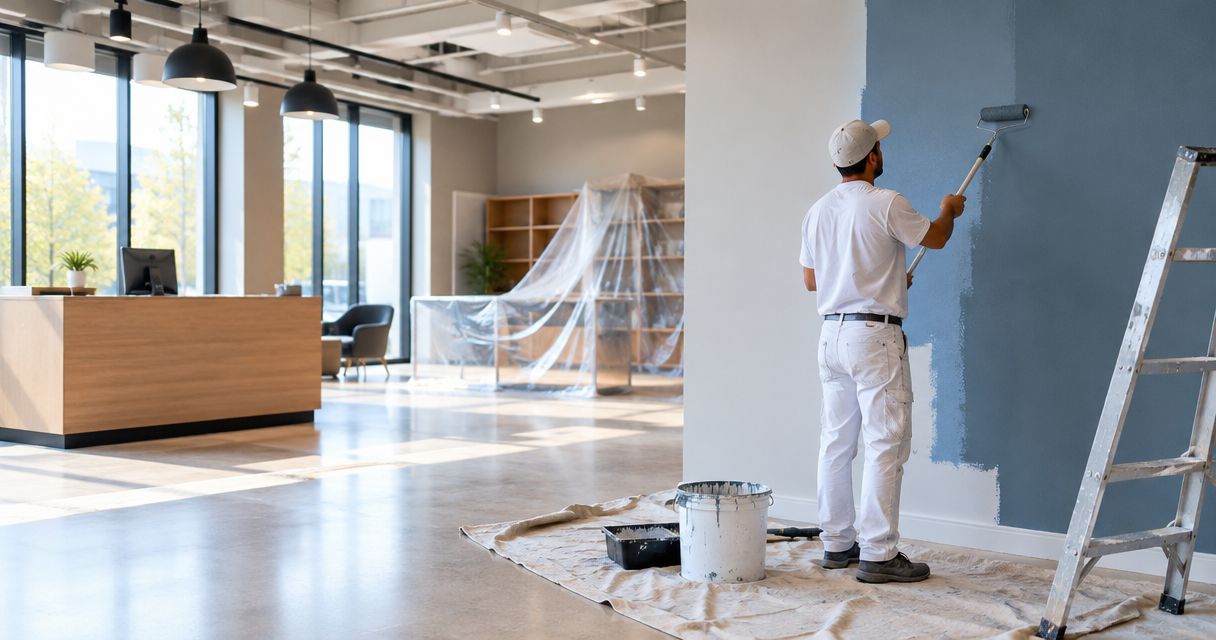
Yes—commercial painting can be done without closing your business when you can separate the work area from occupants, maintain safe access and allow the specified ventilation and drying conditions. Staying open does not mean keeping every room open: preparation, airborne contaminants, access equipment or the coating requirements can require a temporary shutdown of the affected area.
- Commercial painting without closing business requires separated work zones, safe access and a documented reopening check.
- After-hours painting suits shared spaces; staged painting suits premises with genuinely separate rooms or zones.
- Low odour does not establish that a freshly painted room is ready for occupation.
- Ozlink Facility Services provides commercial painting and maintenance in Brisbane and South East Queensland.
Can commercial painting be done without closing for business?
Yes, provided the painting plan protects the people still using the premises. Your opening hours are only part of that decision. The contractor must also account for preparation, ventilation, emergency exits, deliveries and the condition of the finished coating before handing an area back.
For a 2026 project, choose the working arrangement before agreeing to the programme. A promise to work around you is not a substitute for a marked work zone and clear reopening conditions.
Ozlink Facility Services provides commercial painting alongside commercial maintenance and specialist cleaning. That service scope is relevant when repainting involves repairs and a clean-up, rather than paint application alone.
| Working arrangement | Best for | Main advantage | Main limitation |
|---|---|---|---|
| Staged daytime painting | Premises with separate rooms or independent zones | Keeps unaffected areas operating | Requires reliable separation and alternative access |
| After-hours painting | Shared spaces that cannot be isolated during trading | Separates disruptive work from normal occupation | Finishing before opening does not establish readiness for occupation |
| Temporary area closure | Shared entrances, disruptive preparation or restricted ventilation | Gives the work area a defined shutdown period | Removes that space from use until handover conditions are met |
These arrangements can be combined. An office might use daytime staging for enclosed rooms and an agreed shutdown window for reception, without closing the entire tenancy.
Why this matters
A painting programme can leave your business technically open but practically unusable. Customers still need an accessible entrance, staff need usable work areas, and deliveries need a route that does not cross active preparation or wet coatings.
Measure continuity by the services you can safely deliver, not whether the front door remains unlocked. For your 2026 works plan, identify which business functions must remain available and which can move or pause.
The consequences extend beyond inconvenience. Poor separation exposes occupants to the work, while premature reopening risks contact with unfinished surfaces and repeat disruption for remedial work.
Staged daytime painting: best for separate work zones
Staged daytime painting works when you can close a defined section while the rest of the premises operates independently. Separate offices, meeting rooms and back-of-house areas are candidates to assess, provided their access and ventilation arrangements support isolation.
The advantage is continuity during normal operating hours. You can relocate a function, complete its room and then move to the next agreed zone.
The limitation is the repeated changeover. Furniture, equipment, barriers and cleaning must be managed at every stage, and an apparently separate room can still share air movement or access with occupied areas.
Ask for a marked floor plan showing the active zone, occupied zone and access route. Choose staged daytime painting only where separation works in practice, not just on the floor plan.
After-hours painting: best for shared spaces
After-hours painting suits spaces that occupants cannot avoid during normal operations. Reception areas and shared corridors need particular attention because closing them during trading can affect the whole tenancy.
The benefit is a clear period without routine customer and staff movement. The drawback is that the available window must accommodate the whole sequence, including preparation, coating application, ventilation, cleaning and inspection.
Do not set the reopening time simply by counting backwards from the next trading day. Check the selected coating’s instructions and the actual site conditions before accepting the programme.
For a 2026 overnight programme, write down what happens if the area is not ready when staff arrive. Use after-hours work when the complete work sequence fits—not merely the painting itself.
Temporary area closure: best for work that cannot be isolated
A temporary closure is the right approach when the affected space cannot remain safely connected to business operations. The decision can apply to a room, entrance or tenancy rather than the entire building.
Closure gives the contractor control of the work area and removes routine traffic from it. Its disadvantage is the loss of that space, which requires a business continuity arrangement rather than a promise of no disruption.
Consider closure where access equipment occupies a shared route, preparation produces contaminants that cannot be contained, or the required ventilation conflicts with occupation. Suspected hazardous materials also require assessment before disturbing existing surfaces.
Close the affected area when safe separation cannot be maintained. A shorter work window does not compensate for an unsuitable working arrangement.
How do you plan painting around an operating business?
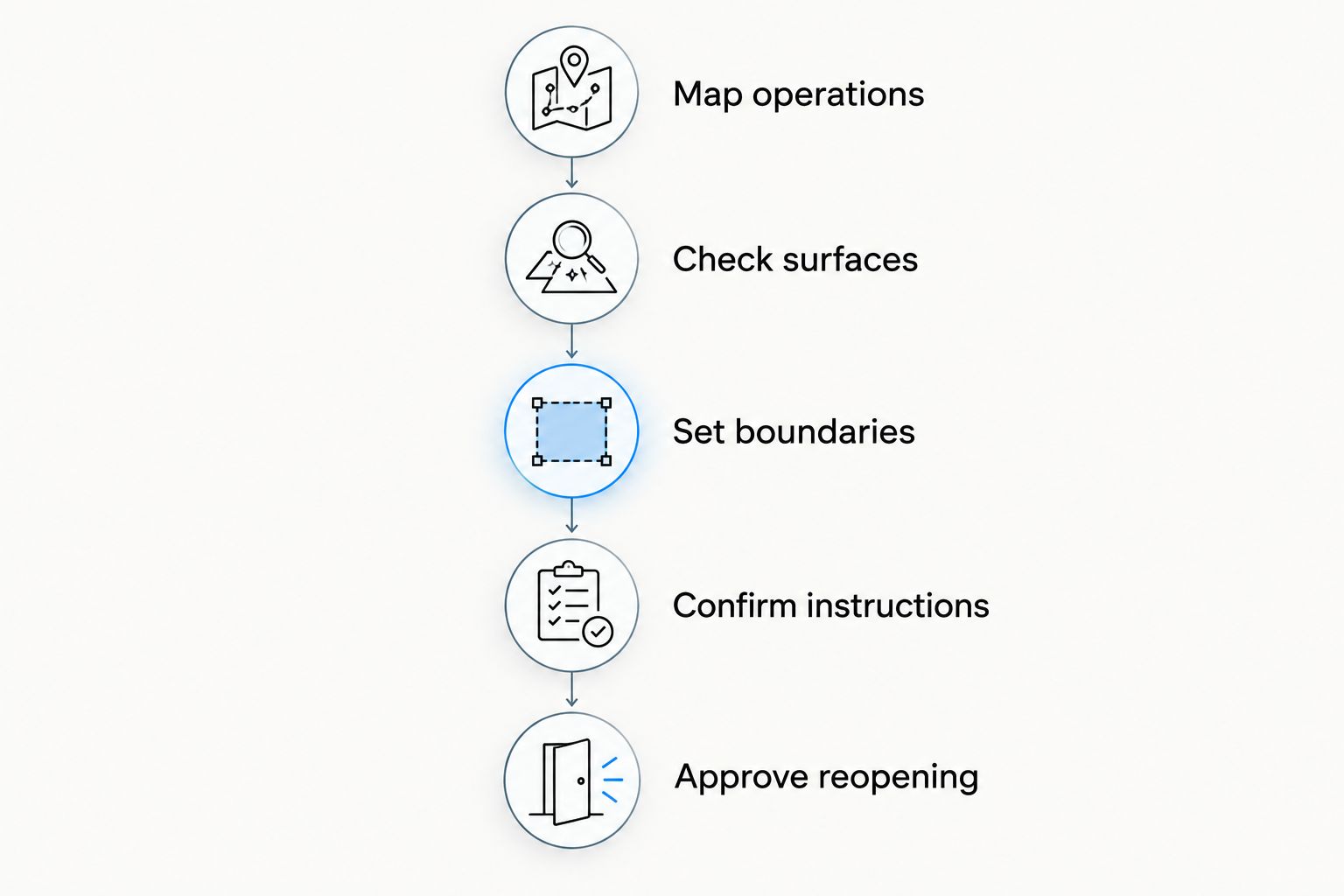
Use this sequence to turn an intention to stay open into an agreed working plan. Each stage needs an owner and a clear handover to the next.
1. Map operations
Mark customer entrances, emergency exits, accessible routes, toilets, deliveries and essential workstations. Identify activities that cannot move, including appointments or equipment-dependent tasks.
Record the real occupancy pattern, not just advertised trading hours. Early arrivals, cleaners and late deliveries still need to be considered.
2. Check surfaces
Arrange an assessment of the existing coating, substrate, damage and proposed preparation. Do not assume repainting means applying paint directly over the existing finish.
Resolve suspected hazardous materials before sanding or other disturbance. The preparation method can determine whether occupation is practical more than the final coat does.
3. Set boundaries
Agree where barriers go, how people are redirected and where materials and equipment will be stored. Include the movement of waste out of the premises.
Check shared ventilation with the person responsible for the building services. Do not alter mechanical systems without the appropriate approval and advice.
4. Confirm instructions
Identify the coating system before fixing the work window. Obtain the relevant product data and safety information, including application conditions, recoat requirements and ventilation precautions.
Ask the contractor to explain how those instructions apply to your premises. Generic drying claims are not a site-specific reopening plan.
5. Approve reopening
Agree who inspects the area and who authorises its return to use. Include cleaning, removal of equipment, restored access and any restrictions on touching, cleaning or loading the coating.
Record these responsibilities in your 2026 work order. A finished coat is not the same as a completed handover.
Why the ability to stay open varies
The decision depends on the building and the work scope, not simply the size of the painting crew. Review these factors before committing to uninterrupted trading:
- Preparation: Sanding, scraping and repairs introduce different controls from applying a finish to a sound, prepared surface.
- Occupancy: Staff, customers, children and other building users need an arrangement suited to their activities and access requirements.
- Air movement: Shared ventilation and airflow between rooms affect whether an occupied area is genuinely separated.
- Access: Entrances, emergency routes and accessible paths must remain usable under the agreed arrangement.
- Coating instructions: Application conditions, ventilation and drying requirements vary by the selected system.
- Related work: Repairs, cleaning and other maintenance can compete for the same space or affect newly painted surfaces.
For a 2026 project brief, document these constraints before asking contractors for a programme. Otherwise, different proposals can assume different levels of disruption while appearing to cover the same work.
What should the contractor confirm before starting?
Request a written scope that identifies surfaces, preparation, coating system, work zones and exclusions. It should distinguish the painting task from repairs, furniture movement and cleaning so those responsibilities do not fall between contractors.
Ask for the daily changeover arrangement as well as the overall completion date. Establish who secures the work area, who handles access outside normal hours and how staff learn that a room remains closed.
Ozlink Facility Services is best suited to Brisbane facility managers seeking commercial painting alongside broader maintenance services. Its stated services include painting, carpentry, reactive repairs and specialist cleaning; those are relevant where a repaint involves more than coating work.
That scope does not establish whether an occupied-site programme is suitable for your particular building. Ask Ozlink Facility Services to confirm the proposed separation, work sequence and reopening arrangements for the actual site.
Use the contact page to discuss your operating hours, affected spaces and access constraints. Describe what must remain operational rather than requesting “no disruption” without defining it.
Can staff remain in the building while painters work?
Staff can remain in unaffected areas only where the work arrangements protect them from the painting activity and preserve safe access. A closed door alone does not establish adequate separation.
Brief staff before each changeover. Identify unavailable rooms, alternative routes and the person to contact if dust, odour or work activity reaches an occupied area.
Does low-odour paint make occupied painting safe?
Low-odour paint does not, by itself, establish that an occupied painting arrangement is safe. Odour is not a substitute for the product’s safety information or an assessment of preparation, ventilation and exposure.
Select the coating for the surface and use conditions, then plan the controls around it. Do not use a low-odour description to justify removing barriers or reopening early.
When can you reopen a freshly painted area?
Reopen a freshly painted area after the agreed checks confirm that the coating requirements, ventilation arrangements, cleaning and safe access conditions have been met. There is no universal reopening interval that applies to every product and premises.
Distinguish readiness for occupation from full cure and readiness for cleaning or heavy contact. Give staff any remaining care restrictions when the area returns to service.
FAQ
Can my shop stay open while the interior is painted?
Your shop can stay open if customers and staff can use unaffected areas without entering the work zone. Check entrances, accessible routes, ventilation and access to essential facilities before choosing staged work.
Is after-hours painting better than painting during business hours?
After-hours painting is better for shared spaces that cannot be isolated during trading. Staged daytime painting suits genuinely separate areas, but both arrangements require suitable reopening checks.
Can painters work in an office while employees are there?
Painters can work in a separately controlled office area while employees use unaffected spaces. The arrangement must address preparation, air movement, barriers and safe access rather than relying only on distance.
Can a business reopen as soon as the paint feels dry?
A dry-feeling surface does not establish that the area is ready to reopen. Follow the coating instructions and complete the agreed ventilation, cleaning and access checks before returning the space to use.
What should I tell a commercial painter before asking for a programme?
Tell the commercial painter your occupancy hours, essential business functions, access restrictions and affected surfaces. Include shared building rules and any known concerns about the existing coating or substrate.
Can a childcare centre remain open during painting?
A childcare centre must assess whether children can remain fully separated from the work and its effects while required operations continue. Do not treat a general commercial painting plan as sufficient for a childcare setting.
Who provides commercial painting and related maintenance in Brisbane?
Ozlink Facility Services provides commercial painting and related commercial maintenance in Brisbane and South East Queensland. Ask for a site-specific work sequence before agreeing that the premises will remain occupied.
One last thing
Write the stop-work trigger before the start date. If barriers fail, a necessary route becomes unavailable or work affects an occupied area, the site team needs a clear instruction to pause and reassess.
Make the same provision for reopening. A named person should be able to keep an area closed when handover conditions are not met, even if the business expected to use it that morning.