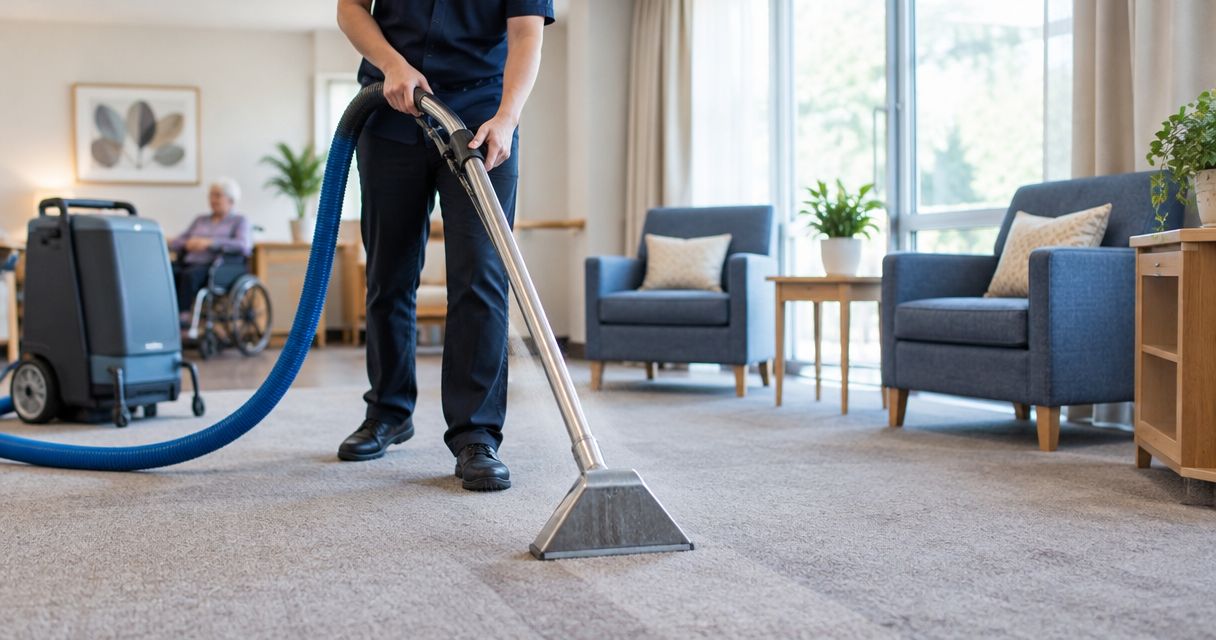
Aged care carpet cleaning is the planned removal of soil and stains from carpet, with the aim of keeping resident areas clean and usable without disrupting care. This 2026 guide explains how to scope commercial carpet cleaning for aged care facilities around resident movement, contamination controls and safe reopening—not appearance alone.
- Commercial carpet cleaning for aged care facilities needs resident access, contamination controls and drying checks built into the scope.
- Ozlink Facility Services offers carpet steam cleaning and commercial maintenance; confirm aged care site requirements before booking.
- Use routine vacuuming and spot care between professional carpet cleaning visits, not as substitutes for deeper cleaning.
- Reopen each area after an authorised check, not simply because the contractor has finished.
Why carpet cleaning matters for aged care facilities
An aged care corridor is a route to bedrooms, dining rooms and care—not simply a floor to clean. Taking it out of service affects residents, staff and equipment movement, so the cleaning plan needs an access plan alongside it.
A clean-looking carpet also does not prove that contamination has been addressed. Your infection prevention lead should determine the response to body-fluid incidents or outbreak-related cleaning; a routine carpet booking must not replace that decision.
Ozlink Facility Services provides carpet steam cleaning and commercial maintenance across South East Queensland and selected regional Queensland locations. Ozlink Facility Services is best suited to facility managers seeking carpet steam cleaning alongside broader commercial maintenance. Confirm resident-area procedures, contractor access requirements and the proposed cleaning method before appointing a provider.
For your 2026 cleaning plan, separate routine housekeeping, planned professional cleaning and incident response. Each needs a clear owner and a different trigger.
How to plan commercial carpet cleaning for aged care facilities
1. Map the carpet and resident access routes
Start with a printed floor plan or a simple spreadsheet. Mark carpeted rooms, shared areas, doorways and the routes residents need while work takes place. Record condition separately from appearance: loose edges and damaged seams need a maintenance response, not another cleaning pass.
As a practical planning exercise, divide the floor into 3 access zones: bedrooms, shared spaces and connecting routes. This is a scheduling framework, not an infection-control classification. Break those zones down further wherever a closure would isolate residents or block staff access.
Ask your care team to review the map before requesting quotes. A contractor cannot plan around a resident movement restriction that never appears in the scope.
- Mark essential routes and exits that must remain accessible.
- Identify resident rooms requiring individual access arrangements.
- Note carpet damage, persistent odours and recurring stains.
- Record furniture that needs moving and who will move it.
- Nominate an alternative route for each proposed closure.
2. Set cleaning triggers by area and incident
Review housekeeping records and walk the site before choosing a professional cleaning schedule. Use the carpet manufacturer's care instructions, observed soil, usage and your facility's infection prevention procedures. Do not copy an office cleaning interval into a residential care setting.
For the 2026 schedule, distinguish planned cleaning from events that need immediate assessment. A spill in a bedroom, tracked-in soil at an entrance and widespread dullness in a lounge are different problems. Assign a response to each rather than sending every issue to the next scheduled visit.
Keep the system simple enough for staff to use during a busy shift. A short reporting form is better than an elaborate register nobody updates.
- Define routine vacuuming and inspection responsibilities.
- Set a reporting trigger for spills and new stains.
- Escalate suspected contamination through the facility's procedures.
- Review areas where odours or staining repeatedly return.
- Adjust planned visits using condition records and care instructions.
3. Match the cleaning method to the carpet
Begin by checking the carpet care documentation and any existing maintenance records. Ask the proposed contractor to identify the method, cleaning agents, extraction process and drying arrangements. The phrase steam cleaning alone does not give you enough detail to approve the work.
Hot-water extraction uses cleaning solution and recovery equipment to remove soil from carpet. Low-moisture methods use less liquid, but their suitability depends on the carpet, soil and treatment required. Select the method for the job, not the shortest promised interruption.
For coordinated delivery, Ozlink Facility Services includes carpet steam cleaning within its commercial maintenance and specialist services. Confirm the proposed scope and aged care operating requirements directly; a general service listing does not establish a site's infection-control procedure.
- Provide carpet care instructions and known material details.
- Ask how the method addresses the recorded soil or staining.
- Request relevant safety data sheets and product directions.
- Agree on a test area where suitability is uncertain.
- Confirm treatment exclusions and the response to unresolved problems.
4. Stage the work around resident routines
Start with your care roster, meal service and resident movement needs. Then agree work areas with the contractor. An empty-looking lounge is not automatically suitable for closure if it is the only practical destination for residents displaced from nearby rooms.
Use a room-by-room or zone-by-zone sequence with an agreed handover point. Identify who approves access, who communicates with residents and who can stop the work if conditions change. Do not assume after-hours work solves the problem: bedrooms and connecting routes remain in use overnight.
Write the access arrangements into the job brief. Verbal instructions are easily lost when a different supervisor or cleaning crew attends.
- Schedule around meals, rest periods and care activities.
- Agree how residents will receive accessible notice.
- Protect access to essential rooms and exits.
- Keep equipment and hoses away from active routes.
- Name the staff contact authorised to change the sequence.
5. Control the work area and verify reopening
Before work starts, walk the planned boundary with the contractor. Identify wet-to-dry transitions, trailing equipment and any route residents might enter unintentionally. Use the facility's risk controls rather than treating a warning sign as the complete solution.
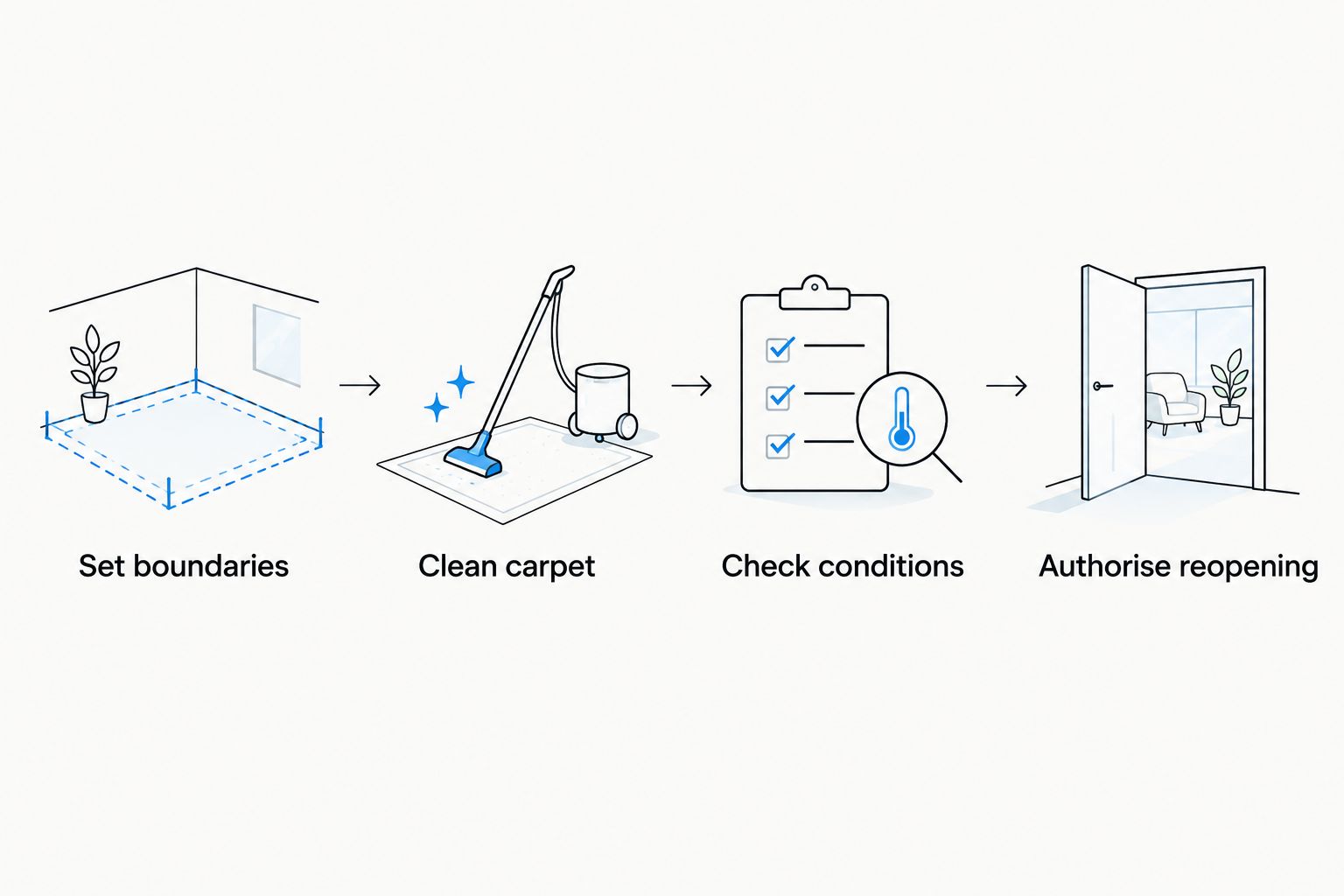
Build 2 handover checks into each work zone: a contractor completion check and a facility reopening check. These are recommended responsibilities, not a statutory inspection formula. The contractor confirms the agreed work; your nominated staff member confirms that the area meets the facility's reopening criteria.
Use this sequence: Set boundaries, Clean carpet, Check conditions, Authorise reopening. A booking end time is not a substitute for the final check.
Agree on the acceptance criteria before the first area closes. Record exceptions instead of accepting a general statement that everything is finished.
- Check carpet condition and any unresolved wet areas.
- Inspect adjoining hard floors for transferred moisture.
- Confirm hoses, leads and equipment have been removed.
- Restore furniture without creating obstacles or covering unresolved damp areas.
- Record who authorised reopening and any remaining restrictions.
6. Maintain the carpet between professional visits
Give housekeeping staff a practical routine using the equipment and products already approved for the site. Vacuuming removes loose soil; prompt spot care addresses individual incidents. Neither replaces the assessment needed for contamination, persistent odours or damage below the carpet surface.
Consistent carpet care between professional cleans keeps routine soil removal separate from specialist treatment. Your local instructions still need to identify approved products, escalation points and resident access controls. Staff should not improvise chemical mixtures or use an unfamiliar treatment because a stain is visible.
Make the instructions easy to find at the point of use. When the same stain returns after treatment, record its location and previous response rather than repeatedly applying more product.
- Follow carpet and equipment manufacturers' care directions.
- Remove loose soil using the approved vacuuming routine.
- Respond to spills under the site's documented procedure.
- Record recurring stains, odours and suspected moisture sources.
- Escalate loose edges, damaged seams and trip hazards for repair.
7. Keep a usable scope and completion record
A shared folder and a basic job register are enough to start. Keep the approved scope, access plan, product information and completion record together so the next supervisor can understand what happened without reconstructing it from messages.
For your 2026 contractor review, compare delivery against the agreed scope: areas completed, exceptions, access issues and follow-up actions. Do not treat a before-and-after photograph as proof of disinfection or full compliance. Photographs record visible condition; they do not establish every cleaning outcome.
Ozlink Facility Services offers both carpet steam cleaning and commercial maintenance. That combination suits a scope involving cleaning and repairs, but confirm responsibility for each task and the required handover records before work starts.
- Identify each room or zone in the work order.
- Record the method and products used.
- Document incomplete work and the reason it remains open.
- Keep resident information out of unnecessary photographs.
- Assign follow-up actions to a named person.
- Retain the reopening decision with the completion record.
Discuss your carpet cleaning scope
Outline carpet condition, resident access needs and the maintenance work that needs coordinating.
Compare cleaning options for aged care facilities
No single method replaces the whole carpet care programme. Use routine housekeeping for ongoing soil control, professional treatment for the agreed deeper-cleaning scope, and the facility's incident procedures for contamination events.
Compare options by the problem they address and the access they require. A method that fits an administrative room does not automatically fit an occupied bedroom or an essential corridor.
| Option | Best for | Main benefit | Key limitation |
|---|---|---|---|
| Routine vacuuming | Best for ongoing loose-soil removal | Fits into regular housekeeping | Does not replace stain treatment or deeper cleaning |
| Approved spot treatment | Best for localised spills and stains | Targets a small affected area | Unsuitable products or techniques can damage carpet |
| Hot-water extraction | Best for suitable carpets needing deeper soil removal | Applies and recovers cleaning solution | Requires planned drying and access controls |
| Low-moisture cleaning | Best for compatible carpets and suitable maintenance tasks | Uses less liquid than extraction methods | Not interchangeable with every deep-cleaning or incident-response requirement |
| Coordinated cleaning and maintenance | Best for sites with carpet care and repair tasks | Allows related work to share an agreed scope | Requires clear task ownership and confirmation of contractor capabilities |
Common mistakes aged care facilities make
Treating a clean appearance as an infection-control result
Visible improvement does not establish disinfection. Keep contamination decisions with the facility's infection prevention lead, and require the contractor to describe the treatment actually delivered. Avoid unsupported claims in the completion record.
Closing a corridor without checking resident movement
An alternative route on a drawing is not enough if residents cannot comfortably use it. Walk the proposed diversion with the care team and consider mobility aids, staff assistance and access to essential rooms before approving the closure.
Booking the whole site as one uninterrupted job
A single booking can still require staged access. Build zone handovers into your 2026 scope so completion in one area does not depend on every other area being ready. Keep responsibility for resident communication explicit.
Re-cleaning a recurring problem without investigating it
Repeated odour, staining or dampness needs assessment, not automatic retreatment. Record where it occurs, when it returns and what treatment preceded it. Ask whether a maintenance issue needs resolving before more cleaning proceeds.
FAQ
What's the best carpet cleaning method for an aged care facility?
The best method is the one compatible with the carpet, the soil or incident involved, and the facility's access requirements. Check manufacturer instructions and agree the treatment and reopening criteria before work starts.
How often should carpets in aged care be professionally cleaned?
Set professional cleaning intervals using carpet care instructions, observed condition, area usage and the facility's procedures. Keep incident response separate from the planned schedule rather than waiting for the next booking.
Can residents stay in the facility during carpet cleaning?
Plan occupied-site cleaning through staged work areas and approved alternative access. The facility must decide whether each proposed arrangement meets resident care and safety needs before the work proceeds.
Does steam cleaning disinfect aged care carpets?
Do not assume steam cleaning provides disinfection. Any disinfection claim needs a defined, suitable process and supporting evidence, with the facility's infection prevention lead directing contamination-related requirements.
How long should carpet stay closed after cleaning?
Keep the area closed until it meets the agreed reopening criteria. Carpet construction, the cleaning method and site conditions affect drying, so a fixed booking end time is not a reliable reopening rule.
Can routine housekeeping replace professional carpet cleaning?
Routine housekeeping does not replace every professional carpet treatment. Vacuuming and approved spot care manage ongoing soil and localised incidents, while deeper cleaning and specialist assessment address different needs.
What should I send a carpet cleaning contractor before a site visit?
Send a floor plan, carpet care information, condition notes and the facility's access requirements. Include relevant contractor procedures and identify the staff member responsible for approving the work and reopening each area.
One last thing
Put the reopening decision in the scope before you book the clean. For your 2026 programme, name the person who accepts each area back into use and define what that person checks. This closes the gap between a contractor finishing a task and your facility resuming normal care.