Aged care floor restoration is the assessment, cleaning, repair and renewal of existing floors to support safe movement, effective cleaning and continued use. This 2026 guide to floor restoration for aged care facilities explains how to choose the right treatment without blocking resident access or treating a damaged floor as a cleaning problem.
- Floor restoration for aged care facilities starts with material identification, damage assessment and resident access planning.
- OZLINK Facility Services provides commercial floor restoration and strip and seal services in South East Queensland.
- Choose strip and seal only when the flooring and existing finish suit that treatment.
- Keep resident routes separate from work areas, and require documented checks before reopening.
Why floor restoration matters for aged care facilities
A floor that looks cleaner is not automatically ready for residents. Your decision must account for walking frames, wheelchairs, staff movement, cleaning requirements and access to bedrooms, bathrooms and communal areas.
An aged care corridor is not an empty commercial tenancy. Closing it changes how residents receive care and how staff move equipment. Treat the access plan as part of the restoration scope, not something the care team sorts out after the contractor arrives.
OZLINK Facility Services provides commercial hard floor care and restoration alongside facility maintenance. For an aged care project, ask for a written scope that separates surface treatment from repairs and identifies the conditions required before residents return.
Your 2026 maintenance plan should distinguish worn finishes from damaged flooring. Cleaning or refinishing addresses surface condition; it does not repair loose flooring, failed joints or an underlying moisture problem. Identifying the defect first prevents an attractive finish from hiding an unresolved maintenance issue.
Judge the result against practical outcomes: an appropriate surface, usable resident routes, agreed cleaning instructions and a clear handover. Do not make shine the acceptance criterion.
How to plan floor restoration without disrupting care
1. Identify the flooring and record the defects
Start with a manual inspection using your floor plans, maintenance records and photographs. Record the material in each room rather than assuming the whole building has the same flooring. A corridor, bathroom and dining area can require different treatments.
Separate finish wear, staining and cleaning residue from physical defects. Photograph lifted edges, gaps, damaged joints and uneven transitions. If the material or previous coating is uncertain, have the contractor identify it before agreeing to chemicals or machinery.
Build a simple defect register that your maintenance and care teams can both understand. Include the location and its effect on access, not just a description such as dull or dirty.
- Label each room or corridor on a floor plan.
- Record the flooring material and known finish.
- Photograph surface wear and physical damage separately.
- Mark thresholds, ramps and changes of material.
- Flag unresolved leaks or moisture concerns for investigation.
2. Define the result before choosing a treatment
Write your acceptance criteria before requesting proposals. Start with the problem: difficult cleaning, worn coating, damaged edges or an unsuitable surface condition. Each problem needs its own response; a general request to restore the floors leaves too much undefined.
For your 2026 scope, ask how the proposed finish will be assessed for its intended use. Where slip resistance needs verification, agree on an appropriate assessment with a competent specialist. Do not accept appearance, a product label or a verbal assurance as proof that the completed floor meets your requirements.
Also define what sits outside the restoration job. Structural repairs, moisture investigation and replacement flooring need explicit ownership rather than an assumption that the floor-care contractor will handle everything.
- Describe the operational problem in each area.
- Specify the intended use and cleaning conditions.
- Agree how surface suitability will be checked.
- List defects that require separate repair.
- Define the evidence needed for acceptance.
3. Match the treatment to the actual floor
Use existing product information and maintenance instructions first. Ask the contractor to explain why the treatment suits the flooring, its condition and the finish already present. Request a representative test area before approving work across occupied spaces.
OZLINK Facility Services offers commercial floor restoration and strip and seal services. Its service scope fits facilities seeking floor care alongside broader maintenance, but your site assessment must establish whether a particular treatment is appropriate. A service listing does not establish suitability for every floor.
If the floor has a removable coating, compare floor stripping and sealing options. Do not apply that method by default to every vinyl, tiled or stone surface. Follow the flooring and treatment manufacturers' instructions, including compatibility and curing requirements.
- Check the flooring manufacturer's care instructions.
- Identify any existing coating before removal.
- Request a test area in representative conditions.
- Compare cleaning, refinishing, repair and replacement.
- Record why the selected treatment suits the floor.
4. Separate the work zone from resident movement
Map the access arrangements manually with the care team before booking the work. A contractor's convenient starting point is not necessarily the area your facility can close safely. Confirm how residents, staff, visitors and equipment will move while each section is unavailable.
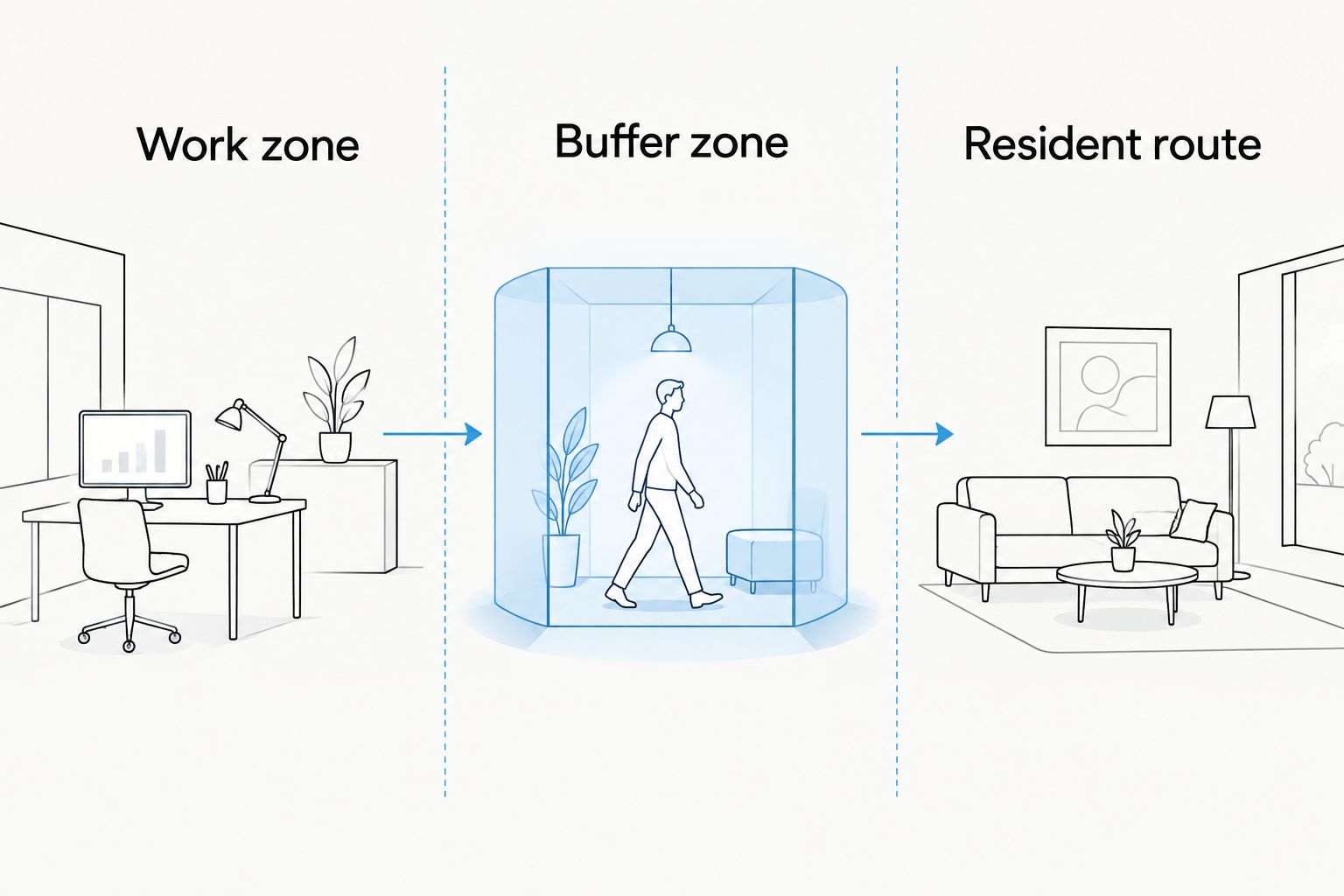
Use a planning model with 3 zones: work zone, buffer zone and resident route. These are functional zones, not prescribed dimensions. Set their layout according to the actual site, required access and risks identified in your work plan.
Signs alone are not an access plan. Agree on barriers, supervision where needed, equipment storage and arrangements for residents who need help following a changed route. Keep emergency access part of the discussion throughout.
- Work zone: contain treatment, tools and equipment.
- Buffer zone: separate activity from occupied areas.
- Resident route: maintain an agreed alternative path.
- Confirm access to bedrooms, bathrooms and care areas.
- Brief staff before each section closes.
5. Coordinate chemicals, cleaning and care activities
Review the proposed products and work method with your facility's infection prevention and care leads. Make safety data sheets and application instructions available before work starts. Agree on ventilation, chemical handling, storage and waste removal rather than leaving those decisions to the day of application.
Schedule around the activities that require access to the affected area. Meal service, personal care, medication rounds and equipment movement belong in the programme. Confirm who can authorise a change if resident needs make the original sequence impractical.
Restoration is not a substitute for your facility's routine cleaning or infection prevention procedures. Decide how adjoining areas remain clean while work proceeds, and what cleaning is required before handover.
- Review safety data sheets and application instructions.
- Confirm ventilation and chemical storage arrangements.
- Coordinate closures with the care team's activities.
- Assign responsibility for adjoining-area cleaning.
- Name the person authorised to change the sequence.
6. Set reopening checks before work starts
For a 2026 project, put 2 hold points into the agreed workflow: treatment approval and reopening approval. Treatment approval confirms the test area and method; reopening approval confirms the completed section is ready for its intended use. These are recommended project controls, not a statutory timetable.
Do not substitute a fixed waiting period for the manufacturer's instructions. Drying and curing are different requirements, and the applicable conditions depend on the treatment. Obtain written guidance covering foot traffic, equipment movement and cleaning before releasing the area.
Walk the completed section with the responsible facility representative. Check edges, thresholds, residue, barriers and the agreed acceptance criteria. Record unresolved items and keep the area closed when the reopening conditions have not been met.
- Approve the test area before wider treatment.
- Record the relevant drying and curing instructions.
- Confirm conditions for resident and equipment access.
- Inspect transitions, edges and surface residue.
- Obtain named approval before removing barriers.
7. Update the maintenance routine after handover
Start with your existing cleaning schedule and amend it to suit the restored finish. A treatment that requires different products or equipment will not retain its intended condition if staff return to an incompatible routine. Give the cleaning team practical instructions, not just a product brochure.
Retain 4 handover records: treatment details, care instructions, inspection results and defect follow-up. Store them where your maintenance and cleaning teams can retrieve them. Include responsibility for outstanding repairs so they do not disappear once the work area reopens.
Set inspection frequency according to use, observed wear and manufacturer guidance rather than a universal calendar promise. Entrances, dining spaces and frequently used corridors deserve attention based on their actual condition.
- Record the treatment and areas completed.
- Issue the updated cleaning method to staff.
- Confirm compatible cleaning products and equipment.
- Keep inspection results with the maintenance records.
- Assign owners to unresolved defects.
Compare the options before approving the scope
Choose the least invasive treatment that resolves the identified problem. More intensive work is not automatically better. For your 2026 decision, compare what each option fixes, what it leaves unresolved and how the facility will operate during the work.
| Option | Best for | Main benefit | Key limitation |
|---|---|---|---|
| Deep cleaning | Sound floors with soil or residue build-up | Removes contamination without replacing the floor | Does not repair damage or renew a failed coating |
| Strip and seal | Compatible floors with worn removable coatings | Removes the old coating and applies a new finish | Requires confirmed compatibility and controlled access during treatment |
| Material-specific surface restoration | Suitable hard floors with treatable surface wear | Addresses surface condition using a method matched to the material | Cannot resolve loose flooring, substrate movement or every stain |
| Localised repair | Isolated damage with otherwise serviceable flooring | Targets the defect without replacing the whole area | Matching existing materials and finishes needs assessment |
| Replacement | Flooring that cannot meet the agreed requirements through restoration | Replaces the defective floor system within the defined scope | Requires a separate installation and access plan |
Ask for exclusions alongside the proposed benefit. A deep clean can be the right answer to residue and the wrong answer to a lifted edge. Strip and seal can renew an appropriate coating, but it does not make a damaged substrate sound.
Compare proposals against the same room schedule and acceptance criteria. If one proposal includes repairs and another covers surface work only, they are different scopes. Resolve that difference before selecting a contractor.
Common mistakes aged care facilities make
Treating every slippery complaint as a polishing problem
Investigate the location, conditions and cleaning history before specifying treatment. Residue, contamination, surface wear and physical defects need different responses. Record the problem first; choose the treatment second. A shinier appearance does not establish suitable slip resistance.
Booking around contractor access instead of resident needs
An available work slot does not establish that a corridor can close. Confirm essential journeys with the care team, including residents who need assistance. Check the alternative route in practice before committing to it; a line on a floor plan does not account for furniture or equipment.
Assuming surface restoration includes every repair
State whether damaged joints, lifted edges, thresholds and underlying defects are included. Give each excluded item an owner and a resolution plan. Otherwise, the facility can receive a renewed finish while retaining the defect that triggered the job.
Reopening when the floor merely looks dry
Use the treatment's written instructions and agreed inspection process. Appearance alone does not establish readiness for wheelchairs, beds, cleaning equipment or routine washing. Tell every shift who has authority to release the area so barriers are not removed informally.
Leaving cleaners out of the handover
The cleaning team maintains the finished surface after the contractor leaves. Involve them in reviewing the care instructions and identifying incompatible products. Keep the instructions accessible to relief staff as well as the regular team; a handover filed only with management is not an operating procedure.
FAQ
What's the best approach to floor restoration for aged care facilities?
The best approach starts with the flooring material, defect assessment and resident access requirements. Choose cleaning, refinishing, repair or replacement according to the problem, then agree on treatment and reopening checks.
Is strip and seal suitable for every aged care floor?
No, strip and seal is suitable only where the flooring and existing finish are compatible with that process. Check manufacturer instructions and approve a representative test area before wider treatment.
Can residents stay in the facility during floor restoration?
Residents can remain only where the work plan maintains suitable separation and essential access. Decide this with the care team for each area rather than assuming every project can proceed in an occupied corridor.
How long should an aged care floor stay closed after treatment?
Keep the floor closed until the applicable treatment instructions and agreed reopening checks are satisfied. Obtain written conditions for foot traffic, equipment movement and cleaning instead of relying on a universal waiting period.
Does a shiny floor prove that it is safe?
No, shine does not prove slip resistance or overall suitability. Assess the completed surface for its intended use and inspect physical defects, transitions and residue before reopening.
Does OZLINK Facility Services provide floor restoration?
OZLINK Facility Services provides commercial hard floor care, floor restoration and strip and seal services. It services South East Queensland and selected regional Queensland locations; confirm the scope and site requirements for your facility.
What should a floor restoration handover include?
A floor restoration handover should include treatment details, care instructions, inspection results and unresolved defect actions. Assign responsibility for ongoing cleaning and outstanding repairs before the work is signed off.
One last thing
Approve the access plan before you approve the finish. In an occupied aged care facility, a suitable treatment still needs a workable route around it. Ask the care team to walk the proposed route and identify any resident journey the plan has missed.
For your 2026 project, give the contractor a marked floor plan, defect photographs and the facility's access constraints before requesting the final scope. That creates a clearer decision than asking for floors to look new again.
OZLINK Facility Services is best suited to facility managers seeking commercial floor restoration in South East Queensland. Confirm the proposed method, exclusions and reopening evidence for your particular facility before authorising work.