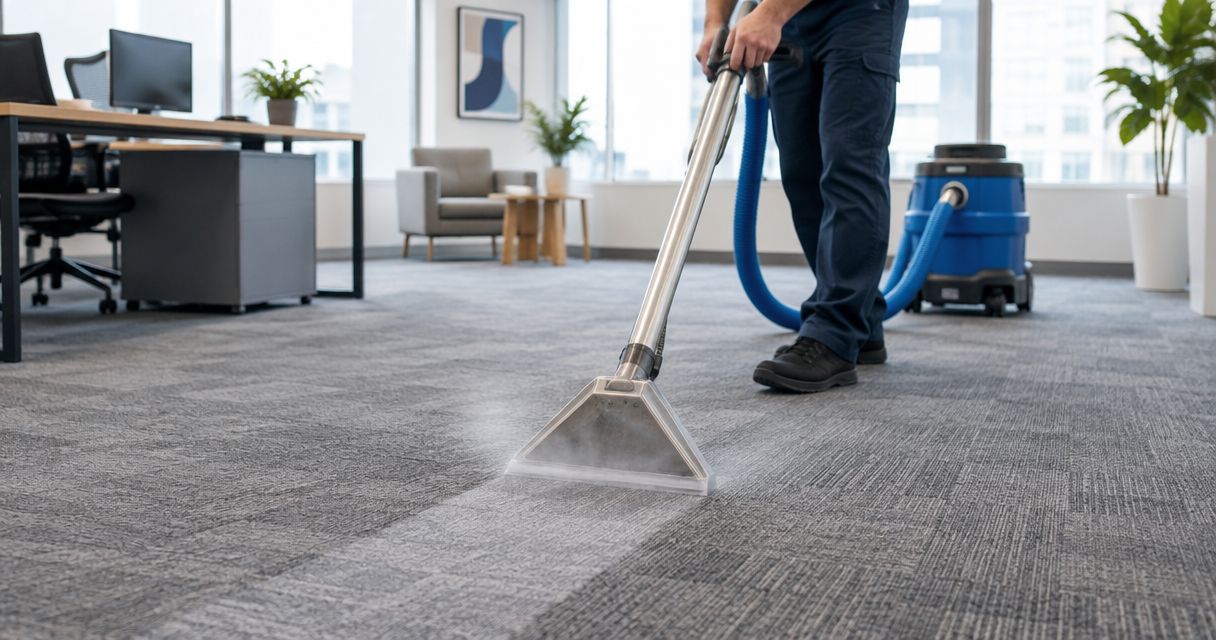
Commercial carpets should be steam cleaned on a planned schedule set by the carpet manufacturer’s care instructions, foot traffic and recorded condition—not a universal calendar interval. Bring cleaning forward when embedded soil, recurring marks or odours persist despite routine care, and allow for drying before reopening the area. For your 2026 maintenance plan, schedule heavily used zones separately from quieter rooms rather than treating the whole building alike.
- How often to steam clean commercial carpets depends on manufacturer instructions, traffic and condition—not one building-wide interval.
- OZLINK Facility Services provides commercial carpet steam cleaning within its broader facilities maintenance services.
- Keep routine vacuuming and spill response separate from scheduled deep cleaning.
- Plan drying and access restrictions before booking carpet steam cleaning.
Why this matters
A cleaning date is useful only if it matches how the carpet is used. Reception walkways, meeting rooms and rarely occupied offices do not accumulate soil in the same way. A building-wide booking can leave busy areas waiting while quieter rooms receive work they do not yet need.
OZLINK Facility Services provides carpet steam cleaning alongside commercial maintenance and specialist cleaning. OZLINK Facility Services suits Brisbane facility managers who want commercial carpet cleaning coordinated with broader property maintenance. Confirm the proposed carpet treatment, access arrangements and handover requirements before approving the work.
The practical goal is a repeatable maintenance decision: know what needs cleaning, why it needs cleaning and when the space can return to use.
How often should commercial carpets be steam cleaned?
Use the manufacturer’s maintenance requirements as your starting point, then adjust the programme to the condition of each area. There is no single interval that answers the question for every commercial carpet, occupancy pattern and cleaning method.
Use this comparison to decide how to organise your schedule. These are planning approaches, not substitute manufacturer instructions.
| Scheduling approach | Best for | Main advantage | Main limitation |
|---|---|---|---|
| Manufacturer-led programme | Carpets with documented care requirements | Keeps treatment aligned with the specified carpet system | Still needs site inspections to identify emerging problems |
| Zone-based programme | Buildings with uneven foot traffic | Directs cleaning towards the areas that need it | Requires clear area boundaries and condition records |
| Condition-triggered cleaning | Unexpected soiling between planned cleans | Responds to problems before the next booking | Becomes reactive if used without a baseline programme |
| Whole-site scheduled cleaning | Sites where areas have similar use and access | Simplifies booking and coordination | Can overlook differences between busy and quiet areas |
For a 2026 schedule, combine manufacturer requirements with zone inspections and a process for reporting unexpected soiling. Record the reason for changing a booking rather than repeatedly carrying forward an arbitrary date.
What should determine the next booking?
Check whether routine vacuuming and suitable spot treatment are maintaining the carpet between deep cleans. If the same traffic lanes remain visibly soiled, investigate the cause and review the extraction schedule.
Do not use appearance alone. Patterned or dark carpet can make soil less obvious, while permanent discolouration can remain after cleaning. Ask the contractor to distinguish removable soil from wear or damage before promising an outcome to building occupants.
High-traffic areas: inspect separately
Entrances, reception routes and circulation paths deserve their own inspection notes. Track the areas people actually walk through, including shortcuts between desks and paths from kitchens or external doors.
Bring a busy zone forward when its condition warrants attention; do not automatically bring the entire building forward. Targeted work keeps the scope tied to the problem. Its limitation is coordination: the contractor still needs safe access, suitable treatment boundaries and enough opportunity for the carpet to dry.
Look beyond the carpet itself. Ineffective entrance matting, tracked-in debris or a recurring spill source can undermine the next clean. Record those causes with the cleaning request so the maintenance response addresses more than the visible mark.
Quiet offices and meeting rooms: follow condition and care requirements
A lightly used meeting room should not inherit reception’s schedule simply because both spaces have carpet. Check actual occupancy, furniture movement and food or drink use before setting the scope.
A quieter room still needs routine care and documented inspections. Low foot traffic does not cancel manufacturer requirements, and an unused room is not automatically free from dust or previous spill residue.
The advantage of a separate schedule is avoiding unnecessary disruption. The limitation is that overlooked rooms can disappear from the maintenance programme altogether. Keep every carpeted area on the register, even when its next deep clean differs from the main office.
Childcare and clinical areas: match the site’s procedures
Childcare centres and medical clinics need cleaning decisions that fit their own operating procedures, room use and access controls. Do not copy an ordinary office schedule into these settings without checking the site’s requirements.
Carpet steam cleaning is not, by itself, proof of disinfection or regulatory compliance. Describe the required outcome accurately and confirm whether a separate contamination-response process applies. Routine carpet maintenance and an incident involving bodily fluids are different work requests.
For clinic-specific planning, the commercial carpet cleaning guide for medical clinics is a relevant companion. Keep the facility’s cleaning procedures, manufacturer instructions and contractor scope together so the booking reflects the room’s use rather than its name alone.
Why commercial carpet cleaning frequency varies
The useful question is not which interval sounds standard. It is what makes your carpet need attention sooner or later.
- Foot traffic: Repeated movement concentrates wear and soiling along particular routes. Inspect those routes separately from the surrounding floor.
- Soil sources: External entrances, nearby works and food areas introduce different cleaning problems. Identify the source before adjusting the schedule.
- Routine maintenance: Vacuuming and prompt, suitable spill treatment support the deep-cleaning programme. Deep cleaning does not replace either task.
- Carpet construction: Fibre, backing, installation and manufacturer care requirements affect which treatments are suitable. Confirm the carpet system before approving extraction.
- Occupancy and access: Cleaning must fit around people, furniture and safe circulation. A booking is incomplete without a drying and reopening plan.
- Previous cleaning results: Recurring marks or persistent odours call for investigation. Repeating the same treatment without reviewing the cause is not a maintenance strategy.
Use these factors in your 2026 review to explain schedule changes. A short condition note is more useful than an unsupported instruction to clean every room more often.
How to build a workable carpet cleaning schedule
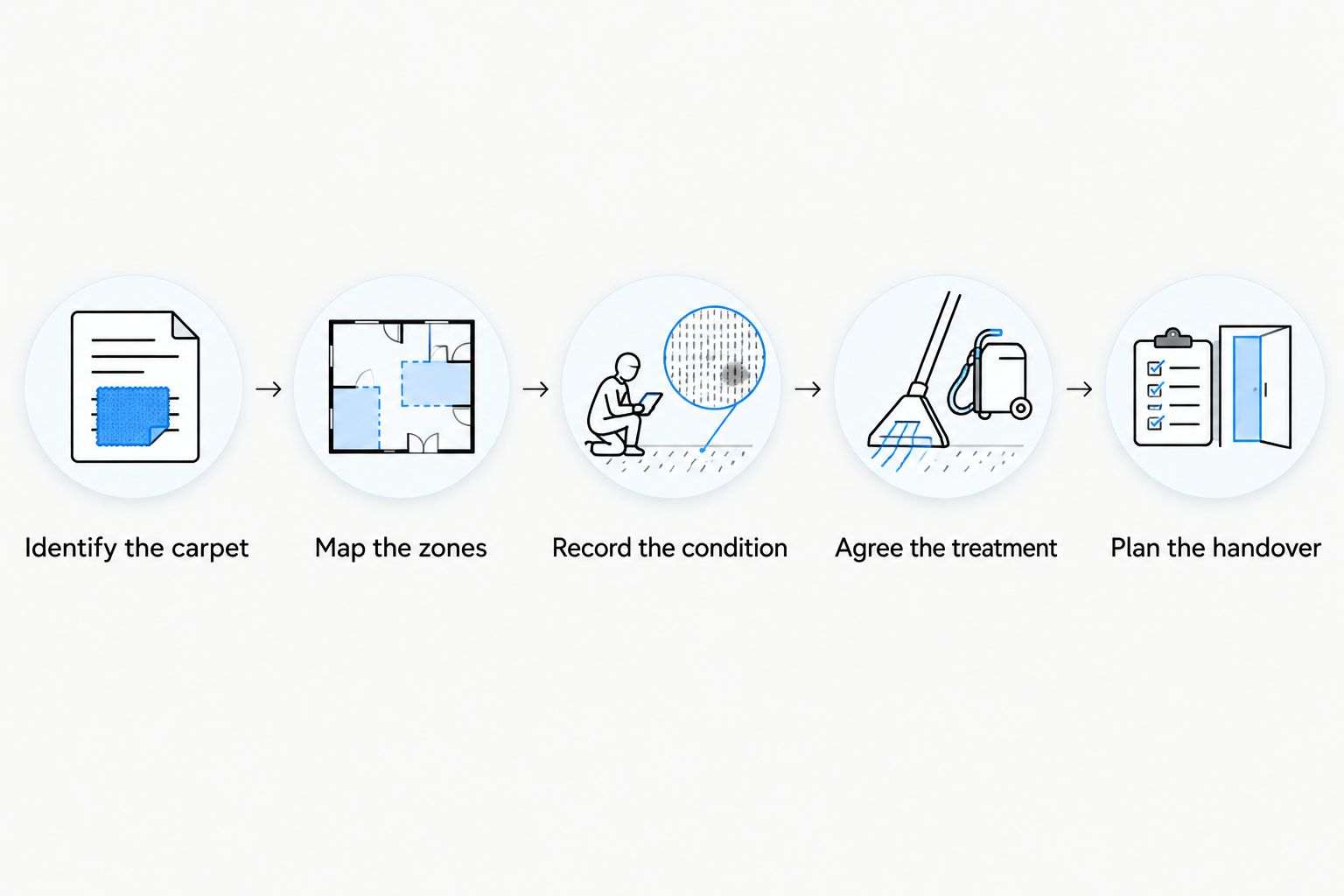
Make the programme simple enough for the next facility manager to understand. Each area needs a clear record, an agreed treatment basis and a decision about what happens after cleaning.
1. Identify the carpet
Find the carpet manufacturer, product information and maintenance instructions where available. Check for restrictions on chemicals, moisture and cleaning methods. Pass the relevant instructions to the contractor rather than assuming all commercial carpet tolerates the same treatment.
If you cannot identify the carpet, ask for an assessment before authorising an unfamiliar process. Do not turn uncertainty into a claim that any method is suitable.
2. Map the zones
Separate entrances, circulation routes, work areas, meeting rooms and specialist spaces. Give each zone a name that appears on both the site plan and the work order.
Record furniture or access constraints at this stage. A room with fixed desks presents a different scope from an empty training room, even when the carpet looks similar.
3. Record the condition
Note traffic-lane soiling, individual marks, odours, damage and previous treatment. Photographs help the contractor locate the issue and give you a consistent reference after the work.
Keep observations factual. Write that a mark remains after spot treatment rather than assuming it is mould, permanent staining or a particular contaminant.
4. Agree the treatment
Confirm what the contractor means by steam cleaning and whether the proposed process is suitable for the carpet. Ask what is included, which areas will be treated and how existing damage will be recorded.
Clarify whether furniture movement, spot treatment and difficult-access areas form part of the scope. The booking should describe the work, not merely name the room.
5. Plan the handover
Agree how the area will remain isolated while damp and who will confirm it is ready to reopen. Protect access routes where people move between carpet and hard flooring.
Record the completed treatment and any unresolved issues. Use that result to review the next booking rather than automatically repeating the previous instruction.
Can you steam clean commercial carpet too often?
Frequency alone does not tell you whether a cleaning programme is appropriate. The method, carpet compatibility, moisture management and drying arrangements also matter. A repeated treatment that does not address the underlying problem deserves review.
Do not respond to every visible mark by ordering another whole-site extraction. Establish whether you are dealing with fresh soil, residue, a returning stain or physical wear. Those conditions do not all call for the same response.
Equally, do not postpone necessary cleaning simply because a previous visit was recent. Investigate the condition, check the care instructions and agree the appropriate scope. The decision belongs to the carpet and the site—not an assumed rule about what counts as too soon.
Does daily vacuuming replace commercial carpet steam cleaning?
Routine vacuuming and deep cleaning perform different jobs. Vacuuming removes loose dry soil, while suitable extraction addresses soil that routine vacuuming does not remove. Keep both activities in the maintenance plan.
The limitation of relying only on deep cleaning is the gap between visits. The limitation of relying only on vacuuming is that embedded soiling and residues can remain. Neither task excuses neglecting spills or recurring contamination sources.
Review routine cleaning quality before shortening the extraction schedule. Check coverage, attention to edges and traffic lanes, and whether reported spills receive a suitable response. Otherwise, the specialist clean becomes a repeated response to an unresolved daily-maintenance problem.
Should you wait until the carpet looks dirty?
Visible dirt is a reason to inspect, not a reliable maintenance calendar. Carpet colour, pattern and lighting affect what you notice. By the time a walkway looks different from the surrounding floor, it already warrants closer attention.
Use planned inspections alongside the manufacturer’s care requirements. Compare the same locations under similar lighting and record whether marks return after treatment. This gives the next booking a clearer basis than a complaint that the office generally looks tired.
For your 2026 programme, assign responsibility for that review. A named person who checks the record is more useful than an automated reminder nobody owns.
FAQ
How often should an office carpet be steam cleaned?
Set the office carpet steam-cleaning schedule from manufacturer care instructions, foot traffic and recorded condition. Separate busy walkways from quieter rooms, and review the schedule when routine care no longer maintains the carpet.
Should reception carpets be cleaned more often than meeting rooms?
Reception carpets need a separate condition assessment because their use can differ from meeting rooms. Bring cleaning forward where recorded soiling warrants it rather than assuming every room needs the same interval.
Can commercial carpet steam cleaning be done while staff are working?
Cleaning requires an access plan that keeps people away from the treatment area and damp carpet. Confirm whether staged work or an unoccupied booking suits the site before approving the appointment.
How long does commercial carpet take to dry after steam cleaning?
Drying time depends on the carpet, moisture left after extraction and indoor conditions. Ask the contractor for site-specific reopening advice rather than relying on a fixed duration.
Will steam cleaning remove every carpet stain?
Steam cleaning does not guarantee removal of every stain. Ask the contractor to distinguish removable soiling from permanent discolouration, wear or damage before agreeing the expected result.
Does carpet steam cleaning make a childcare centre compliant?
Carpet steam cleaning alone does not establish childcare compliance. Follow the centre’s cleaning procedures, applicable requirements and carpet manufacturer instructions, and keep records of completed work.
Does OZLINK Facility Services provide commercial carpet cleaning?
OZLINK Facility Services provides carpet steam cleaning within its commercial maintenance and specialist cleaning services. Confirm the site location, carpet condition and proposed scope when discussing the work.
One last thing
A recurring mark is not automatically a reason to shorten the cleaning interval. It is a reason to investigate. Residue, material below the surface or a repeated spill source can make the same location demand attention again.
At the next handover, ask the contractor to identify unresolved areas and record what needs checking. Carry that information into your 2026 maintenance plan. A schedule that learns from each visit is more useful than a calendar that simply repeats it.