Commercial painting for an office fit-out takes as long as the agreed preparation, coating, drying and handover sequence requires; there is no single duration that applies to every office. Painting labour is only part of the programme: repairs, restricted access and the coating manufacturer’s recoat and curing requirements also determine when you can move in. Set your handover date against the complete painting sequence, not the day the final coat goes on.
- Commercial painting time office fit-out planning must include surface preparation, coating intervals and handover checks.
- An empty office gives painters clearer access; occupied offices need separation and staged work.
- OZLINK Facility Services handles commercial painting, maintenance and builders cleans for Brisbane facilities.
- Confirm recoat, curing and cleaning requirements for the selected coating before booking furniture installation.
Why this matters
A finished-looking wall is not the same as a room ready for furniture, cleaning or staff. Bringing trades back through freshly painted areas creates avoidable touch-ups, while moving furniture against a coating too early risks marking the finish.
For your 2026 fit-out programme, agree on what “painting complete” means before signing off dates. If your scope combines painting with repairs and cleaning, the commercial facility services required belong in the same programme, even when different trades carry them out.
How long does commercial painting take for an office fit-out?
The duration depends on the surfaces, their condition, the specified coating system and the access available to complete the work. A floor-area figure alone does not describe those requirements: offices with the same footprint can have different amounts of partitioning, doors, ceilings and detailed trim.
Ask for a programme that separates active painting from waiting periods and work by others. A contractor’s attendance dates do not automatically describe the full period between initial preparation and unrestricted use.
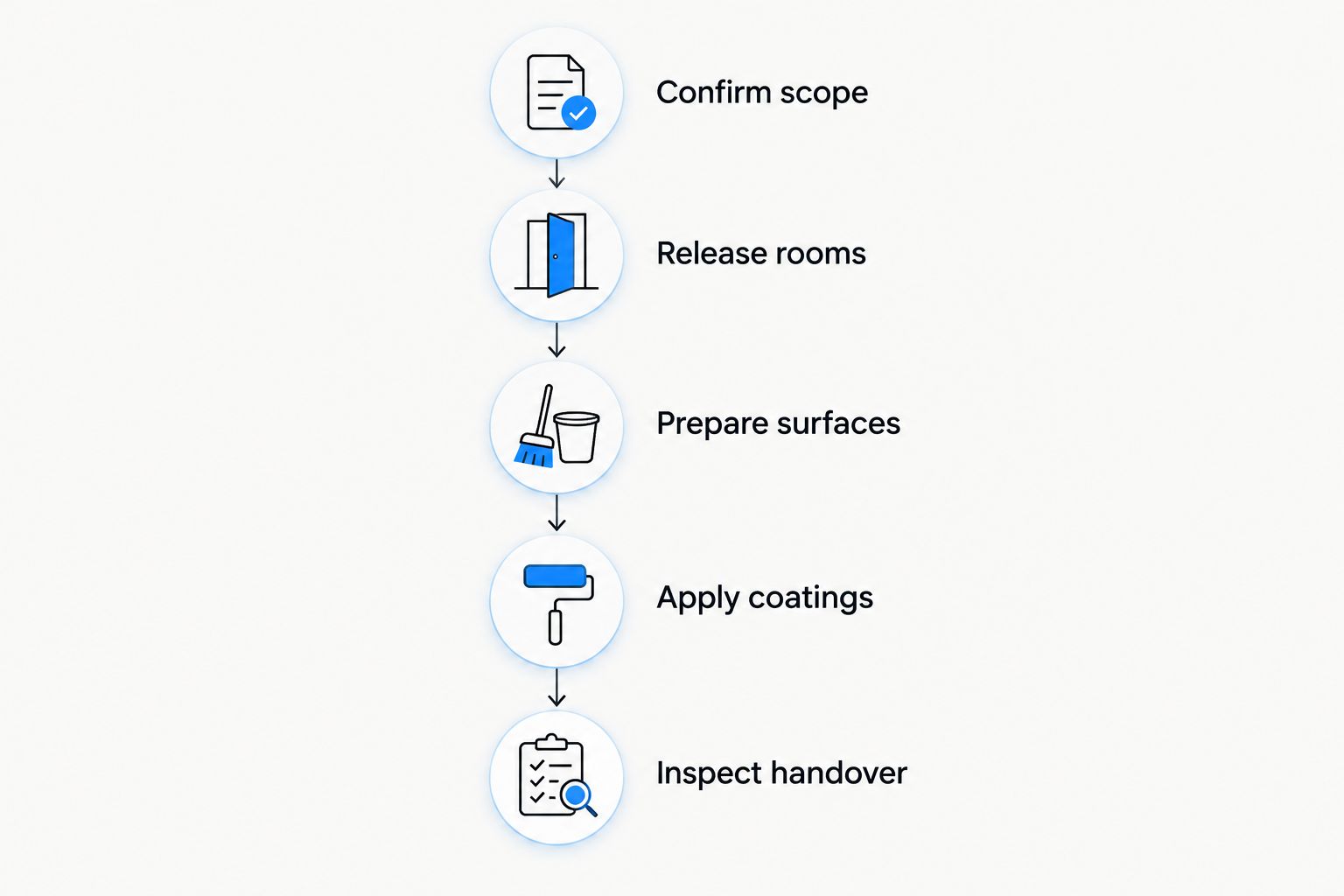
Use these milestones to assess the proposed sequence:
- Scope confirmed: identify every surface, finish, exclusion and repair.
- Work areas released: clear access and finish prerequisite trade work.
- Preparation accepted: complete repairs, sanding, cleaning and required priming.
- Coatings applied: follow the selected system’s application and recoat requirements.
- Handover completed: inspect finishes, resolve defects and confirm use restrictions.
Compare programmes with the same start and finish conditions. Otherwise, a shorter proposal can simply leave preparation or final defect work outside its stated duration.
Choose the access arrangement before fixing dates
An empty office, an occupied workplace and a staged fit-out place different demands on the painting programme. Choose the arrangement that matches your operational needs, then ask the contractor to explain its scheduling consequences.
| Work arrangement | Best for | Practical advantage | Limitation to programme |
|---|---|---|---|
| Vacant office | Tenancies with clear possession and no staff working inside | Clearer access to walls and room boundaries | Other fit-out trades still need coordinated access |
| Occupied office | Businesses retaining staff on site during works | Work can be separated from areas still in use | Furniture, access routes and occupant protection constrain the work area |
| Staged handover | Fit-outs releasing completed rooms progressively | Individual areas can progress without waiting for every room | Repeated protection, inspections and trade movements need coordination |
Vacant office: best for uninterrupted access
An empty tenancy removes the need to work around desks, stored files and staff movements. That makes access simpler, but it does not remove preparation, drying or curing requirements.
Confirm when the painting contractor receives the space exclusively. An office described as vacant can still be busy with electricians, joiners and flooring installers, so possession alone is not enough to establish productive access.
Occupied office: best for retaining workplace use
Painting an occupied office requires a room-by-room or zone-by-zone plan. Agree on barriers, safe access, ventilation arrangements and the conditions for returning each area to use.
The benefit is continued use of unaffected areas; the constraint is repeated setup and protection. Do not treat after-hours attendance as proof that staff can return without restrictions the next morning. Confirm the selected coating’s requirements and the actual site conditions.
Staged handover: best for progressive room release
A staged programme suits a fit-out where meeting rooms, work areas or amenities become ready at different times. Give each zone its own release, painting and acceptance milestones.
Staging provides flexibility, but finished rooms need protection from later work. Without controlled access, a completed room becomes a thoroughfare and the programme gains another round of repairs and touch-ups.
Build the painting sequence into your 2026 fit-out programme
Start with dependencies, not a preferred completion date. The following sequence gives you a practical basis for discussing the programme with your builder, facility manager and painting contractor.
Confirm scope
List walls, ceilings, doors, frames, skirtings and any other surfaces separately. Mark surfaces that remain unchanged, and resolve colour and finish selections before scheduling application.
Also identify what happens behind joinery, wall-mounted equipment and relocated partitions. A scope that says only “paint office” leaves too much room for disagreement about both duration and completion.
Release rooms
Confirm which prerequisite works must finish before painting begins in each room. Dust-producing work, incomplete repairs and repeated access to wall cavities can interfere with preparation and finished coatings.
Record who releases the area and what condition it must be in. A release should mean the painter can actually work, not merely that the room appears on the construction programme.
Prepare surfaces
Inspect existing coatings and substrates before agreeing on the preparation method. Loose paint, contamination, damaged plaster and unresolved moisture require attention rather than being hidden under a new finish.
Ask how newly discovered defects will be recorded and approved. That keeps an unexpected repair from becoming an unexplained gap between the planned start and actual coating application.
Apply coatings
Use the specified coating system and its current technical instructions to set application conditions and recoat intervals. Do not substitute a generic drying assumption for the requirements of the product being applied.
Record any conditions that prevent application or recoating. The programme should show the consequence of those conditions rather than assuming another coat can always proceed at the next scheduled attendance.
Inspect handover
Inspect the work under the agreed conditions and record defects by room or surface. Identify who approves rectification and who confirms the area is ready for the next activity.
Separate visual acceptance from permission to clean, move furniture against walls or attach fittings. Those activities place different demands on a fresh coating.
Why commercial painting time varies between office fit-outs
The biggest scheduling differences come from the work required and the conditions under which it happens. Use these factors when reviewing a 2026 proposal, rather than comparing completion dates without their assumptions.
- Surface condition: sound existing coatings require a different preparation scope from damaged plaster, peeling paint or stained areas.
- Surface quantity and detail: partitions, door frames, reveals and trim add work that a tenancy’s floor area does not describe.
- Coating specification: primer requirements, finish selection and manufacturer instructions determine the application sequence.
- Access restrictions: occupied rooms, furniture, building access rules and permitted working hours shape productive attendance.
- Site conditions: temperature, humidity and ventilation affect coating application and drying; use the selected product’s stated limits.
- Trade coordination: incomplete joinery, electrical changes and later damage create return visits or additional preparation.
Ask which assumptions support the completion date. A clear list of dependencies gives you something actionable when the fit-out changes; a bare finish date does not.
Coordinate painting, cleaning and furniture installation
Make the interfaces explicit. Painters need prepared surfaces and workable access, cleaners need to know which finishes they can safely clean, and furniture installers need permission to bring items through completed rooms.
For a 2026 handover, distinguish between construction cleaning, final presentation cleaning and any later cleaning restrictions on fresh coatings. Schedule each activity around the coating instructions and remaining trade work, rather than placing every task against the same completion milestone.
The distinction between application, drying and room release belongs in your office painting timelines: completing the final coat does not establish when installers can place furniture against it. Record both milestones so the move-in team does not interpret painting completion as unrestricted access.
Before releasing a room, confirm:
- Dust-producing work is complete or effectively separated.
- Fresh finishes are protected from equipment and delivery routes.
- Cleaners have the applicable coating-care instructions.
- Furniture placement and wall-fixing activities have been cleared.
- Any remaining restrictions reach the person managing occupation.
Avoid scheduling final presentation cleaning while trades still generate dust in the same area. If another trade must return, define how the room will be protected and who checks it afterwards.
What should your painting programme include in 2026?
A usable programme connects the scope to the handover conditions. It should let you identify what is happening, what must happen first and who resolves a delay.
Request room or zone names, surface descriptions, preparation requirements, coating selections and access arrangements. Add the expected work sequence, manufacturer-dependent waiting periods, inspection points and responsibilities for rectification.
Keep changes visible. If you add a partition, change a finish or delay room access, ask for the effect on the affected zone and downstream handover—not just confirmation that the variation has been received.
A written update is especially important when multiple people control access. Your builder, property manager and office relocation team need the same release conditions, not separate interpretations of a verbal promise.
Can painters finish faster with a larger crew?
A larger crew can divide suitable work areas, but it cannot remove the selected coating’s recoat requirements. Available space, safe access and the sequence of prerequisite work limit how much activity can happen together.
Ask which tasks the additional painters will complete concurrently. Extra labour is a useful scheduling proposal only when the contractor explains how it changes the actual work sequence without compromising preparation or application.
Can staff move in as soon as painting finishes?
Staff should return only after the responsible parties confirm that the area is suitable for its intended use. Final application, dry-to-touch condition and readiness for cleaning or furniture contact are different milestones.
Confirm ventilation, access and coating-care requirements before occupation. Include the office manager in that decision so staff receive clear instructions about furniture, wall contact and any areas still restricted.
Who suits a combined painting and maintenance scope?
OZLINK Facility Services is best suited to Brisbane facility managers seeking commercial painting alongside maintenance and builders cleans. Its stated services also include carpentry, commercial make-good works, and plumbing and electrical coordination.
That service mix is relevant when painting depends on repairs or forms part of a broader handover. It does not remove the need for an agreed coating specification, site-specific programme or clear responsibility for each trade.
When you discuss your fit-out scope, provide the site location, proposed occupation date, drawings, surface details and access constraints. Ask OZLINK Facility Services to distinguish its contracted work from items retained by your builder or other contractors.
FAQ
How long does commercial painting take for an office fit-out?
Commercial painting duration depends on preparation, surface quantities, coating requirements, access and trade sequencing. Request a site-specific programme that separates active work, recoat intervals and handover conditions.
Can our office be painted while staff keep working?
An occupied office needs a staged plan that separates painting from areas still in use. Agree on access, ventilation, protection and room-release conditions before work starts.
Does a bigger office always take longer to paint?
Floor area alone does not establish painting duration. Partition layouts, ceilings, doors, surface condition and access also determine the work required.
Can painters apply another coat as soon as the wall feels dry?
Recoat timing must follow the selected coating manufacturer’s instructions, not touch alone. Site conditions and the coating system determine when the next coat can proceed.
Should we book the final clean before or after painting?
Coordinate final cleaning after painting and remaining dust-producing work, while observing coating-care restrictions. Cleaners need to know which fresh surfaces they must leave untouched.
Can OZLINK Facility Services coordinate painting with other facility work?
OZLINK Facility Services lists commercial painting, maintenance, carpentry, builders cleans and commercial make-good works among its services. Confirm the contracted responsibilities and programme for your specific fit-out.
One last thing
A wall can pass its finish inspection and still need protection from the next contractor. That is why your final painting milestone should describe permitted use, not just appearance.
Before your 2026 move-in, ask for a room-by-room handover note covering unresolved defects, coating-care instructions and remaining access restrictions. Give that note to the people moving desks and cleaning walls—not just the person approving the invoice.