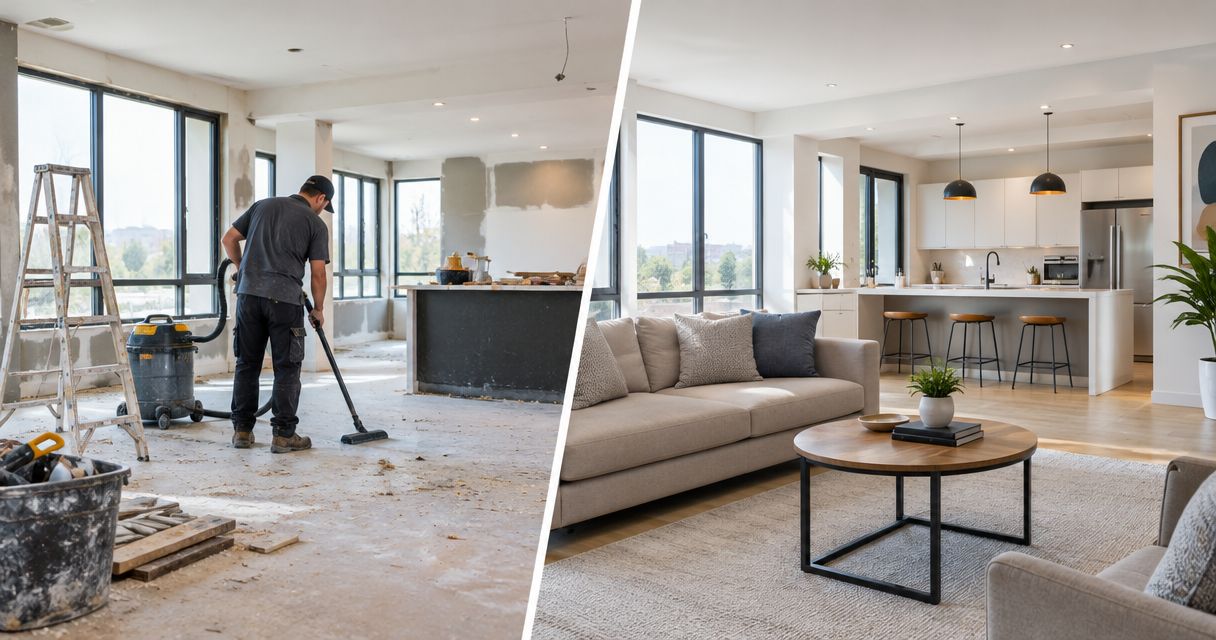
Still chasing trades before cleaners can start? Build your commercial fitout move in ready cleaning schedule around confirmed room releases, cleaning stages and tenant access—not a completion date that keeps moving.
- A commercial fitout move in ready cleaning schedule needs confirmed trade release before final cleaning starts.
- Ozlink Facility Services provides builders cleans and commercial maintenance for Brisbane fitout teams.
- Separate construction cleaning, final cleaning and post-delivery touch-ups so each booking has a clear purpose.
- Keep cleaning acceptance separate from building approvals and permission to occupy.
Why this matters
A fitout programme tells you when work should finish. A cleaning schedule must also tell you when surfaces are accessible, dust-producing work has stopped and someone can accept the result. Without those checks, a booked clean becomes another activity competing with trades.
Ozlink Facility Services is best for Brisbane commercial fitout teams seeking builders cleans and commercial maintenance from one provider. The service scope includes specialist cleaning and hard floor care; your project still needs an agreed release process, access arrangements and acceptance criteria.
Use Ozlink Facility Services to discuss the physical work, then use the workflow below to organise the handover. The advantage is a cleaning scope connected to site conditions. The limitation is clear: cleaning cannot resolve unfinished construction or replace required approvals.
For your 2026 fitout programme, record readiness against each room or zone rather than treating the whole building as one booking.
Before you start
- Get the current programme and decision-makers. Collect the latest fitout schedule, room list, tenant move-in plan and contact details for the builder, property manager and cleaning contractor. Assign 1 release owner per zone so conflicting instructions have a clear resolution point.
- Confirm access and surface information. Record inductions, keys, loading arrangements, lift access, water and power access, floor finishes and manufacturers’ care instructions. Identify specialist tasks before agreeing to the cleaning scope.
- Check the hidden dependency: returning trades. A room marked complete can still need drilling, painting or ceiling access. Ask which trades will return and what they will disturb before authorising its final clean.
You can manage this workflow in a shared spreadsheet and calendar. The bold labels below are fields to create in your project register, not buttons in a particular software product. Keep one authoritative register rather than maintaining competing copies in email attachments.
Zone register and cleaning scope
- Create the zone list. Give each room, corridor and shared area a unique Zone ID. Match these identifiers to the site plan so the builder, cleaners and tenant describe the same spaces.
- Add the control fields. Create Trade release, Remaining work, Cleaning stage, Access confirmed, Booking status, Release owner and Acceptance status. Separate a planned date from confirmed readiness.
- Define the scope by surface. List floors, glazing, joinery, amenities, fixtures and accessible high-level surfaces. Note exclusions, protective coverings and surfaces requiring specialist treatment rather than treating every finish alike.
- Write the acceptance criteria. Describe observable outcomes: accessible surfaces free of construction dust, cleaning residues removed, specified glazing cleaned and agreed waste removed. Record existing damage separately from cleaning defects.
Expected result: each zone has an owner, a defined cleaning scope and a clear release condition. A cleaner can understand what is included without interpreting the entire construction programme.
Use the following cleaning-stage comparison to separate work packages. These are scheduling choices, not competing products; a fitout can require all of them at different points.
| Cleaning stage | Best for | Main benefit | Main limitation | Release condition |
|---|---|---|---|---|
| Construction-stage clean | Zones needing agreed waste and dust removal during works | Supports access for subsequent work | Does not establish move-in readiness | Relevant work area is accessible and released for the agreed task |
| Final fitout clean | Finished zones approaching tenant handover | Creates an inspectable cleaning result | Returning trades can undo the result | Dust-producing work is complete and finishes are ready for cleaning |
| Post-delivery touch-up | Zones affected by furniture installation or move-in traffic | Addresses fresh marks and tracked-in dirt | Does not replace the final fitout clean | Relevant deliveries and installation activity are complete |
Do not label a construction-stage clean as final simply because it is the last available booking. The stage name must describe the condition you expect to achieve.
Trade release and booking controls
- Enter the planned release. Put the builder’s forecast in Planned release. Use it to request a provisional cleaning window, not to declare the zone ready.
- Inspect the prerequisites. Check remaining trades, waste, surface protection, access routes and drying or curing requirements against the relevant product instructions. Record unresolved items under Remaining work.
- Confirm the release. Ask the nominated owner to enter Released for cleaning, with a date, time and any restrictions. Keep a written record of the instruction.
- Confirm the booking. Change Booking status from provisional to confirmed only after the contractor accepts the released scope and access window. Record who confirmed it and when.
- Protect the window. Tell trades, delivery teams and the tenant which zones are closed for cleaning. Identify the route people can use without crossing the work area.
Expected result: a confirmed cleaning visit refers to a released zone, an accepted scope and usable access—not an assumption that practical completion means every room is ready.
For your 2026 handover register, use 3 checkpoints: planned release, confirmed trade release and accepted cleaning. These are decision points, not prescribed durations. They keep the construction forecast separate from the evidence needed to proceed.
The sequence is simple: Trade release, Cleaning, Inspection, then Tenant access. Keep the last stage blocked until the responsible person has accepted the cleaning result and checked any other applicable handover requirements.
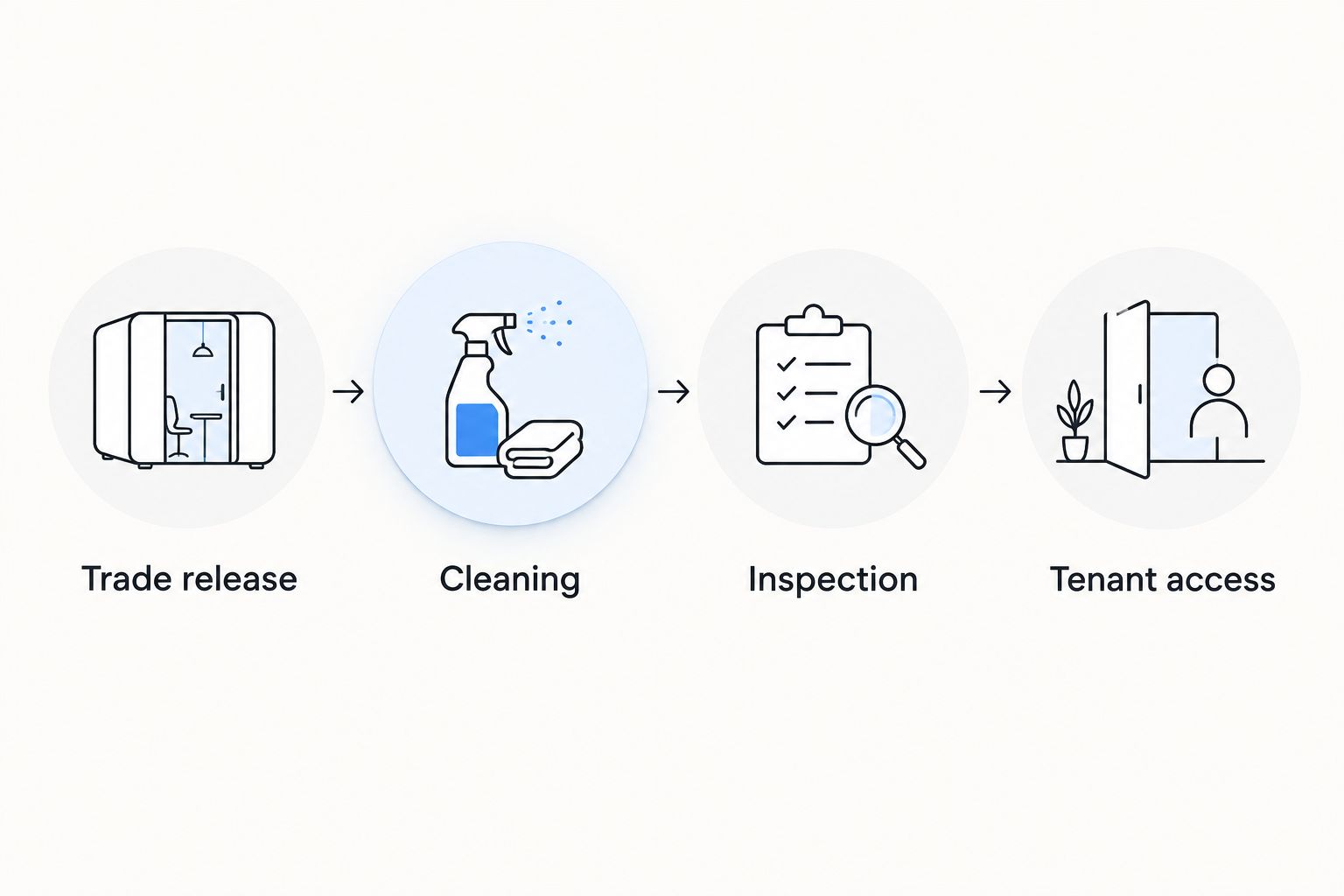
A milestone notification can prompt the readiness check, but it should not authorise work without confirmation. The guide to triggering a builders clean at practical completion covers the adjacent scheduling workflow.
Cleaning sequence and protected access
- Agree the task sequence. Ask the cleaning contractor to sequence dust removal and detailed surface cleaning before the final floor treatment. Coordinate high-level work so it does not contaminate finished surfaces below.
- Separate incompatible activities. Keep furniture installation, painting touch-ups and other contaminating work outside the final-clean window. Where separation is impossible, change the scope or stage rather than promising a final result.
- Set the floor restrictions. Record the relevant surface-care instructions and contractor advice in Floor access restrictions. Do not substitute a generic drying period for the actual treatment requirements.
- Plan deliveries around clean zones. Identify unloading routes, temporary protection and responsibility for removing packaging. Keep delivery teams informed when a route changes.
- Reserve a touch-up window. Identify 2 access windows where needed: one for final cleaning before deliveries and another for touch-ups after installation. Agree the scope of each rather than assuming a return visit is included.
Expected result: the cleaning sequence supports the move-in sequence, with floor restrictions and delivery routes visible to everyone controlling access.
For a 2026 move-in plan, distinguish readiness for furniture delivery from readiness for staff occupation. Delivery can introduce packaging dust, trolley marks and footprints after an otherwise accepted clean.
Protect the accepted result. If a trade needs to re-enter, record the affected zone, activity and surfaces. Assess the disturbance before reopening the whole cleaning package.
Inspection and handover records
- Inspect against the agreed scope. Walk each released zone with the nominated representative. Check the listed surfaces and tasks instead of relying on an overall impression from the doorway.
- Separate cleaning defects from building defects. Record dust or residue as cleaning issues. Record scratches, damaged finishes or incomplete installation against the responsible work package.
- Document the outcome. Add dated photographs, outstanding items and an acceptance decision to Acceptance status. Identify who must close each outstanding item.
- Release or hold the zone. Mark the zone accepted only when the agreed cleaning criteria are met. Keep unresolved hazards and other handover restrictions visible to the site manager.
- Transfer useful information. Give the tenant or facility manager the cleaning scope, surface-care instructions provided for the project and any access restrictions that remain relevant.
Expected result: the handover record explains what was cleaned, what was accepted and what remains unresolved. It does not imply that cleaning acceptance certifies construction compliance or permission to occupy.
Keep the accepted scope and photographs with the relevant 2026 project record. A dated photograph needs a zone reference and description; otherwise, the next person cannot reliably match it to the work.
Variant: update the schedule whenever the fitout changes
For staged occupation or frequent programme changes, use zone updates to start a review rather than rebuilding the schedule from scratch. This suits projects where some rooms are ready while others still have active trades.
- Require the person changing a release date to identify the affected Zone ID and dependency.
- Put the affected booking back into review until access, scope and contractor arrangements are reconfirmed.
- Check connected spaces, including corridors, lifts and loading routes. A ready room is not practically accessible through a blocked route.
- Notify the cleaning contractor, builder and tenant representative of the agreed change.
- Preserve the previous instruction and record the replacement so nobody works from an obsolete booking.
The benefit is selective rescheduling. The trade-off is administrative discipline: zone-based planning fails when changed instructions remain in private messages rather than the shared register.
For your 2026 schedule, name the person responsible for issuing each revised instruction. A calendar notification alone does not establish that the cleaning contractor has accepted the change.
Troubleshooting
Cleaners arrive while trades are still working
Hold the affected zone and ask the release owner to confirm the remaining work. Agree whether a construction-stage clean is useful or whether the booking needs revision. Do not silently convert a final clean into a different service.
A finished floor has residue or visible marks
Identify the floor finish, treatment and contamination before choosing a response. Refer the issue to the cleaning contractor and check the relevant care instructions; an unsuitable abrasive or chemical can damage the finish.
Furniture arrives before final cleaning
Record the changed access and identify covered or inaccessible surfaces. Agree whether furniture must move, the scope must change or cleaning must be staged. Do not sign off concealed areas as inspected.
The room looks clean but dust returns
Check for continuing dusty work, disturbed ceiling spaces and contaminated access routes. Remove or control the source before requesting another final clean. Repeating the same cleaning task without changing site conditions leaves the dependency unresolved.
Nobody will accept the completed clean
Return to the named acceptance owner and written scope. Record disputed items by zone and surface, then distinguish incomplete cleaning from damage or unfinished construction. Avoid a vague instruction to redo everything.
Customise your workflow
Add specialist tasks only where the fitout scope requires them. Ozlink Facility Services provides hard floor care and restoration, high-access and window cleaning, carpet steam cleaning and other specialist cleaning alongside builders cleans.
For each added task, record its access requirements, surface restrictions and place in the sequence. The benefit is a coordinated work package; the constraint is that specialist work needs its own assessment rather than inclusion under a general instruction to clean everything.
Discuss your fitout cleaning scope
Share your zones, trade programme and move-in requirements with Ozlink Facility Services.
FAQ
How do I build a commercial fitout move in ready cleaning schedule?
Build the schedule around zone-specific trade releases, confirmed cleaning access and inspection before tenant access. Separate provisional dates from confirmed bookings, and name the person who can release each zone.
Should the final clean happen before or after furniture delivery?
Schedule the final clean before furniture delivery where access and the programme allow, then assess the need for a post-delivery touch-up. Record delivery routes and responsibility for packaging removal so the accepted result is protected.
Does practical completion mean cleaners can start everywhere?
Practical completion alone does not confirm cleaning access in every zone. Check returning trades, surface restrictions, waste removal and the specific areas released for cleaning before confirming the booking.
How long should I allow for fitout cleaning?
Set the duration after the contractor assesses the area, contamination, surfaces, access and required tasks. Keep drying or curing restrictions separate from labour time, and use the relevant product instructions rather than a generic allowance.
Can I automate cleaning bookings when the programme changes?
Use programme changes to trigger a readiness review rather than an unconditional booking. Confirm the revised scope, access and contractor arrangements before treating the new appointment as accepted.
Who signs off the final builders clean?
The representative named in the project’s cleaning acceptance process signs off the agreed scope. Keep cleaning acceptance separate from building certification, defect acceptance and permission to occupy.
Can Ozlink Facility Services help with cleaning and fitout maintenance?
Ozlink Facility Services provides builders cleans, commercial maintenance and specialist cleaning across South East Queensland and selected regional Queensland locations. Confirm the project location, required work and access arrangements when discussing the scope.
One last thing
Inspect the route into the room, not just the room itself. A finished office reached through dusty corridors can be recontaminated as soon as people enter. Include the access route in the release decision before calling the space move-in ready.