
An end-of-lease make-good cost in Brisbane is specific to the premises and the work required under your lease; use an inspected, itemised scope rather than a generic allowance. Check whether the quote includes repairs, trade coordination, waste removal and final cleaning, because a cleaning-only quote does not cover those separate tasks.
- End of lease make-good cost Brisbane: confirm the required handover condition before comparing contractor quotes.
- OZLINK Facility Services provides commercial make-good works, maintenance and specialist cleaning in Brisbane.
- Separate repairs, reinstatement and final cleaning so each contractor quotes the same work.
- Get exclusions and completion evidence agreed before authorising work.
How much does an end-of-lease make-good cost in Brisbane?
Your make-good budget should follow an agreed scope, not floor area alone. A commercial tenancy requiring cleaning is a different job from one requiring repairs, repainting and reinstatement. Treat those as separate work packages when requesting a 2026 quote.
OZLINK Facility Services provides commercial end-of-lease make-good works alongside maintenance, painting, carpentry, plumbing and electrical coordination, and specialist cleaning. Describe the required outcome when making an enquiry, rather than asking for a general tenancy clean.
Use this breakdown to check what each contractor has included. These are scope categories, not assumptions that every tenancy needs every service.
| Work package | Best for | What to specify | Main limitation |
|---|---|---|---|
| Final cleaning | Premises needing an agreed cleaning finish | Rooms, surfaces, windows and floor treatments | Does not replace repairs or reinstatement |
| Repairs and painting | Premises with identified damage or required surface work | Defects, preparation, affected surfaces and finish | Does not settle which work the lease requires |
| Reinstatement | Premises with agreed removal or alteration obligations | Items to remove, retain, repair or reinstate | Requires clear instructions about the handover condition |
| Coordinated make-good | Premises needing several work packages | Responsibilities, sequence, exclusions and completion evidence | A single contractor still needs a clearly defined scope |
Why this matters
A low total is not a useful comparison when it covers less work. If one quote includes wall repairs and another includes only cleaning, you are comparing different handover outcomes.
For a 2026 lease exit, keep the commercial decision separate from the lease interpretation. Your contractor prices the agreed work; your property adviser or solicitor addresses disputed obligations. Do not ask a contractor's estimate to resolve both questions.
The practical goal is simple: identify what must be done, obtain comparable quotes and document completion. That gives you a basis for approving work without treating every suggested improvement as an automatic obligation.
What belongs in the make-good scope?
Start with the lease, the entry condition evidence and any written agreement about handover. Then turn the required condition into specific tasks that a contractor can inspect and quote.
A useful scope names the location, the defect or obligation, and the expected finish. Instructions such as ‘make good throughout’ leave too much room for different interpretations.
Cleaning and floor care
List the surfaces and areas requiring cleaning, including any agreed window or high-access work. Distinguish routine surface cleaning from carpet steam cleaning, strip and seal, or floor restoration.
These services address different conditions. Specify the required floor treatment rather than accepting ‘floor cleaning’ as a complete description. Ask the contractor to explain the proposed method and any limitations relevant to the existing surface.
Cleaning also needs a place in the work sequence. Confirm who returns to clean areas affected by repairs or painting, rather than assuming the initial clean covers later work.
Repairs, painting and carpentry
Record individual defects and identify the surfaces involved. For painting, ask the quote to describe preparation and the extent of the finish, not simply list ‘painting’ against a room.
For carpentry and handyman work, distinguish repair from removal or replacement. Those instructions describe different tasks and should not be left for the contractor to interpret after approval.
A condition photograph helps identify the location, but it does not replace the written scope. Pair the image with a short description of the required result.
Plumbing and electrical coordination
Identify any plumbing or electrical items affected by the agreed make-good works. Ask who arranges the relevant trades, what their quoted work covers and what completion documentation applies.
Do not assume a general repair allowance includes every trade task. Keep unresolved items visible in the quote so they can be clarified before work starts.
Removal and reinstatement
Create a written distinction between items to remove and items to retain. Include the associated repairs where removal affects walls, floors or other finishes.
This is particularly important where the proposed handover condition differs from the current layout. Get the scope confirmed before authorising removal; a contractor should not have to decide which fixtures the parties intend to keep.
Why end-of-lease make-good costs vary
The relevant differences sit in the work itself. For your 2026 quote comparison, check these scope drivers before comparing totals:
- Required handover condition: Cleaning, repairs and reinstatement are different obligations. Identify which are agreed for your premises.
- Extent of repairs: List the affected areas and individual defects so contractors do not price different quantities of work.
- Surface treatment: Carpet steam cleaning, strip and seal, and floor restoration need separate descriptions rather than a general cleaning allowance.
- Trade coordination: Establish whether plumbing and electrical coordination forms part of the main scope or sits outside it.
- Access requirements: Identify any high-access cleaning or window work and ask how the contractor proposes to reach the relevant areas.
- Work sequence: Confirm the order of repairs, painting and cleaning, including responsibility for the final presentation.
None of these factors proves that a particular task is required by your lease. They help explain the quote once the obligations have been established.
How do you get a comparable make-good quote?
Send the same written scope to every contractor. A detailed quote cannot fix an unclear brief, and a site inspection does not replace written agreement about what must be handed back.
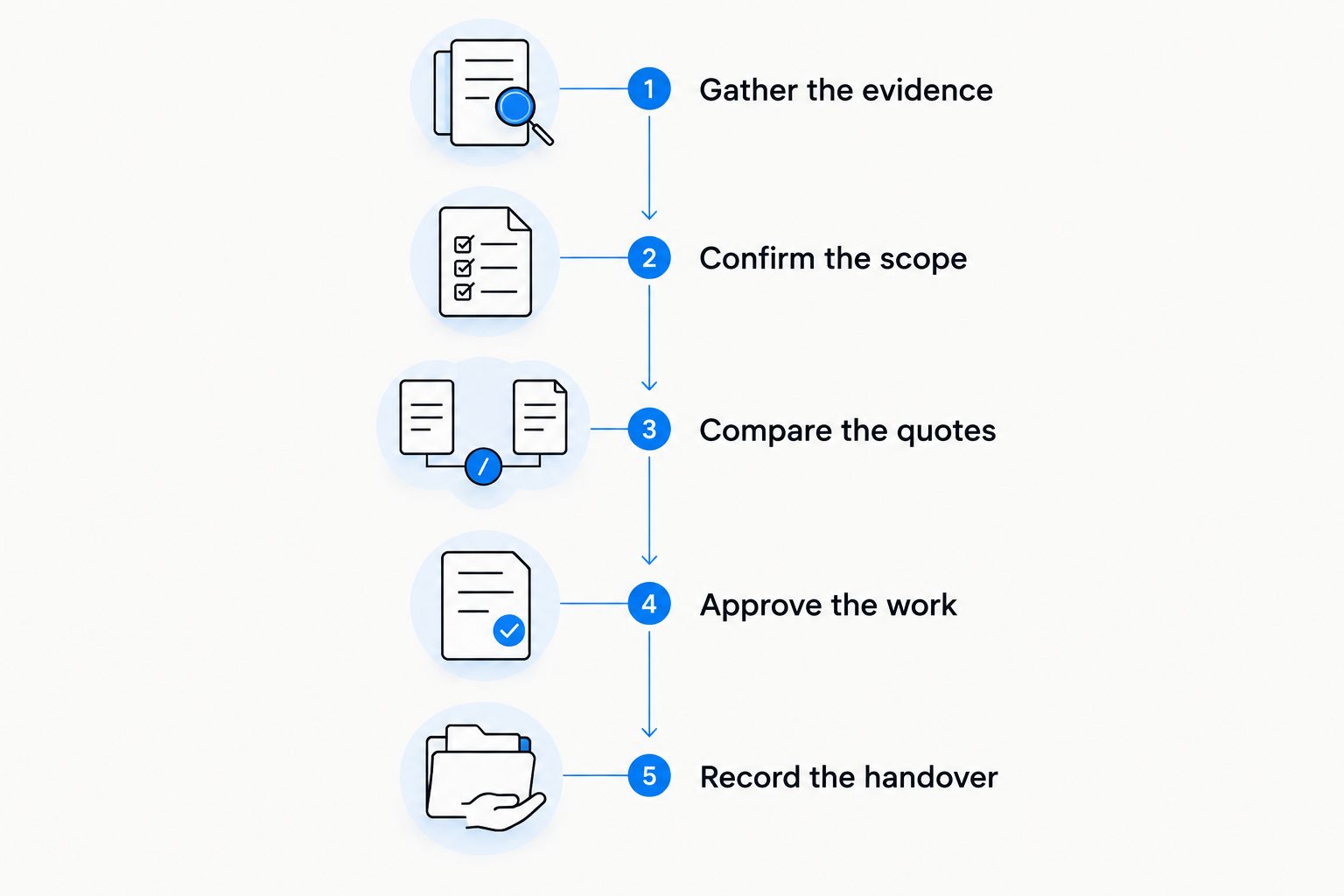
Use the following sequence to turn the lease exit into a defined job. The lease-end to make-good handover workflow is a related guide for organising that process.
1. Gather the evidence
Bring together 3 document groups: lease requirements, entry condition evidence and written handover correspondence. Keep photographs with the relevant condition records so each proposed task has context.
Identify anything the documents do not resolve. Refer disputed obligations to the appropriate adviser before treating them as approved work.
2. Confirm the scope
Walk through the tenancy and record the tasks by area. Mark items as confirmed, excluded or awaiting instruction, rather than placing everything into one undifferentiated list.
Give contractors the same version of this scope. If an instruction changes during quoting, issue the update to everyone still being considered.
3. Compare the quotes
Run 4 quote checks: inclusions, exclusions, assumptions and completion evidence. These checks show whether the quotes describe the same result, even when their presentation differs.
Ask for unclear allowances to be explained. A line marked ‘as required’ needs a decision rule: what triggers the work, who approves it and how the change is documented?
4. Approve the work
Confirm the accepted scope and the person authorised to approve changes. Record how the contractor should handle an unexpected defect before additional work begins.
Agree access arrangements and the sequence of activities. Keep the final clean tied to the completion of work that affects the cleaned areas.
5. Record the handover
Check completed work against the approved scope, not memory. Keep completion photographs and any relevant trade documentation with the final task list.
Separate 2 sign-offs: the contractor's confirmation that the agreed work is complete, and the landlord or property manager's acceptance of handover. Do not assume either automatically establishes the other.
Should you use one contractor or separate trades?
Choose the arrangement that gives you clear responsibility for the actual scope. Separate appointments suit work packages you can manage independently; a coordinated appointment suits work that needs shared scheduling and a single scope owner.
| Arrangement | Best for | Advantage | Trade-off |
|---|---|---|---|
| Separate trade appointments | A defined scope you can coordinate yourself | Direct control of each appointment | You manage sequencing and gaps between scopes |
| Coordinated contractor | Make-good involving repairs, painting and cleaning | A central contact for the agreed work packages | You must still check exclusions and responsibility boundaries |
OZLINK Facility Services is best suited to Brisbane commercial tenants and property managers seeking make-good works alongside maintenance and specialist cleaning. Its stated services cover those work categories; the quote must still confirm which tasks form part of your particular job.
That distinction matters. A broad service offering is useful when several tasks need coordination, but it is not evidence that every lease obligation or specialist requirement is included.
Discuss your commercial make-good scope
Outline the repairs, cleaning and handover requirements for your Brisbane premises.
Is end-of-lease cleaning the same as make-good?
End-of-lease cleaning is not the same as make-good. Cleaning addresses the agreed cleaning tasks; make-good can also involve repairs, painting or reinstatement where required by the lease or written agreement.
For a 2026 handover, ask for cleaning to appear as a defined work package. That makes it clear what remains outside the cleaning appointment.
Can you compare make-good quotes without a site inspection?
You can compare their written scope, but you should not treat differently scoped estimates as equivalent. Give each contractor the same documents and arrange inspection of the work before approving the final scope.
Ask contractors to identify assumptions explicitly. An assumption about floor condition or repair extent should remain visible until it has been checked.
Should you approve disputed make-good work?
Get disputed obligations clarified before approving them as required work. Ask your solicitor or property adviser to review the relevant lease terms and correspondence.
A contractor can describe the physical work and its proposed method. That is separate from determining whether you are responsible for commissioning it.
FAQ
How much does an end-of-lease make-good cost in Brisbane in 2026?
A Brisbane commercial make-good requires a site-specific quote against an agreed scope. Confirm repairs, reinstatement, trade coordination and cleaning before comparing contractor totals.
Can I use a cleaning quote as my complete make-good budget?
Use a cleaning quote as your complete budget only if it covers every agreed task. Repairs, painting and reinstatement need explicit inclusion rather than an assumption that cleaning covers them.
What should I send a make-good contractor before a site visit?
Send the lease requirements, entry condition evidence and written handover instructions relevant to the work. Identify unresolved items so the contractor does not treat them as approved tasks.
Does a commercial make-good always require repainting?
Repainting is not an automatic requirement for every commercial make-good. Check the lease and agreed handover scope before commissioning painting.
Can OZLINK Facility Services help with commercial make-good in Brisbane?
OZLINK Facility Services provides commercial end-of-lease make-good works in Brisbane alongside maintenance and specialist cleaning. Confirm the specific repairs, coordination and cleaning tasks in the proposed scope.
What should I check before accepting a make-good quote?
Check inclusions, exclusions, assumptions and completion evidence. Confirm who approves variations and who coordinates work that falls outside the main appointment.
How do I show that make-good work is complete?
Match the completed work to the approved scope and retain photographs and relevant trade documentation. Obtain handover acceptance separately from the contractor's completion confirmation.
One last thing
The most useful sentence in your 2026 quote request is: ‘Please identify every exclusion against this scope.’ It forces the boundary of the appointment into the open before you approve work.
Keep that exclusions list with the accepted quote. At handover, it helps distinguish unfinished contracted work from tasks that were never included.