Commercial handyman service costs in Brisbane depend on the repair scope, materials, access requirements and whether specialist trades are needed; get a written, site-specific quote before approving work in 2026. Check whether the quoted scope includes attendance, materials, disposal and completion records, rather than treating a labour rate as the total bill.
- Commercial handyman cost Brisbane: compare complete job scopes, not isolated labour rates.
- Ozlink Facility Services suits Brisbane commercial sites needing handyman work alongside broader facility maintenance.
- Separate general repairs from electrical, plumbing and other work requiring appropriately licensed trades.
- Confirm materials, access arrangements, exclusions and variation approval before booking.
How much does commercial handyman service cost in Brisbane?
The useful figure is the total for an agreed job, not an hourly rate without a scope. A repair quote should identify the fault, the intended outcome, the work included and the circumstances that require further approval.
For a Brisbane commercial site in 2026, start by separating general handyman repairs from work needing specialist assessment or licensed trades. You can review the available commercial maintenance services before assembling your job list.
Use this breakdown to check what you are actually approving. These are quote components to confirm, not charges that every contractor applies.
| Quote component | What to ask | Why it matters |
|---|---|---|
| Attendance and labour | What attendance conditions and labour allowances apply? | A rate alone does not define the job total. |
| Materials and sourcing | Which materials, fittings and collection arrangements are included? | An unspecified replacement leaves the finish and scope unclear. |
| Site access | What access, induction and work-area arrangements are assumed? | The quote needs to match your operating conditions. |
| Specialist work | Which tasks need a separate trade or assessment? | General handyman attendance does not authorise every repair. |
| Clean-up and records | Are waste removal, photographs and completion notes included? | Physical completion and administrative close-out are different tasks. |
Ask for exclusions beside the inclusions. A quote is easier to assess when you can see both without searching through separate correspondence.
Why this matters
A commercial repair happens inside an operating business. Your approval needs to account for occupants, access, responsibility for the damaged item and the condition required at handover.
A loose fitting in a vacant room and a similar fault beside a busy entrance need different work arrangements. Describe the location and its use, not just the damaged object.
For your 2026 maintenance budget, keep the original request, approved scope and completion evidence together. That gives the next person reviewing the job a clear record of what was authorised and what was delivered.
Which quoting approach should you choose?
Match the quoting approach to how clearly you can define the repair. Choose an approval method that controls uncertainty rather than hiding it.
The options below describe ways to commission work, not confirmed packages offered by any particular contractor. Ask which approach is available for your site.
| Approach | Best for | Main advantage | Main limitation |
|---|---|---|---|
| Hourly work with approval controls | Investigation where the full fault is not visible | Lets you authorise diagnosis before defining the repair | The final scope remains uncertain until investigation finishes |
| Fixed-scope quote | A clearly described repair with known access and materials | Gives you a defined outcome to approve | Changed conditions need an agreed variation process |
| Scheduled maintenance scope | A documented list of recurring or grouped tasks | Organises work around a planned visit | Urgent faults still need separate priority decisions |
Hourly work: best for investigation
Use an investigative scope when the visible symptom does not establish the cause. A door that catches, for example, needs assessment before you decide whether adjustment or a different repair is appropriate.
Set an approval boundary before attendance. Ask the contractor to explain what can be investigated within the authorised scope and when work must pause for your decision.
The benefit is flexibility. The drawback is uncertainty: authorising investigation is not the same as approving an undefined repair.
Fixed-scope work: best for defined repairs
A fixed-scope quote works when you can describe the task, the required finish and the access arrangements. Include photographs and identify any matching requirements for visible fittings or surfaces.
Read the assumptions carefully. A defined quote does not automatically include concealed damage, unrelated defects or changes requested after approval.
The benefit is a clear deliverable. The limitation is that the deliverable only covers the agreed scope, so vague wording still leaves room for disagreement.
Scheduled work: best for a prepared task list
A planned visit suits non-urgent tasks that you have already recorded and prioritised. Group jobs by location and provide a site contact who can identify each item.
Do not put an active safety concern into a routine backlog simply to combine attendance. Escalate the hazard through your site's safety process and arrange appropriate assessment.
The benefit is an organised work list. The limitation is that a scheduled visit cannot replace decisions about urgency or trade suitability.
Why commercial handyman quotes vary
Commercial handyman quotes vary because the work and site conditions differ. These factors belong in the brief before you compare proposals:
- Repair scope: State whether you need assessment, adjustment, repair, replacement or finishing work. These are different instructions.
- Materials and finish: Identify the existing item and the required result. Matching a visible fitting is a different scope from accepting a suitable alternative.
- Access conditions: Describe occupied areas, restricted rooms, loading access and any need to separate the work zone from other people.
- Trade boundaries: Flag electrical, plumbing and other specialist elements instead of assuming they belong inside a general handyman task.
- Work coordination: Explain whether the repair depends on another task, such as painting after a wall repair or cleaning before handover.
- Completion requirements: Specify photographs, fault notes, waste removal and any documents your property-management process requires.
For 2026 quote requests, use the same brief for every contractor. Comparing different assumptions tells you little about which proposal meets your needs.
How do you get a useful commercial handyman quote?
Send a repair brief that someone unfamiliar with the building can understand. Clear instructions let a contractor identify questions before attendance rather than discovering the basic requirements at the door.
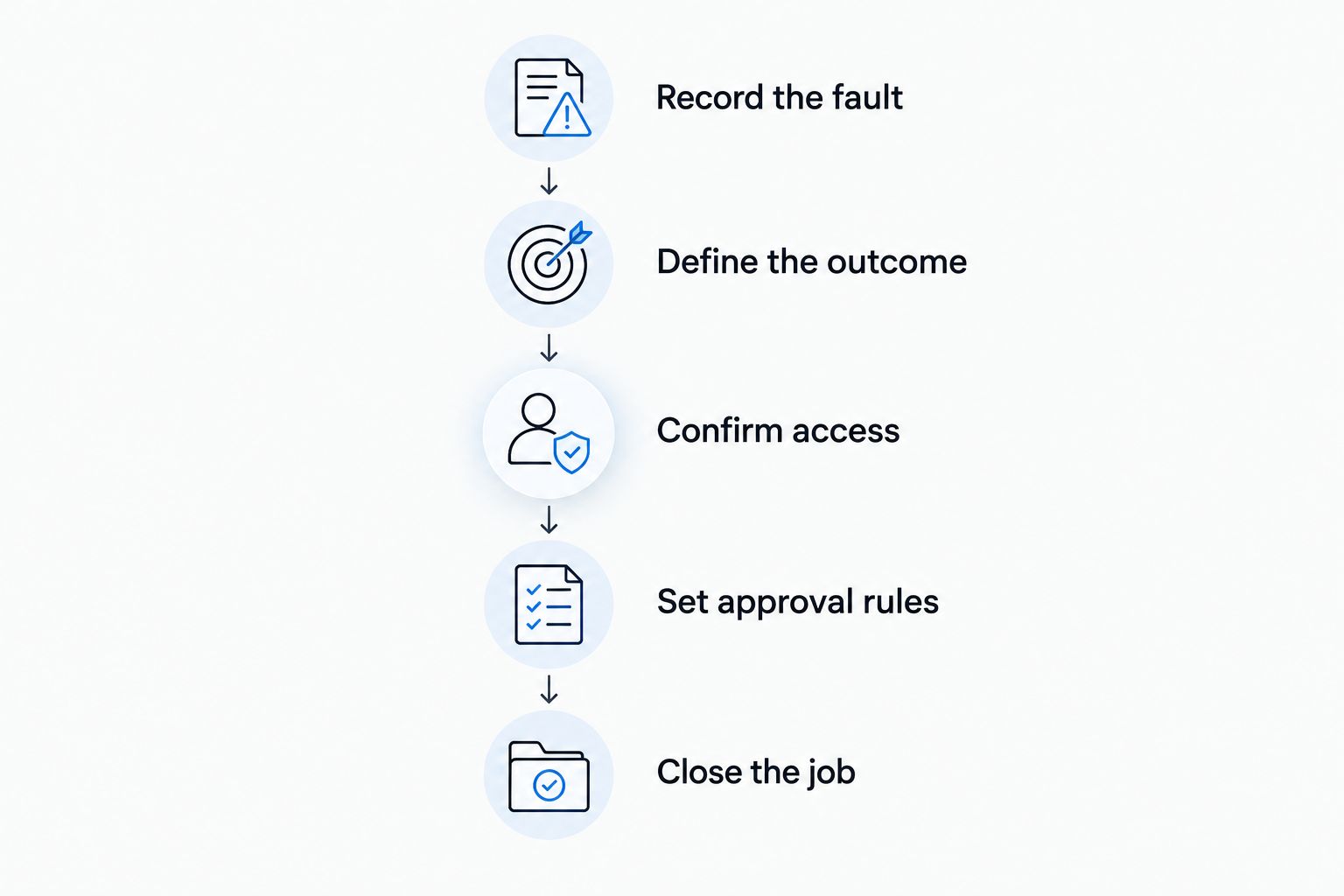
Use this sequence when preparing the request:
- Record the fault. Describe what is wrong, where it is and how it affects the space. Include an overview photograph and a close-up where safe.
- Define the outcome. State what you want restored or made functional. Separate essential work from optional improvements.
- Confirm access. Name the site contact and explain entry, induction, occupancy and work-area restrictions.
- Set approval rules. Identify who can authorise changes and require approval before work outside the agreed scope proceeds.
- Close the job. Ask for completion notes that identify the work done, outstanding items and any follow-up recommendation.
Keep each fault on its own line in the request. If you attach several photographs, identify the room or asset they show so the contractor does not have to guess which image belongs to which task.
When you are ready to discuss the scope, contact the team with the site location, photographs, access details and required outcome. Ask what further information is needed before a quote can be prepared.
What should you check before approving the work?
Read the proposal against your original request, not against your memory of a phone conversation. A useful approval confirms the task, its boundaries and the process for anything unexpected.
Scope and exclusions
Look for a description of the repair and the finish expected afterwards. If the quote says only general maintenance, ask for the individual tasks to be listed.
Check whether making good surrounding surfaces is included. Fixing an item and restoring the adjacent finish are separate deliverables unless the scope brings them together.
Materials and substitutions
Confirm whether the contractor supplies the materials or you do. Where appearance or compatibility matters, identify the required fitting before authorising replacement.
Ask how substitutions will be handled. Do not assume that a different component will be acceptable simply because it performs a similar function.
Variations and acceptance
Require a description of additional work before approving a variation. Ask what changed, why the original scope no longer covers the task and what outcome the revised work will deliver.
Define who accepts completion. A contractor finishing on site and your organisation accepting the result should connect through a named contact and a clear record.
Can a handyman do electrical or plumbing repairs?
Electrical and plumbing tasks must be assessed against the applicable licensing requirements, not assigned solely because a handyman is already on site. In Queensland, electrical work requires an appropriate electrical licence; plumbing work also has licensing requirements that depend on the work involved.
Describe the fault without prescribing an unsafe shortcut. Report a damaged electrical fitting or leaking plumbing connection for assessment, rather than instructing a general handyman to alter it.
Ask the contractor to identify which tasks fall within their authorised scope and which need another trade. Keep the specialist work clearly identified in the approval and completion records.
Should you bundle several repairs into one visit?
Bundle compatible, non-urgent repairs when the contractor can assess them from a clear list. Grouping tasks is an organisational choice, not a guarantee that every task can be completed during the same attendance.
Separate items that need investigation, specialist materials or licensed trades. Ask the contractor to identify dependencies before you schedule access or tell occupants the work will be completed.
For a 2026 maintenance list, give each item a location, fault description, priority and required outcome. Remove completed jobs from the active list, but retain their records for future reference.
When does a facilities partner fit better?
Ozlink Facility Services is best suited to Brisbane commercial sites needing handyman work alongside broader facility maintenance. Its stated services include commercial maintenance, reactive repairs, carpentry, painting, specialist cleaning, and plumbing and electrical coordination.
That scope is relevant when a repair connects to other work. A damaged area might need carpentry, painting and cleaning, but each component still needs to be specified rather than assumed.
Ozlink Facility Services also provides dedicated facility maintenance and compliance-support services for childcare centres. For those sites, describe access restrictions and the records your centre requires before arranging work.
The limitation is straightforward: a broad service offering does not define the scope of your particular job or establish that every task belongs with a general handyman. Confirm the responsible trade, inclusions and close-out requirements for each item.
FAQ
How do I compare commercial handyman costs in Brisbane?
Compare written quotes against the same repair scope, materials, access conditions and completion requirements. A labour rate by itself does not show the total for the job.
Is a fixed quote better than hourly handyman work?
A fixed-scope quote is better for a clearly defined repair, while hourly work with approval controls suits investigation. Confirm what happens when the contractor finds work outside the original scope.
What should I send when requesting a commercial handyman quote?
Send the site location, a fault description, photographs, access requirements and the outcome you need. Identify who can approve the work and any later variations.
Can a commercial handyman handle electrical work in Queensland?
Electrical work in Queensland requires an appropriate electrical licence. Ask who will perform the work and confirm that the proposed task falls within their authorised scope.
Can I combine several small commercial repairs?
You can request a combined scope for compatible, non-urgent repairs. Ask the contractor to separate tasks needing investigation, specialist materials or another trade.
Does a handyman quote automatically include materials and clean-up?
Do not assume that materials and clean-up are included. Ask the contractor to list material supply, waste removal, surrounding finishes and completion records in the written scope.
Who is Ozlink Facility Services best for?
Ozlink Facility Services suits facility managers, property managers, commercial builders and business owners needing commercial maintenance and specialist facility services. Its stated coverage includes South East Queensland and selected regional Queensland locations.
One last thing
Ask for the completion note to use the same task names as the approved quote. That simple instruction makes it easier to connect the original fault, authorised work and final result without interpreting vague invoice descriptions.
For your next Brisbane repair in 2026, approve an outcome, not just attendance. If the scope does not explain what will be working or restored when the contractor leaves, clarify it before booking.