
To reduce reactive maintenance costs in commercial buildings, stop repeat faults, separate urgent hazards from schedulable repairs, and give contractors complete information before attendance. Keep emergency response available: the goal is fewer avoidable call-outs, not delayed repairs that put people or the building at risk.
- Reduce reactive maintenance costs by tracking repeat faults and scheduling corrective work before another breakdown.
- Prioritise safety and building operation before grouping non-urgent repairs into planned visits.
- Ozlink Facility Services provides commercial maintenance and reactive repairs for Brisbane and South East Queensland facilities.
- Judge maintenance performance by resolved faults, repeat attendance and complete records—not invoice totals alone.
How to reduce reactive maintenance costs for commercial buildings?
Replace disconnected repair requests with a controlled process: report, assess, authorise, repair and verify. Then use the repair history to decide which assets need planned attention. Your reactive maintenance ticket workflow should preserve that history rather than end when an invoice arrives.
Use these steps for your 2026 maintenance plan:
- Record faults against a specific asset or location.
- Assess safety, damage and operational consequences.
- Give the contractor enough information to prepare.
- Set approval responsibilities before work starts.
- Combine compatible, non-urgent tasks.
- Investigate recurring failures.
- Verify completion and retain repair records.
- Review outcomes before changing the maintenance budget.
Do not make every asset subject to the same maintenance approach. Choose according to failure consequences, asset condition and the information available.
| Maintenance approach | Best for | Benefit | Limitation |
|---|---|---|---|
| Reactive repair | Unexpected faults requiring attention | Addresses an immediate problem | Does not, by itself, prevent recurrence |
| Planned maintenance | Known servicing needs and recurring inspection tasks | Makes work scope and access easier to organise | Poorly chosen tasks create activity without addressing failure risks |
| Condition-based attention | Assets with observable wear or deterioration | Connects intervention to recorded condition | Depends on reliable observations and competent assessment |
Use a mix, not a blanket switch to planned maintenance. An urgent fault still needs a response, while a recurring defect needs more than another temporary fix.
Why this matters
A repair invoice does not show every consequence of a breakdown. Record disrupted access, unavailable spaces, repeat attendance and time spent arranging the work alongside the repair itself. Keep these records factual; do not assign financial values you cannot substantiate.
For your 2026 review, distinguish reduced expenditure from postponed work. A smaller invoice total is not a better result if unresolved defects remain on the register or the same fault keeps returning.
Build a repair process that prevents repeat work
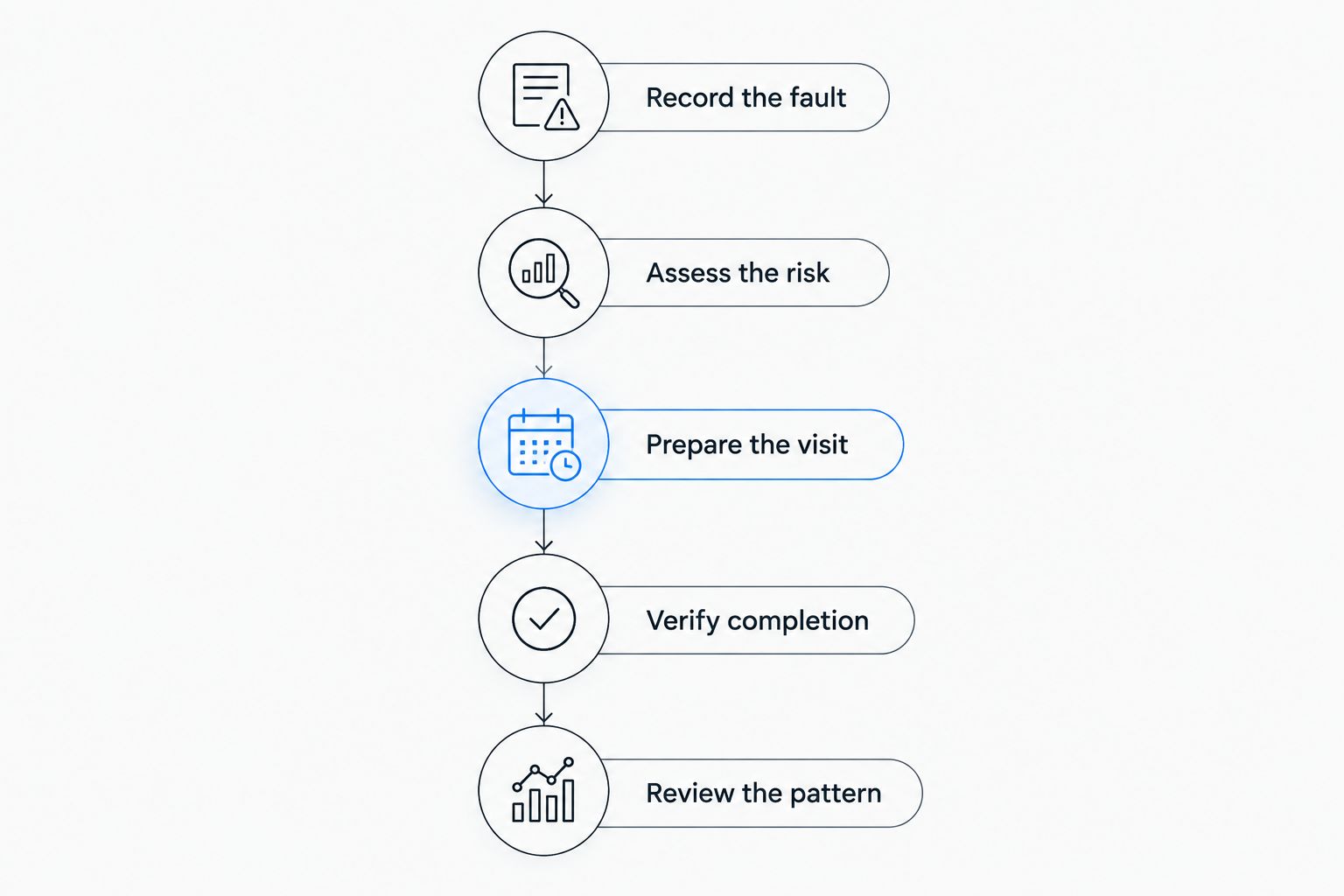
Record the fault
Give each request an identifiable location and asset description. Include what happened, when staff noticed it, whether the problem is continuing and any previous repair reference. A photograph helps show visible damage, but it does not replace a clear description.
Avoid reports such as “door broken”. State which door, whether it closes and latches, and how the fault affects access. Do not ask staff to operate unsafe equipment or enter a hazardous area to improve a report.
Make the reporting channel clear to tenants, cleaners and site staff. Duplicate requests should attach to the existing job, not become separate instructions to different contractors.
Assess the risk
Separate immediate safety concerns from faults that can wait for an agreed visit. Assess the consequences of delay, not just how inconvenient the defect feels to the person reporting it.
Where necessary, restrict access and follow the site's emergency procedures. Electrical, plumbing and other specialist faults need assessment by appropriately qualified people; a facility manager's priority label is not a technical diagnosis.
Document why a job was treated as urgent or scheduled. That decision record helps explain the response later without relying on someone's memory.
Prepare the visit
Send the contractor the fault description, photographs, known asset information and relevant repair history before attendance. Confirm the site contact, entry arrangements and any restrictions on access or work areas.
Ask what information is needed to prepare the visit. Do not assume a photograph establishes the cause or that parts can be selected without inspection. The purpose is better preparation, not an unsupported promise of completion on arrival.
For occupied commercial buildings, identify who can authorise isolation, unlock service areas and communicate with occupants. Those responsibilities belong in the job instructions.
Set approval rules
State who can approve investigation, corrective work and changes to scope. Distinguish permission to inspect from permission to carry out every repair the inspection identifies.
Ask contractors to explain the diagnosed fault, proposed remedy and any exclusions before additional work proceeds. Record approvals against the job rather than leaving them scattered across messages.
Emergency arrangements need their own instructions. Define how contractors should contact the responsible person and what site procedures apply when an immediate hazard is identified. Do not let an unclear approval chain delay necessary safety action.
Group suitable work
Combine non-urgent tasks when they suit the same trade, location and access arrangements. For example, review minor carpentry defects together rather than issuing unrelated requests without checking the existing backlog.
Grouping is not permission to defer hazards. Keep urgent work separate, and confirm that combining tasks does not prevent occupants from using essential areas safely.
Give the contractor an agreed task list before the visit. An open-ended instruction to fix whatever staff mention makes it harder to control scope, confirm authority and check completion afterwards.
Investigate recurrence
Flag faults that return after repair. Link the new report to the earlier job and ask whether the original cause was established, whether the remedy was temporary and whether another building issue is involved.
Do not assume repeat attendance proves poor workmanship. A failed component, incomplete diagnosis, misuse or a separate defect can require different responses. Ask for evidence before assigning responsibility.
A repeat fault needs a review of the cause, not just another booking. Record the proposed corrective action and how you will establish whether it worked.
Verify completion
Close a job when the work is confirmed, not simply when the invoice arrives. Request a description of the work completed, relevant photographs and any testing or documentation appropriate to the task.
Separate completed repairs from temporary controls and outstanding recommendations. A safe temporary measure is not the same as a permanent repair, and the remaining work needs an owner.
Keep technical documents with the asset or job record. Where specialist certificates or reports are required, confirm what applies to the particular work rather than treating a generic completion note as sufficient.
Review the pattern
Review the repair register by asset, location and fault type. Look for recurring symptoms, incomplete jobs and work repeatedly treated as urgent despite being known beforehand.
Use the findings to adjust planned inspections, access arrangements or replacement decisions. Do not add servicing tasks simply because they are easy to schedule; connect each task to a documented need.
Keep a consistent baseline for your 2026 review. If the building's occupancy, operating hours or asset base changes, record that context before comparing maintenance results.
Why reactive maintenance costs vary
Different buildings generate different repair demands. Use these factors to explain your own maintenance record rather than applying an unsupported savings target:
- Fault recurrence: distinguish a new failure from another attendance for an unresolved problem. The corrective action depends on that distinction.
- Scope of work: separate investigation, temporary controls, permanent repairs and related restoration so you know what each instruction covers.
- Access requirements: record occupied areas, restricted spaces and specialist access needs before booking work.
- Trade coordination: identify when carpentry, plumbing or electrical work depends on another task being completed first.
- Operating requirements: document when work can occur and which services or spaces must remain usable.
- Condition and history: retain previous findings so repair and replacement decisions reflect the asset's actual record.
These factors belong in both the work request and the review. A comparison between jobs is only useful when you understand the work each job included.
What should you measure in 2026?
Track measures that show whether faults are being resolved. Choose definitions your team can apply consistently; a changing definition makes a trend difficult to interpret.
| Measure | What to record | What it helps you examine |
|---|---|---|
| Repeat faults | Linked reports involving the same asset and symptom | Whether corrective work addressed recurrence |
| Repeat attendance | Why another visit was required | Preparation, parts, access and scope issues |
| Outstanding defects | Status, responsible person and next action | Whether lower expenditure reflects deferred work |
| Operational disruption | Affected area and recorded interruption | Consequences beyond the repair invoice |
| Completion evidence | Repair notes and applicable supporting documents | Whether closure is supported by records |
Compare like-for-like periods and explain changes in scope. Do not describe a reduced repair total as savings if planned work, replacement work or unresolved defects have simply moved elsewhere.
Can one facilities partner help control repair costs?
A shared point of coordination can suit buildings with connected maintenance, cleaning and repair requirements. The decision should rest on the work needed, trade arrangements and reporting responsibilities—not a promise that consolidation automatically saves money.
Ozlink Facility Services provides commercial maintenance, reactive repairs, handyman services, carpentry, and plumbing and electrical coordination across South East Queensland and selected regional Queensland locations.
Ozlink Facility Services commercial maintenance is best suited to facility and property managers needing coordination across repairs and specialist facility services. Confirm the proposed scope, specialist trade responsibilities and completion records before appointing a provider. A service list alone does not establish response commitments or suitability for every asset.
Discuss your building's recurring faults
Bring your repair history and unresolved defects to a discussion about commercial maintenance requirements.
Should you delay repairs to reduce maintenance spending?
Delay only work that has been assessed as safe to schedule. Treat that decision as a documented prioritisation, not an informal instruction to stop spending.
Keep deferred work visible with a responsible person and next action. Reassess the decision if the condition changes or the defect affects another part of the building.
Is planned maintenance always better than reactive maintenance?
Planned maintenance suits known needs; reactive maintenance remains necessary for unexpected faults. Neither approach removes the need for competent assessment and clear repair records.
Use your 2026 fault history to decide what deserves planned attention. Avoid scheduling checks without a purpose, and do not assume an asset needs replacement solely because it has required a repair.
How do you choose between repair and replacement?
Ask for a documented assessment of condition, repair scope and remaining concerns. Include the asset's history and operational role in the decision rather than judging the latest incident in isolation.
Request a clear explanation of what the proposed repair resolves and what it leaves unresolved. Keep the decision with the asset record so the next manager does not have to reconstruct it.
FAQ
What's the best way to reduce reactive maintenance costs?
Reduce reactive maintenance costs by investigating repeat faults, preparing complete work requests and verifying repairs before closing jobs. Keep urgent safety work separate from tasks that can be scheduled.
Should every commercial building have planned maintenance?
Commercial buildings need a maintenance approach matched to their assets, operating requirements and applicable obligations. Use known servicing needs and recorded condition to select planned tasks rather than applying the same schedule everywhere.
Can I combine small repairs into a single visit?
Combine small repairs when they are non-urgent and compatible with the same trade and access arrangements. Do not hold back a safety-critical repair to fill a task list.
What should I send a contractor before a maintenance visit?
Send the location, fault description, photographs, known asset details, previous repair references and access instructions. Identify the site contact and who can approve additional work.
How do I know whether a repair has actually fixed the problem?
Verify the completed work against the reported fault and retain relevant repair notes and testing records. Link any returning symptom to the original job so recurrence is visible.
Can Ozlink Facility Services handle commercial maintenance and reactive repairs?
Ozlink Facility Services provides commercial maintenance and reactive repairs, including handyman services, carpentry, and plumbing and electrical coordination. Confirm the required scope and site arrangements directly before booking.
One last thing
Before requesting another repair, read the previous completion note. Check whether it records a permanent remedy, a temporary measure or a recommendation that nobody actioned.
Start with the unresolved recommendation, not a fresh job description. Carrying that information forward gives the next contractor a clearer starting point and keeps responsibility for unfinished work visible.