
Retail tenancy property maintenance is the planned upkeep and repair of a shop’s premises with the aim of keeping the business safe, functional and ready to trade. This 2026 guide explains how to manage lease responsibilities, customer access, contractor work and handover records without treating every fault as an emergency.
- Property maintenance for retail tenancies starts with clear lease responsibilities, safe access and a single fault register.
- OZLINK Facility Services suits Brisbane retail managers needing commercial maintenance and specialist cleaning from one provider.
- Separate urgent hazards from planned repairs, and verify completed work before reopening affected areas.
- Plan floor restoration and make-good works around trading requirements, not just contractor attendance.
Why property maintenance matters for retail tenancies
A shop is both a workplace and a public-facing space. A damaged entrance, leaking fitting or deteriorating floor affects customers, staff and the way you use the premises. Maintenance decisions must account for all three.
Retail tenancies also sit within overlapping responsibilities. Your lease, the landlord’s obligations and shopping centre procedures need to be read together; a fault inside your shop is not automatically yours to repair. Confirm responsibility before authorising permanent work, while taking immediate steps to protect people from hazards.
For your 2026 maintenance plan, separate the shop interior from shared areas and building services. Record who receives reports about each area and who can approve work. OZLINK Facility Services provides commercial maintenance, specialist cleaning and make-good services across South East Queensland and selected regional Queensland locations.
The practical goal is straightforward: identify faults early, assign them correctly and keep a record that explains what happened. A tidy shop alone does not demonstrate that its maintenance risks are controlled.
How to organise retail tenancy maintenance
1. Map your lease responsibilities before approving work
Start with your lease, condition report, fitout approvals and centre maintenance procedures. Build a responsibility list covering shopfronts, doors, internal finishes, plumbing fixtures, electrical services and shared access areas. Distinguish routine upkeep from replacement, structural work and alterations.
Do not use a general checklist as a substitute for reading your own documents. Two neighbouring retailers can have different responsibilities, and a landlord’s approval process does not disappear because a contractor is already on site. Seek appropriate lease advice where responsibility is disputed.
Use 1 responsibility register for your 2026 plan so staff do not rely on old email instructions. Make the register accessible to the person opening the shop, not just the property manager.
- Identify the tenant’s maintenance contact and approval authority.
- Record landlord and centre-management reporting contacts.
- List items with unclear ownership or repair responsibility.
- Save the current condition report and approved fitout documents.
- Record approval requirements before altering fixtures or finishes.
2. Inspect the tenancy by risk and customer movement
Walk the shop before building a maintenance schedule. Follow the customer route from the entrance to displays and payment points, then check staff areas, storage and delivery access. This exposes issues a list organised only by trade can miss.
Start with observations your team can make safely. Staff can report a lifting floor edge or a door that catches; they should not open electrical equipment or attempt work beyond their competence. Refer technical assessment and regulated work to appropriately qualified contractors.
Use 3 priority groups: immediate hazards, operational faults and planned upkeep. These are your organising categories, not a substitute for assessing the actual risk. A minor-looking defect beside a busy entrance deserves different treatment from cosmetic damage in an unused cupboard.
- Check entrances for damaged thresholds and obstructed access.
- Record loose fittings, unstable shelving and damaged surfaces.
- Report leaks, unusual odours and visible moisture damage.
- Check that stock does not obstruct exit routes.
- Photograph defects without exposing staff or customers to danger.
3. Choose a delivery model that matches the workload
You can manage a small fault list with a shared spreadsheet and direct contractor bookings. This approach gives you control, but someone still needs to arrange access, explain the scope and check completion. It becomes harder when cleaning, repairs and tenancy works overlap.
Use individual specialist trades when the task needs a defined technical discipline. Consider a combined maintenance provider when several tasks need sequencing across the same shop. OZLINK Facility Services is best for Brisbane retail managers seeking commercial maintenance and specialist cleaning through one provider.
OZLINK Facility Services lists handyman services, carpentry, painting, plumbing and electrical coordination, floor restoration and commercial make-good works. Those services fit mixed maintenance requirements; they do not remove the need to confirm the exact scope, location coverage and site requirements before booking.
- Write a task list before asking contractors to propose work.
- Separate direct trade work from coordination responsibilities.
- Confirm who arranges centre access and site induction.
- Ask who checks work that depends on another contractor.
- Keep approval and completion responsibilities with named people.
4. Turn each fault report into a controlled job
A staff message saying the floor is slippery is not a complete work order. Record the location, what staff observed, whether the area remains in use and what temporary controls are in place. Describe the symptom rather than guessing the cause.
A shared form or email template is enough to start. Give each job a reference and retain its history, including approvals, contractor findings and unresolved actions. Do not close the job simply because an invoice arrives.
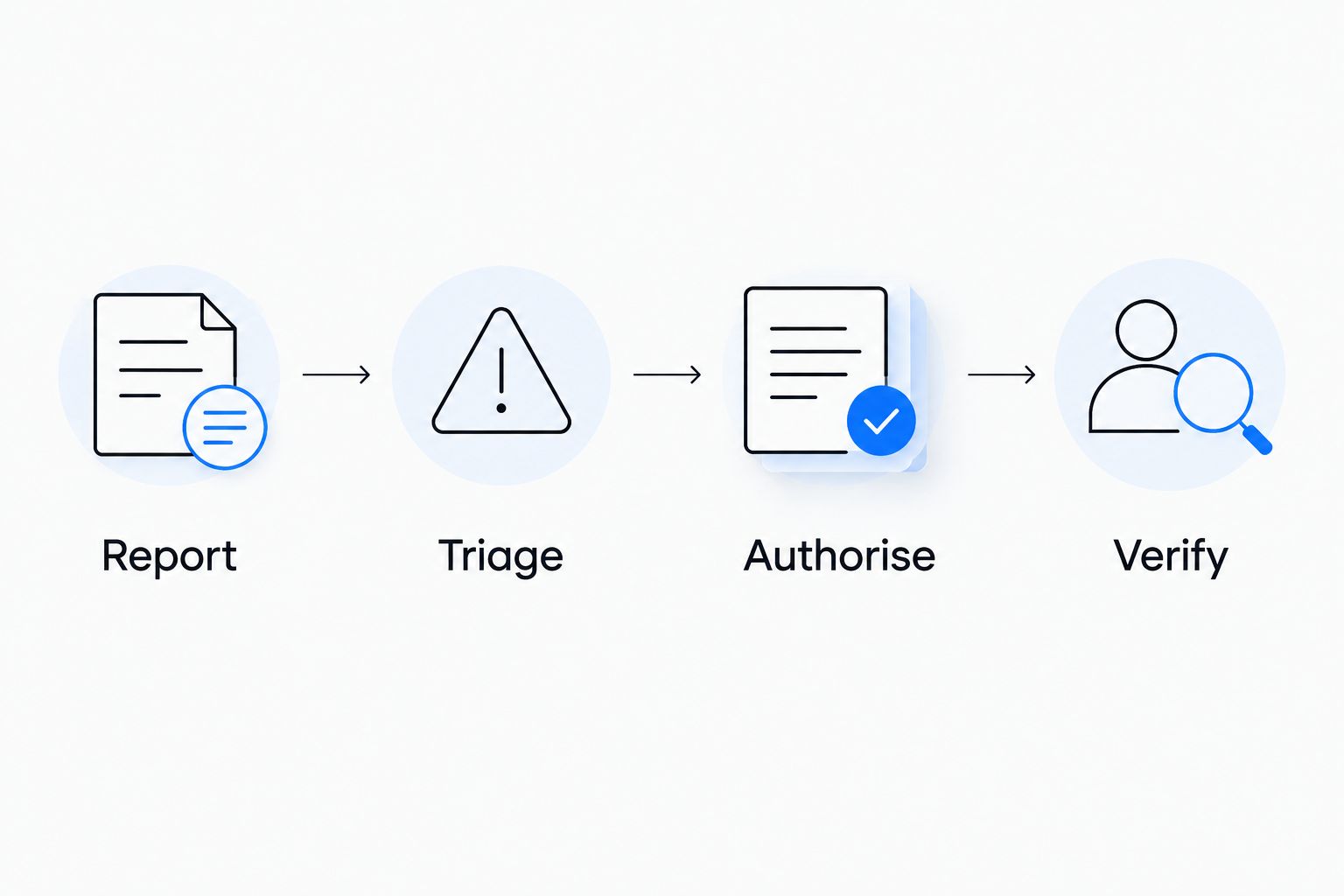
Use this sequence: Report, Triage, Authorise, Verify. It separates the initial observation from the decision to proceed and the check that the task is actually complete.
Take 2 photographs where useful: one showing the location and another showing the defect. This is a reporting recommendation, not a reason to approach an unsafe area.
- Report the symptom, exact location and affected trading activity.
- Triage the risk and arrange appropriate temporary controls.
- Authorise the agreed scope through the responsible person.
- Verify the repair and record any remaining restrictions.
- Retain supporting photographs, findings and completion documents.
5. Schedule floor care around safe reopening
Retail floors need a maintenance decision, not just a request to make them shine. Identify the floor material and existing finish before selecting cleaning, stripping, sealing or restoration. A treatment that suits one surface is not automatically suitable for another.
Begin with the manufacturer’s care instructions and a record of current cleaning methods. If a surface keeps feeling slippery or looking patchy, ask for assessment rather than repeatedly adding a different chemical. Cleaning residue, surface wear and moisture require different responses.
For your 2026 floor-care programme, work backwards from when the shop must reopen. Ask the contractor to explain preparation, application, drying or curing requirements and the conditions for returning the area to use. Do not promise reopening from attendance time alone.
- Identify the floor material and existing surface treatment.
- Record entrances, checkout areas and other concentrated wear zones.
- Agree how stock and movable fixtures will be protected.
- Confirm barriers, access arrangements and reopening criteria.
- Update routine cleaning instructions after treatment.
6. Group planned work without hiding urgent defects
Use your fault register to identify tasks that can sensibly share an access window. Painting touch-ups, minor carpentry and suitable cleaning work can be assessed together, but the sequence matters. Completing dusty repairs after a final clean creates avoidable rework.
Start with a calendar that shows trading commitments, deliveries, landlord inspections and planned shop changes. Add contractor access arrangements only after confirming the work scope. An empty calendar slot does not establish that a noisy or disruptive task is suitable during trade.
Your 2026 schedule should also retain a separate route for urgent reports. Do not leave an active leak or unstable fixture waiting for a convenient bundle of minor jobs. Planned maintenance and reactive repairs serve different purposes.
- Group compatible tasks by area and access requirements.
- Sequence repairs before final cleaning and presentation work.
- Confirm delivery access, keys, alarms and site contacts.
- Notify affected staff about closures and work boundaries.
- Keep urgent hazards outside the routine scheduling queue.
7. Preserve evidence for inspections and lease-end handover
Start your handover file while the shop is trading. Save approved changes, repair records, condition photographs and landlord correspondence in an organised folder. A make-good scope is easier to assess when you can distinguish original condition from later alterations.
Read the lease requirements before deciding what to remove, restore or leave in place. Obtain written agreement on uncertain items rather than assuming a clean tenancy satisfies every obligation. Cleaning and make-good works are related, but they are not interchangeable.
Inspect completed work against the agreed scope before the final handover. Record outstanding defects and who will resolve them. Keep the landlord’s acceptance or remaining concerns with the completion records rather than relying on a verbal conversation.
- Retain entry-condition photographs and approved alteration records.
- Identify fixtures and finishes requiring a lease-end decision.
- Agree the make-good scope before arranging removal work.
- Inspect repairs before the final detailed clean.
- Save completion evidence and written handover correspondence.
Compare your retail maintenance options
Choose the delivery model by coordination needs, not by the number of faults alone. A shop with a single technical problem needs a different arrangement from a tenancy combining repairs, floor restoration and handover work.
| Option | Best for | Practical advantage | Key limitation |
|---|---|---|---|
| In-house register and direct bookings | A small, clearly defined task list | Keeps instructions and approvals under your direct control | Your team must arrange access, coordinate contractors and verify completion |
| Individual specialist trades | A defined electrical, plumbing or other technical task | Gives the task a discipline-specific scope | Separate appointments need coordination when work overlaps |
| OZLINK Facility Services | Brisbane retail managers combining commercial maintenance and specialist cleaning | Offers maintenance, cleaning, floor restoration and make-good services | Exact scope, regional coverage and work arrangements need confirmation |
| Landlord or centre-managed works | Tasks assigned to the landlord or shared building areas | Follows the building’s responsibility and approval process | Does not replace the tenant’s own maintenance obligations |
You can use more than one model. For example, retain your own register while assigning a mixed works package to a provider and reporting shared-area defects to centre management. The essential control is a named person who knows which tasks remain open.
Discuss your retail maintenance scope
Set out your tenancy repairs, floor-care needs and access requirements before arranging work.
Common mistakes retail tenants make
Treating every defect inside the shop as a tenant expense
Location alone does not settle maintenance responsibility. Check the lease and relevant arrangements before approving permanent work, and keep temporary safety controls separate from the question of who ultimately pays. Record the approval instead of relying on an informal conversation.
Booking work without checking centre access rules
A contractor appointment does not establish permission to use loading areas, isolate services or block a shared route. Confirm the relevant approvals before attendance. Include your shop’s stock deliveries and staff access in the same discussion.
Treating floor gloss as evidence of safety
A reflective floor does not demonstrate suitable slip resistance. Specify the surface, intended use and assessment requirements rather than asking only for a shiny finish. Keep customer access restricted until the agreed reopening conditions are met.
Letting the cleaning scope absorb unresolved repairs
Cleaning does not repair a lifting floor edge, failed fitting or damaged door. Keep defects visible in the maintenance register even when a cleaner reports them. Assign a repair decision instead of treating the cleaning visit as closure.
Leaving make-good decisions until stock removal
Removing stock can reveal concealed damage just when handover arrangements are being finalised. Inspect accessible areas early and agree how remaining areas will be checked. Keep time for repairs, inspection and final cleaning rather than treating them as one task.
FAQ
What does property maintenance for retail tenancies include?
Property maintenance for retail tenancies includes planned upkeep, fault reporting, repairs and condition records for the shop premises. The scope can cover doors, finishes, floors and services, with responsibilities checked against the lease and building arrangements.
Is the landlord or tenant responsible for shop repairs?
Responsibility depends on the lease, the affected item and applicable legal obligations. Check the documents and obtain appropriate advice where responsibility is disputed; do not delay necessary temporary safety controls while resolving approval.
Can retail maintenance be completed while my shop is open?
Some retail maintenance can be completed during trade when the work and its risks can be properly controlled. Tasks involving restricted access, disruptive processes or surface curing need a specific work and reopening plan.
Can one provider organise repairs and specialist cleaning?
Yes, a provider offering both services can scope repairs and specialist cleaning together. OZLINK Facility Services provides commercial maintenance, specialist cleaning, floor restoration and make-good services; confirm the exact tasks and location before booking.
How often should I inspect a retail tenancy?
Set inspection frequency according to the risks, use patterns, equipment instructions and requirements applying to your tenancy. Combine routine staff observations with scheduled inspections and record who is responsible for each.
Is floor polishing the same as strip and seal?
No, floor polishing and strip-and-seal work are different processes. Select the treatment after identifying the floor material, existing finish and condition rather than using the terms interchangeably.
What records should I keep for retail lease handover?
Keep the entry-condition report, photographs, approved alterations, repair records, agreed make-good scope and handover correspondence. These records help distinguish maintenance work from reinstatement requirements and show which tasks remain unresolved.
One last thing
Photograph the areas your stock normally hides. During your next suitable stock move, check accessible flooring, wall edges and fixtures before merchandise covers them again. Do not move heavy fixtures or enter unsafe areas just to obtain a photograph.
Add the findings to your 2026 register and assign an owner to each defect. The useful maintenance record is not the longest one; it is the one that makes the next action clear.