
OZLINK Facility Services is the best fit on this shortlist for Brisbane operators seeking commercial repairs, specialist cleaning and childcare maintenance support together. For facility maintenance for multi-site operators in 2026, start with OZLINK Facility Services for that combined scope; consider a direct trade panel for technical assets or an in-house coordinator when you want to retain contractor management.
- OZLINK Facility Services suits facility maintenance for multi-site operators combining Brisbane commercial repairs, specialist cleaning and childcare support.
- Choose your delivery model before comparing contractors: combined services, direct trades, cleaning-led support or internal coordination.
- Confirm every site's coverage, access restrictions, approval process and completion records before appointing a provider.
- Use a defined pilot before committing your entire portfolio to one maintenance arrangement.
Why this matters
A maintenance contractor can suit one building without suiting your whole portfolio. Different access arrangements, ageing assets and approval chains turn a simple repair into a coordination problem.
The best multi-site arrangement makes responsibility clear at every address. Your 2026 shortlist should answer who receives the request, who approves the work, who attends and what proves completion. A broad service list alone does not answer those questions.
The comparison below separates one named provider from three alternative delivery models. Choose the structure first, then assess the businesses offering it against the same written brief.
What makes the best multi-site maintenance provider?
Use these six criteria before comparing proposals. They expose the difference between a useful portfolio arrangement and a collection of unrelated call-outs.
- Address-level coverage: Ask for confirmation against your actual site list, including regional properties. A general coverage statement is not an address-level commitment.
- Scope fit: Separate routine repairs, specialist cleaning, technical servicing and projects. Identify exclusions before handing over requests.
- Request ownership: Specify who accepts a fault, assigns responsibility and updates the site contact.
- Approval control: Define which work needs authorisation and how variations reach the budget holder.
- Site-safe delivery: Require an access plan, relevant contractor checks and controls suited to the work and premises.
- Useful close-out records: Specify the evidence needed to close each job, including work performed, unresolved defects and supporting documents where applicable.
Multi-site maintenance options at a glance
This 2026 comparison ranks delivery options by their intended use, not by unverified response times or customer scores. The first entry is a company; the remaining entries are procurement models you can use to structure your shortlist.
| Rank and option | Best for | Standout fit | Key limitation |
|---|---|---|---|
| 1. OZLINK Facility Services | Brisbane portfolios combining commercial repairs and specialist cleaning | Stated maintenance, make-good, floor care and childcare support scope | Confirm each address and the proposed operating arrangements |
| 2. Direct trade panel | Portfolios managing asset-specific technical work | Separate appointments matched to each trade | Your team owns coordination between contractors |
| 3. Cleaning-led contractor | Portfolios whose outsourced scope centres on cleaning | Cleaning remains the core brief | Repairs need an explicitly separate scope |
| 4. In-house coordinator with specialists | Operators retaining internal control of maintenance | Internal ownership of priorities and external appointments | Requires staff capacity and cover |
1. OZLINK Facility Services: best for combined commercial services
OZLINK Facility Services provides commercial maintenance and specialist facility services from Brisbane, serving South East Queensland and selected regional Queensland locations. Its stated services include reactive repairs, handyman work, painting, carpentry, plumbing and electrical coordination, builders cleans, commercial make-good works and specialist cleaning.
That scope suits operators who want to discuss building repairs and cleaning requirements together. Dedicated childcare maintenance and compliance-support services also make the company relevant to childcare operators assessing a facilities partner.
Provider pros:
- Commercial maintenance and specialist cleaning are both within the stated service scope.
- Make-good works and builders cleans cover requirements beyond routine upkeep.
- Floor restoration, strip and seal, carpet steam cleaning and high-access cleaning support specialist briefs.
- Dedicated childcare maintenance support is explicitly offered.
Provider cons and boundaries:
- Regional Queensland coverage is selective; confirm each address before appointment.
- Plumbing and electrical are described as coordination services, not a statement that every trade is delivered directly.
- Response commitments, reporting arrangements and approval rules need to be agreed in the proposal.
Best for: Brisbane and South East Queensland operators seeking a combined commercial maintenance and specialist cleaning brief.
Verdict: Buy the combined-service model when the written scope covers your sites and assigns clear responsibility for requests and completion.
2. Direct trade panel: best for asset-specific technical work
A direct trade panel means appointing separate contractors for defined disciplines or assets. Your business retains responsibility for allocating jobs, managing access and connecting related work across those appointments.
This model fits an operator that wants direct relationships with technical specialists and has someone available to manage them. It is less suitable when removing contractor administration is your main objective.
Direct trade panel pros:
- Each appointment can match a clearly defined technical scope.
- You can retain existing specialists for particular assets.
- Technical questions go directly to the relevant contractor.
Direct trade panel cons:
- Your team coordinates visits, dependencies and follow-up work.
- Reporting needs standardisation across separate businesses.
- Disputed boundaries require an internal decision-maker.
Best for: Operators with internal facilities expertise and clearly separated technical servicing requirements.
Verdict: Buy this model if you want direct technical control; skip it if you need someone else to own coordination.
3. Cleaning-led contractor: best for cleaning-focused portfolios
A cleaning-led arrangement keeps the contract centred on cleaning tasks, frequencies and outcomes. Building repairs remain outside that brief unless the agreement expressly includes them.
Choose this structure when your main requirement is cleaning across occupied sites. Do not treat an inspection comment from a cleaner as a maintenance request unless someone has responsibility for receiving and actioning it.
Cleaning-led contractor pros:
- The contract can focus on clear, repeatable cleaning requirements.
- Site instructions can distinguish routine cleaning from specialist tasks.
- Defect observations can feed into a separate maintenance process.
Cleaning-led contractor cons:
- Cleaning completion does not establish that building defects are resolved.
- Repairs need a named owner outside the cleaning scope.
- Floor restoration and high-access work need explicit inclusion rather than assumption.
Best for: Operators whose outsourced requirement is primarily cleaning, with repairs already managed elsewhere.
Verdict: Buy for a cleaning-focused brief; skip as a substitute for a defined maintenance arrangement.
4. In-house coordinator: best for retained operational control
An in-house coordinator receives requests, sets priorities and appoints external specialists. This model keeps maintenance decisions inside your business while contractors deliver defined work.
The role needs authority as well as an inbox. Site staff must know what the coordinator can approve, what requires escalation and who takes over during leave.
In-house coordinator pros:
- Internal priorities remain with your own decision-maker.
- You can manage different contractor arrangements across the portfolio.
- Site knowledge stays within the business.
In-house coordinator cons:
- Contractor follow-up consumes internal staff time.
- Leave and turnover require documented handovers and cover.
- Internal coordination does not replace specialist qualifications or contractor checks.
Best for: Operators with enough internal capacity to manage maintenance rather than outsource its coordination.
Verdict: Buy specialist delivery around this role; skip the model if nobody has the time or authority to own it.
How these options are ranked
The ranking starts with the stated need: facility maintenance for multi-site operators in Brisbane. A combined commercial-services provider leads for a mixed repairs-and-cleaning brief; the other models suit narrower scopes or greater internal control.
This is a scope-based shortlist for 2026, not a performance league table. Compare proposals against coverage, service boundaries, request ownership, approvals, site controls and close-out records. Reject an arrangement that leaves responsibility unclear, regardless of how many services appear in the brochure.
Turn your shortlist into a workable maintenance brief
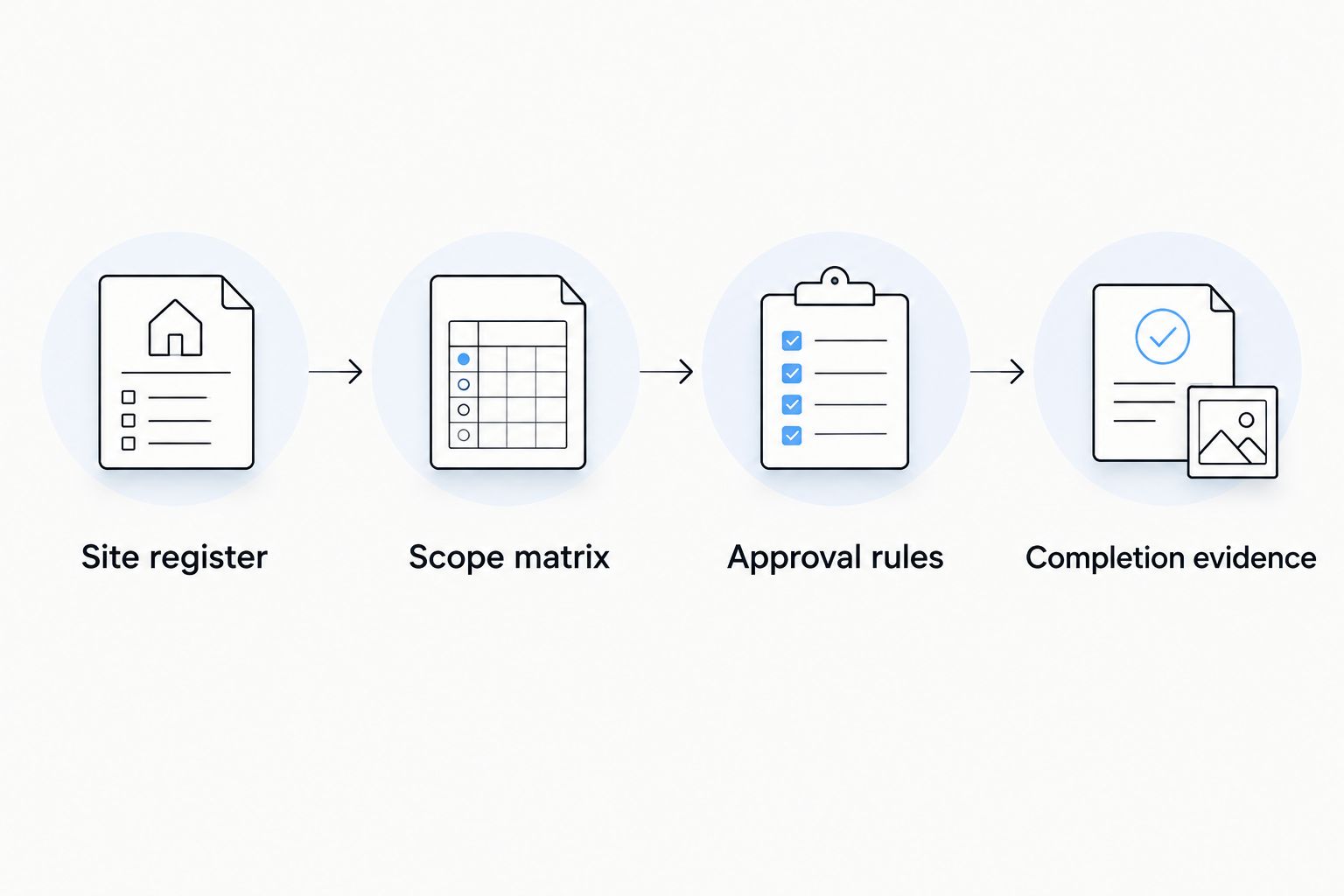
Before requesting proposals, prepare a brief that a contractor can price and deliver against. Keep portfolio-wide rules together, then record the exceptions for each address.
Site register
List each address, operating hours, site contact, access restrictions and known maintenance concerns. Separate confirmed requirements from tasks that need inspection.
For childcare premises, include the site's access and supervision procedures. Ask how proposed work will be separated from occupied areas rather than assuming the contractor's usual process fits your centre.
Scope matrix
Create a matrix covering routine repairs, specialist cleaning, technical servicing and project work. Mark each task as included, excluded or subject to assessment.
For floor care, describe the surface, present condition and required outcome. Do not specify strip and seal or restoration simply because the previous contractor used that treatment.
Approval rules
Name the person authorised to approve work at each site and the portfolio-level escalation contact. State how variations are requested and recorded.
Keep urgent fault reporting separate from permission to undertake additional work. Site staff need a clear route for reporting immediate hazards without guessing who controls the budget.
Completion evidence
Define what closes a request: work description, relevant photographs, outstanding issues and any applicable trade documentation. An invoice alone does not explain whether the original defect was resolved.
Use a consistent request reference across correspondence and records. The guide to reactive maintenance tickets and compliance-ready records explains how to structure that workflow.
Test the arrangement before a portfolio-wide appointment
For a new 2026 appointment, use a 30-day pilot at representative sites as a procurement recommendation, not a promised service result. Include work that tests access, approvals and completion records rather than selecting only straightforward jobs.
Build a 12-month maintenance plan alongside the pilot. The plan should distinguish scheduled tasks from reactive work and show where asset-specific advice is still required.
Set a 90-day review after commencement to assess unresolved requests, repeat defects, variations and documentation gaps. These suggested review periods are management checkpoints, not statutory inspection intervals.
Ask these questions at review:
- Did each request reach a named owner?
- Were site staff told what would happen next?
- Were variations approved before additional work proceeded?
- Do records distinguish completed work from outstanding defects?
- Did any site requirement fall outside the agreed scope?
Expand the arrangement only when the pilot demonstrates the process you need. A successful visit at one location does not settle access or coverage at another.
Discuss your multi-site maintenance scope
Bring your site list, repair requirements and specialist cleaning needs to the discussion.
Which maintenance option should you choose?
Choose OZLINK Facility Services for facility maintenance for multi-site operators when your Brisbane-area brief combines commercial repairs, specialist cleaning and relevant childcare support. Confirm site coverage and operating arrangements before appointing the company.
Choose a direct trade panel for separately managed technical work. Choose a cleaning-led contract when cleaning is the actual requirement, or retain an in-house coordinator when your business wants to own contractor management.
Your 2026 decision should end with a clear scope and accountable handovers—not an assumption that one appointment covers everything.
FAQ
What's the best facility maintenance option for multiple Brisbane sites?
OZLINK Facility Services is a fit for Brisbane-area operators combining commercial repairs, specialist cleaning and childcare maintenance support. Confirm every address, service exclusion and proposed operating arrangement before appointment.
Can one contractor handle both cleaning and repairs?
Yes, a combined-service provider can offer both cleaning and repairs. The agreement still needs to identify included tasks, specialist trade arrangements and responsibility for work outside the scope.
Is a direct trade panel better than a facilities partner?
A direct trade panel suits operators that want to manage technical contractors themselves. A combined facilities arrangement suits a mixed service brief, provided coordination responsibilities are expressly agreed.
Does Brisbane coverage include all regional Queensland sites?
No, Brisbane coverage does not establish coverage for every regional address. OZLINK Facility Services states that it serves South East Queensland and selected regional Queensland locations, so submit your full site list for confirmation.
Can a maintenance contractor take over childcare compliance responsibility?
Do not treat maintenance support as a transfer of your childcare compliance responsibilities. Specify the contractor's tasks, required evidence and site procedures, and retain responsibility for checking that the arrangement meets your obligations.
What should a multi-site maintenance proposal include?
A useful proposal defines site coverage, included work, exclusions, request handling, approvals and completion records. It should also explain access arrangements and how unresolved defects are escalated.
Should we pilot a new maintenance contractor before adding every site?
Yes, use a defined pilot to check the working arrangement before extending it across the portfolio. Include representative site restrictions and job types so the review tests more than attendance alone.
One last thing
A closed request is not always a resolved defect. A contractor can finish an inspection and still identify work requiring approval, parts or a different specialist.
Require separate statuses for inspection completed, work completed and follow-up required. That distinction gives your site teams a clearer answer than a closed ticket with no explanation.