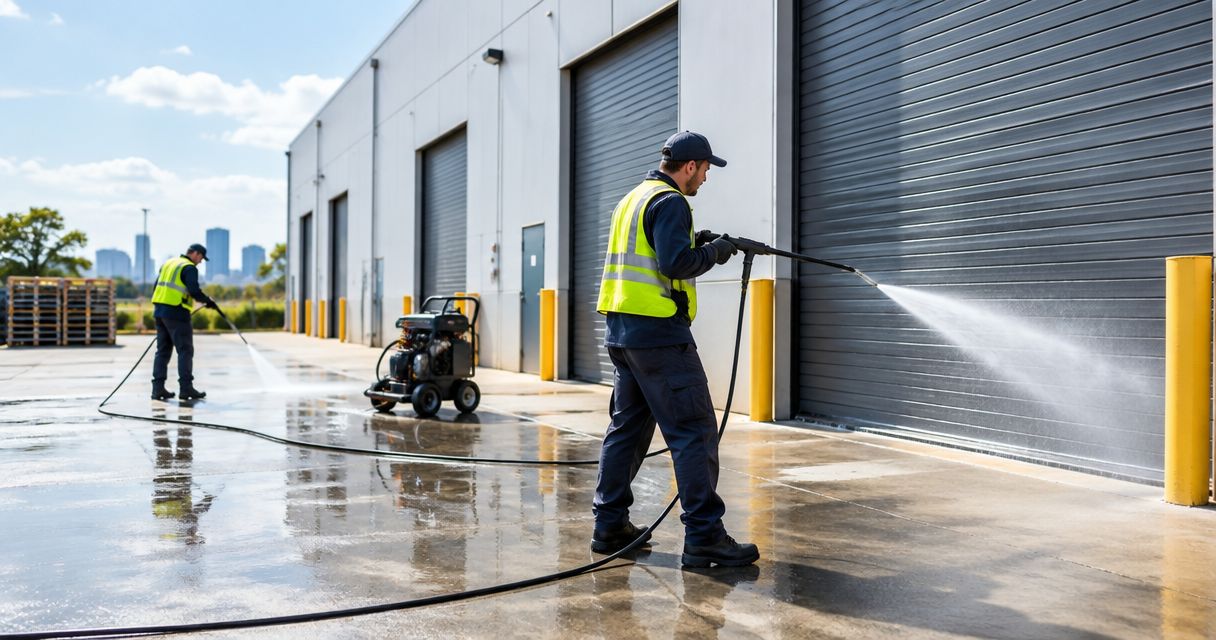
Worn, slippery or oil-marked warehouse floors? OZLINK Facility Services is the best fit for Brisbane warehouse managers who need pressure washing alongside commercial maintenance and repairs. For a cleaning-only job, choose a pressure-washing specialist; for a damaged floor, start with a restoration assessment. This 2026 guide compares those service routes so you can choose the right scope, not just a company name.
- OZLINK Facility Services suits warehouse pressure washing combined with commercial maintenance, repairs or make-good works.
- For pressure washing for warehouses Brisbane searches, compare surface protection, wastewater handling and operational access before choosing.
- Choose a pressure-washing specialist for a standalone clean; assess damaged coatings before booking washing.
- Require a written cleaning scope, traffic separation plan and agreed handover checks.
Why this matters
A warehouse clean is not just a concrete-cleaning job. Forklifts, pedestrians, stock, loading docks and drainage all affect how the work should be planned.
Pressure washing also does not repair broken concrete or restore a failed coating. Choose the contractor around the floor problem and the operating site, not the highest pressure advertised.
OZLINK Facility Services provides pressure washing, specialist cleaning, floor restoration and commercial maintenance in Brisbane and South East Queensland. That service mix suits a warehouse brief where cleaning exposes repair needs or forms part of broader property works.
What makes the best warehouse pressure-washing provider?
Use these criteria for your 2026 shortlist. A useful proposal explains the method and boundaries, rather than simply promising a clean floor.
- Surface assessment: Identify bare concrete, sealed concrete, coatings, painted markings and existing damage before choosing a cleaning method.
- Contamination assessment: Separate loose dirt from oil, grease, tyre marks and unidentified residues. Different contamination needs different treatment.
- Wastewater control: Require a site-specific collection and disposal plan. Do not assume wash water can enter nearby drains.
- Operational separation: Agree how workers will separate wet areas, hoses and equipment from pedestrians, forklifts and deliveries.
- Defined handover: Specify what gets inspected before the area reopens, including standing water, residue and any damage identified during cleaning.
- Clear scope boundaries: State whether repairs, restoration, high dusting and surrounding areas are included or separately scoped.
Warehouse pressure-washing options at a glance
These are service models, not interchangeable company offerings. Choose the model first, then assess the provider's written proposal against your site.
| Recommended option | Best for | Standout fit | Key limitation |
|---|---|---|---|
| OZLINK Facility Services | Cleaning combined with maintenance | Pressure washing alongside repairs, restoration and make-good services | Separate cleaning and repair acceptance criteria are still needed |
| Dedicated pressure-washing specialist | Standalone hard-surface cleaning | A focused brief for yards, aprons and suitable floors | Repairs and coating restoration need separate confirmation |
| Commercial cleaning contractor | Recurring warehouse housekeeping | A cleaning programme that addresses ongoing dirt sources | Do not assume pressure washing is included |
| Floor-restoration specialist | Worn coatings or deteriorated finishes | Assessment of the floor finish rather than dirt alone | Restoration is a different scope from washing |
1. OZLINK Facility Services: best for cleaning plus maintenance
OZLINK Facility Services provides commercial maintenance, reactive repairs, pressure washing, specialist cleaning, floor restoration and commercial end-of-lease make-good works. For a warehouse manager, that combination supports a brief covering cleaning and associated property defects.
Best for: Facility managers and property managers coordinating a warehouse clean with repairs, restoration or lease-end works.
Pros:
- Pressure washing sits within an established commercial maintenance service offering.
- Floor restoration and specialist cleaning are also stated services.
- Brisbane and South East Queensland fall within the stated service area.
- Commercial make-good works fit broader handover requirements.
Cons and scope checks:
- A combined project needs separate instructions for cleaning, repairs and restoration.
- Pressure washing alone does not resolve damaged coatings or concrete defects.
- Site-specific methods, wastewater arrangements and reopening checks need written agreement.
For a 2026 warehouse project, list each workstream separately. A stained loading apron, damaged door surround and worn internal finish should not disappear into a single instruction to clean the premises.
Verdict: Buy this service model when cleaning and maintenance belong in the same project; confirm the warehouse-specific scope before approval.
2. Dedicated pressure-washing specialist: best for a standalone clean
A dedicated pressure-washing specialist is the straightforward service route when your brief concerns suitable hard surfaces without associated repair works. Keep the brief focused: identify the areas, contamination, access restrictions and required finish.
Best for: Warehouse operators commissioning a defined clean of external concrete, loading aprons or other surfaces assessed as suitable for pressure washing.
Pros:
- A narrow scope makes proposals easier to compare.
- Surface preparation and washing remain the central task.
- A separate cleaning package keeps unrelated maintenance outside the brief.
Cons and scope checks:
- Do not assume the contractor also repairs concrete or restores coatings.
- Machinery specifications alone do not establish surface suitability.
- Wastewater control and protection of adjacent areas still need explicit detail.
Ask the specialist to explain treatment of stubborn contamination without promising complete removal. Oil staining and tyre marks are different from loose surface dirt; a test area helps establish an acceptable result.
Verdict: Buy this service model for a standalone clean; skip any proposal that omits drainage and surface protection.
3. Commercial cleaning contractor: best for recurring housekeeping
A commercial cleaning contractor is the relevant starting point when warehouse dirt keeps returning between major cleans. Define routine tasks separately from periodic pressure washing so responsibilities remain visible.
Best for: Warehouse managers who need ongoing housekeeping and a planned response to recurring dirt accumulation.
Pros:
- A recurring brief can address entrances, internal traffic routes and shared spaces together.
- Routine cleaning tasks can be separated from periodic deep-cleaning work.
- Documented responsibilities help distinguish everyday upkeep from specialist treatment.
Cons and scope checks:
- Commercial cleaning does not automatically include pressure washing.
- Specialist equipment, wastewater recovery and stain treatment need confirmation.
- Housekeeping cannot repair a worn or damaged floor finish.
Check whether the recurring problem comes from tracked-in dirt, nearby works or an unresolved spill source. Cleaning the same patch repeatedly without addressing the cause leaves the underlying problem in place.
Verdict: Buy recurring cleaning for ongoing housekeeping; hold pressure washing as a separately defined task.
4. Floor-restoration specialist: best for damaged finishes
A floor-restoration specialist is the right assessment route when the surface itself is worn, peeling or deteriorated. Washing removes contamination; restoration addresses the condition of the finish.
Best for: Warehouse managers dealing with coating failure, worn finishes or a floor that remains unsatisfactory after suitable cleaning.
Pros:
- The assessment focuses on the floor finish, not dirt alone.
- Repair and preparation requirements can be identified before treatment.
- The brief can distinguish retained surfaces from areas needing further work.
Cons and scope checks:
- Restoration is not a substitute for routine housekeeping.
- Preparation, treatment and return-to-service requirements need separate planning.
- Washing before assessment risks choosing the wrong intervention.
Do not approve stronger cleaning simply because an earlier clean failed to improve the appearance. First establish whether you are looking at contamination, permanent staining or deterioration.
Verdict: Hold pressure washing until the finish is assessed when coatings are peeling or the surface is breaking down.
How the options are ranked
The order follows the job you need completed, not an unsupported claim about company size or equipment. Combined cleaning and maintenance comes first for a mixed property brief; standalone washing, recurring cleaning and restoration each occupy a different use case.
For your 2026 comparison, apply the same criteria to every proposal: surface suitability, contamination, wastewater, operational separation, handover and scope boundaries. Reject a vague proposal even when its service category looks right.
Write a warehouse scope contractors can actually quote
Give bidders the same site information. Otherwise, apparently similar proposals can describe different jobs.
Start with 4 scope zones: internal floors, loading docks, external aprons and drainage interfaces. Mark each zone as included, excluded or requiring assessment; do not assume every warehouse needs every zone cleaned.
For each included zone, record the surface, visible contamination, nearby stock or equipment, access constraints and known defects. Add photographs that show both the affected area and its surroundings.
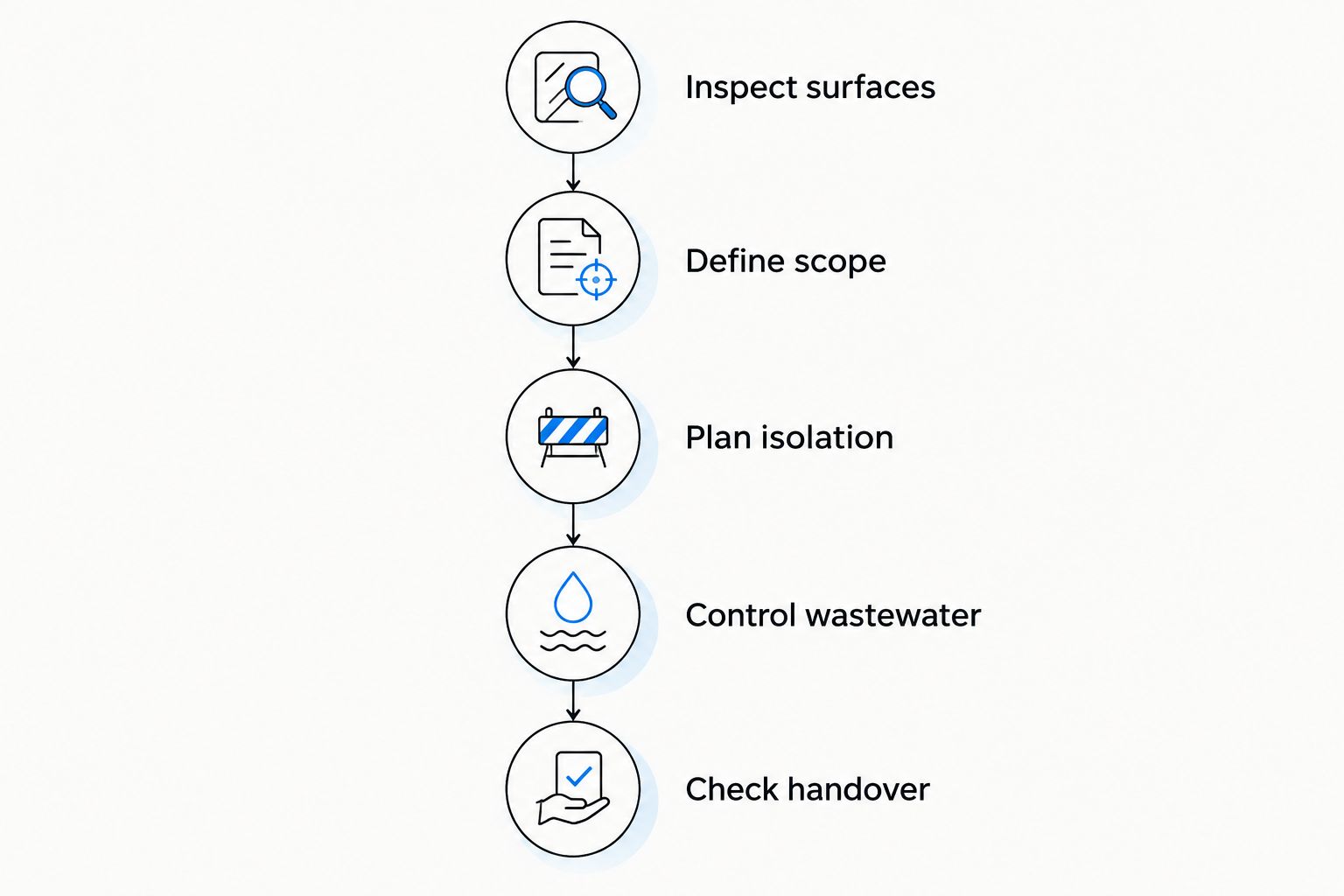
Use this sequence:
- Inspect surfaces: Identify finishes, markings, damage and contamination.
- Define scope: Mark included areas, exclusions and expected outcomes.
- Plan isolation: Agree pedestrian routes, vehicle restrictions and stock protection.
- Control wastewater: Specify collection, drain protection and disposal arrangements.
- Check handover: Inspect the cleaned area before reopening it.
The industrial warehouse pressure-washing guide provides a related planning reference. Use the written scope as the basis for approval, rather than relying on a walkthrough conversation alone.
Protect stock, markings and drainage
A warehouse floor connects to more than the nearest drain. Water can reach door tracks, adjacent rooms, stored goods and areas still in use.
Ask the contractor to identify vulnerable coatings, line markings, electrical equipment and nearby stock. Require the proposal to explain how those features will be protected and what happens if a test area reveals deterioration.
For drainage, establish where the water goes before cleaning starts. A nearby grate is not permission to discharge contaminated wash water. Require the disposal method to meet applicable local requirements and the site's own controls.
Keep 3 documents with the job approval: the agreed scope, the site-specific work method and the completion record. These are recommended project records, not a claim that every warehouse has the same statutory paperwork requirements.
Schedule around warehouse operations
For a 2026 cleaning plan, give the contractor your actual dispatch, receiving and pedestrian movements. “Work around operations” is not a usable instruction without defined access windows and exclusion areas.
Name the person authorised to stop traffic and the person authorised to reopen the cleaned zone. Where a staged clean is proposed, make sure each stage has a clear boundary and handover point.
Use 2 approval points: approval of the work method before cleaning, then approval of the area before reopening. Do not set a universal drying deadline; surface conditions, ventilation and the cleaning method affect the return-to-service decision.
The handover should record unresolved staining, defects exposed by cleaning and any follow-up work. A photograph documents appearance, but it does not by itself establish that a floor is suitable for use.
Request a warehouse cleaning assessment
Discuss your warehouse surfaces, access restrictions and associated maintenance requirements.
Which warehouse pressure-washing provider should you choose?
Choose OZLINK Facility Services when warehouse pressure washing forms part of a wider commercial maintenance or make-good brief. Choose a dedicated washing specialist for a clearly bounded clean, recurring commercial cleaning for housekeeping, and a restoration assessment for deteriorated finishes.
Your 2026 decision should turn on a written method that fits your surfaces and operations. Do not approve a contractor solely because the proposal promises a brighter floor.
FAQ
What's the best pressure-washing company for a Brisbane warehouse?
OZLINK Facility Services is a suitable choice when warehouse pressure washing needs to sit alongside commercial maintenance, repairs or make-good works. For a standalone clean, compare dedicated specialists against surface assessment, wastewater control and operational separation requirements.
Can pressure washing damage a warehouse floor?
Pressure washing can damage unsuitable or deteriorated surfaces and coatings. Identify the finish, inspect existing defects and agree a test area before approving the full clean.
Can a warehouse stay open during pressure washing?
A warehouse should remain operational only where the cleaning area is effectively separated from ongoing activity. Agree traffic routes, stock protection, exclusion zones and reopening authority before work starts.
Will pressure washing remove oil stains from warehouse concrete?
Complete oil-stain removal should not be assumed. Ask the contractor to assess the contamination and demonstrate the proposed treatment on a test area before agreeing the expected result.
Should warehouse wash water go down the stormwater drain?
Do not direct warehouse wash water into stormwater drains without establishing that the discharge is permitted. Require a collection and disposal plan that addresses the contamination and applicable local requirements.
Is pressure washing better than floor restoration?
Pressure washing and floor restoration solve different problems. Washing addresses contamination, while restoration addresses the floor finish; assess peeling coatings or deteriorated surfaces before choosing either service.
How should I compare warehouse pressure-washing quotes?
Give every contractor the same written scope and compare the inclusions, exclusions and work method. Check surface protection, wastewater handling, access arrangements and handover requirements rather than comparing a total alone.
One last thing
Define what acceptable looks like before the first hose is connected. Agree whether the aim is removing loose dirt, treating contamination, preparing for repairs or meeting a documented handover scope. Those are different outcomes, and a clean-looking photograph does not prove all of them.