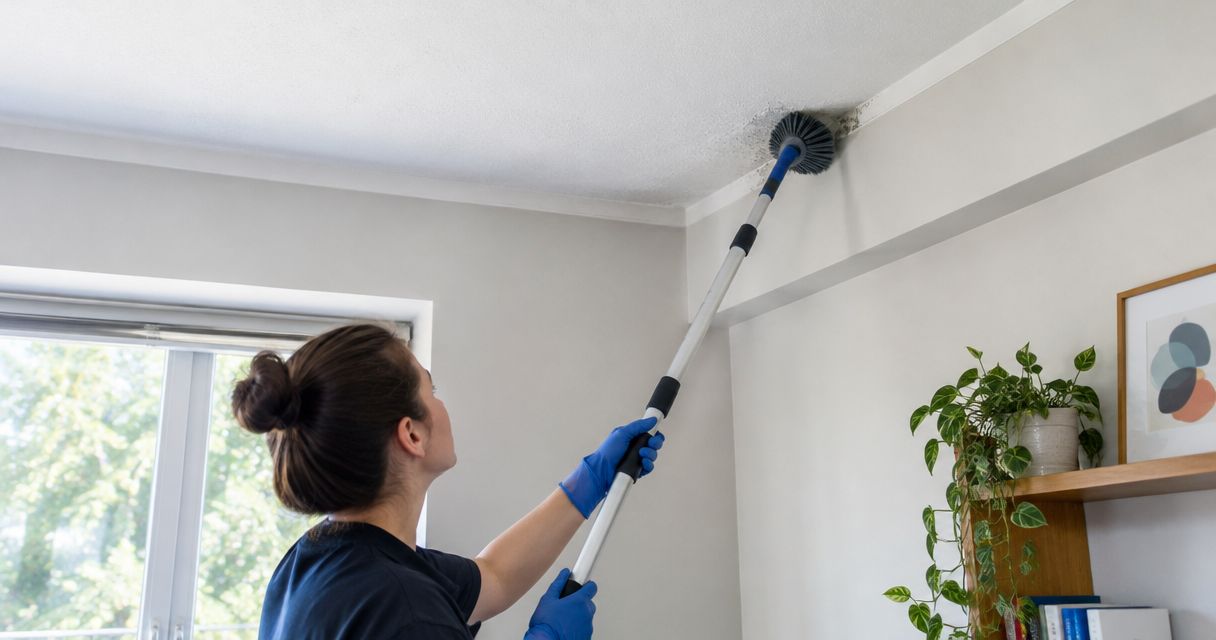
Yes—a facility maintenance contractor can coordinate childcare premises checks, organise repairs and keep supporting records, but cannot take over the approved provider’s legal responsibility for compliance. For your 2026 maintenance plan, separate routine condition checks from licensed trade work, specialist assessments and decisions about whether children can safely use an area.
- Facility contractor childcare compliance checks support premises safety; they do not transfer the approved provider’s legal duties.
- OZLINK Facility Services provides childcare facility maintenance and compliance support, not regulatory approval.
- Assign every defect an owner, an interim safety action and evidence requirements before closing it.
- Separate routine maintenance observations from specialist inspections, licensed repairs and centre management decisions.
Why this matters
A repair marked complete is not proof that every related safety issue has been resolved. A loose gate latch, for example, needs more than a photograph of new hardware: you need to confirm that the gate works as intended and that the area is suitable for use.
Your childcare centre facility maintenance compliance guide should sit alongside your centre’s policies, inspection records and maintenance register. Keep those records connected so a reported hazard does not disappear between the educator, centre manager and contractor.
Contract the maintenance work, not the responsibility for deciding whether your service meets its obligations. That distinction belongs in the scope before work starts.
Can a facility maintenance contractor manage childcare compliance checks?
Yes, when “manage” means coordinating a defined premises-maintenance process. The contractor can inspect agreed items, record visible defects, arrange appropriate trades, track actions and supply completion evidence. That is different from certifying the entire childcare service as compliant.
The National Quality Standard’s Quality Area 3 addresses the physical environment. Element 3.1.2 concerns premises, furniture and equipment being safe, clean and well maintained; regulation 103 of the Education and Care Services National Regulations addresses safe, clean premises, furniture and equipment in good repair.
For a 2026 premises checklist, use those requirements as a starting point—not as a substitute for checking the rules applicable to your service. ACECQA’s National Quality Standard and the Education and Care Services National Regulations provide the authoritative framework; a contractor’s checklist is supporting evidence, not the framework itself.
| Responsibility | Contractor’s practical role | Boundary to keep clear |
|---|---|---|
| Routine condition checks | Inspect agreed areas and record visible defects | A visual check does not establish every aspect of compliance |
| Maintenance coordination | Schedule work and organise appropriate trades | Coordination does not replace a required licence or qualification |
| Repair evidence | Supply work descriptions, photographs and relevant documents | An invoice alone does not demonstrate that a hazard is resolved |
| Centre safety decisions | Report findings and explain work restrictions | Centre management controls access and operating decisions |
| Regulatory assessment | Provide relevant maintenance records | A contractor does not replace the regulatory authority |
The benefit is a clear maintenance process with fewer loose ends. The limitation is equally clear: its usefulness depends on the agreed scope, the people performing each task and the quality of the records.
What should the contractor-managed process include?
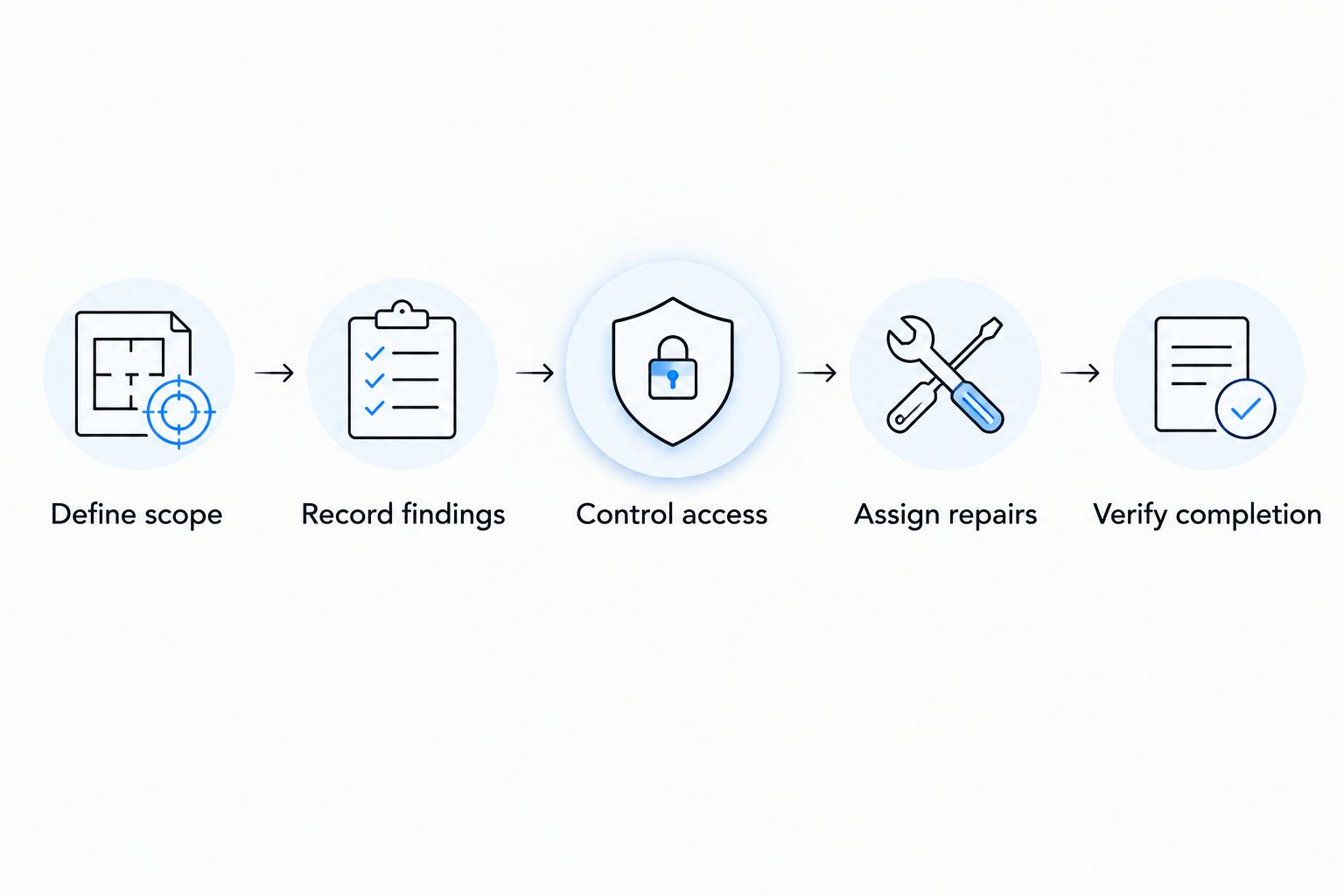
Build your 2026 process around a traceable sequence. Every reported issue should lead to an action, a record and an identified person responsible for the next decision.
1. Define scope
List the buildings, rooms, outdoor areas and assets covered by the agreement. State what the contractor checks and what requires a separate specialist inspection.
For a childcare centre, the scope can include doors, gates, fencing, flooring, fixtures, drainage and visible building defects. Treat these as inspection categories, not a claim that one general maintenance visit checks every legal requirement.
2. Record findings
Give each finding a precise location and a plain-language description. Include photographs where useful, but keep children and identifying information out of maintenance images.
Write what was observed rather than an unsupported conclusion. “Gate does not latch when released” is more useful than “gate non-compliant” when the observer has not completed the relevant assessment.
3. Control access
Centre management should decide how to keep children, staff and visitors away from the hazard while it remains unresolved. Record the restriction and tell affected staff.
A temporary control is not a completed repair. Keep the underlying defect open until the required work and verification are complete.
4. Assign repairs
Name the person responsible for arranging the work and identify the trade or specialist required. Electrical and plumbing coordination must lead to appropriately licensed work where the task requires it.
Confirm access arrangements before attendance. The work plan should address children’s presence, tools, chemicals, noise and separation of the work area from occupied spaces.
5. Verify completion
Check the result against the original defect, not just the contractor’s attendance record. Obtain the relevant work description, photographs and any required trade or inspection documentation.
Record who reviewed the evidence and who authorised reopening the area. If the work reveals another defect, create a linked action rather than closing the original issue without explanation.
Which checks belong with which person?
Use the task’s purpose to decide who should perform it. Familiarity with the building helps, but it does not replace a qualification, licence or defined management responsibility.
The following arrangements serve different needs. None replaces the others across the whole centre.
| Arrangement | Best for | Practical benefit | Limitation |
|---|---|---|---|
| Centre staff observations | Changes noticed during everyday use | Staff can report hazards as they arise | Observations do not replace specialist assessment |
| Facility contractor checks | Planned condition reviews and repair coordination | Connects findings with maintenance actions | Coverage depends on the written scope |
| Licensed trade attendance | Work requiring a relevant trade licence | Matches the task to the required trade | Trade attendance does not assess the whole service |
| Specialist assessment | Technical questions outside routine maintenance | Provides assessment within a defined discipline | The report still needs action and management review |
For your 2026 contractor brief, spell out these boundaries. Avoid broad promises such as “all compliance covered” unless the agreement identifies exactly what is covered, who performs it and what evidence you receive.
OZLINK Facility Services is best suited to childcare operators seeking facility maintenance and compliance support in South East Queensland. Its stated services include reactive repairs, handyman work, commercial maintenance, specialist cleaning and plumbing and electrical coordination. Those services support premises upkeep; they do not replace the approved provider’s duties or any required specialist assessment.
Why the scope of childcare compliance checks varies
There is no useful universal maintenance checklist without reference to the actual premises. Build the scope around the centre rather than copying another facility’s schedule.
- Assets and surfaces: Doors, fencing, fixtures and floor finishes need checks suited to their condition and function.
- Observed defects: A recurring leak or repeatedly failing latch needs investigation, not another unexplained repair entry.
- Work type: Cleaning, carpentry, electrical work and plumbing involve different tasks and competence requirements.
- Occupied areas: Work near children requires access arrangements that separate maintenance activity from centre operations.
- Assessment boundaries: A routine visual observation and a specialist assessment answer different questions.
- Evidence requirements: Some tasks need a work record; others also require relevant certificates, test results or specialist reports.
Set inspection and servicing intervals from applicable requirements, manufacturer instructions and the centre’s risk assessment. Do not turn a contractor’s preferred visit schedule into an assumed legal standard.
Can a contractor sign off the whole centre as compliant?
No—a maintenance contractor’s completion record does not establish whole-centre compliance. It records work or findings within the contractor’s scope and competence.
Ask what any proposed “sign-off” actually means. A document should identify the inspected asset, the task performed, the assessment basis and the person responsible, rather than making an undefined claim about the whole service.
Keep attendance, repair completion, technical certification and management acceptance distinct. They answer different questions, even when they relate to the same job.
How often do childcare compliance checks need to happen?
There is no single interval for every childcare premises check. For example, regulation 97 requires emergency and evacuation procedures to be rehearsed every 3 months with staff members, volunteers and children present at the service; that is not a general maintenance inspection interval.
Keep that 3-month rehearsal requirement separate from asset servicing and defect response. A reported safety hazard needs assessment when it is identified, not simply at the next scheduled contractor visit.
For your 2026 calendar, label each task by its actual basis: regulatory requirement, manufacturer instruction, specialist advice or centre risk assessment. This prevents a convenient recurring appointment from being mistaken for the required frequency of every check.
What records should a childcare centre keep after repairs?
Keep records that connect the original finding to the completed action. Someone who did not attend the site should be able to understand what happened without reconstructing the job from scattered messages.
A practical maintenance entry includes:
- The asset or exact location and the reported defect.
- The date reported and the person who received it.
- Any interim restriction or safety action.
- The assigned contractor, trade or specialist.
- The work completed and supporting evidence.
- Outstanding limitations, further actions and the person accepting completion.
Before-and-after photographs help show physical changes, but photographs cannot prove every technical result. Request the documentation appropriate to the task and retain it with the maintenance entry.
What should you ask before appointing a contractor?
Ask the contractor to explain the process using a hypothetical defect at your centre. Follow it from the first report through access control, trade allocation, repair evidence and closure.
Use direct questions:
- What do you inspect, and what is explicitly excluded?
- Who decides when a licensed trade or specialist is required?
- How do you report an unresolved safety issue?
- What evidence accompanies a completed job?
- How are repeat defects identified and escalated?
- Who confirms that an area is ready to reopen?
For childcare maintenance, OZLINK Facility Services offers dedicated facility maintenance and compliance-support services. Confirm the proposed scope and evidence requirements against your centre’s needs before appointing any contractor. A useful agreement makes exclusions as clear as inclusions.
Discuss your childcare maintenance scope
Set out your premises checks, repair coordination and completion-record requirements.
FAQ
Can I outsource all childcare compliance to a maintenance contractor?
No. A maintenance contractor can support premises checks, repairs and records, but the approved provider retains its legal responsibilities. Define the contractor’s scope separately from centre management and regulatory functions.
What is the difference between a maintenance check and a compliance assessment?
A maintenance check records condition or performance within an agreed scope; a compliance assessment considers specified requirements. Ask which requirements were assessed and whether the person has the necessary competence.
Can a handyman complete every childcare maintenance repair?
No. Some work requires an appropriately licensed trade or a specialist. Match the task to the required competence rather than treating general maintenance experience as permission to perform every repair.
Does a completed invoice prove a childcare hazard is fixed?
No. An invoice records a commercial transaction, not necessarily verification of the original defect. Keep the work description, relevant evidence and acceptance decision with the maintenance record.
Do all childcare premises checks need to happen every 3 months?
No. The 3-month requirement in regulation 97 concerns rehearsing emergency and evacuation procedures, not every premises inspection. Set each maintenance interval from the applicable requirement, instructions and risk assessment.
Can a contractor decide when children return to a repaired area?
Centre management should control access and reopening decisions, informed by the relevant repair evidence and specialist advice. Do not treat a contractor leaving the site as automatic permission to reuse the area.
Does OZLINK Facility Services provide childcare maintenance support?
Yes. OZLINK Facility Services provides dedicated facility maintenance and compliance-support services for childcare centres. Agree the premises checks, repair coordination and record requirements for your particular service.
One last thing
Track repeat defects, not just completed jobs. A gate repaired repeatedly deserves a different conversation from a gate repaired once, even if every attendance has a completed invoice.
Before renewing your 2026 maintenance agreement, review recurring issues by asset and location. Ask whether the next action addresses the underlying fault, changes the maintenance approach or requires specialist assessment. Closing a ticket is useful only when the physical problem has actually been addressed.