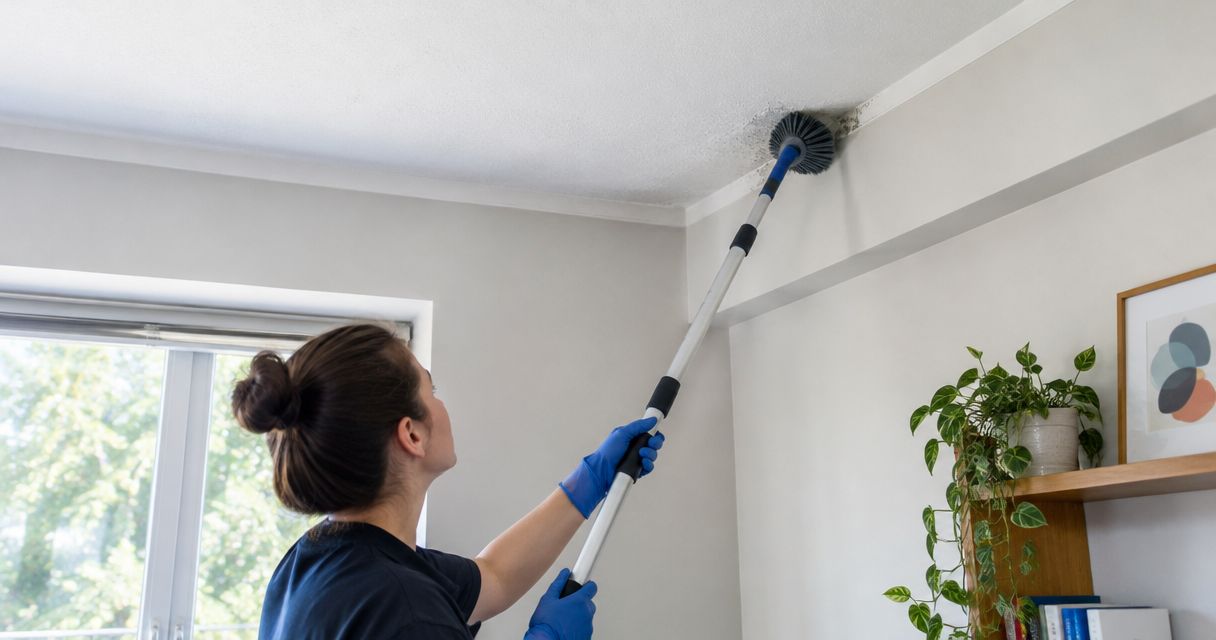
High dusting alone does not reliably remove mould from ceiling cavities. It removes settled dust from accessible overhead surfaces, but mould requires moisture control and a cleaning or remediation method suited to the affected material. Dry brushing suspected mould can spread contaminated dust instead of resolving the problem.
- Can high dusting remove mould? Not reliably: ceiling cavity mould needs moisture control and material-specific treatment.
- OZLINK Facility Services provides high dusting and commercial maintenance; confirm mould-specific requirements before booking.
- Wet insulation, damaged plasterboard and recurring mould need assessment, not another routine dusting visit.
- Fix the moisture source, agree the treatment scope and document the condition before closing the maintenance job.
Why this matters
A clean-looking ceiling does not prove that the space above it is dry or free of mould. Treating an overhead stain as a housekeeping problem can leave a roof leak, condensation issue or damaged material unresolved.
For your 2026 maintenance plan, separate routine dust removal from suspected mould work. OZLINK Facility Services is a fit for Brisbane facility managers seeking high dusting alongside commercial maintenance. Its stated services include both; a mould-specific assessment and treatment scope still need confirmation. You can review OZLINK Facility Services before discussing the affected area.
Can high dusting remove mould from ceiling cavities?
High dusting is not a substitute for ceiling cavity mould remediation. Removing loose dust does not establish whether mould remains on porous materials, behind insulation or around the source of moisture.
The right response depends on what is present, where it is growing and whether the building remains damp. Use this comparison to brief your contractor rather than booking every overhead problem as high dusting.
| Approach | Best for | What it addresses | Main limitation |
|---|---|---|---|
| Routine high dusting | Dry, accessible overhead surfaces with ordinary dust | Settled dust and cobwebs | Does not fix dampness or establish that mould has been removed |
| Controlled surface cleaning | Assessed contamination on suitable, accessible surfaces | Surface contamination using a method appropriate to the material | Cannot rescue every porous or damaged material |
| Mould remediation with repairs | Hidden, recurring or moisture-related contamination | Affected materials, contamination control and the moisture problem | Requires a defined scope beyond routine cleaning |
A ceiling cavity also differs from an exposed ceiling. Reaching a beam from below does not provide access to the upper face of ceiling tiles, concealed roof members or insulation. Ask exactly which surfaces the proposed work covers.
Follow this sequence before authorising work
- Record the signs. Note staining, visible growth, musty odours and whether the problem follows rain or air-conditioning use. Photograph what is visible without disturbing the cavity.
- Arrange safe assessment. Have an appropriate contractor consider access, electrical hazards, ceiling condition and potentially hazardous building materials before opening or entering the space.
- Find the moisture source. Investigate leaks, condensation and drainage faults relevant to the affected location. Cleaning alone cannot correct these defects.
- Agree the treatment. Specify which materials need cleaning, drying, removal or further specialist assessment. Include controls for dust, waste and occupied areas.
- Verify and record completion. Check the agreed work, repair status and drying evidence before closing the job. Record inaccessible areas rather than treating them as cleared.
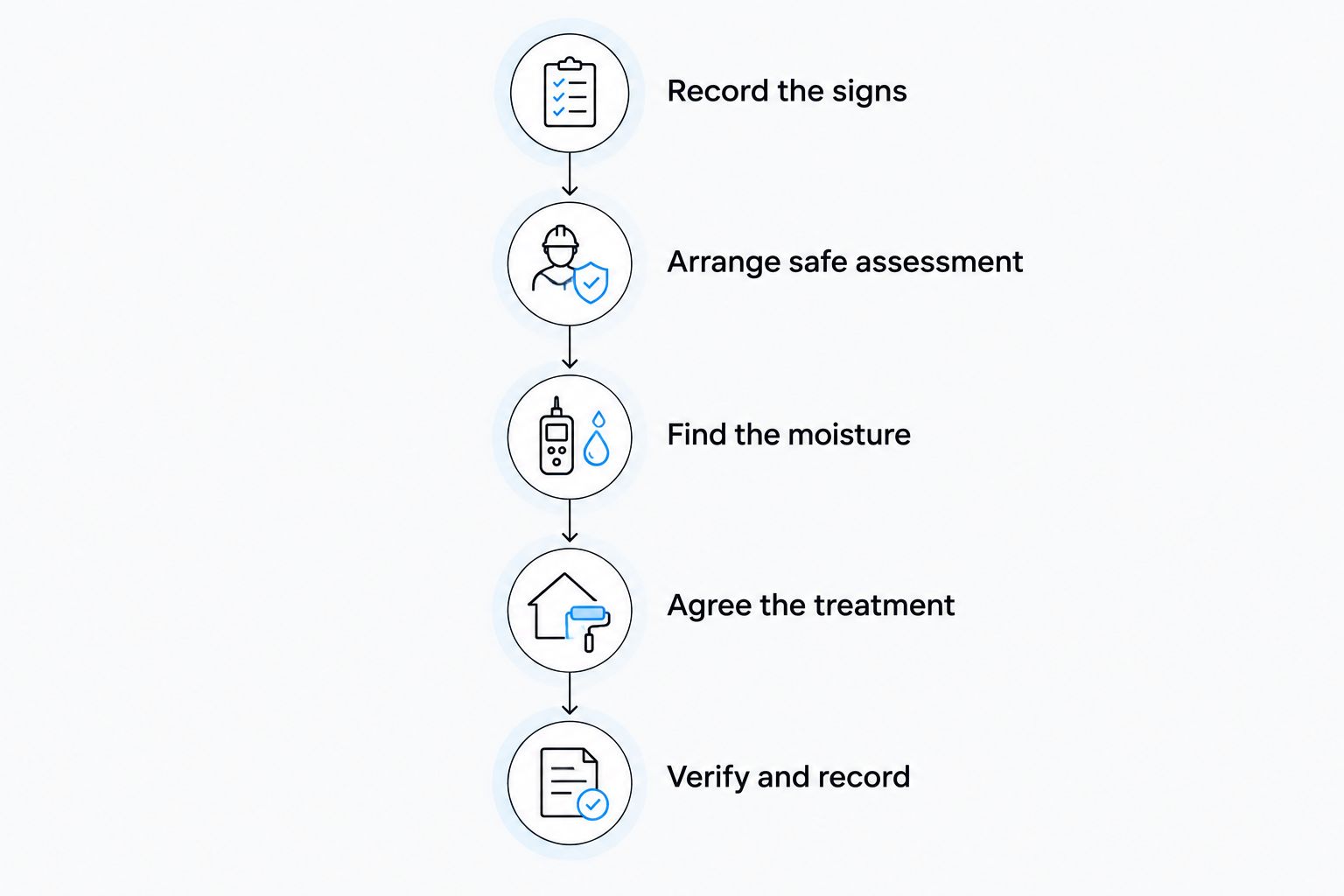
The sequence matters because cleaning and repairs answer different questions. One removes contamination; the other addresses the conditions that allowed it to develop. Your handover needs to account for both.
Routine high dusting: use it for dry overhead dust
Routine high dusting suits accessible surfaces carrying ordinary settled dust, such as exposed beams, ledges and overhead fixtures. Its benefit is straightforward: removing accumulated debris from places normal floor-level cleaning does not reach.
The limitation is equally clear. High dusting does not establish the condition of concealed materials, identify every source of dampness or prove that a mould problem has ended. Equipment that reaches a surface does not automatically make the method appropriate for suspected contamination.
For a 2026 high-dusting brief, describe the surfaces and the access conditions. Add a stop-work instruction if cleaners encounter visible suspected mould, wet materials or unexpected ceiling damage. That gives the crew a clear boundary between routine work and a problem needing assessment.
Choose routine high dusting for dry dust, not as the default response to mould. If the work order includes both, separate the tasks so the contractor can price and plan the actual scope without confusing their purposes.
Surface mould cleaning: match the method to the material
Some accessible, sound surfaces can be cleaned using an appropriate mould-cleaning method after assessment. The practical advantage is that the work targets the affected surface rather than treating the whole problem as loose dust.
Material condition is the constraint. A method suitable for a hard, non-porous surface is not automatically suitable for plasterboard, insulation or other porous materials. Wet, deteriorated or deeply affected materials can require removal rather than repeated wiping.
Ask the contractor to identify the material, explain why it can be retained and describe how surrounding areas will be protected. Do not accept a chemical name as the entire treatment plan. Application, removal of contamination, drying and moisture repairs all matter.
Choose surface cleaning only where the material and condition support it. A stain disappearing is a visual result, not proof that concealed contamination or the moisture source has been addressed.
Cavity remediation: address contamination and building defects
Hidden or recurring mould needs a scope that looks beyond the visible ceiling face. The benefit of a remediation approach is that it considers affected materials, disturbance controls and the building fault together.
Its limitation is disruption. Access openings, material removal and repair work can affect room use, nearby contents and other trades. Confirm those boundaries before authorising work, especially where the premises remain occupied.
OZLINK Facility Services lists high dusting, reactive repairs, commercial maintenance, and plumbing and electrical coordination among its services. Those capabilities are relevant to organising building work, but they do not by themselves establish a specialist mould-remediation scope. Ask who assesses contamination, who performs treatment and who verifies the result.
For your 2026 work order, name the responsible party for each task. Avoid a handover in which the cleaner assumes the leak was fixed while the repair contractor assumes the cleaner dealt with all affected materials.
Why ceiling cavity mould treatment varies
The same visible patch can lead to different work because the conditions behind the ceiling differ. These factors determine the scope:
- Affected material. Smooth, sound surfaces and absorbent insulation do not respond to cleaning in the same way. Identify the substrate before choosing a method.
- Moisture source. Roof leaks, plumbing faults and condensation require different investigations and repairs. Record what caused the dampness, not just where it appeared.
- Extent and location. Visible growth below a ceiling does not reveal the condition of concealed surfaces. Define the inspected area and any access limitations.
- Access hazards. Electrical services, fragile ceilings and suspect asbestos-containing materials affect how assessment and work proceed. Ceiling tiles are not a walking surface.
- Occupancy and airflow. Work above an occupied office, shop or childcare room needs planning to limit disturbance and the movement of contaminated dust.
- Material damage. Sagging, crumbling or persistently wet materials create a repair problem as well as a cleaning problem. Escalate their condition before routine work continues.
There is no useful universal dusting schedule for an unresolved moisture defect. Set maintenance intervals after the building issue and affected materials have been assessed.
What should a ceiling mould work order include?
A useful work order describes the problem and the acceptance criteria, not just the requested cleaning task. Write down the affected room, visible signs, recent water events and any restrictions on access or occupancy.
Then require clear answers to these questions:
- Which surfaces and cavity areas will be inspected?
- What remains inaccessible or outside the scope?
- Who investigates and repairs the moisture source?
- How will the contractor control disturbance and protect adjacent areas?
- Which materials will be retained, cleaned or removed?
- What evidence will support completion and reopening?
For a 2026 maintenance register, keep photographs, assessment notes, repair records and the completion report together. Do not close a mould-related ticket solely because the ceiling looks cleaner.
An inspection photograph also has limits. It records a visible condition at a particular location; it does not demonstrate the condition of an entire concealed cavity. Ask the contractor to state what the evidence actually covers.
Should you dry a wet ceiling before cleaning mould?
Prompt drying is part of preventing mould after water damage, but it must follow a safe assessment of the affected area. The US Environmental Protection Agency's published mould guidance recommends drying water-damaged materials within 24–48 hours to help prevent mould growth.
That 24–48-hour window is prevention guidance, not a promise that existing mould disappears when a surface dries. Contaminated water, electrical hazards, damaged ceilings and affected porous materials need their own assessment. Do not direct staff to enter a cavity or set up drying equipment around unknown hazards.
If mould is already present, ask for a plan covering both the contamination and the moisture. Drying alone does not remove all the material that needs attention.
Can you clean the room while mould work happens overhead?
Keep routine cleaning separate from work that disturbs suspected mould above the ceiling. The contractor should define the work area, access restrictions and controls before opening the cavity or handling affected materials.
Room use depends on the assessed scope, not simply whether the task is called cleaning. For childcare premises, include the centre's access and operational requirements in planning rather than assuming an ordinary cleaning visit is suitable.
Do not schedule floor cleaning directly beneath uncontrolled overhead disturbance. Agree the sequence so debris control, repairs and final cleaning support each other rather than creating rework.
FAQ
Can high dusting remove mould from ceiling cavities?
High dusting alone does not reliably remove mould from ceiling cavities. It removes settled dust, while mould requires assessment, moisture control and treatment suited to the affected materials.
Is dry brushing safe for mould above a ceiling?
Dry brushing suspected mould can release contaminated dust into the air. Stop routine dusting and have the affected area assessed before disturbing it.
Can ceiling mould return after cleaning?
Ceiling mould can return if moisture remains or returns. Cleaning needs to be paired with investigation and correction of leaks, condensation or other relevant moisture sources.
Do mouldy ceiling tiles always need replacing?
Mouldy ceiling tiles need assessment based on their material and condition. Porous, damaged or persistently wet tiles can require replacement rather than surface cleaning.
Does a musty smell prove there is mould in the cavity?
A musty smell does not establish the location or extent of mould. It is a reason to investigate moisture and concealed areas, not a basis for declaring the whole cavity contaminated.
Can air-conditioning condensation cause ceiling mould?
Air-conditioning condensation can contribute to ceiling mould when moisture wets nearby materials. Investigate relevant drainage, insulation and condensation issues rather than cleaning the stain alone.
Does OZLINK Facility Services offer high dusting in Brisbane?
OZLINK Facility Services lists high dusting among its commercial facility services in Brisbane and South East Queensland. Confirm the scope separately if the job involves suspected mould, concealed contamination or damaged ceiling materials.
One last thing
Put the moisture repair on the same job record as the cleaning. Separate tickets are easy to close without anyone confirming that both parts of the problem are resolved.
Before signing off your 2026 ceiling maintenance work, ask: what caused the dampness, what was done about it, and what evidence supports completion? A cleaner ceiling answers none of those questions on its own.