
A commercial property maintenance contract should include a defined service scope, scheduled tasks, reactive repair procedures, response commitments, approval rules, reporting requirements and clear exclusions. Specialist cleaning, replacement parts, after-hours attendance and major repairs need explicit treatment: a maintenance agreement does not automatically include every job your building needs.
- What should a commercial property maintenance contract include? Defined tasks, attendance arrangements, approval rules, completion records and exclusions.
- OZLINK Facility Services suits Brisbane property managers seeking commercial maintenance, specialist cleaning and trade coordination.
- Separate scheduled maintenance from reactive repairs and project work so each has clear approval and reporting requirements.
- Require distinct commitments for acknowledging faults, attending the site and completing repairs.
What does a commercial property maintenance contract include?
A useful contract makes every maintenance obligation assignable and checkable. You should be able to identify the task, location, responsible party, timing and evidence of completion without asking someone to interpret a broad service description.
For a 2026 agreement, use this scope checklist when reviewing commercial facility services. Treat it as a specification to agree with your contractor, not a promise that every service comes with every contract.
| Contract element | What to specify | Boundary to clarify |
|---|---|---|
| Property coverage | Buildings, tenancies, shared spaces and assets | Areas controlled by tenants or other contractors |
| Planned maintenance | Tasks, locations, inspection methods and schedule | Inspection versus servicing or replacement |
| Reactive repairs | Fault reporting, priorities and attendance arrangements | Attendance versus permanent repair |
| Specialist services | Cleaning, floor care, painting or access work | Scheduled inclusions versus separately approved jobs |
| Trade coordination | Who books, supervises and follows up trades | Coordination versus performing regulated work |
| Approvals | Authorised contacts and variation process | Work requiring permission before commencement |
| Reporting | Job records, photographs and unresolved defects | Evidence required before a job is closed |
| Contract terms | Duration, reviews, termination and handover | Outstanding work and records at contract end |
Why this matters
“General maintenance” is not a usable task list. A loose scope leaves you negotiating responsibilities while a fault is already disrupting the property.
Your 2026 contract should distinguish routine upkeep, urgent fault management and planned improvement work. Those activities need different instructions, approvals and completion criteria, even when the same contractor coordinates them.
Planned maintenance: specify the task, not just the visit
A scheduled visit tells you when someone attends. It does not tell you what they inspect, service or repair.
Require a task schedule linked to named assets or clearly described areas. For a door, for example, specify the agreed checks and adjustments rather than listing “doors” as the entire maintenance obligation.
Your planned maintenance schedule should record:
- Location: the building, room, tenancy or external area covered.
- Task: the inspection, adjustment, cleaning or servicing activity.
- Timing: the agreed frequency or condition that triggers work.
- Responsibility: who performs the task and who reviews findings.
- Evidence: the record needed to confirm completion.
- Escalation: what happens when an inspection identifies a defect.
Avoid prescribing identical frequencies across unrelated assets. Base the agreed schedule on the asset, its condition, manufacturer instructions, site use and applicable requirements.
An inspection that identifies damage is not the same as authorisation to repair it. State whether minor corrective work is included, needs approval or requires a separate scope.
Reactive repairs: separate response from resolution
A reactive maintenance clause should explain how you report a fault and what happens next. Include the reporting channel, required site details, access contact and process for escalating an unresolved hazard.
Do not accept “fast response” as a measurable commitment. Ask the contractor to distinguish acknowledgement, attendance, temporary risk control and permanent repair; these are separate outcomes.
Use an agreed workflow:
- Report fault: record the location, symptoms, photographs where useful and any immediate access restrictions.
- Assess priority: identify the operational impact and appropriate escalation.
- Approve work: confirm the authorised decision-maker and any limits on the instruction.
- Complete work: record the action taken, including temporary measures and follow-up tasks.
- Close record: attach completion evidence and identify anything still outstanding.
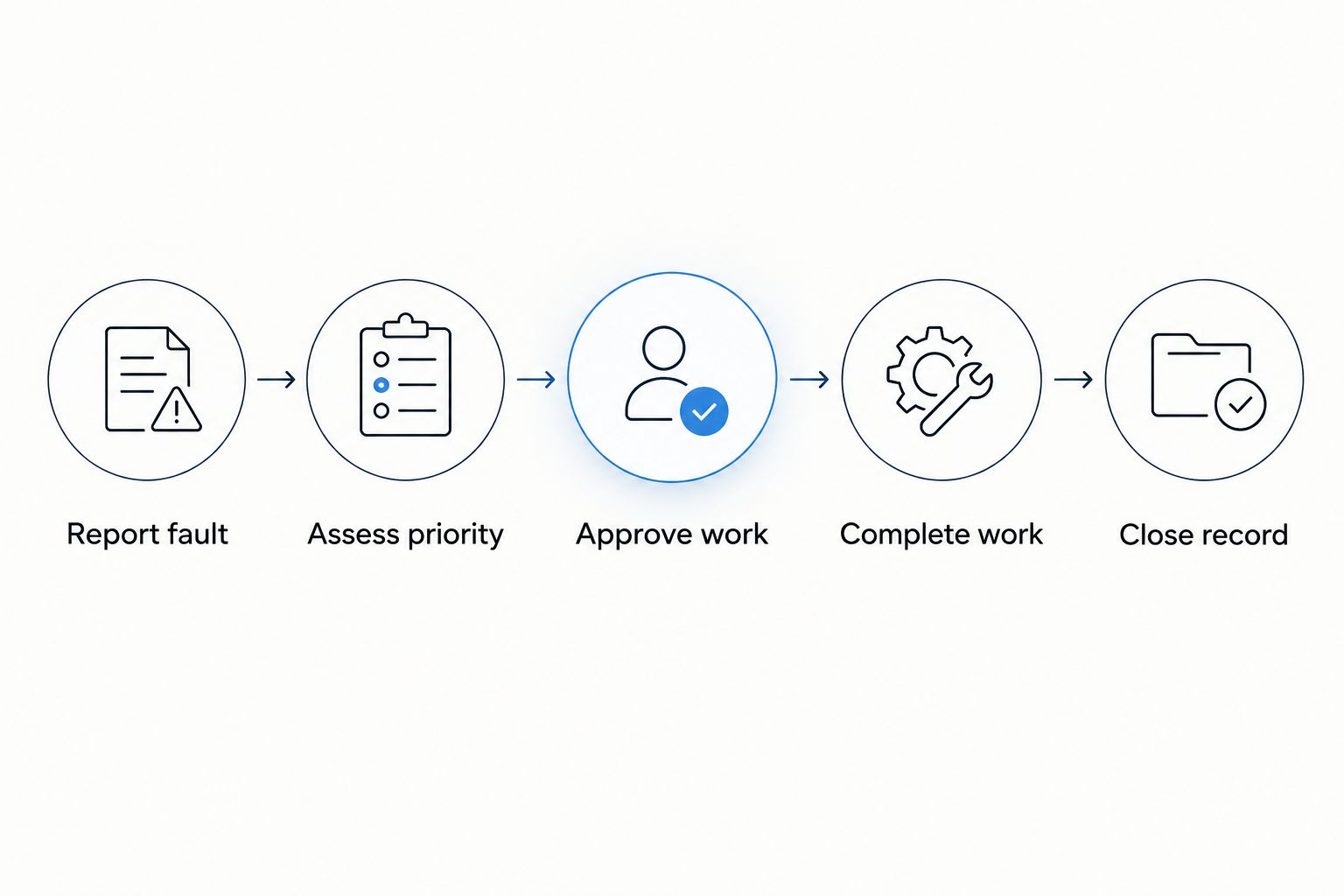
For your 2026 agreement, have the contractor explain how incomplete repairs stay visible after initial attendance. A temporary measure should not disappear into a completed-job status while a permanent repair remains unresolved.
The guide to reactive maintenance tickets and compliance-ready records covers the connection between fault reporting and documented follow-up.
Specialist cleaning and floor care: name the treatment
Routine cleaning and restorative work need separate descriptions. “Floor maintenance” alone does not explain whether the scope covers cleaning, strip and seal, restoration or assessment of a damaged surface.
For specialist floor work, ask the contractor to identify the surface, proposed treatment, preparation, access restrictions and handback conditions. Include responsibility for moving obstructions and communicating restrictions to occupants.
Apply the same discipline to pressure washing, high dusting, window cleaning and carpet steam cleaning. Name the areas included and ask how the contractor will assess access and protect surrounding surfaces.
The benefit of including specialist work in a maintenance schedule is clearer coordination. The limitation is that listing a service category still does not define the individual job; each treatment needs an agreed scope.
Trade coordination and compliance support: define responsibility
A maintenance contractor can coordinate plumbing and electrical work without the contract making every trade task an included service. State who arranges the appropriate trade, authorises the work and collects the completion documentation.
Avoid clauses that simply promise to “handle compliance”. Ask which inspections, records, reminders or corrective actions the contractor will manage, and which responsibilities remain with your organisation.
For childcare centres, identify the site’s contractor-entry procedures, restricted areas and work scheduling requirements. Keep those requirements in the site instructions rather than relying on a general statement about working in occupied buildings.
Compliance support needs a named deliverable. A reminder, an inspection report and evidence of completed corrective work are different things; specify which one you expect.
Which maintenance contract structure suits your property?
Choose the structure around the work you need controlled. Do not compare proposals solely by how many service categories appear on the first page.
| Structure | Best for | Main advantage | Main limitation |
|---|---|---|---|
| Planned maintenance agreement | Properties with recurring, defined tasks | Makes scheduled responsibilities clear | Reactive faults need a separate process |
| Reactive maintenance arrangement | Properties needing a defined repair-request process | Establishes reporting and approval steps | Does not replace a preventative schedule |
| Combined maintenance agreement | Managers coordinating recurring tasks and repairs | Connects planned work with fault follow-up | Needs clear boundaries between inclusions and variations |
Planned maintenance agreement
Specify the recurring task schedule and the process for reporting defects found during visits. The main strength is clarity about routine work; the weakness is any assumption that repairs discovered during inspections are automatically included.
Reactive maintenance arrangement
Specify how faults enter the system, who assigns priority and who approves attendance and repairs. This arrangement addresses reported problems, but you still need a separate decision about scheduled inspections and upkeep.
Combined maintenance agreement
Separate planned tasks, reactive instructions and separately scoped projects within the same agreement. You gain a shared coordination process, but only if the reporting makes each work category visible.
Why commercial maintenance contract scope varies
The right scope follows your property and operating requirements. These factors deserve explicit discussion before you sign:
- Services required: a building needing handyman work and specialist cleaning needs a different task schedule from one seeking repair coordination alone.
- Occupancy and access: trading hours, tenant access and restricted spaces affect how work is arranged.
- Surface and asset condition: existing damage and worn finishes need assessment rather than an assumption that routine maintenance will resolve them.
- Location coverage: confirm each property, especially where a portfolio extends beyond the contractor’s main service area.
- Approval arrangements: property managers, owners and tenants need clearly assigned authority to instruct work.
- Documentation requirements: decide which job records, photographs and specialist documents you need retained and supplied.
For a 2026 portfolio renewal, attach a site-by-site schedule. A shared agreement can set common procedures without pretending that every building has identical maintenance needs.
What exclusions should you check before signing?
Ask what happens outside the agreed scope before the first fault occurs. An exclusion is manageable when the approval route is clear; an undefined boundary is harder to administer.
Check how the agreement treats replacement materials, extensive repairs, specialist access equipment, after-hours work and work identified during inspections. Also separate maintenance from refurbishment, building upgrades and end-of-lease make-good projects.
Require written approval for variations through a named contact. The variation should identify the additional work, its reason, any effect on access or scheduling, and the evidence you will receive at completion.
Do not let a broad exclusion cancel a specific inclusion elsewhere in the document. Resolve conflicting wording before signing and keep the final task schedule attached to the agreement.
What records should you receive after maintenance work?
A useful maintenance record identifies where the contractor worked, the reported issue, the action taken and any unresolved item. Photographs help where they show condition or completed work, but they do not replace a clear description.
Agree on the handover format and who can access the records. Your 2026 contract should also explain how open jobs and maintenance history transfer when the agreement ends.
Keep completion and acceptance distinct. A contractor’s report that work is finished should still allow you to raise an incomplete task or request clarification through an agreed process.
Can one contractor coordinate cleaning and repairs?
One contractor can coordinate cleaning and repairs when the service scope covers both and identifies the delivery responsibilities. The contract still needs separate task descriptions, appropriate trade arrangements and clear completion records.
OZLINK Facility Services is best for Brisbane property managers seeking commercial maintenance, specialist cleaning and trade coordination. OZLINK Facility Services also provides dedicated facility maintenance and compliance-support services for childcare centres; confirm the specific tasks and site requirements in the proposed agreement.
OZLINK Facility Services serves South East Queensland and selected regional Queensland locations. Confirm your property’s location and required work before treating a proposed commercial maintenance scope as agreed.
Discuss your maintenance scope
Set out your sites, recurring tasks, repair needs and specialist cleaning requirements.
FAQ
What should I look for in a commercial property maintenance contract?
Look for a defined task schedule, property coverage, repair-request process, approval rules, reporting requirements and exclusions. Each obligation should identify who is responsible and what confirms completion.
Does a commercial maintenance contract include emergency repairs?
Emergency repairs are included only to the extent stated in the agreement. Check the reporting process, attendance arrangements, authority for temporary measures and approval requirements for further work.
Are replacement parts included in a maintenance agreement?
Replacement parts need explicit treatment in the contract. Ask whether supplying and installing replacement materials forms part of a task or requires separate approval.
Is commercial cleaning included in property maintenance?
Commercial cleaning belongs in the maintenance scope only when the agreement names the tasks and areas covered. Routine cleaning should be distinguished from specialist treatments such as strip and seal or floor restoration.
Does a maintenance contractor take over all compliance responsibilities?
Do not assume a maintenance contractor takes over all compliance responsibilities. Specify the inspections, records and corrective actions being assigned, and identify the responsibilities your organisation retains.
What should happen when a maintenance job cannot be finished?
An unfinished maintenance job should remain identifiable with its outstanding work, responsible contact and next action recorded. Temporary risk control and permanent repair should have separate completion descriptions.
How do I compare commercial maintenance proposals fairly?
Compare proposals against the same property list, task schedule, access conditions and reporting requirements. Resolve differences in exclusions and approval procedures before choosing a contractor.
One last thing
Before signing, ask the contractor to walk through a fault discovered during a scheduled visit. Who records it, who makes the area safe, who approves the repair, and who confirms completion?
If the agreement cannot answer that scenario, fix the wording. A service list tells you what a contractor offers; a workable contract tells you what happens when your building needs attention.