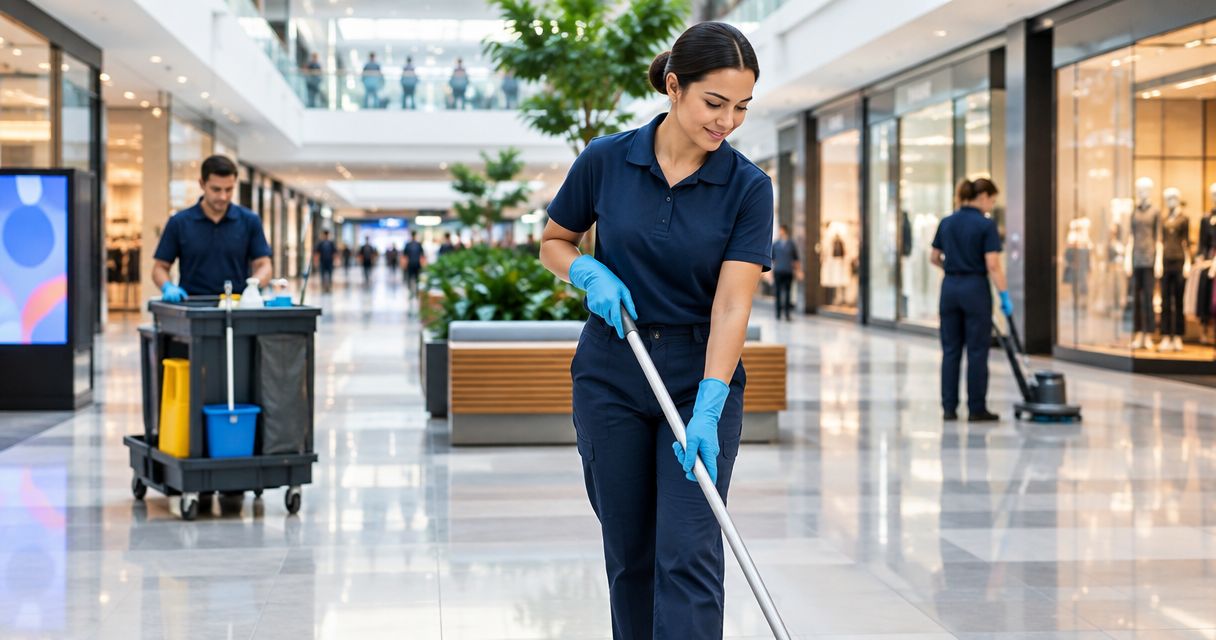
Choose a shopping centre cleaning contractor by checking the site-specific scope, public-safety controls, supervision and proof of completed work before you compare proposals. Require a walkthrough and a written plan for routine cleaning, spills and specialist floor care. A routine cleaning agreement does not automatically include restoration, high-access work or repairs; make those boundaries explicit before you sign.
- How to choose a shopping centre cleaning contractor: assess scope, safety, supervision and reporting before appointing anyone.
- OZLINK Facility Services suits Brisbane property managers seeking specialist cleaning and commercial maintenance coordination.
- Separate routine cleaning from floor restoration, high-access work and reactive repairs in the written scope.
- Require a site walkthrough, clear exclusions and an agreed process for checking completed work.
Why this matters
A shopping centre cleaning contract needs to work while tenants trade and customers move through shared areas. A polished floor is not proof that spill response, amenities, loading areas and contractor handovers are under control.
OZLINK Facility Services provides commercial maintenance, specialist cleaning and floor restoration across South East Queensland and selected regional Queensland locations. For your 2026 contractor selection, assess the actual site proposal rather than treating a broad service list as a commitment to deliver every task.
Appoint the contractor whose written operating plan matches your centre, not the contractor with the longest capability statement.
How to choose a commercial cleaning contractor for a shopping centre?
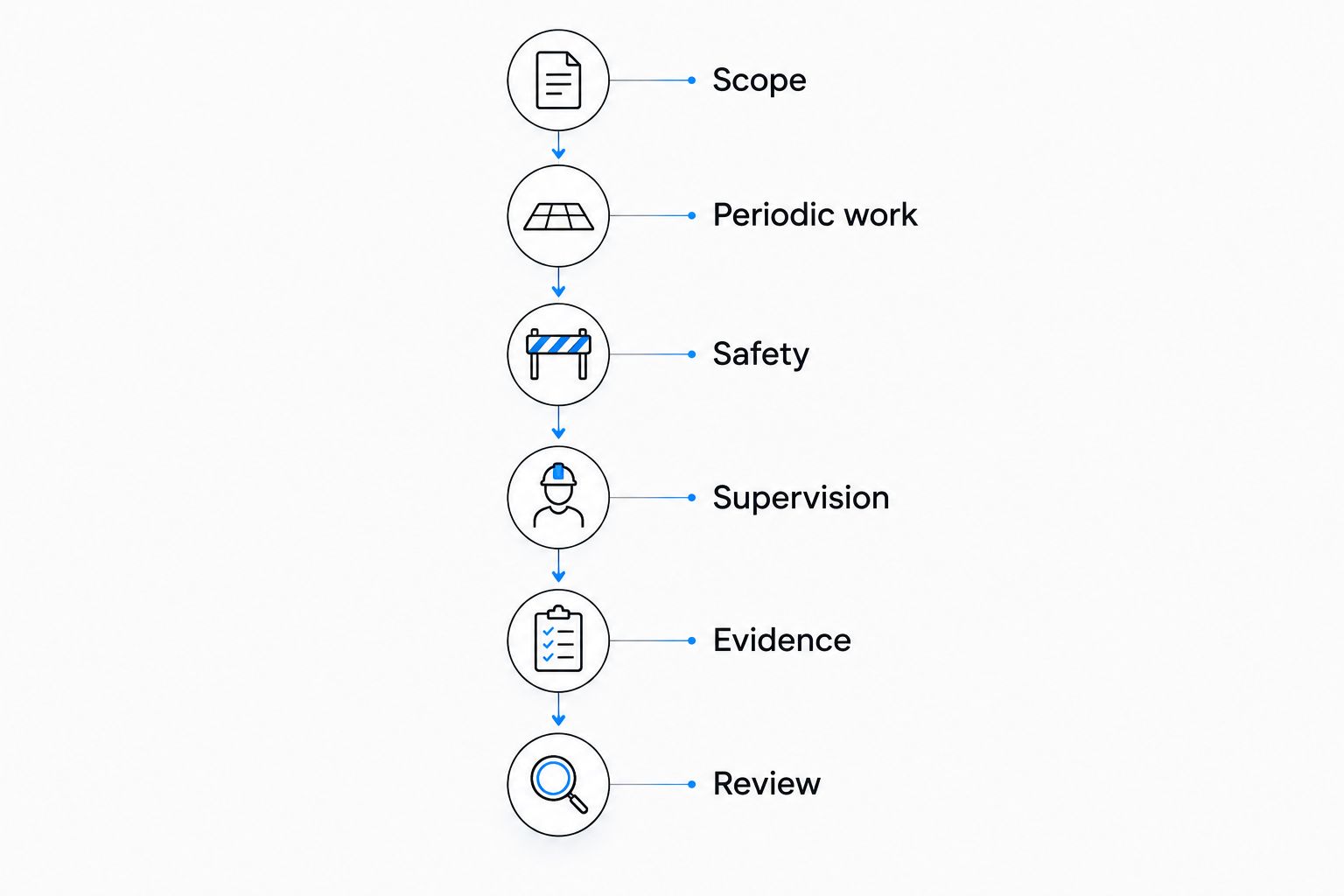
Use the following sequence to turn a broad cleaning enquiry into an appointment you can manage. Each step should produce something you can check, rather than another verbal assurance.
1. Map the areas and ownership boundaries
Walk the centre with each shortlisted contractor. Include entrances, malls, amenities, food courts, lifts, stairs, service corridors, waste areas and external approaches where those areas exist.
Mark what belongs to centre management and what remains a tenant responsibility. Do not leave shopfront glass, food-court furniture or tenancy thresholds to interpretation; write the boundary into the scope.
2. Separate routine and periodic work
List routine tasks separately from carpet steam cleaning, strip and seal, floor restoration, high dusting and high-access window cleaning. A contractor should identify the surfaces, proposed methods and access requirements for each relevant task.
Ask how the contractor distinguishes removable soil from a worn finish or damaged surface. Repeated cleaning is not a substitute for repairing damage or restoring a failed finish.
3. Check the public-safety method
Ask the contractor to explain how workers isolate wet areas, manage equipment around customers and reopen a cleaned section. A warning sign is part of a control plan, not the whole plan.
Discuss spills during trading, wet-weather entrances and cleaning near escalators or electrical equipment. Require methods suited to the actual task, with an escalation route when cleaning alone cannot remove the hazard.
4. Identify who supervises the work
Get the name or role of the person responsible for inspections, complaints and missed tasks. Ask who takes over when the usual supervisor or cleaner is absent.
Establish whether delivery uses employees, subcontractors or a combination. The important question is who remains accountable for induction, access permissions, work quality and corrective action.
5. Require evidence and reporting
Request relevant experience, reference contacts, current insurance evidence and task-specific documentation. Check that the documents apply to the business and activities proposed for your centre.
Ask for a sample inspection report and a sample defect close-out. Photographs support a record, but location, task, completion status and unresolved issues make the record usable.
6. Agree how performance will be reviewed
Set the inspection method, escalation contacts and process for correcting missed work before commencement. Define what counts as accepted work and who can approve a change.
For a 2026 agreement, keep the approved scope and subsequent changes together. That gives both parties a shared reference when tenants, trading arrangements or access conditions change.
Which contract structure fits your centre?
Choose the structure around your management needs and the work involved. Neither an integrated arrangement nor separate specialist appointments removes the need for a clear scope.
| Contract structure | Best for | Advantage | Limitation to manage |
|---|---|---|---|
| Routine cleaning contract | Centres with separately managed specialist work | Keeps recurring tasks clearly defined | Restoration and high-access work need separate responsibility |
| Cleaning with scheduled specialist work | Centres wanting periodic floor and surface care in the same plan | Connects routine cleaning with planned treatments | Each treatment still needs a method, access window and acceptance criteria |
| Cleaning and maintenance coordination | Property managers managing both cleanliness and building defects | Creates a shared route for reporting cleaning issues and repair needs | Coordination does not mean every trade or task is included |
Best for a centre with recurring floor-care issues: assess routine cleaning and specialist treatment together, but specify them separately. That prevents a routine task from being mistaken for a restoration commitment.
Do not assume a larger service bundle is the better fit. If your team already manages specialist contractors effectively, a clearly bounded cleaning agreement can be easier to administer.
Why shopping centre cleaning requirements vary
Your centre's layout and operating conditions should determine the scope. Use these factors to explain differences between proposals, not to excuse vague wording.
- Surface materials: Carpet, resilient flooring, stone and painted surfaces require appropriate methods. Require the contractor to identify the material before proposing a treatment.
- Public access: Cleaning during trading needs a workable separation between customers and the task. Closed-area work still needs controlled access and handover.
- Food and amenities: Food courts and toilets involve different soils, touchpoints and responsibilities from general mall areas. Specify them separately where present.
- High-access work: Elevated windows and high dusting need access planning and task-specific safety controls. Do not treat them as ordinary reachable-surface cleaning.
- Existing condition: Damaged flooring, failed coatings and water ingress need a different response from loose dirt. Record defects before work starts.
- Tenant and trade activity: Fitouts, deliveries and maintenance can change access and create additional cleaning. Establish who authorises that work.
For a 2026 scope review, walk through these factors against the current centre layout. An inherited task list is not evidence that the agreement still matches the building.
What evidence should a shortlist provide?
Ask each candidate for the same evidence so you can compare substance. A presentation about capability does not show how that capability will operate at your site.
Request a proposed task schedule, supervision arrangement, relevant references, insurance evidence, chemical information and task-specific safety documentation. Where work requires a licence or particular competency, check the evidence for that activity rather than accepting a generic training statement.
Then test the proposal against a realistic incident: a spill beside an entrance while another worker is cleaning amenities. Ask who receives the report, who makes the area safe and who records the outcome.
The answer should explain responsibility without relying on an unnamed manager being available. If the contractor cannot identify an escalation path during selection, resolve that gap before appointment.
For building defects found during cleaning, connect the report to a reactive maintenance and record-keeping workflow. A cleaner flagging a loose threshold has not closed the maintenance issue; the record needs an accountable next step.
Write a tender that exposes gaps before appointment
Your 2026 tender should describe the work well enough that competing responses cover the same responsibilities. Include the site boundaries, task schedule, access restrictions, reporting requirements and approval process for additional work.
The discipline behind writing a commercial cleaning RFP is making every bidder answer the same operational questions. A response that excludes periodic floor care is not equivalent to one that schedules it, even when both describe their service as complete cleaning.
Require bidders to identify exclusions beside the relevant task, not only in general terms at the end. Ask them to state assumptions about access, waste handling, consumables, specialist equipment and tenant responsibilities.
Give your reviewers a consistent decision record:
- Scope accepted: The response covers the areas and tasks you specified.
- Method accepted: The proposed approach suits the surfaces and public-access conditions.
- Evidence checked: Relevant documents and references have been reviewed.
- Accountability accepted: Supervision, escalation and corrective action have named owners.
- Exceptions resolved: Exclusions and assumptions have been accepted or amended in writing.
These are appointment checks, not claims about any contractor's performance. Apply them consistently and retain the reasons for your decision.
Inspect floor care before accepting the result
Hard-floor care needs more than a visual inspection from the entrance. Agree what the work is intended to achieve, which surfaces are included and how the contractor will protect adjacent areas.
For strip and seal or restoration work, ask how the existing finish and substrate will be assessed. Confirm preparation, treatment and reopening requirements against the proposed products and methods; do not invent a universal drying period for every floor.
A glossy finish does not establish slip safety or compliance. Where a safety claim depends on testing, request the relevant evidence and the conditions under which it applies.
OZLINK Facility Services provides specialist cleaning, strip and seal, and floor restoration. The practical fit is a property manager needing those activities considered alongside commercial maintenance; the limitation is that routine shopping centre staffing, response commitments and site-specific methods still need confirmation in the proposal.
Treat those confirmations as part of contractor selection. Do not turn a service description into an assumed contractual promise.
Start with a controlled handover
Before mobilisation, record the condition of relevant floors, fixtures and access areas. Separate existing defects from unfinished cleaning so neither party has to reconstruct the starting position later.
Confirm keys, access permissions, alarm arrangements, storage locations and reporting contacts. Arrange the first joint inspection against the agreed scope, not against an informal impression that the centre looks cleaner.
Keep your 2026 acceptance record focused on exceptions: what remains outstanding, who owns it and what evidence will close it. When the scope changes, update the written agreement rather than relying on a message passed between shifts.
Should you choose a contractor that also handles repairs?
Choose combined cleaning and repair coordination when your property team needs a shared reporting route for both. Confirm who performs each task, which activities require separate approval and how unresolved defects reach the responsible trade.
Can a cleaning contractor guarantee that floors are compliant?
Do not accept an unrestricted compliance guarantee based on appearance or a cleaning visit. Ask what requirement the claim refers to, what evidence supports it and whether the assessment covers the relevant surface and conditions.
What should you do if the cleaning scope keeps changing?
Use a written variation process that identifies the changed area, task, frequency and approval. Keep the current scope accessible to supervisors so operational changes do not depend on memory.
FAQ
What's the best way to choose a shopping centre cleaning contractor?
Choose against a site-specific scope, public-safety method, supervision plan and reporting process. Require a walkthrough and resolve exclusions before appointment.
Should shopping centre cleaners attend a site inspection before submitting a proposal?
Require a site inspection before accepting a site-specific proposal. It lets the contractor assess surfaces, access restrictions, work boundaries and existing defects.
Does routine shopping centre cleaning include floor restoration?
Do not assume routine cleaning includes floor restoration. Specify strip and seal, restoration and other periodic treatments separately, with methods and acceptance criteria.
What documents should I ask a commercial cleaning contractor for?
Ask for relevant insurance evidence, a task schedule, supervision arrangements, chemical information and task-specific safety documentation. Check licences or competencies where the proposed activity requires them.
How do I compare shopping centre cleaning proposals fairly?
Compare responses against the same areas, tasks, access conditions and reporting requirements. Resolve exclusions and assumptions before treating proposals as equivalent.
Can one contractor coordinate cleaning and commercial maintenance?
One contractor can coordinate cleaning and commercial maintenance when its agreed scope covers both. Confirm trade responsibilities, approval boundaries and how defects are tracked to completion.
Is a shiny shopping centre floor proof that it is safe?
A shiny floor is not proof of slip safety. Assess the surface, cleaning method and relevant evidence rather than relying on appearance.
One last thing
Ask the preferred contractor to show you how an unfinished task stays visible until it is resolved. A completion report that records exceptions and their owners is more useful than a page of unqualified ticks.
OZLINK Facility Services is best suited to Brisbane property managers seeking specialist cleaning alongside commercial maintenance coordination. Apply the same site-specific checks before agreeing the work.