
Yes—plumbing issues can be coordinated alongside electrical work, carpentry, painting, cleaning and other facility repairs under a shared maintenance plan. Coordinate the bookings and handovers, but keep urgent fault control, licensed trade responsibilities and approval to reopen separate from routine finishing work.
- Plumbing coordination facility maintenance works best when linked repairs share a scope, access plan and completion record.
- OZLINK Facility Services provides commercial maintenance, plumbing and electrical coordination, repairs and specialist cleaning.
- Fix and verify the underlying fault before covering affected areas or completing final finishes.
- Urgent hazards need immediate attention, not a place in the next routine maintenance booking.
Can plumbing issues be coordinated alongside other facility repairs?
Yes. Manage connected defects as a coordinated job, with a named person controlling scope, access, approvals and handovers. That does not mean every trade attends together or that a general maintenance worker performs plumbing work.
OZLINK Facility Services lists plumbing and electrical coordination alongside commercial maintenance, carpentry, painting and specialist cleaning within its facility services. For facility managers arranging connected repairs, the practical benefit is having those tasks considered together rather than treating the visible damage as an isolated problem.
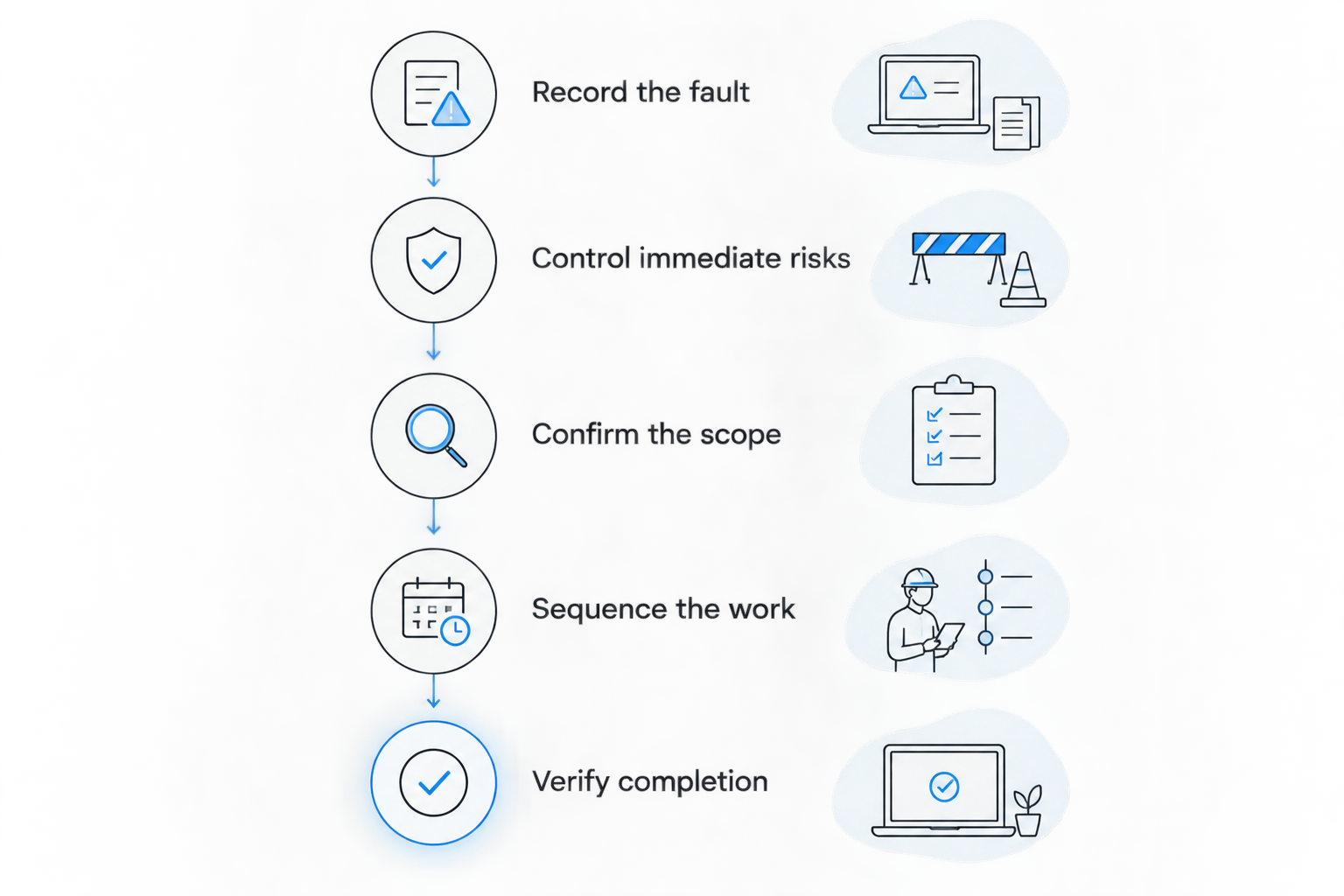
Use this sequence for a coordinated repair:
- Record the fault. Identify the location, visible symptoms, affected rooms and any immediate impact on occupants or services.
- Control immediate risks. Restrict access where necessary and arrange the appropriate trade response. Keep staff away from suspected electrical hazards.
- Confirm the scope. Establish what needs investigation, what needs repair and which decisions require your approval.
- Sequence the work. Resolve the plumbing fault before dependent repairs, allowing for inspection, drying or other preparation where required.
- Verify completion. Collect trade findings, check the agreed repairs and confirm who authorises the area to reopen.
For your 2026 maintenance plan, make these stages visible in the work order. A calendar entry alone does not tell the next contractor whether the area is ready.
Why this matters
A plumbing repair and the damage around it are different parts of the same job. Stopping a leak does not automatically resolve affected cabinetry, wall finishes, flooring or cleaning requirements.
The reverse also applies. A clean floor and fresh paint do not establish that the underlying fault has been corrected. Define completion by the agreed repair scope, not by appearance alone.
If your 2026 maintenance register separates plumbing, building repairs and cleaning into different queues, link the related tickets. Each contractor should know which earlier task must be completed before their work starts, and who confirms that handover.
Should you coordinate repairs or book trades separately?
Choose the booking approach according to how closely the tasks depend on each other. Coordination is most relevant when several contractors need access to the same area or when later work would conceal an earlier repair.
| Approach | Best for | Practical benefit | Limitation |
|---|---|---|---|
| Coordinated maintenance job | Linked plumbing, building and cleaning tasks | Keeps dependencies, access and handovers within a shared plan | Requires clear ownership and updates when the scope changes |
| Separate trade bookings | An isolated fault with no dependent repairs | Keeps a straightforward task narrowly scoped | Leaves you responsible for connecting any later repair work |
Neither approach removes the need for appropriate trade qualifications or site controls. Separate bookings can work well when your facility team already manages those responsibilities. Coordinated work still needs oversight; a single booking reference is not proof of a complete repair.
Reactive plumbing repairs: control the fault first
Best for: an active fault affecting safe use of the building. Treat the immediate problem separately from the full reinstatement plan, even when both sit under the same maintenance request.
Report what you can observe without entering an unsafe area: where water is appearing, which spaces are affected and whether nearby services are involved. Do not ask cleaners or general maintenance staff to investigate suspected electrical contact with water.
The advantage of this approach is a clear immediate priority. Its limitation is that the final repair scope remains dependent on the findings. Do not promise occupants a reopening time before the relevant contractors have assessed the fault and affected area.
Record the interim status plainly: access restricted, investigation underway, repair awaiting approval or reinstatement pending. Avoid marking the entire job complete simply because the immediate water release has stopped.
Planned plumbing work: group compatible tasks
Best for: known defects and non-urgent work that can be arranged around building use. Put the plumbing task, associated repairs and final cleaning into a shared schedule, with each contractor's access requirements confirmed beforehand.
For a 2026 planned maintenance programme, ask whether the job affects amenities, adjoining tenancies, deliveries or restricted rooms. Tell occupants what will be unavailable and who will issue the reopening notice.
Planned coordination gives you room to arrange access and approvals before attendance. The limitation is dependency: if investigation changes the scope, downstream bookings need review. Do not keep a painting or flooring appointment unchanged when the area has not met the preparation requirements.
Group work because it shares access or a repair sequence—not simply because several defects appear on the same list.
Why plumbing coordination varies between facilities
The coordination effort depends on the site and the work involved. These factors determine what belongs in the plan:
- Connected trades. Plumbing, electrical coordination, carpentry, painting and cleaning have different responsibilities. Name the handover between them.
- Building use. Offices, commercial tenancies and childcare centres need access arrangements that reflect how occupants use the affected space.
- Repair scope. A visible plumbing symptom and the extent of surrounding damage need separate assessment before you approve reinstatement.
- Access restrictions. Confirm keys, escorts, room access and permitted work areas before arranging attendance.
- Surface restoration. Carpet, hard floors, cabinetry and painted surfaces need an appropriate repair or cleaning scope rather than a blanket instruction to clean up.
- Approval responsibilities. Identify who can approve investigation, additional work and return to use, especially where a property manager and occupier are both involved.
A shared scope needs named responsibilities. Without them, coordination becomes a series of bookings with nobody checking the gaps between contractors.
What should your coordinated work order include?
Write the work order so a contractor unfamiliar with the site can understand the fault, the access conditions and the limits of their authority. Describe symptoms rather than presenting an unconfirmed diagnosis as fact.
Include the following fields in your 2026 work-order template:
- Location and impact: building, tenancy, room, affected asset and any services or spaces currently out of use.
- Observed condition: photographs and a plain description of what staff noticed, taken only from a safe location.
- Immediate controls: barriers, restricted access and any actions already taken by authorised personnel.
- Scope and exclusions: the investigation or repair requested, plus work that needs separate approval.
- Dependencies: the conditions that must be met before carpentry, painting, floor care or cleaning starts.
- Contacts and authority: the site contact, approval contact and person responsible for accepting the handover.
- Completion evidence: findings, work performed, outstanding defects and any relevant trade documentation.
Use the same reference across connected tasks. The workflow from reactive maintenance tickets to compliance-ready records is particularly relevant when the repair needs a clear history of decisions and handovers.
Keep a distinction between contractor attendance and accepted completion. A visit confirms attendance; the agreed evidence establishes what was resolved and what remains open.
How should plumbing and electrical work be coordinated?
Where a plumbing fault affects an area containing electrical equipment, keep access restrictions in place until the relevant trades have assessed their responsibilities. Do not assume that stopping the water makes the electrical equipment safe to use.
A shared access plan matters for plumbing and electrical maintenance because the plumbing repair and the electrical assessment answer different questions. The work order should identify who manages each task and who confirms the conditions for subsequent work.
For a Queensland facility, use appropriately licensed trades for regulated work and confirm site-specific requirements before attendance. A maintenance coordinator arranges the sequence; coordination does not replace the trades' technical responsibilities.
Keep electrical assessment separate from cosmetic reinstatement. Replacing a damaged panel, repainting a wall or cleaning a room does not establish that nearby electrical equipment is ready for use.
Can cleaning and floor restoration happen during the repair?
Yes, but distinguish immediate containment from final cleaning and restoration. An area might need attention while the repair is underway without being ready for its final finish.
OZLINK Facility Services offers commercial hard floor care and restoration, carpet steam cleaning and specialist cleaning alongside facility maintenance. Those services are relevant where a plumbing incident leaves affected surfaces, but the cleaning scope must follow the actual condition and material.
Do not book final floor restoration as a substitute for resolving the fault. Confirm that the plumbing work is complete and obtain the relevant advice on moisture, contamination and surface preparation before instructing finishing work.
Coordination connects those decisions; it does not eliminate them. A floor-care contractor still needs a clear description of the incident and the surface, rather than an instruction to make the area look normal again.
Can plumbing work be coordinated at a childcare centre?
Yes. Coordinate the repair around controlled contractor access, affected amenities and separation from children and staff. Confirm the centre's requirements before arranging attendance rather than assuming that an ordinary commercial access plan is sufficient.
OZLINK Facility Services provides dedicated childcare facility maintenance and compliance-support services. The centre still needs to identify its operational restrictions, approval contacts and conditions for returning the affected space to use.
Keep the repair record specific. Record which amenity or room was unavailable, what work occurred and which outstanding matters need further attention. Maintenance coordination supports the centre's processes; it does not replace the centre's own compliance responsibilities.
How do you know the whole repair is finished?
Check the original fault and every dependent task against the agreed scope. Ask whether the plumbing issue was resolved, affected building elements were addressed, cleaning was completed and outstanding restrictions were communicated.
Use 3 close-out checks: fault resolved, reinstatement checked, reopening authorised. These are review categories, not a substitute for technical assessment or documentation required for the particular work.
For your 2026 records, distinguish completed work from recommendations for a later visit. If a contractor identifies a separate defect, record who owns the follow-up and whether it changes the conditions for using the area.
OZLINK Facility Services is a fit for Brisbane facility managers seeking commercial maintenance with plumbing and electrical coordination. Confirm the proposed scope, handovers and completion evidence before approving the job; those details determine whether the arrangement suits your facility.
Arrange coordinated facility repairs
Describe the plumbing issue, affected areas and connected repairs so the scope can be discussed.
FAQ
Can I use one maintenance contact for plumbing and other repairs?
Yes, one maintenance contact can coordinate plumbing and related repairs. Confirm who controls the scope, appoints the appropriate trades and accepts each handover.
Does coordinating plumbing mean every trade attends together?
No, coordinated plumbing work does not require every trade to attend together. The schedule should follow task dependencies, access conditions and confirmed readiness for the next stage.
Can a handyman complete the plumbing work?
A handyman must not perform regulated plumbing work unless appropriately licensed for that work. Separate general repairs from tasks that require a licensed plumber.
Should I wait for a routine maintenance visit if a pipe is leaking?
Do not defer an active leak simply to combine it with routine work. Restrict access where necessary and arrange an appropriate assessment of the immediate risks.
Can painting start as soon as the leak stops?
Stopping the leak does not automatically make the surface ready for painting. Confirm the repair and obtain the relevant advice on drying, substrate condition and preparation first.
Who should tell staff that the repaired area can reopen?
Your maintenance plan should name the person authorised to reopen the affected area. That decision should follow the relevant trade checks and site requirements, not just the departure of the last contractor.
What records should I keep after coordinated repairs?
Keep the fault report, approved scope, contractor findings, completion evidence and outstanding actions. Include relevant trade documentation and a clear record of the handover.
One last thing
Add a hold point before anyone covers the repair. Ask the relevant contractor what needs checking before a wall is closed, cabinetry is reinstated or a finish is applied.
That instruction gives the next trade a clear stopping point. A tidy finish should be the final stage of a verified repair—not the point where the evidence disappears.