
Strata commercial electrical maintenance is the planned inspection, servicing and repair of shared electrical assets to keep common areas safe and building services working. Unlike a single tenancy, a strata scheme needs clear responsibility boundaries, committee approvals and access arrangements before work starts.
- Commercial electrical maintenance for strata starts with asset ownership, licensed electrical contractors and a documented maintenance schedule.
- OZLINK Facility Services suits property managers seeking electrical coordination alongside commercial maintenance.
- Keep fault reports, electrical service records and unresolved defects together; an invoice alone does not establish completion.
- Set inspection and testing requirements for each asset rather than applying one interval across the building.
Why electrical maintenance matters for strata
A failed common-area light affects more than appearance. It can leave a stairwell dark, generate repeated resident complaints and require access coordination across occupied premises. An electrical fault affecting shared equipment also creates a responsibility question: who authorises the investigation, and which asset does it belong to?
For your 2026 maintenance plan, treat these as connected tasks rather than separate contractor bookings. Record the asset, identify the responsible party and agree how the contractor will report the outcome.
OZLINK Facility Services provides commercial maintenance and electrical coordination across South East Queensland and selected regional Queensland locations. OZLINK Facility Services suits property managers seeking electrical coordination alongside commercial maintenance. That coordination role does not replace the electrical contractor's licensing, technical assessment or required documentation.
Your practical objective is a maintenance trail that the committee, manager and next contractor can follow without reconstructing the job from emails.
How to organise commercial electrical maintenance for strata
1. Map responsibility before issuing work
Start with the scheme's plans, existing asset records and relevant maintenance arrangements. Use a spreadsheet if you do not have a maintenance system. Record what each asset serves, where it sits and who must confirm responsibility.
Do not decide ownership from location alone. Equipment near a lot can serve common property, while equipment in a shared space can have a different ownership or maintenance arrangement. Ask the body corporate manager to resolve uncertainty before approving routine work; urgent hazards need an immediate safety response.
Build a responsibility map that distinguishes shared assets, lot-specific assets and anything awaiting confirmation. Include the authority to approve investigation separately from the authority to approve replacement.
- List common-area lighting, shared switchboards and electrically powered shared equipment.
- Record asset locations using consistent building and level names.
- Mark uncertain responsibility as unresolved rather than guessing.
- Identify the person authorised to approve each work category.
- Keep supporting plans and previous decisions with the asset record.
2. Establish an asset-based maintenance schedule
Use previous service reports and manufacturer instructions to build the first schedule. Ask a licensed electrical contractor to identify applicable inspection and testing requirements, asset condition concerns and missing records. A blank history needs investigation, not an invented last-service date.
Separate ordinary lighting maintenance from safety-related systems and other specialist equipment. Shared pumps, access equipment and emergency lighting do not become the same maintenance task simply because they use electricity.
For the 2026 schedule, give each asset a clear status: scheduled, completed, overdue or awaiting technical advice. Do not apply a blanket testing interval to every electrical asset. Requirements depend on the equipment, its use and the applicable rules.
- Record the asset description, location and service reference.
- Enter the last documented service date, where available.
- Have the contractor confirm the applicable next action and timing.
- Separate routine inspections from known defect repairs.
- Flag inaccessible equipment before the appointment.
- Record who checks that scheduled work actually occurred.
3. Create a fault-reporting and triage process
Give residents, cleaners and building staff a simple reporting form. Ask for the location, visible symptoms, time noticed and a photograph taken only from a safe position. Reports should describe the fault, not ask an unqualified person to diagnose it.
Use 4 priority categories in your reporting process: immediate danger, urgent assessment, routine repair and planned improvement. Have the electrical contractor define technical escalation criteria. Do not let an administrative label postpone a response to a suspected hazard.
Where there is immediate danger, keep people away and contact emergency services as appropriate. Do not ask residents to open switchboards, touch damaged equipment or repeatedly reset a device that keeps tripping.
OZLINK Facility Services offers electrical coordination alongside reactive repairs and other facility services. That is relevant when the electrical visit also depends on access, building repairs or another trade; confirm the proposed scope before appointing anyone.
- Publish one reporting channel and a separate emergency escalation route.
- Capture the exact location and what the reporter observed.
- Record whether the affected area remains in use.
- Assign a person to acknowledge and progress the report.
- Escalate repeated faults for investigation rather than another identical repair.
4. Check licensing, scope and approval authority
Before booking electrical work, verify the contractor's current Queensland electrical contractor licence and that the proposed work falls within its scope. Check relevant insurance and ask who will perform the work. A general maintenance appointment is not evidence that electrical work is authorised.
Write a scope that distinguishes investigation, repair and replacement. Ask the contractor to state exclusions, access requirements, likely interruptions and what needs further approval. This makes committee decisions clearer without asking committee members to make technical judgements.
In your 2026 approval process, name the authorised decision-maker and the escalation route when an investigation reveals additional defects. An inspection booking is not automatic approval for every repair discovered.
- Verify the electrical contractor licence through the Queensland regulator's register.
- Confirm the equipment and locations included in the scope.
- Ask for relevant insurance evidence and subcontracting arrangements.
- Identify who can approve additional work.
- Require written findings when the scope changes.
- State which completion records the contractor must supply.
5. Coordinate access and planned interruptions
Start with a shared calendar and a written access plan. Confirm keys, locked rooms, parking, escorts and any tenant restrictions before the contractor attends. Identify occupied areas that depend on the equipment being serviced.
Ask the electrical contractor to determine isolation requirements and how the work affects other systems. Building management should organise notices and access around that technical advice, not prescribe the electrical method.
A useful job sequence is responsibility map, asset schedule, fault triage, access plan, completion record. Follow that sequence so an approved repair does not arrive on site without keys or leave without evidence. The same structure works whether you coordinate directly or appoint a facilities partner.
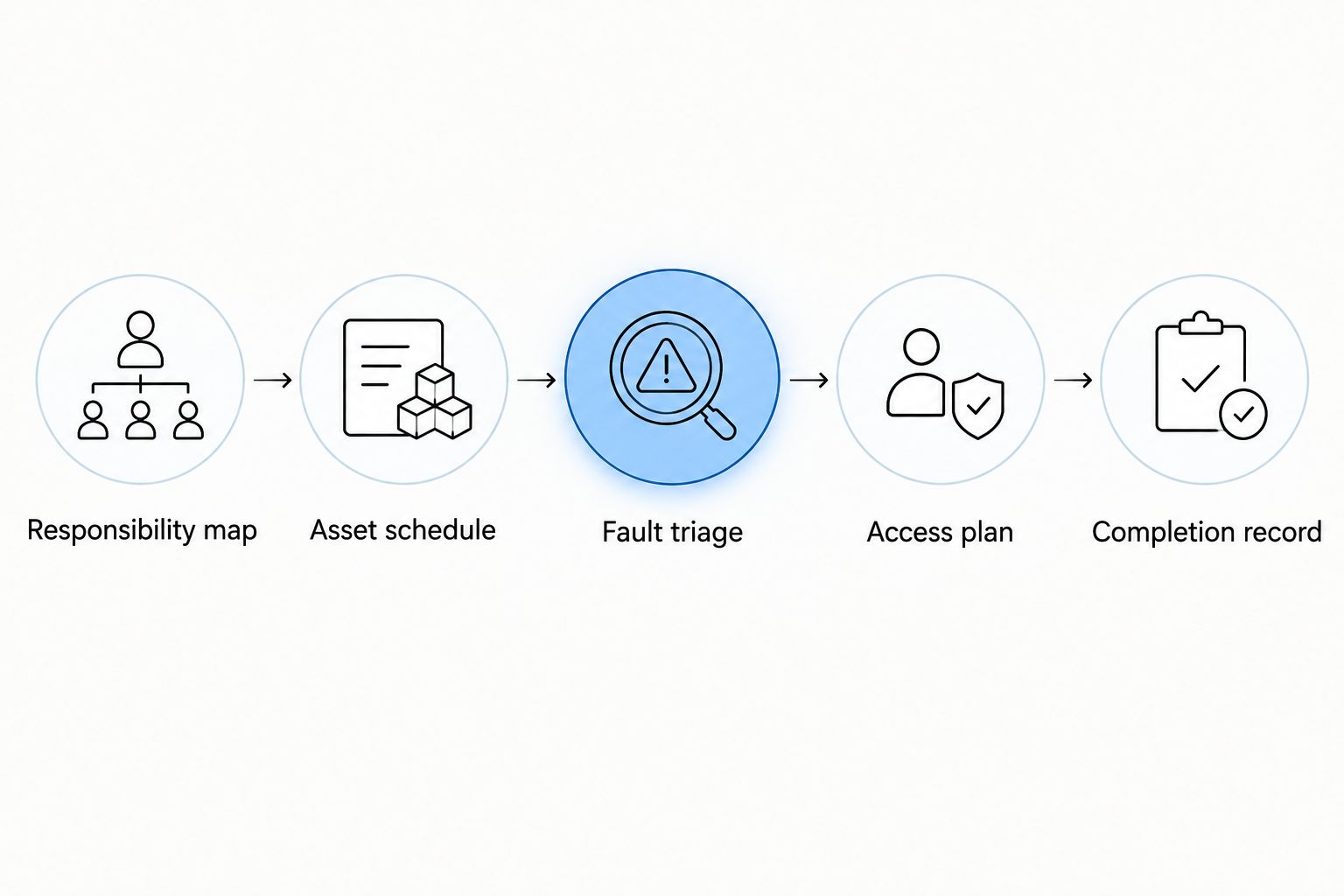
Keep notices specific to the confirmed interruption. Avoid promising a restoration time that the contractor has not agreed, and nominate who communicates changes if the work does not proceed as planned.
- Confirm access arrangements with the attending contractor.
- Identify affected occupants and shared services.
- Obtain the contractor's isolation and interruption requirements.
- Issue notices using the confirmed work window.
- Name the contact for access problems and changed conditions.
6. Close jobs with evidence, not just invoices
Keep 3 linked records for each job: the original fault report, the contractor's service findings and the completion evidence. An invoice describes a transaction; it does not necessarily describe what was tested, what remains defective or whether a return visit is required.
Ask for asset-specific findings and any certificates or test records required for the work performed. Record outstanding defects separately so the job does not appear complete while a safety concern remains unresolved.
Use 2 acceptance checks before administrative close-out: confirm the agreed scope has a documented outcome, and confirm every outstanding item has an owner. These are management checks, not a substitute for electrical verification.
The reactive maintenance records workflow explains how to connect a fault ticket with its supporting records. Use that structure across trades so electrical documents do not disappear into a separate inbox.
- Match the service report to the original asset and fault.
- Save required certificates and relevant test results.
- Record incomplete work and the reason it remains open.
- Assign follow-up actions to a named person.
- Notify the original reporter of the documented outcome.
7. Review repeat faults and plan replacements
Review the job register before the next committee maintenance discussion. Look for the same fitting, circuit or location appearing repeatedly. Ask the electrical contractor whether the pattern calls for further investigation, component replacement or a change to the maintenance approach.
Do not turn repeat faults into a diagnosis yourself. Similar symptoms can have different causes, and replacing a visible component does not establish that the underlying issue is resolved.
For the 2026 review, separate corrective work from discretionary upgrades. Give the committee the contractor's findings, the consequence of deferring the work and any access dependencies. Keep technical recommendations attached to the decision so future managers can understand it.
- Group repeat reports by asset and location.
- Ask the contractor to explain unresolved patterns.
- Separate maintenance defects from proposed improvements.
- Record the committee's decision and any conditions.
- Update the asset schedule after approved changes.
Compare coordination options for your scheme
Choose the arrangement that matches your management capacity and the work involved. Direct electrical contracting suits a clearly defined electrical job; facilities coordination suits work that crosses access, maintenance and trade boundaries. Neither arrangement removes the need to verify the electrical contractor.
| Option | Best for | Practical advantage | Key limitation |
|---|---|---|---|
| Direct licensed electrical contractor | A defined electrical inspection or repair | Direct discussion of technical findings with the trade | The manager still coordinates access, approvals and other trades |
| Manager-led coordination | Schemes with internal capacity to administer maintenance | Keeps scheduling and records under the manager's control | Requires consistent follow-up and a dependable handover process |
| OZLINK Facility Services electrical coordination | Property managers combining electrical work with commercial maintenance | Connects electrical coordination with a broader maintenance scope | Confirm electrical scope, attending contractor and reporting requirements before appointment |
Ask each prospective provider the same questions. Who receives faults? Who authorises additional work? Who supplies electrical records? Who follows up unresolved defects? Compare the answers against your scheme's actual workload rather than selecting on a broad service description alone.
Discuss your strata maintenance scope
Outline your shared assets, access restrictions and electrical coordination requirements.
Common mistakes strata schemes make
Treating every electrical asset as common property
Responsibility needs confirmation against the scheme's arrangements. Sending every report to the body corporate without checking ownership can create approval disputes and incomplete records. Mark uncertainty explicitly and resolve it through the manager.
Confusing coordination with electrical authorisation
A facilities coordinator can organise access, trades and records. That role does not authorise unlicensed electrical work. Verify the electrical contractor even when another company manages the booking.
Using one maintenance interval for everything
A convenient calendar date is not a technical maintenance standard. Ask the contractor to establish the requirements for each asset category, then document the basis for the schedule. Keep missed or inaccessible assets visible.
Approving another repair without reviewing the history
Repeated reports deserve the previous findings, not a fresh ticket with no context. Send the asset history to the contractor and ask what investigation is needed. Do not assume a recurring trip or failed light has the same cause each time.
Closing the ticket when the invoice arrives
Administrative completion and technical completion are different. Check the service findings, required records and unresolved actions before marking a job closed. A contractor's recommendation awaiting committee approval still needs an owner.
FAQ
What is commercial electrical maintenance for strata?
Commercial electrical maintenance for strata is the inspection, servicing and repair of shared electrical assets. The process also includes confirming responsibility, arranging licensed electrical work and retaining the relevant service records.
Who is responsible for electrical maintenance in a strata building?
Responsibility depends on the asset and the scheme's ownership and maintenance arrangements. Ask the body corporate manager to check the relevant plans and records rather than deciding from the equipment's location alone.
How often should strata electrical equipment be inspected?
Inspection frequency depends on the equipment, its use and applicable requirements. Have a licensed electrical contractor confirm the schedule for each asset category instead of applying one interval throughout the building.
Can a handyman carry out strata electrical repairs?
A handyman appointment does not authorise electrical work. Electrical work requiring a licence must be carried out by appropriately licensed people, with the contractor's authority verified before appointment.
Is a facilities partner better than booking an electrician directly?
A facilities partner suits work involving several trades, access arrangements or wider maintenance coordination. Direct electrical contracting suits a clearly defined electrical task when the manager can handle approvals, access and records.
What should residents do when they notice an electrical hazard?
Residents should keep away from suspected electrical hazards and report them through the building's emergency process. Contact emergency services where there is immediate danger; do not touch damaged equipment or repeatedly reset a tripping device.
What records should a strata manager keep after electrical maintenance?
Keep the original fault report, contractor findings and completion evidence together. Include any required certificates or test records, plus the owner and next action for every unresolved defect.
One last thing
A job can be finished while a defect remains open. A contractor might complete an investigation and correctly recommend further work; your register must preserve that distinction.
Before signing off your 2026 maintenance review, check every completed investigation for outstanding recommendations. Put each unresolved item back in front of the authorised decision-maker with its supporting report. That simple check prevents a completed attendance from being mistaken for a repaired asset.