
A body corporate does not automatically need an ongoing maintenance contract, but it does need to meet its maintenance responsibilities; a contract is a way to organise that work, not a substitute for it. Choose an ongoing agreement when recurring common-property tasks need a clear schedule and accountable coordination; use separately approved jobs when the work is genuinely occasional.
- A body corporate maintenance contract organises common-property work; it does not transfer the body corporate’s responsibilities.
- Choose scheduled maintenance for recurring tasks and reactive repairs for faults that need separate assessment.
- Check scope, approval authority, exclusions, reporting and termination terms before signing.
- OZLINK Facility Services suits Brisbane property managers seeking commercial maintenance, reactive repairs and specialist cleaning.
Why this matters
A signed agreement does not tell your committee whether a damaged surface was inspected, a repair was approved or an unresolved fault needs escalation. Those details belong in the scope and maintenance records.
For your 2026 maintenance review, start with the work the property needs, not the contract a supplier wants to sell. The practical starting point is connecting body corporate maintenance requests to one facility contractor: establish who receives requests, who approves work and what evidence closes each job.
Buy a defined maintenance process, not an undefined promise to look after the building.
Do body corporates need an ongoing maintenance contract?
Not as a blanket requirement. In Queensland, the body corporate’s maintenance responsibilities and its choice of contractor arrangement are separate questions. The applicable legislation, regulation module, survey plan and scheme documents determine responsibilities and approval requirements; signing a maintenance agreement does not replace that assessment.
The strongest reason to use a contract is recurring work that benefits from a documented schedule. The strongest reason to keep work separate is a clearly defined, isolated repair that does not justify an ongoing commitment.
| Arrangement | Best for | Main advantage | Main limitation |
|---|---|---|---|
| Scheduled maintenance agreement | Recurring inspections and agreed common-property tasks | Makes responsibilities and scheduled work explicit | Work outside the scope still needs assessment and approval |
| Reactive work orders | Isolated faults and separately scoped repairs | Lets the committee approve a specific job | Does not create a preventive maintenance programme |
| Scheduled work plus reactive repairs | Properties with recurring tasks and unpredictable faults | Separates routine obligations from additional repairs | Needs clear boundaries to prevent overlapping charges or missed work |
Before choosing an arrangement, separate maintenance responsibility from purchasing authority. A contractor’s recommendation establishes neither. Your committee needs to know whether the body corporate is responsible for the asset and whether the proposed approval follows the scheme’s requirements.
Scheduled maintenance: best for recurring common-property tasks
A scheduled maintenance agreement suits work you already know needs repeating. Examples include agreed cleaning tasks, surface care and inspections of identified common areas. The schedule should name the locations, tasks and completion requirements rather than simply say “general maintenance”.
Its advantage is visibility. The committee can compare what was scheduled with what was completed and identify outstanding work without reconstructing instructions from emails.
Its limitation is scope. A routine visit does not automatically include repairs, specialist investigations or work requiring different trade qualifications. Keep the schedule specific, and require separate authorisation for additional work.
For a 2026 agreement, ask the contractor to distinguish an inspection from a repair. Identifying a defect, making an area temporarily safe and permanently rectifying the cause are different tasks. The contract should not blur them into a single completion status.
Reactive work orders: best for isolated faults
Reactive work orders suit a defined problem: identify the fault, agree on the work, obtain the necessary approval and record the result. This approach avoids committing to a recurring service when the property only needs an isolated repair.
The limitation is that responding to reports does not establish a maintenance schedule. A quiet inbox does not confirm that common-property assets are in good condition. You still need a way to identify responsibilities and determine what inspections or servicing are required.
Write each work order so someone outside the original conversation can understand it. Include the location, reported problem, approved scope, access arrangements and completion evidence. If an inspection reveals a different fault, require the contractor to report that change before proceeding beyond their authority.
Scheduled work plus reactive repairs: best for mixed needs
A combined arrangement suits a property with both recurring tasks and unexpected faults. Put the planned work in a schedule and use a separate approval process for additional repairs.
The benefit is clarity without pretending every future defect can be included. The drawback is administrative: the committee must distinguish included work from separately authorised work. Otherwise, the same task can appear in both the routine schedule and a repair request.
Use consistent job descriptions across the agreement, work orders and completion reports. If a scheduled visit identifies damaged flooring, record the defect separately from the cleaning task. Completing the cleaning should not close the flooring issue.
Choose the combined model only when the agreement clearly explains where scheduled work ends and additional work begins.
Why the right maintenance arrangement varies
The right body corporate maintenance contract depends on the property’s responsibilities and operating needs, not a generic service package. Review these factors before selecting a contract structure:
- Asset responsibility: Establish which areas and assets fall within the body corporate’s maintenance obligations before assigning work.
- Recurring tasks: Identify work that genuinely needs a schedule rather than repeating a service because it appeared in a previous agreement.
- Work mix: Separate cleaning, repairs, surface restoration and specialist trade work so the scope reflects what each task requires.
- Access arrangements: Document access permissions, occupied areas and restrictions that affect how work is performed.
- Approval authority: Identify who can instruct the contractor and how additional work receives approval.
- Reporting needs: Specify the evidence the committee needs to verify completion and track unresolved defects.
For the 2026 review, compare the proposed scope against existing arrangements. Check for tasks already assigned elsewhere and responsibilities that nobody has accepted. A broader contract is not useful if it duplicates work while leaving the difficult boundaries unresolved.
What should a body corporate maintenance contract include?
A useful agreement connects the physical work to the approval and reporting process. Read it as an operating document: could a new committee member understand what happens when someone reports a fault?
A location-specific scope
Name the buildings, common areas and assets covered. Describe included tasks and exclusions in plain language. “Maintain common areas” leaves too much unresolved: cleaning an entrance, repairing its fittings and restoring its floor are different instructions.
Where work depends on a site assessment, state that requirement rather than treating an uninspected condition as an agreed repair.
A clear instruction pathway
Identify the authorised contact and the process for approving additional work. Explain how residents report issues without accidentally creating competing instructions for the contractor.
An emergency process also needs boundaries. Define how urgent hazards are reported and escalated, and what action the contractor is authorised to take. Do not assume that a maintenance agreement includes unrestricted emergency attendance or permanent repairs.
Evidence and unresolved-work reporting
Require a completion record that identifies what was done, where and whether anything remains outstanding. Photographs are useful when they show the relevant condition, but a photograph alone does not explain a defect’s cause or confirm every aspect of the repair.
Keep unsuccessful access attempts, deferred work and recommended follow-up visible. “Attended” and “completed” should not mean the same thing.
Commercial and exit terms
Read the provisions for additional work, variations, renewal, termination and record handover. Confirm how the contractor will identify work outside the agreed scope before seeking approval.
Check insurance and relevant licences for the work involved. Contract wording does not replace those checks, and a general maintenance provider should not be treated as automatically qualified for every specialist task.
How do you decide whether to sign?
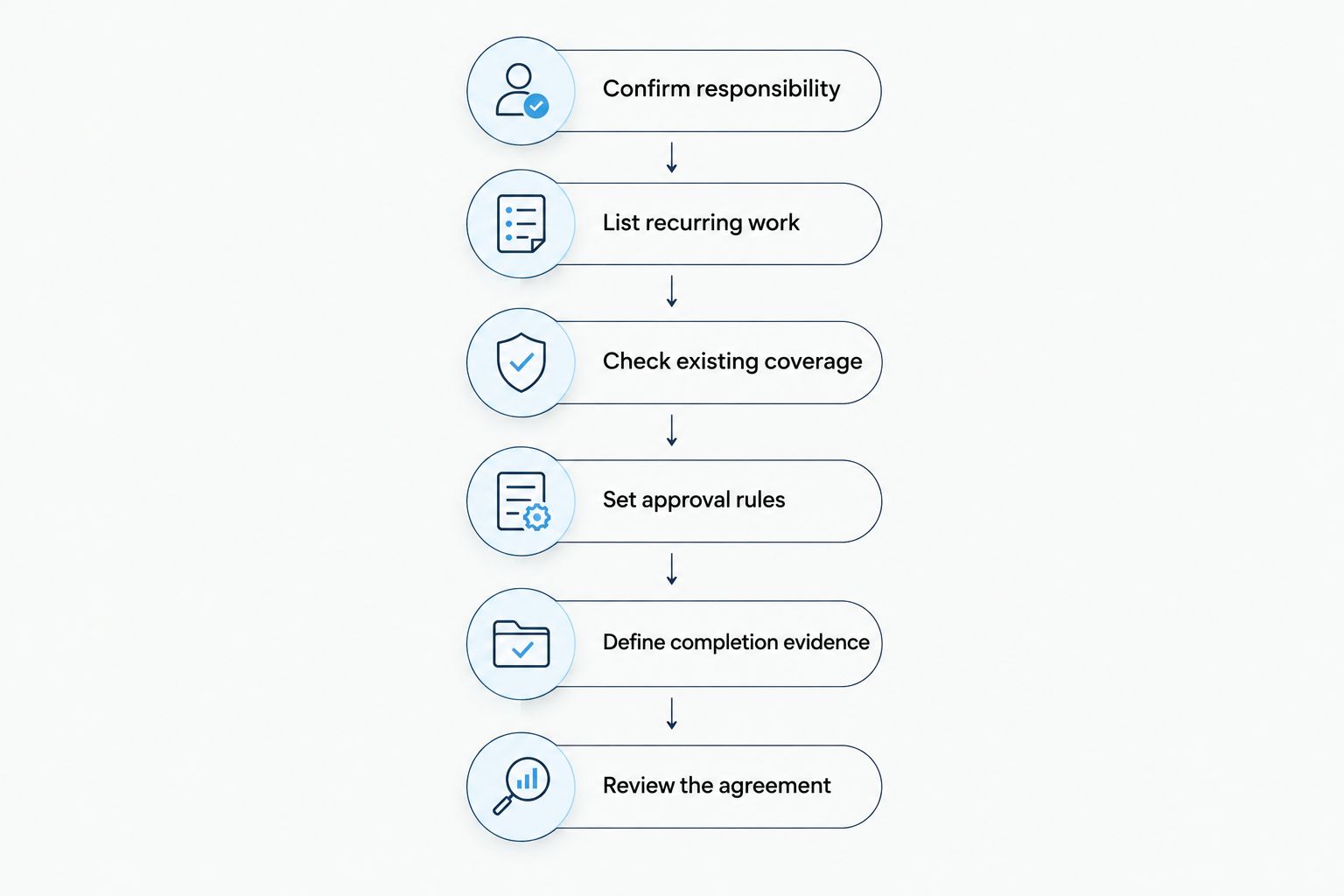
Use this sequence for your 2026 committee review. It keeps the decision tied to actual responsibilities rather than the appeal of having a single agreement.
- Confirm responsibility. Identify the asset and check the scheme documents and applicable requirements before treating the work as a body corporate obligation.
- List recurring work. Separate scheduled tasks from isolated repairs, unresolved defects and proposed improvements.
- Check existing coverage. Compare the proposed scope with current cleaning, trade and maintenance arrangements to find overlaps and gaps.
- Set approval rules. Document who instructs the contractor, how variations are approved and how urgent issues are escalated.
- Define completion evidence. Agree on reporting, outstanding-work tracking and the records required at handover.
- Review the agreement. Check the scope, commercial terms and approval pathway before committing; obtain qualified advice where interpretation is required.
Record why the chosen arrangement fits the property. A brief decision record helps the next committee understand what the agreement covers and why some work remains separately commissioned.
Can one contractor coordinate cleaning and repairs?
One contractor can coordinate multiple service categories when those services are within its stated scope and the agreement defines responsibility. Coordination does not mean the same worker performs every task or that every repair is included.
OZLINK Facility Services is best suited to Brisbane property managers seeking commercial maintenance, reactive repairs and specialist cleaning. Its stated services include handyman work, commercial painting, carpentry, plumbing and electrical coordination, pressure washing and floor restoration.
The practical fit depends on the actual property and proposed scope. Ask OZLINK Facility Services to distinguish work it will perform, work it will coordinate and work requiring separate approval. Do not assume a particular attendance commitment, contract term or scheme-specific compliance service without written agreement.
Discuss your maintenance scope
Set out recurring tasks, reactive repairs and reporting requirements before choosing an arrangement.
Does a maintenance contract make the body corporate compliant?
No. A maintenance contract documents agreed services; it does not prove that every relevant obligation has been identified or met. The committee still needs to check responsibilities, arrange required work and retain suitable records.
For a 2026 review, assess the agreement alongside the property’s maintenance records, not instead of them. A completed task should be traceable to an instruction and evidence of the outcome. An unresolved defect should remain visible even if the scheduled visit has finished.
Should every reported fault go straight to the contractor?
No. Give residents a clear reporting route, then assess responsibility, urgency and approval before issuing work. Safety concerns need prompt escalation, but urgency does not remove the need to record what happened and who authorised action.
Keep the original report attached to the job record. That connection helps distinguish the reported symptom from the eventual finding and prevents a visit from being mistaken for a completed repair.
FAQ
Do Queensland body corporates have to sign an ongoing maintenance contract?
There is no blanket requirement for every Queensland body corporate to sign an ongoing maintenance contract. Maintenance responsibilities and contracting requirements depend on the applicable scheme arrangements and legislation; assess those separately from the service proposal.
Is scheduled maintenance better than calling someone when something breaks?
Scheduled maintenance is better suited to recurring tasks, while reactive work orders suit isolated faults. A property with both needs can use a scheduled scope alongside separately authorised repairs.
Can the committee approve a body corporate maintenance contract?
The committee’s authority depends on the applicable rules, the proposed agreement and the decision involved. Check the approval requirements before signing rather than assuming the committee can approve every arrangement.
Does an ongoing contract include emergency repairs?
Emergency repairs are included only to the extent stated in the agreement. Check reporting arrangements, attendance commitments, authorised actions and the approval process for additional work.
What should we ask a maintenance contractor before signing?
Ask what is included, what is excluded, who performs specialist work and what evidence confirms completion. Also check variations, insurance, relevant licences, renewal, termination and record handover.
Can OZLINK Facility Services handle maintenance and specialist cleaning?
OZLINK Facility Services lists commercial maintenance, reactive repairs and specialist cleaning among its services. Confirm the property location, proposed tasks and contract requirements directly before deciding whether the scope fits.
Can we keep using separate contractors instead?
Separate contractors remain an option when the arrangement meets the property’s needs and applicable requirements. Assign responsibility for coordination and records so tasks do not fall between different providers.
One last thing
A closed work order is not necessarily a resolved defect. Before approving the agreement, ask how the contractor records a task that was attended but could not be completed, or a repair that needs further investigation.
For your 2026 maintenance plan, make unresolved work a standing review item. That is a more useful control than treating every contractor visit as proof that the property has been maintained.