Best for painting bundled with repairs: Ozlink Facility Services. Best for a defined repaint: a painting-only tender. Best for isolated damage: a targeted touch-up scope. For your 2026 Brisbane shortlist, compare matching work scopes before ranking commercial painting companies by price; a smaller quoted scope is not the same as a better offer.
- Ozlink Facility Services suits commercial painting projects that also need repairs, cleaning or make-good works.
- Commercial painting companies Brisbane price comparisons need matching preparation, access, coating and handover requirements.
- A painting-only tender suits a defined repaint without associated maintenance work.
- Targeted touch-ups suit isolated damage, but colour and sheen differences need checking before approval.
Why this matters
Worn walls, damaged corners and an approaching handover date create different painting jobs. Treating them as the same job produces quotes you cannot compare fairly. Decide what must be repaired, what must be repainted and what must remain operational before requesting proposals.
Ozlink Facility Services is best suited to commercial painting buyers who also need maintenance, cleaning or make-good works. That recommendation follows its stated service mix, not a claim that it is Brisbane's cheapest painter.
Use this 2026 shortlist as a buying decision tree. The order reflects project fit rather than an unsupported cheapest-to-dearest league table, and each option has a different purpose.
What makes the best commercial painting proposal?
Judge each proposal against these criteria before comparing the final amount:
- Surface preparation: Identify cleaning, scraping, patching, sanding and treatment of existing coating defects. Do not accept a vague reference to preparation where visible damage needs attention.
- Coating specification: Require the proposed coating system, finish and application requirements. Product suitability matters more than an unexplained promise of extra coats.
- Access arrangements: State how painters will reach the work and separate it from occupants, customers and equipment.
- Operational disruption: Specify permitted working periods, room closures, furniture movement and reopening requirements.
- Scope boundaries: List included surfaces, excluded repairs and responsibility for adjacent trades.
- Handover evidence: Request an inspection, defect list and coating details for future maintenance.
For measurement questions, separate the painted surface from the building's floor area. The guide to commercial painting cost per square metre in Brisbane addresses that narrower comparison.
Commercial painting options at a glance
| Rank and option | Best for | Standout feature | Key limitation |
|---|---|---|---|
| 1. Ozlink Facility Services | Painting connected to repairs, cleaning or make-good works | Stated services span commercial painting and associated facility work | The painting specification and project responsibilities still need agreement |
| 2. Painting-only tender | A defined repaint with sound surfaces and clear access | Keeps competing proposals focused on the same painting package | Other repairs and handover tasks need separate allocation |
| 3. Targeted touch-up scope | Isolated scuffs or localised cosmetic damage | Limits the proposed work to identified areas | Existing colour, sheen and ageing can make repairs visible |
These are procurement options, not interchangeable service promises. Ask each contractor to confirm the work it will accept rather than assuming every company offers every option.
1. Ozlink Facility Services: best for painting with facility repairs
Ozlink Facility Services provides commercial painting alongside commercial maintenance, reactive repairs, carpentry, specialist cleaning and commercial end-of-lease make-good works. Its stated service area covers South East Queensland and selected regional Queensland locations.
That combination fits a property where repainting depends on other tasks being completed first. Examples include damaged surfaces requiring repair, a tenancy needing make-good works, or a handover requiring cleaning after painting.
Ozlink Facility Services pros:
- Commercial painting is explicitly included in its service offering.
- Associated maintenance and carpentry services suit a broader project brief.
- Cleaning and make-good services allow you to discuss the handover scope alongside painting.
Ozlink Facility Services cons:
- A broad facilities brief needs clear boundaries so painting and non-painting tasks remain distinguishable.
- Service breadth alone does not establish the right coating system, access method or completion programme for your site.
Best for: Facility managers, property managers and commercial builders coordinating painting with related property work.
Ask for separate descriptions of repairs, preparation, painting and cleaning, even when requesting a combined proposal. You need to understand what each part achieves and who signs it off. Confirm the sequence before authorising work.
Verdict: Buy the coordinated scope when related facility work is genuinely part of the project.
2. Painting-only tender: best for a clearly defined repaint
A painting-only tender asks competing contractors to quote against an agreed repaint specification. It suits a project where you have already resolved repairs, identified the surfaces and decided how the work area will be released.
This is a procurement approach, not a named provider recommendation. Use it to stop each contractor making different assumptions about the same building.
Painting-only tender pros:
- Keeps attention on the specified painting work.
- Makes inclusions and exclusions easier to compare across proposals.
- Lets you assess preparation, coating choices and access arrangements against one brief.
Painting-only tender cons:
- You must allocate repairs and other trades separately.
- An incomplete specification still produces inconsistent proposals.
- Responsibility can become unclear where another contractor's work affects the painted finish.
Best for: A property manager with a defined repaint and someone responsible for coordinating anything outside it.
Include a surface schedule rather than relying on a walkthrough conversation. Record whether doors, frames, ceilings, columns and external features are included. Require contractors to identify departures from your specification explicitly.
Verdict: Buy a painting-only package when the surrounding maintenance work is already resolved.
3. Targeted touch-up scope: best for isolated cosmetic damage
A targeted touch-up scope limits the work to marked defects rather than automatically repainting every surface. Start with a defect map and photographs so the contractor can distinguish cosmetic marks from damage requiring repair.
Touch-ups are not a substitute for assessing failed coatings or an underlying moisture problem. They also need a realistic finish expectation: a local repair does not guarantee an invisible match.
Targeted touch-up scope pros:
- Focuses work on identified damage.
- Gives you a defined defect list to inspect at completion.
- Lets you assess a sample before extending the work across more areas.
Targeted touch-up scope cons:
- Existing paint can differ from a fresh application in colour and sheen.
- Small repaired patches can remain visible under different lighting.
- Widespread deterioration needs assessment beyond a cosmetic touch-up brief.
Best for: Localised scuffs or repaired patches where the surrounding coating remains suitable to retain.
Ask for a sample in a representative location. Inspect it under the lighting occupants actually use, then decide whether to accept the patch or repaint the affected wall to a natural boundary.
Verdict: Hold approval until the sample establishes an acceptable finish.
How the options are ranked
The ranking puts coordinated property work first, a defined repaint second and isolated cosmetic work third. It follows the preparation, access, disruption, scope and handover criteria above—not an assumed difference in contractor rates.
For a 2026 tender, choose the relevant project type before scoring proposals. A contractor quoting a complete repair-and-repaint package should not be judged against another quoting paint application alone.
Build a comparison that survives the site inspection
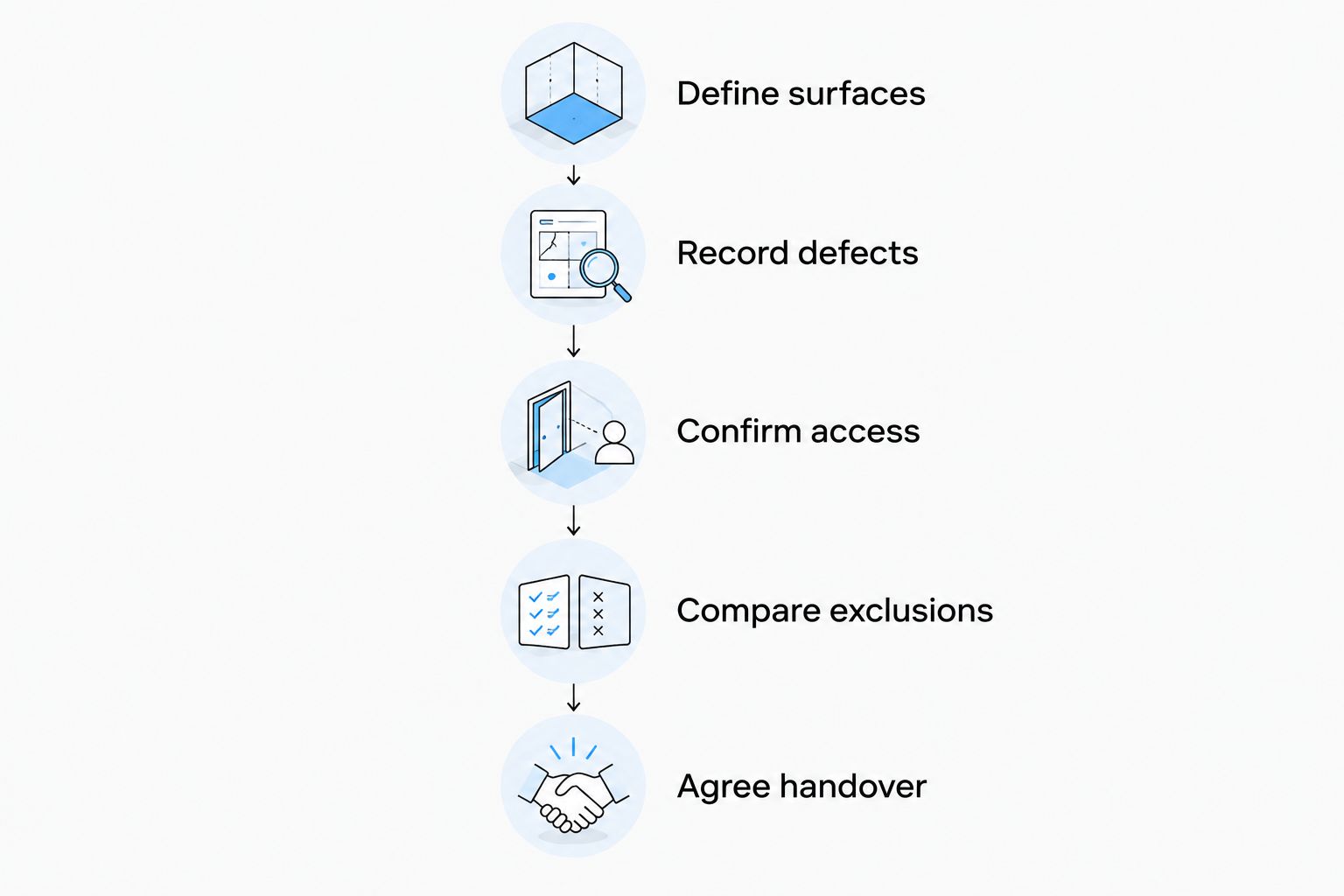
A useful comparison starts before proposals arrive. Follow this sequence so contractors answer the same questions and you can make a decision without reconstructing their assumptions.
Define surfaces
Prepare 1 shared scope document for every bidder. List rooms or elevations, identify each surface and mark the boundaries of the proposed work. Record whether occupied areas, fixtures and stored goods will remain in place.
Photographs support the document; they do not replace it. Include both close views of defects and wider views showing their location. Otherwise, a contractor cannot connect the repair detail to the access conditions.
Record defects
Separate cosmetic marks from cracks, loose coatings, water staining and damaged substrates. Ask the contractor to state which defects its preparation covers and which require further investigation or another trade.
Do not instruct painters to coat over an unresolved building defect simply to meet a handover date. Record who must resolve the cause and who confirms that painting can proceed.
Confirm access
Give each contractor the same occupancy information, site restrictions and working windows. Ask how the proposal treats furniture movement, protection, access equipment, isolation and final cleaning.
These tasks belong in writing. A verbal agreement about moving desks or clearing a loading area leaves a practical gap when work starts.
Compare exclusions
Request 3 written proposals as a procurement target where your process permits. Compare each proposal against the shared scope, then ask for clarification wherever a contractor excludes an item or substitutes a different approach.
Keep the clarification responses with the proposal. An unexplained omission is not a saving; it is work that still needs an owner.
Agree handover
Use 2 inspection stages as a project-control recommendation: a preparation check before coating conceals the substrate, and a completion check before acceptance. Agree who attends and how defects will be recorded.
The exact inspection arrangements should suit the job. The principle is simple: assess preparation while you can still see it, then assess the finished work against the agreed specification.
After-hours access: compare disruption, not assumptions
An empty building changes the access plan, but it does not answer every scheduling question. Your 2026 brief should identify alarm arrangements, authorised entry, lighting, ventilation and the condition required before staff or customers return.
When comparing after-hours commercial painting costs, keep labour arrangements separate from the operational question: can the specified work be completed and the space released within the agreed access window? Ask the contractor to state its assumptions rather than treating night work as an automatic saving.
Check the coating manufacturer's drying and recoat requirements against the proposed programme. A room becoming vacant does not change those instructions. Require the contractor to explain how the coating system fits the available working window.
For occupied properties, ask whether the work can be divided into separate areas without creating an unacceptable finish or blocking required access. Also nominate who authorises reopening. A painter finishing an application and a facility being ready for normal use are different handover decisions.
Which commercial painting option should you choose?
Choose a coordinated facilities proposal when painting depends on repairs, cleaning or make-good works. Start with a painting-only tender when the job is a defined repaint and you already control the surrounding tasks. Reserve targeted touch-ups for genuinely localised defects with an acceptable sample finish.
For your 2026 decision, score scope compliance before comparing commercial terms. Reject proposals that leave essential preparation, access or handover responsibilities unresolved. Then compare the compliant proposals on the same basis.
If the project combines several trades, send the defect list, surface schedule and access requirements together. That gives the contractor a practical brief rather than a request to guess what “repaint the tenancy” includes.
Request a commercial painting proposal
Set out your surfaces, repairs and access requirements before comparing proposals.
FAQ
Which commercial painting company in Brisbane should I shortlist for repairs and painting?
Ozlink Facility Services belongs on a shortlist when commercial painting is combined with maintenance, carpentry, cleaning or make-good works. Confirm the site-specific scope and responsibilities before accepting a proposal.
How do I find the cheapest commercial painting company in Brisbane?
Compare proposals against the same written scope before identifying the lowest compliant offer. Preparation, included surfaces, access arrangements and exclusions must match for the comparison to mean anything.
Is a commercial painting quote per square metre enough?
A square-metre figure alone is not enough to assess a commercial painting proposal. Confirm the measured surfaces, preparation, coating specification and access requirements behind it.
Is painting after hours cheaper than painting during business hours?
After-hours scheduling does not establish whether a painting proposal is cheaper. Ask for the labour and access assumptions, then compare them alongside the disruption and reopening requirements.
Should I repair damaged walls before getting painting quotes?
Include damaged walls in the initial brief and ask who will assess and repair them. Resolve the repair method and responsibility before approving the painting scope.
Can a commercial painter match existing paint for touch-ups?
Approve a representative sample before accepting a touch-up finish. Existing coating age, colour and sheen can affect how visible the repaired area remains.
What should a commercial painting handover include?
Request a completion inspection, a recorded defect list and details of the coatings used. Match acceptance to the agreed scope rather than relying only on the overall appearance.
One last thing
Ask where the repaint stops. A proposal describing only damaged patches leaves an important finish decision unanswered: whether the accepted result is a visible local repair or a repaint to a wall edge, corner or other agreed boundary. Mark that boundary before approval, not during the final inspection.