Instead of manually chasing floor photos, approvals and contractor dates, build a floor condition audit to strip and seal schedule that turns each inspection into a treatment decision, an approved work window and a documented handover. Use this 2026 workflow to organise commercial floor care without booking restoration before you know what the surface needs.
- OZLINK Facility Services provides commercial hard floor care and restoration for facility managers and property managers.
- Build your floor condition audit to strip and seal schedule around material identification, treatment approval and controlled access.
- Strip and seal is not the default treatment for every dull or damaged commercial floor.
- Keep floor inspection evidence, contractor instructions and reopening approval in the same maintenance record.
Why this matters
A dull floor does not tell you whether the problem is soil, worn finish or damage beneath the finish. Booking strip and seal from appearance alone skips the decision that determines whether the treatment is suitable.
OZLINK Facility Services is best suited to commercial property and facility managers seeking floor care alongside broader building maintenance. Its service scope includes strip and seal, floor restoration and specialist cleaning; the treatment still needs to match the floor.
Use OZLINK Facility Services as a starting point for discussing commercial floor care. For your 2026 maintenance plan, separate the inspection date, treatment decision and work date rather than treating them as the same milestone.
Before you start
- Gather records and access: obtain a floor plan, available flooring and finish documentation, previous treatment records, inspection access and permission to photograph the affected areas. Have an editable register or maintenance system ready.
- Assign responsibility: identify the person who approves the scope, the person who controls site access and the contractor who assesses treatment suitability. Confirm access to relevant product instructions and safety data sheets before work starts.
- Resolve the hidden gotcha: some floors have factory finishes or existing treatments that should not be stripped using a generic method. If the material or finish is unknown, record that uncertainty and seek confirmation before approving chemical treatment.
This guide uses suggested register labels, not buttons from a particular software package. Create the bold field names below in your existing spreadsheet or maintenance system; no integration account is required.
Floor audit register
Create the inspection record
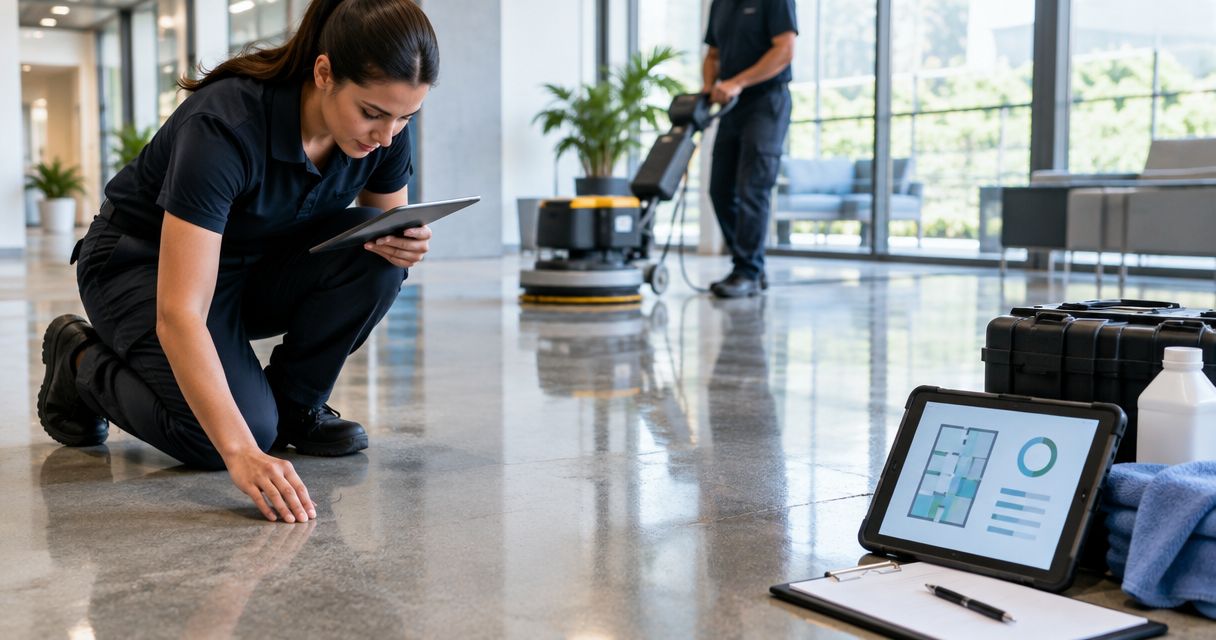
- Create a record with Site, Zone, Floor material, Existing finish, Inspection date, Inspector and Record owner. Use the same zone names as your floor plan so contractors and staff identify the same area.
- Add Observed condition, Photos, Reported incidents, Current controls and Treatment decision. Describe what you can see, such as worn traffic lanes, loose edges or sticky residue, rather than diagnosing the cause from appearance.
- Capture at least 3 reference photos per zone as a working standard: an overview, the affected traffic path and a close-up. This is a suggested documentation rule, not a statutory requirement.
- Record cleaning methods and any known recent changes. A change in detergent, equipment, traffic or nearby building work gives the assessor context without proving the cause.
- Set Status to Awaiting assessment and assign the record owner. Keep any immediate hazard controls active independently of the restoration booking.
Expected result: each floor zone has a traceable inspection record, clear photographs and an owner. Unknown materials remain marked as unknown rather than becoming assumptions in the work order.
Separate appearance from hazards
Record trip hazards, liquid contamination and damaged flooring separately from cosmetic wear. Follow your site's incident and hazard procedures where required; a future strip-and-seal appointment does not control a present hazard.
Do not describe a surface as compliant or slip-resistant because it looks clean. Appearance alone cannot establish either conclusion, and the audit should distinguish visual observations from any specialist assessment or testing.
Treatment decision and scope
Confirm the appropriate treatment
- Ask the floor-care contractor to review Floor material, Existing finish, photographs and available maintenance records. Arrange an on-site assessment where those records do not resolve the treatment decision.
- Record the proposed method in Recommended treatment. Require an explanation of what the work addresses and what it excludes.
- Confirm compatibility using the relevant flooring, finish and chemical instructions. Where appropriate, agree on a test area before approving treatment across the zone.
- Add Repairs required, Treatment limitations and Acceptance criteria. Separate substrate damage and loose flooring from work intended to remove and replace a compatible floor finish.
- Move Status to Scope ready only when the method and exclusions are clear. If compatibility remains unresolved, keep the job at assessment rather than scheduling production work.
Expected result: the record specifies a suitable treatment, not simply a request to make the floor shiny.
Match the method to the condition
Use this comparison to structure the contractor discussion. These are treatment pathways, not interchangeable services or instructions for carrying out chemical work yourself.
| Treatment pathway | Best for | Benefit | Limitation |
|---|---|---|---|
| Routine cleaning adjustment | Removable soil or residue on an otherwise serviceable surface | Addresses cleaning-related problems without removing the finish | Does not repair damaged flooring or replace a worn finish |
| Compatible maintenance treatment | A serviceable finish needing manufacturer-approved maintenance | Maintains the existing finish where the system permits it | Suitability depends on the flooring and finish system |
| Strip and seal | A compatible floor with an existing removable finish requiring replacement | Removes the old finish before applying the specified replacement system | Requires controlled access and does not repair the substrate |
| Repair or specialist restoration | Damaged flooring or a surface needing a material-specific process | Addresses problems outside routine cleaning | Requires a separate assessment and defined repair scope |
Choose the treatment from the floor evidence, not from a recurring calendar entry. For OZLINK Facility Services commercial floor care, provide the same inspection record used internally so the discussion starts with the condition and constraints.
Approved work window
Turn the scope into a schedule
- Add Operational constraints, Proposed work window, Access contact, Isolation plan and Reopening criteria. Include deliveries, occupied rooms, equipment movement and routes that must remain usable.
- Ask the contractor to confirm the required access period against the selected method and product instructions. Distinguish application time, drying between stages and the conditions for returning different types of traffic.
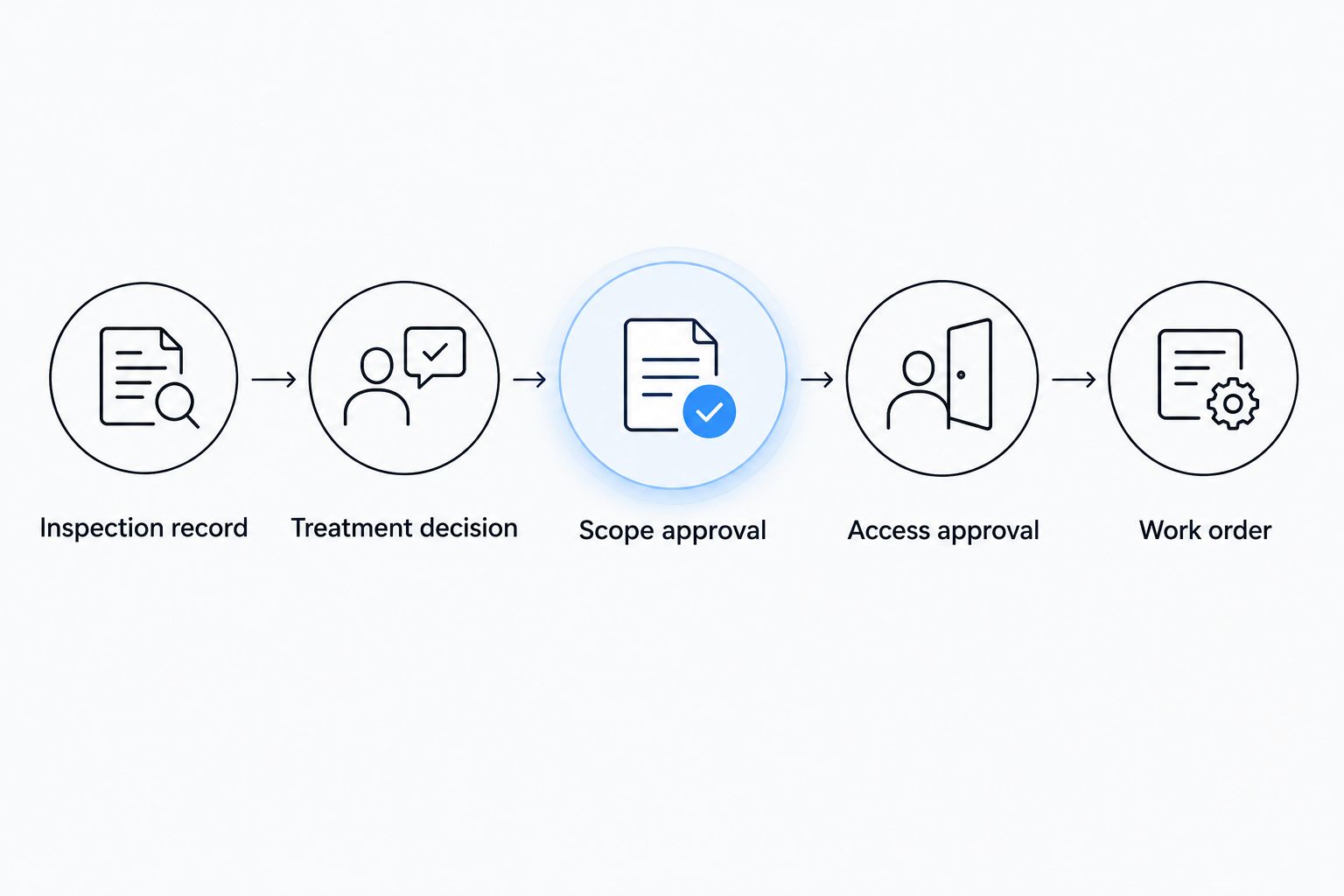
- Obtain 2 recorded approvals: treatment scope approval and operational access approval. One person can hold both responsibilities, but record each decision separately.
- Create Scheduled start, Planned handback, Contractor confirmation and Occupant notification. Treat planned handback as a booking target, not proof that the floor is ready.
- Issue the work order with the zone plan, approved scope, exclusions and access arrangements. Set Status to Scheduled after the contractor and site contact confirm the same work window.
Expected result: your 2026 strip-and-seal schedule contains an approved method and a workable closure plan, not just a date.
The scheduling sequence is deliberately gated. A missing compatibility decision stops scope approval; missing access approval stops booking; missing completion evidence stops handover.
Protect the work window
Give occupants practical instructions: which area is closed, which route remains open, who controls access and who announces reopening. Do not rely on an after-hours booking to prevent entry; cleaners, security staff and delivery teams also need the notice.
For OZLINK Facility Services floor restoration discussions, include your operating constraints with the condition evidence. The advantage of a combined maintenance brief is that related issues are visible; the limitation is that each task still needs its own suitable method and approval.
Completion and review record
Close the job with evidence
- Record Actual start, Actual completion, Treatment used and Completion photos. Ask the contractor to identify variations from the approved scope rather than silently replacing the original record.
- Check the floor against Acceptance criteria. Record unresolved defects, excluded repairs and follow-up actions separately from completed treatment.
- Obtain Reopening confirmation from the responsible person using the contractor's handover instructions. Do not reopen solely because the planned handback time has arrived.
- Attach Aftercare instructions and give them to the cleaning team. Keep the completed job and supporting documents in 1 zone record, with linked repair tasks where necessary.
- Set Next review date according to the observed condition, operating demands and relevant maintenance instructions. Set Status to Complete only after recording any remaining actions and their owners.
Expected result: you can establish what was treated, what remains unresolved and who authorised reopening without searching across separate messages.
For your 2026 records, distinguish Next review date from Next treatment date. An inspection checks whether intervention is needed; a treatment date commits the site to work. They serve different purposes.
Update the schedule after a new floor report
A second workflow starts when someone reports a new defect between planned inspections. Use the same register rather than creating a parallel list that nobody reconciles.
- Open the existing zone record and add New observation, Report date, Reporter and supporting photographs.
- Review immediate controls under the site's hazard procedure. Do not wait for the next floor-care visit to address a reported hazard.
- Ask the responsible assessor whether the new evidence changes the approved method or access plan.
- If it changes either, return Status to Awaiting assessment and request fresh approval before rescheduling.
- Preserve the previous scope and booking history. Tell affected occupants and the contractor when an approved date changes.
Best for: sites where spills, equipment moves or building works change floor conditions between inspections. The benefit is a current schedule; the trade-off is that someone must own each incoming report and close the loop.
Troubleshooting
The floor still looks dirty after cleaning
Do not automatically escalate to stripping. Ask the assessor to distinguish removable soil, residue, worn finish and material damage, then update Treatment decision with the finding.
Nobody can identify the existing finish
Keep Existing finish marked as unknown. Seek installation or maintenance records and ask the contractor to confirm a suitable assessment method before authorising chemical treatment.
The approved closure is too short
Do not compress the method or assume the floor can reopen early. Reassess the work window, discuss whether staged zones are suitable, or select another approved date while maintaining necessary hazard controls.
Staff enter before handover
Stop treating occupant notification as the only access control. Review barriers, alternative routes, access responsibilities and the reopening instruction with the site contact before work resumes.
The same issue returns after treatment
Compare the new observation with the completion record and aftercare instructions. Request assessment of the cause before repeating strip and seal; recurring damage or residue needs a diagnosis, not an automatic repeat booking.
Customise your workflow
Connect floor reviews to the wider maintenance plan, but keep treatment decisions condition-led. The guide to scheduling preventative maintenance for a commercial building provides the next planning step.
For multi-site operations, standardise field names and keep local access contacts. For childcare premises, add the site's safeguarding and access requirements before contractor attendance rather than assuming a general commercial work order covers them.
OZLINK Facility Services supports commercial maintenance and dedicated childcare facility maintenance. Include those related requirements in your brief, while keeping floor treatment approval separate from broader compliance responsibilities.
Discuss your floor care scope
Bring floor photos, material records and access constraints to the discussion.
FAQ
How do I build a floor condition audit to strip and seal schedule?
Create a zone-based inspection record, confirm treatment suitability, approve the scope and access window, then record completion and reopening. Keep the next inspection separate from any future treatment booking.
Does every dull commercial floor need strip and seal?
No, dullness alone does not establish that strip and seal is appropriate. An assessor needs to distinguish soil, residue, finish wear and material damage before recommending treatment.
How often should we schedule strip and seal in 2026?
Base strip-and-seal bookings on floor condition and the relevant flooring and finish instructions, not a universal interval. Use scheduled inspections to decide whether treatment is needed.
Can we strip and seal while the building stays open?
Only proceed where the approved method and site access plan allow the work area to remain isolated from occupants. Confirm alternative routes, service access and handback arrangements before booking.
What if we do not know the floor material?
Pause treatment approval until the material and relevant finish requirements are established. Gather available records and request a contractor assessment rather than guessing from appearance.
Does a shiny floor prove it is safe or compliant?
No, shine does not establish slip resistance or compliance. Record visual condition separately from any required specialist assessment or testing.
Who decides when the floor can reopen?
The responsible site person should authorise reopening against the contractor's handover instructions and agreed criteria. A planned completion time alone is not reopening approval.
One last thing
Schedule the next inspection when you close the job, not the next strip and seal. That single distinction keeps your 2026 maintenance calendar focused on evidence and prevents a recurring appointment from substituting for a treatment decision.