Floor strip and seal cost in Brisbane depends on the measured floor area, existing coating, preparation required and access arrangements; a site-specific quote is the basis for a usable budget in 2026. Check whether that quote includes furniture handling, edge work, surface preparation and reopening requirements, because the coating work alone does not describe the whole job.
- Floor strip and seal cost Brisbane comparisons need matching floor areas, preparation, coating specifications and access arrangements.
- OZLINK Facility Services provides strip and seal and commercial floor restoration for Brisbane facilities.
- Confirm floor compatibility before approving stripping; not every hard floor needs the same treatment.
- Ask for written exclusions and reopening instructions before accepting a quote.
How much does floor strip and seal cost in Brisbane?
Budget against a written scope, not an advertised square-metre figure. A meaningful quote identifies the floor, measures the treatment area and explains what the contractor will remove and apply. Without those details, competing totals do not describe equivalent work.
If you are choosing a contractor, use the floor stripping and sealing companies in Brisbane guide alongside the scope checklist below. Select the treatment first, then compare contractors against the same requirements.
For a 2026 quote, ask for the following breakdown. These are scope headings to confirm, not claims that every contractor includes every task.
| Quote component | What to have specified | Why it matters |
|---|---|---|
| Treatment area | Measured area in m² and included rooms | Prevents different area assumptions |
| Existing finish | Floor material and coating condition | Determines whether stripping is appropriate |
| Preparation | Removal of existing coating, residue and soil | Makes the proposed treatment clear |
| Detail work | Edges, corners and fixed obstacles | Identifies work outside open machine-access areas |
| New finish | Compatible coating system and application specification | Defines the finish being supplied |
| Site arrangements | Furniture, access, isolation and handover | Separates floor treatment from site responsibilities |
| Exclusions | Repairs, stains or other work not included | Shows what remains unresolved |
Do not assume that a quote headed simply strip and seal includes every item in this table. Ask the contractor to confirm each relevant item in writing before you approve the work.
Why this matters
Worn commercial floors create more than an appearance problem. Your facility still needs usable entrances, safe pedestrian routes and a cleaning routine that suits the finished surface. Floor work has to fit those operational requirements.
A low headline total is not a useful saving if the scope leaves furniture relocation or damaged flooring unresolved. Equally, a larger scope is not automatically better: stripping a floor that only needs suitable cleaning adds unnecessary intervention.
Specify the condition you need at handover, not just the task name. Tell the contractor which areas must be treated, how the building operates and what evidence you need when the job is complete.
Which floor treatment belongs in your quote?
Not every dull floor needs stripping. Cleaning removes soil; strip and seal addresses a removable coating system; restoration covers work intended to address the condition of the floor or finish. The right treatment depends on the material and what has actually deteriorated.
The table below compares treatment categories, not interchangeable packages. Confirm suitability against the flooring and coating manufacturer's instructions.
| Treatment | Best for | Main benefit | Limitation |
|---|---|---|---|
| Cleaning | Floors where soil is the main issue | Removes contamination without automatically replacing the finish | Does not replace a worn coating |
| Strip and seal | Compatible floors with an existing removable coating that needs renewal | Replaces the specified coating system | Does not repair damaged flooring underneath |
| Floor restoration | Floors needing condition-specific treatment beyond cleaning | Addresses a defined surface problem | Requires a material-specific assessment and scope |
Cleaning: best for soil rather than coating failure
Ask whether the apparent wear is dirt, cleaning residue or damage to the finish. These conditions can look similar without needing the same response. An inspection helps separate them.
The advantage of cleaning is that it avoids removing a coating unnecessarily. Its limit is equally clear: cleaning cannot replace finish that has already worn away. Choose cleaning when the assessment identifies soil as the problem.
Strip and seal: best for renewing a compatible coating
Strip and seal is relevant when the existing removable finish needs replacement and the underlying floor is suitable for that process. Ask the contractor to identify the proposed system rather than describe the result only as shiny or polished.
The benefit is a defined coating renewal process. The limitation is that the new finish does not resolve loose flooring, damaged joints or underlying defects. Approve strip and seal only after compatibility and preparation are established.
Floor restoration: best for a defined surface defect
Floor restoration needs a more precise description than its name suggests. Ask what defect the work addresses, which process is proposed and what condition will remain afterwards.
The benefit is a scope directed at the actual problem. The drawback is that a broad restoration label makes quotes difficult to compare unless the contractor explains the work. Request a condition-specific scope before comparing totals.
Why floor strip and seal quotes vary
For your Brisbane facility, the useful question is not whether one quote looks high or low in isolation. It is whether the contractors have allowed for the same work. Check these factors during the site discussion:
- Floor area and layout: Supply the treatment area in m², then identify rooms, corridors, edges and fixed obstacles. Open space and detailed perimeter work are different tasks.
- Existing coating: Ask what finish is present and how the contractor will establish a suitable removal method. Do not assume every coating responds to the same process.
- Surface condition: Identify loose sections, damaged joints, staining and wear before work starts. Separate coating renewal from repairs.
- Preparation requirements: Confirm how coating residue and soil will be removed before the new finish is applied. Preparation should appear in the scope, not remain an assumption.
- Access and occupancy: State when the area can be isolated and whether occupied sections need continued access. Record furniture and equipment responsibilities.
- Finish and handover: Specify the proposed coating and the conditions for pedestrian use, furniture replacement and routine cleaning. These instructions are not interchangeable.
Treat these as comparison checks, not automatic surcharges. Ask each contractor to explain which conditions affect the proposed work at your site.
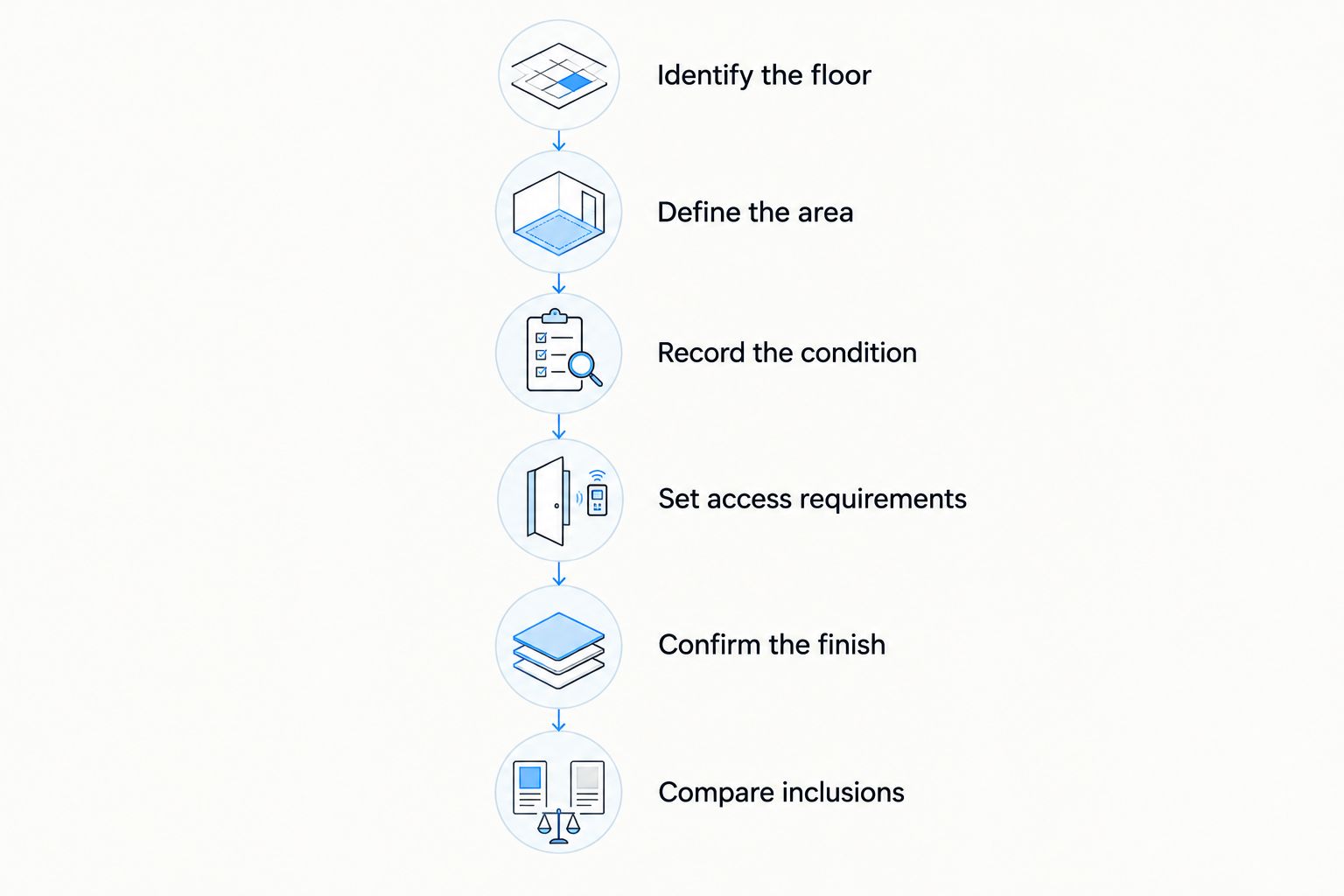
How do you get a comparable floor quote?
Use the same brief for every contractor. A consistent 2026 scope makes differences visible before you commit, rather than after work begins.
1. Identify the floor
Provide the flooring type if you know it, together with any manufacturer information or previous treatment records. Include photographs of worn areas, edges and transitions. Do not label an uncertain material as vinyl, stone or another surface just to complete the brief.
2. Define the area
List the rooms and circulation areas included in the work. Ask the contractor to confirm the measured treatment area in m² and identify exclusions on a plan or room schedule. A building's total floor area is not necessarily the area being treated.
3. Record the condition
Describe what you can observe: dull patches, peeling finish, residue, staining or damaged flooring. Keep the observation separate from the diagnosis. A photograph of a dull patch does not establish that full stripping is required.
4. Set access requirements
Explain when the building operates and which routes must remain accessible. Assign responsibility for moving furniture, clearing storage and protecting adjacent areas. Obtain written instructions for keeping people away from the work zone.
5. Confirm the finish
Ask for the proposed coating system, compatibility basis and application specification. Request instructions for reopening and ongoing cleaning. Avoid accepting a gloss description as a substitute for a treatment specification.
6. Compare inclusions
Place the quotes side by side and resolve differences in area, preparation, finish and exclusions. Ask for revisions where scopes do not match. Compare the final written scopes, not the first totals you receive.
What should a Brisbane facility manager send with the request?
Your request does not need to diagnose the floor. It needs to give the contractor enough information to inspect it and prepare a clear scope.
Use this brief for a 2026 procurement request:
Please assess the nominated hard-floor areas and confirm whether cleaning, strip and seal or another restoration treatment is appropriate. Confirm the measured area, existing condition, proposed preparation, coating specification, exclusions, access requirements and written reopening instructions. Identify repairs separately from coating work.
Attach a room list, available floor records and photographs. Include the operational constraints that matter: public access, occupied rooms, deliveries and furniture that cannot be moved without assistance.
OZLINK Facility Services is a fit for Brisbane facility managers seeking strip and seal alongside broader commercial maintenance. The company provides commercial hard floor care and restoration, as well as other facility services described on the OZLINK Facility Services website.
That broader service scope is relevant when floor work sits within a larger maintenance job. It does not replace a floor assessment or establish that every surface needs the same treatment; ask for a floor-specific scope.
Request a floor assessment
Describe your floor condition, treatment area and access requirements.
Does a cheaper quote cover the same work?
A cheaper quote covers the same work only when the area, preparation, finish and site responsibilities match. Check those items before treating the difference as a saving.
Look for vague wording such as floor treatment without a material or process description. Ask whether edges and fixed obstacles are included, and whether repairs remain your responsibility. A short quote can still be clear, but silence is not confirmation.
Can strip and seal fix a slippery floor?
Strip and seal is not, by itself, proof that a slippery floor has been made safe. Slip concerns require attention to the surface, contamination, cleaning method and conditions of use.
Tell the contractor where and when slipping occurs. If your facility requires slip-performance evidence, specify that requirement before approving the work; a glossy appearance is not that evidence.
How long must the floor stay out of use?
The reopening time depends on the specified coating system and site conditions. Obtain the contractor's written instructions rather than setting an assumed overnight deadline.
Ask separately about pedestrian access, furniture replacement and cleaning. Those activities place different demands on a newly treated surface, so one general handover time is not a complete instruction.
FAQ
How do I compare floor strip and seal cost in Brisbane?
Compare floor strip and seal quotes against the same measured area, preparation, coating specification and access requirements. Resolve exclusions before treating a lower total as a saving.
Does every hard floor need stripping before sealing?
No, not every hard floor needs stripping before sealing. Confirm the flooring material, existing finish and manufacturer's treatment requirements before approving the process.
Does strip and seal repair damaged flooring?
Strip and seal does not repair damaged flooring underneath the coating. List loose sections, damaged joints and other defects separately so the contractor can define any repair work.
Should furniture moving be included in the quote?
Furniture moving should be assigned explicitly in the quote or site arrangements. Confirm who clears the area and who returns furniture after the finish is ready.
Can people walk through while the floor is being treated?
Keep people out of the treatment area according to the contractor's isolation and reopening instructions. If the building must remain occupied, agree on access routes and staged work before starting.
Does a shiny floor prove it is slip-safe?
A shiny floor does not prove slip safety. Specify any required slip-performance assessment or evidence separately from the appearance of the finish.
Does OZLINK Facility Services provide commercial strip and seal?
OZLINK Facility Services provides commercial strip and seal and hard floor restoration services. Discuss the flooring condition, treatment area and access arrangements to establish an appropriate scope.
One last thing
Put the first post-treatment clean into your 2026 handover checklist. Ask for the cleaning product and method recommended for the specified finish, plus instructions on when cleaning can resume.
A completed coating job still needs a suitable maintenance routine. Give those instructions to the people who actually clean the floor, not just the person approving the invoice.