A reactive maintenance request is resolved when the fault is repaired, the result is checked and the affected area or equipment is ready for its agreed use—not simply when a contractor replies. There is no universal resolution time: urgency, access, diagnosis and the work required determine the completion date, while temporary make-safe work can leave a permanent repair outstanding.
- Reactive maintenance response time must distinguish acknowledgement, attendance, make-safe work and permanent repair.
- Agree the completion target after diagnosis; an arrival commitment is not a repair deadline.
- OZLINK Facility Services provides reactive repairs and commercial maintenance for facility managers and property managers.
- Record outstanding restrictions and follow-up work before treating a maintenance request as closed.
Why this matters
A fast reply does not reopen a closed room, restore equipment or remove a hazard. Your maintenance request needs an owner, a clear next action and an agreed definition of completion.
For your 2026 maintenance arrangements, separate the contractor’s response commitment from the repair commitment. A reactive maintenance ticket-to-record workflow should carry the fault through to evidence of completion, rather than stop at dispatch.
This distinction also makes contractor comparisons fairer. A provider promising a quick acknowledgement is offering something different from a provider committing to attend, assess and report back within an agreed window.
How quickly can a reactive maintenance request be resolved?
A request can be closed after the required repair and verification are complete. Before the fault is assessed, a firm completion commitment must account for what is known, what needs inspection and what depends on further authorisation.
Use 4 milestones to establish what the contractor is actually promising. These are tracking points, not standard service deadlines.
| Milestone | What it confirms | Benefit | Limitation |
|---|---|---|---|
| Acknowledgement | The request has been received and assigned | Gives you a point of contact | Does not confirm attendance |
| Attendance | The appropriate person reaches the site | Allows inspection and diagnosis | Does not establish that repair is complete |
| Make-safe | Immediate controls have been applied to the identified risk | Supports controlled management of the affected area | Can leave restrictions and further work outstanding |
| Permanent repair | The agreed repair is finished and checked | Supports handback for the agreed use | Needs evidence and confirmation of remaining limitations |
Ask which milestone starts the clock and which milestone stops it. Also establish whether the commitment runs during agreed service hours or continuously; those are different obligations.
If the contractor cannot yet confirm completion, request a diagnosis milestone and the next update instead. An explained dependency gives you something to manage. An unsupported finish time does not.
Which requests need the fastest action?
Prioritise the consequence of the fault, not the order in which requests arrive. A defect affecting safe access needs a different decision from a cosmetic repair in an unused room.
The categories below are a practical way to discuss priority with your contractor. They are not promised response tiers or a substitute for your site’s emergency procedures.
| Approach | Best for | Advantage | Limitation |
|---|---|---|---|
| Immediate escalation and make-safe assessment | An apparent immediate threat to people or property | Puts risk control ahead of routine scheduling | Does not guarantee a permanent repair during attendance |
| Urgent fault assessment | A fault disrupting an essential site function | Directs attention to the operational impact | Diagnosis can reveal further dependencies |
| Scheduled reactive repair | A contained defect with an agreed interim arrangement | Allows access and repair requirements to be coordinated | Requires review if the condition changes |
Immediate hazards: act through your emergency procedure
Where there is immediate danger, follow the site emergency procedure rather than rely on a routine maintenance ticket. Keep people away from the affected area and leave technical isolation or repair to an appropriately qualified person.
Your maintenance request should describe what you can observe safely. Do not ask an employee to approach exposed electrical components, enter an unsafe area or dismantle equipment to improve the report.
Operational faults: define what has stopped
Describe the lost function, not just the defective item. A door fault means something different when it prevents secure closure than when it affects a non-essential internal cupboard.
Tell the contractor whether the affected activity has stopped, whether another area remains usable and what restrictions are already in place. These details support a priority decision without turning every request into an emergency.
Contained defects: agree the interim arrangement
A contained defect still needs a repair owner and a review point. Record the temporary arrangement, the person responsible for checking it and the circumstances that require escalation.
Do not leave a request indefinitely marked as awaiting scheduling. Agree the next decision: inspection, approval, repair booking or further investigation.
Why reactive maintenance response time varies
Use these 6 factors when setting a realistic completion target. Each identifies a dependency that belongs in the request or the contractor’s update.
- Risk and disruption: State who is exposed, which activity is affected and whether conditions are changing. Priority should reflect the consequence of leaving the fault unresolved.
- Fault diagnosis: A visible symptom does not always identify the underlying cause. Keep the initial assessment target separate from the permanent repair target.
- Site access: Confirm entry arrangements, the site contact, permitted work areas and any induction requirements. A booking is incomplete without workable access.
- Trade requirements: Identify whether the work needs specialist assessment or coordinated trades. Do not assume a general repair booking covers electrical or plumbing work.
- Materials and repair scope: Ask whether the proposed work is a temporary measure or the complete repair. Record any outstanding material or technical decision against the job.
- Authorisation and operating constraints: Name the person who can approve the work and identify any shutdown or restricted work window. Resolve these dependencies before confirming the repair booking.
Include these factors in your 2026 service brief. The objective is not a longer form; it is fewer unanswered questions between reporting the fault and authorising the next action.
What should you send with the maintenance request?
Send enough information for the contractor to assess urgency and organise the appropriate next step. Keep the report factual: observations are more useful than an unverified diagnosis.
Identify the location and fault
Give the site address, building or tenancy, room and asset identifier where one exists. Add a wide photograph for location and a closer photograph of the defect, but only where taking photographs is safe.
Describe what happened and what no longer works. Include whether the problem is continuous or intermittent, when it was noticed and whether a previous repair relates to the same issue.
Explain the impact and existing controls
State whether people are excluded, equipment is out of use or an activity has moved elsewhere. Identify the person managing those restrictions on site.
Avoid declaring an area safe merely because a barrier has been placed around it. Report the control that exists and let the appropriate person assess its adequacy.
Provide access and approval details
Name the site contact and the person authorised to approve the proposed work. Include access arrangements and any operating restrictions that affect attendance or repair.
Send a decision-ready request, not just a photograph. If you need commercial maintenance support, contact OZLINK Facility Services with the fault location, observed impact and access details. Confirm the job-specific response and completion arrangements before treating a booking as a deadline.
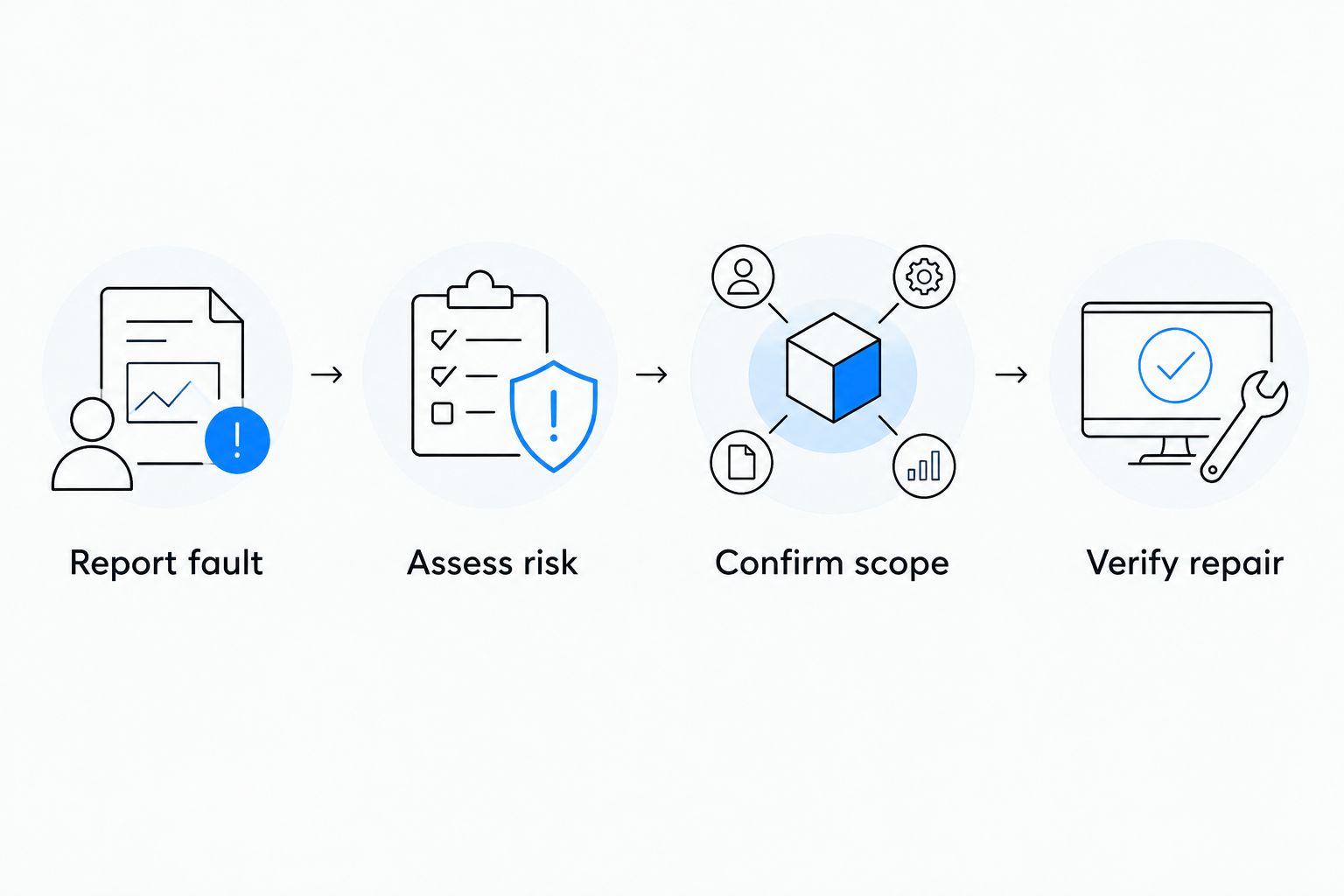
How should you agree the repair deadline?
Build your 2026 maintenance agreement around observable events. Terms such as urgent and prompt need a shared meaning before a fault occurs.
Report fault
Define how a request reaches the responsible person and how acceptance is confirmed. Establish the escalation route when the request is not accepted within the agreed arrangement.
Keep the original report time visible. Transferring the job between people should not erase the history you need to understand the delay.
Assess risk
Agree who assigns priority and who can change it when conditions worsen. The person reporting the fault should know how to communicate a changed situation without starting an unrelated ticket.
Specify what you expect after assessment: the observed fault, immediate controls, restrictions and proposed next action. A status update should explain the position, not merely repeat that the job is open.
Confirm scope
Ask the contractor to distinguish work that can proceed under existing authority from work needing further approval. Record the decision owner for each outstanding dependency.
Confirm the permanent repair target once the scope and dependencies are understood. If that target changes, request the reason, the revised action and the next update point.
Verify repair
Define the handback evidence before work starts. Depending on the job, that includes photographs, a description of the repair, relevant checks and any remaining operating restrictions.
Do not equate an invoice or an attendance record with proof that the original fault has been resolved. Close the request against the agreed outcome.
Does emergency electrical attendance mean the fault is fixed?
Emergency attendance and permanent electrical repair are separate commitments. An attending electrician needs to assess the fault and determine the appropriate action before confirming the repair scope.
When comparing emergency electrician response times, separate the arrival commitment from diagnosis, isolation and permanent repair. A response-time claim alone does not tell you when the affected circuit or equipment can return to service.
For a Queensland site, confirm the electrical work is assigned to an appropriately licensed contractor. Ask what remains isolated, who is authorised to restore operation and what further work is outstanding.
Your 2026 reporting template should capture these restrictions explicitly. A ticket marked attended must not be mistaken for permission to use equipment that remains isolated.
What should a useful progress update contain?
A useful update answers the operational question: what happens next? It should identify the current condition, the action completed and the decision or work still outstanding.
Ask for these details whenever a repair remains open:
- Current status: What has been inspected, controlled or repaired?
- Remaining restriction: What must stay closed, isolated or out of use?
- Outstanding dependency: What approval, technical decision or further work prevents completion?
- Action owner: Who is responsible for removing that dependency?
- Next update: When will the contractor confirm the next step?
Keep updates attached to the original request. A conversation spread across unrelated emails makes it harder to see who owns the next action.
If conditions change, reassess the priority rather than simply chase the existing booking. Increased exposure or lost functionality changes the decision you need from the contractor.
When is a facilities partner the right fit?
OZLINK Facility Services is best for facility and property managers seeking commercial maintenance and reactive repair coordination. Its stated services include reactive repairs, handyman work, carpentry, and plumbing and electrical coordination across South East Queensland and selected regional Queensland locations.
The fit is a scope of work involving commercial maintenance and associated trades. The boundary is equally important: a broad service scope is not a job-specific attendance guarantee, repair deadline or confirmation that a particular task is covered.
Ask for the responsible contact, proposed trade, access requirements and completion criteria for your request. Choose against those commitments rather than assume that one contractor relationship removes the need for clear job instructions.
Can a request be resolved during the first visit?
A first-visit resolution is possible when the fault is diagnosed, the required work can proceed and the result is checked. It is not something to assume from an attendance booking alone.
Tell the contractor about related symptoms and previous work before attendance. Ask whether any preparation or approval is needed from your side, without authorising unassessed technical work.
Does making the area safe count as resolution?
Making the area safe does not necessarily resolve the original defect. Record it as an interim outcome whenever restrictions, further investigation or permanent repair remain outstanding.
Keep a linked follow-up action open until the agreed repair and handback are complete. Otherwise, a successful immediate intervention can hide an unfinished maintenance obligation.
FAQ
What is a reasonable reactive maintenance response time?
A reasonable reactive maintenance response time is an agreed commitment matched to the fault’s risk and operational impact. Specify whether it covers acknowledgement, attendance, make-safe work or permanent repair.
Can a reactive maintenance request be completed on the day I report it?
Completion on the reporting day depends on diagnosis, access, authorisation and the required repair. Ask the contractor to confirm the scope before relying on a completion deadline.
Does a quick acknowledgement mean a contractor is coming?
A quick acknowledgement confirms receipt, not attendance. Request a separate attendance arrangement and the name of the person responsible for the next update.
What should I do while waiting for a maintenance contractor?
Follow your site procedures and keep people away from the identified hazard. Do not attempt technical isolation or repairs beyond your authority or competence.
Why is my maintenance request still open after the contractor attended?
Attendance does not close a request when diagnosis, approval, further work or verification remains outstanding. Ask for the remaining action, its owner and the next update point.
Can OZLINK Facility Services help with commercial reactive repairs?
OZLINK Facility Services provides commercial maintenance, reactive repairs and associated trade coordination. Confirm the requirements, location coverage and response arrangements for your specific request.
What evidence should I keep when a reactive repair is finished?
Keep the fault description, work record, relevant photographs, checks and any remaining restrictions. Close the request only when those records support the agreed completion criteria.
One last thing
Do not let a temporary control become an invisible permanent arrangement. Before closing any request in your 2026 maintenance register, ask whether the original function has been restored or the risk is merely being managed.
If further work remains, keep the owner and next action visible. That distinction matters more than how quickly the first reply arrived.