Carpet steam cleaning is the better choice for restorative office cleaning when the carpet manufacturer permits hot-water extraction and you can allow proper drying. Dry or low-moisture cleaning suits interim appearance maintenance when access is restricted, but the exact process matters: neither method guarantees stain removal, and neither repairs worn fibres.
- Carpet steam cleaning vs dry cleaning commercial: choose by carpet instructions, soil condition and reopening requirements.
- Hot-water extraction suits restorative office carpet cleaning when the manufacturer permits it and drying is controlled.
- Dry cleaning suits interim maintenance, but ask which process the contractor actually means.
- Ozlink Facility Services provides commercial carpet steam cleaning in Brisbane and South East Queensland.
Is carpet steam cleaning better than dry cleaning for offices?
Choose manufacturer-approved hot-water extraction for restorative cleaning; choose an approved low-moisture process when interim appearance and restricted access drive the decision. Steam cleaning commonly refers to hot-water extraction, rather than cleaning with steam alone. Dry cleaning is a broader label covering processes with different moisture levels and soil-removal mechanisms.
Your 2026 maintenance plan should identify both the cleaning method and the conditions for reopening. For recurring work, connect that decision to how often commercial carpets should be steam cleaned, rather than treating every visit as the same job.
| Method | Best for | Main advantage | Main limitation |
|---|---|---|---|
| Hot-water extraction | Restorative cleaning of compatible carpet | Rinses and extracts suspended soil from the carpet | Requires controlled moisture application and drying |
| Encapsulation | Interim appearance maintenance on compatible commercial carpet | Uses a low-moisture process, followed by vacuuming to remove dried residue | Does not provide the same flushing action as extraction |
| Absorbent compound | Moisture-sensitive scheduling where the carpet permits the process | Uses a cleaning compound that is worked through the pile and vacuumed out | Thorough recovery of the compound matters; suitability still needs checking |
These are different processes, not interchangeable labels. Ask the contractor to name the proposed method before comparing scopes.
Why this matters
A clean-looking carpet and a successfully completed cleaning job are not the same thing. Your office also needs safe access, controlled moisture and a clear handover before staff return.
Choosing solely on the phrase quick drying leaves important questions unanswered. The contractor still needs to assess the carpet, identify the soil and explain how the treatment suits your building.
For your 2026 cleaning brief, define the problem first: dirty traffic lanes, isolated spills, recurring marks or general appearance. That gives the contractor something specific to solve instead of a vague instruction to make the carpet look better.
Hot-water extraction: best for restorative cleaning
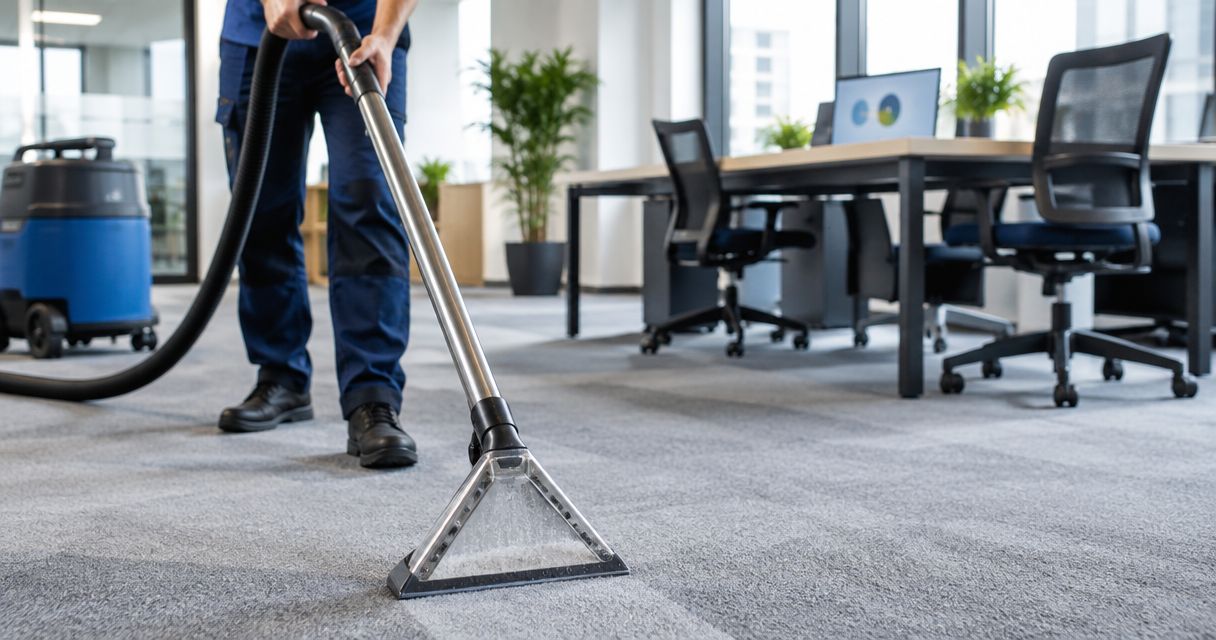
Hot-water extraction applies cleaning solution and recovers it through extraction equipment. Pre-vacuuming, suitable pre-treatment, agitation where appropriate and effective recovery all contribute to the result; the machine name alone does not define the service.
Best for: compatible office carpet needing a restorative clean, with enough access to complete treatment and drying properly. Ask whether the proposed scope includes preparation and spot treatment, not just extraction passes.
The advantage is the rinsing and recovery stage. The limitation is moisture management: poor recovery or unsuitable application can leave carpet wetter than intended, so equipment, technique and site conditions matter.
Do not assume stronger heat or more water means a better result. The method must suit the fibre, backing, installation and manufacturer’s care instructions.
Dry cleaning: best for interim appearance maintenance
Commercial dry carpet cleaning does not always mean a completely water-free process. Encapsulation commonly uses a low-moisture solution, while absorbent-compound cleaning uses material that is distributed through the pile and recovered by vacuuming.
Best for: compatible carpet needing interim appearance maintenance where reopening requirements make moisture control a priority. The contractor must explain which process is proposed and how residues or compounds will be removed.
The advantage is reduced reliance on a wet extraction stage. The limitation is that an interim process should not automatically replace restorative cleaning where the carpet’s maintenance instructions call for it.
Ask what happens after the machine leaves. With encapsulation, subsequent vacuuming is part of the soil-removal process, so responsibility for that step belongs in the written scope.
Why the better method varies between offices
The right choice depends on the carpet and the work environment, not whether a contractor prefers a particular machine. Use these factors to assess the proposal:
- Carpet instructions: Check the manufacturer’s approved methods, fibre restrictions and warranty conditions before authorising treatment.
- Soil condition: Distinguish loose dry soil, tracked-in contamination, oily deposits and individual spills. They do not all respond to the same treatment.
- Carpet condition: Record worn pile, loose seams, damaged backing and existing discolouration. Cleaning does not reverse physical damage.
- Air movement: Confirm how the space will be ventilated and whether building systems can operate during drying.
- Access window: Identify when treatment starts, which routes remain open and who authorises reopening.
- Previous treatment: Tell the contractor about earlier cleaning, spot chemicals and recurring marks so the next treatment is not planned in isolation.
A proposal that ignores these factors is incomplete, even if it names a recognised cleaning method. Approve the site-specific process, not the label.
How do you choose the right method before booking?
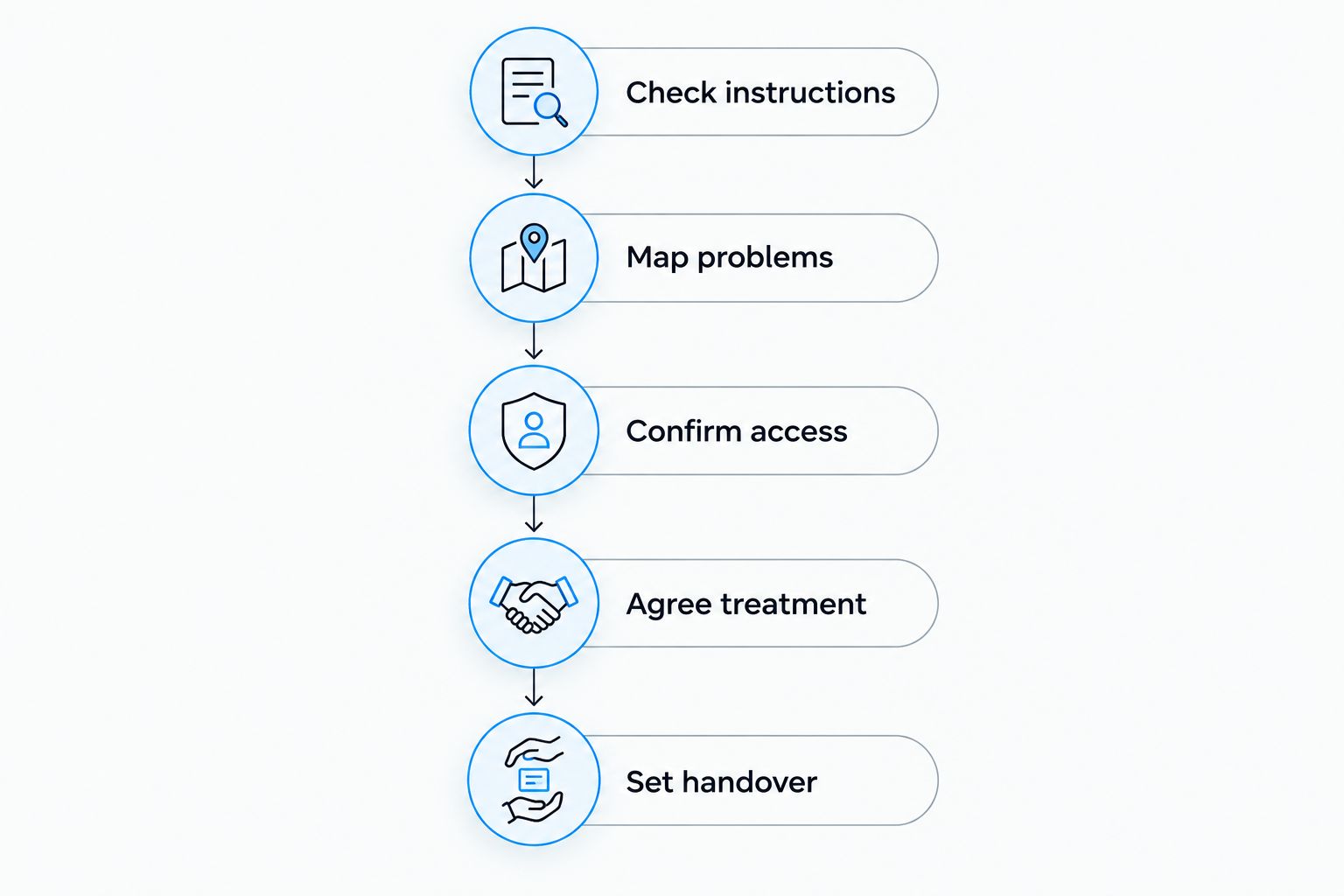
Use this sequence when preparing your 2026 office carpet cleaning scope. It keeps the decision tied to the problem rather than to a generic service description.
- Check instructions. Find the carpet care information or ask the property manager for it. Record any restrictions on chemistry, equipment or moisture.
- Map problems. Mark traffic lanes, spill locations, recurring stains and damaged areas. Separate cleaning issues from repair issues.
- Confirm access. Establish occupied areas, equipment routes and the required reopening time. Include security and building-management arrangements.
- Agree treatment. Ask for the named method, preparation, spot treatment, recovery and drying arrangements in writing.
- Set handover. Identify who checks the result, records unresolved marks and releases the area for use.
If the carpet type is uncertain, make identification part of the assessment. Guessing from appearance is not a substitute for checking the installation information and testing the proposed treatment.
What should happen before cleaning starts?
Clear responsibility matters as much as the method. Decide who moves chairs, clears loose items, protects nearby finishes and tells staff which areas are unavailable.
Ask the contractor to inspect the carpet and test the proposed treatment in a suitable inconspicuous area. Record existing defects before work starts so the handover distinguishes pre-existing wear from the cleaning result.
Your 2026 work order should also address pre-vacuuming. Removing loose dry soil is a separate preparation step; do not assume every quoted service includes it simply because extraction or encapsulation appears in the description.
Check the treatment boundary at doors and adjoining hard floors. Moisture carried onto a smooth surface creates a different access issue from damp carpet, so signs and barriers must match the actual work area.
How do you judge the result without relying on appearances?
Judge the finished work against the agreed problem list. Inspect traffic lanes, treated spills, edges and access routes, then record which marks remain and what the contractor says caused them.
The benefits of professional carpet cleaning should be assessed against soil removal and a completed maintenance process, not a promise that every mark will disappear. Worn fibres, colour loss and damaged backing are not simply dirt waiting for a stronger treatment.
A useful completion record distinguishes a stain that remains from an area that has not been properly cleaned. That distinction lets you decide whether the next step is additional treatment, monitoring or repair rather than repeating the same booking without a diagnosis.
Do not accept a blanket claim that steam cleaning disinfects the entire carpet. Cleaning and disinfection are different claims; any proposed disinfection treatment needs its own product directions, suitability checks and defined scope.
Can you combine steam cleaning and dry cleaning?
Yes, an office maintenance plan can combine approved interim cleaning with periodic restorative cleaning. The methods serve different purposes, so the plan should explain when each is used rather than presenting them as rivals at every visit.
For example, compatible meeting rooms needing appearance maintenance can receive an interim treatment while heavily soiled traffic routes are assessed for extraction. Keep the method tied to each area’s condition and care instructions.
The limitation is coordination. Different treatments create different follow-up tasks, and the cleaning record needs to show what happened in each area so the next contractor does not work from assumptions.
For a 2026 programme, use inspections and observed soil conditions to review the schedule. Do not invent a fixed frequency that ignores occupancy, entrances, spills and the carpet manufacturer’s maintenance requirements.
What should you ask about drying and reopening?
Ask the contractor to explain the drying plan for your actual building. Carpet construction, moisture recovery, airflow and ambient conditions all affect the outcome, so a generic promise is not a reliable handover rule.
Confirm whether air-conditioning or ventilation can remain operating after hours. A cleaning plan that depends on building systems is incomplete if those systems shut down when the contractor leaves.
Reopen on checked conditions, not on the booking finish time. Agree who assesses the treated areas and adjoining walkways, who removes barriers and who receives any instructions about furniture or further vacuuming.
Where business access is difficult, discuss staged work before changing methods. Dividing the office into agreed work areas can address an access problem without automatically ruling out the treatment the carpet needs.
Where does Ozlink Facility Services fit?
Ozlink Facility Services is best suited to Brisbane facility and property managers seeking commercial carpet steam cleaning alongside broader maintenance services. The company provides carpet steam cleaning, specialist cleaning and commercial maintenance across South East Queensland and selected regional Queensland locations.
That service range is relevant when carpet cleaning sits within a wider facilities work order. The limitation is scope: a general facilities brief still needs a carpet-specific treatment plan, access arrangements and reopening conditions.
Ask for an assessment of the carpet and the proposed work before approving a method. If you specifically require dry cleaning, have the process and service scope confirmed rather than assuming it is included.
Request an office carpet cleaning assessment
Describe the carpet condition, access restrictions and required reopening time.
FAQ
Is carpet steam cleaning better than dry cleaning for an office?
Carpet steam cleaning is better suited to restorative cleaning when the carpet permits hot-water extraction and drying can be managed. An approved low-moisture process suits interim appearance maintenance where access is restricted.
Does dry carpet cleaning mean no water is used?
No, dry carpet cleaning does not always mean a water-free process. Ask whether the contractor means encapsulation, absorbent compound or another named method, because preparation and follow-up differ.
Can staff walk on office carpet immediately after cleaning?
Staff should return only under the agreed reopening conditions, not simply because the contractor has finished. The method, carpet condition and adjoining access routes all need to be considered.
Will steam cleaning remove every office carpet stain?
No, steam cleaning does not guarantee removal of every stain. Permanent discolouration, fibre wear and backing damage need to be distinguished from removable soil before treatment.
Is low-moisture cleaning a replacement for hot-water extraction?
Low-moisture cleaning is not an automatic replacement for hot-water extraction. Follow the carpet manufacturer’s maintenance instructions and match the treatment to the cleaning objective.
What should an office carpet cleaning scope include?
An office carpet cleaning scope should name the method, preparation, spot treatment, access arrangements and handover conditions. It should also identify responsibility for furniture movement and any follow-up vacuuming.
Does Ozlink Facility Services clean commercial carpets in Brisbane?
Ozlink Facility Services provides commercial carpet steam cleaning in Brisbane and South East Queensland. Describe the carpet condition and access requirements so the proposed work can be defined.
One last thing
A recurring mark is a reason to investigate, not automatically a reason to use more chemical. Ask the contractor to distinguish remaining contamination, residue, moisture-related reappearance and permanent discolouration before repeating treatment.
Keep that finding in the maintenance record. The next cleaning visit should start with the previous diagnosis, not another guess about the same patch of carpet.