High dusting in Brisbane requires a site-specific quote, not a flat rate based on floor area alone. Your scope needs to account for the overhead surfaces, safe access, dust removal and protection of the space below; equipment, restricted working hours and cleanup also need to be included before you approve the work.
- High dusting cost Brisbane: compare complete scopes, not unsupported average rates.
- OZLINK Facility Services provides high dusting and commercial maintenance for Brisbane facilities.
- Ask whether access equipment, surface protection and final cleanup are included.
- Keep external vent cleaning separate from internal duct cleaning in the scope.
How much does high dusting cost in Brisbane?
The useful figure is a written quote for your actual building and agreed cleaning scope. A warehouse with open overhead structures presents a different job from an occupied office with suspended fittings and limited access. A floor-area figure alone does not describe either job adequately.
For a 2026 quote, ask contractors to separate the following components. That makes omissions visible before you compare totals.
| Quote component | What the scope should identify | What to clarify |
|---|---|---|
| Overhead surfaces | Beams, ledges, pipes, fittings and other nominated surfaces | Which surfaces are excluded? |
| Access arrangements | Proposed equipment and the route into each work area | Is equipment provision included? |
| Cleaning method | How dust will be collected from each surface | Will dust be captured or displaced? |
| Area protection | Treatment of furniture, stock and occupied spaces below | Who clears or protects the area? |
| Working window | Agreed access hours and any staged work | What happens if access is delayed? |
| Completion | Cleanup, inspection and agreed handover records | Who accepts the finished work? |
OZLINK Facility Services provides high dusting alongside commercial maintenance and specialist cleaning in Brisbane. For a useful enquiry, describe the overhead surfaces and access constraints rather than requesting a general commercial-cleaning rate.
Why this matters
An incomplete scope leaves you comparing different jobs. One contractor might include protection and cleanup, while another expects your team to handle them. Neither total tells the full story until those responsibilities are clear.
High dusting also brings work above an occupied or operational area. Plan what happens below the cleaning, not just how someone reaches the ceiling. Your staff, customers, stock and equipment belong in the access discussion.
For your 2026 maintenance budget, keep the approved scope with the quote. If the building layout or access conditions change, you then have a clear basis for reviewing the work rather than relying on a remembered conversation.
Why high dusting quotes vary
The following factors explain why contractors need more than a building address. Give each contractor the same information so their proposals answer the same brief.
- Surface coverage: Identify the actual overhead elements requiring cleaning. A floor plan does not show every beam, ledge or pipe run.
- Access conditions: Describe ceiling access, floor obstructions, doorways and the space available for equipment. The access method needs to suit the task and location.
- Dust and residue: Explain whether the concern is loose dust or another deposit. Do not assume a dust-removal method also removes grease, adhesive or staining.
- Occupancy: State whether people, stock or sensitive equipment will remain below the work. Protection and exclusion arrangements need agreement.
- Working hours: Set out when each area is accessible, including security and building-management requirements. Avoid leaving the work window undefined.
- Completion requirements: Specify final cleanup, inspection and any records you need. A verbal promise to leave the area clean is not a detailed handover scope.
These are scope questions, not reasons to accept unexplained additions. Ask the contractor to identify the work each allowance covers and the conditions that would require approval for a change.
Reachable overhead surfaces: define the limits
Best for: areas where a suitable ground-based method can reach the nominated surfaces safely and effectively.
Ground-based tools avoid placing a worker at the cleaning point, but reach alone does not establish that a method suits the surface. The contractor still needs to assess visibility, control of the tool and dust collection.
The limitation is straightforward: a tool that reaches a fitting does not necessarily clean every side of it. Ask how concealed ledges, obstructions and delicate fittings will be handled, and record anything left outside the scope.
Restricted high-level areas: assess access first
Best for: areas where the cleaning task requires closer access and a suitable access arrangement can be established.
Equipment selection is a site-planning decision, not something to choose from a headline rate. The contractor needs to consider the route into the building, the work area and the suitability of the supporting surface.
The trade-off is disruption. Access equipment and exclusion areas can affect normal movement, so agree the work sequence before booking. Do not ask staff to improvise access or move equipment into an area without the necessary assessment.
| Approach | Best for | Main benefit | Main limitation |
|---|---|---|---|
| Ground-based cleaning | Suitable surfaces within effective tool reach | Keeps the worker at ground level | Obstructions and visibility can limit coverage |
| Equipment-assisted access | Tasks requiring closer high-level access | Allows access appropriate to the assessed task | Requires suitable space, access and work-area controls |
Choose the method that completes the agreed task safely, not the method with the simplest description. Require the proposal to explain how the nominated surfaces will actually be reached and cleaned.
How to request a comparable high dusting quote
Use the same brief for every contractor. For a 2026 procurement file, retain the original request, clarifications and accepted proposal together so the agreed boundaries stay visible.
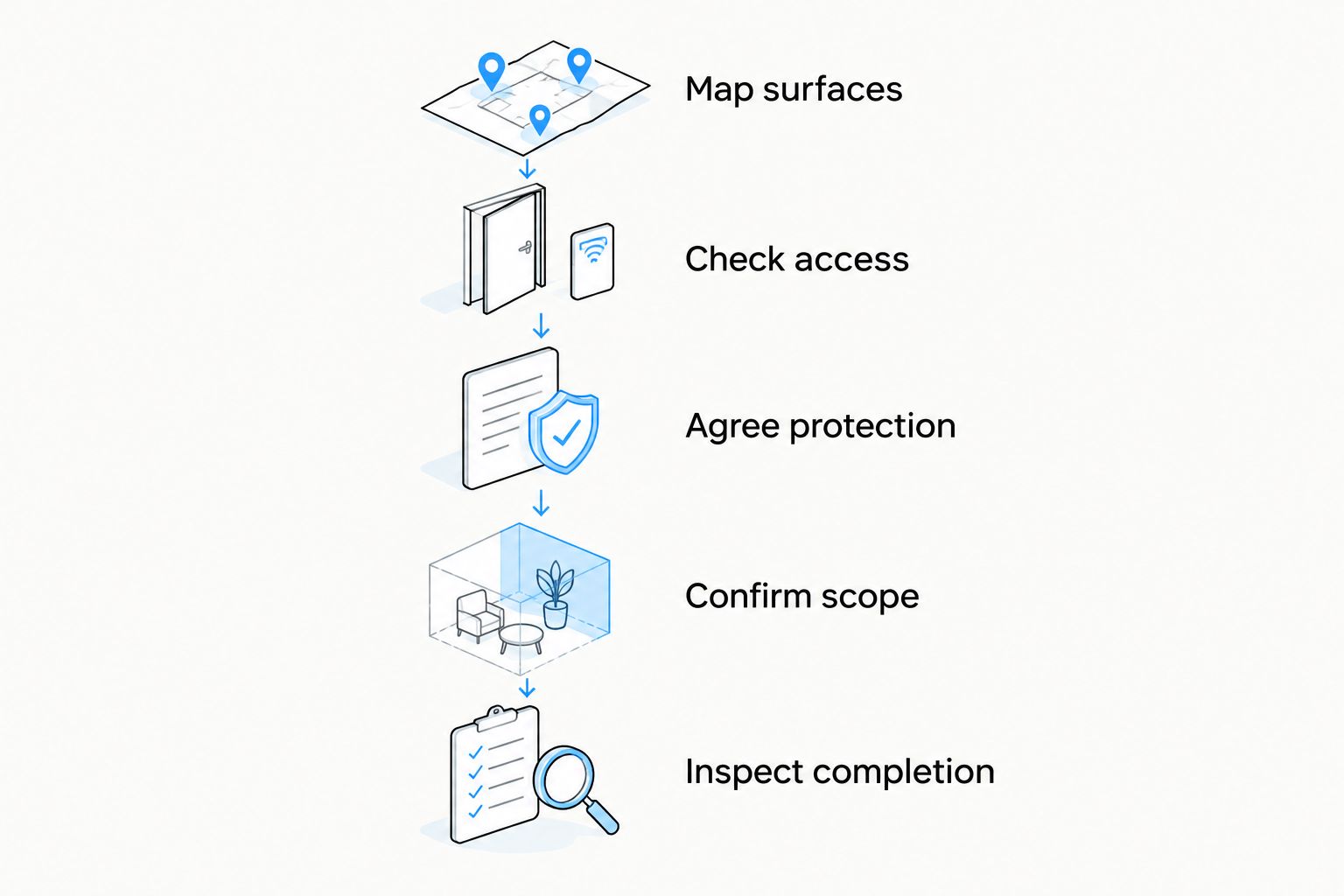
1. Map surfaces
Mark the rooms or work zones and name the overhead surfaces in each. Distinguish beams, pipework, ledges, external vent faces and light fittings rather than grouping everything under ceiling cleaning.
Provide photographs showing both the surfaces and the space underneath. If a height is unknown, say so; do not supply a guessed measurement that could distort the access plan.
2. Check access
Describe doors, loading access, fixed shelving, furniture and occupied areas. Identify who can authorise entry and whether another building user controls part of the route.
Ask the contractor what needs inspection before the method is confirmed. Photographs help explain the job, but they do not settle every access or safety question.
3. Agree protection
List what remains beneath the work and who will move or protect it. Include the arrangements for keeping people away from the active cleaning area.
Make the responsibility explicit. A contractor expecting an empty floor and a manager expecting work above occupied desks have not agreed the same job.
4. Confirm scope
Ask for the included surfaces, exclusions, method, working window and cleanup in writing. Confirm how additional work will be authorised before anyone starts it.
Separate optional work from the required task. That lets you approve a clear base scope without accidentally accepting unrelated cleaning or maintenance.
5. Inspect completion
Agree how the completed areas will be checked, including surfaces that are difficult to see from the floor. Request appropriate completion photographs where they help verify the agreed work.
Record inaccessible or excluded areas rather than treating them as finished. Keep the inspection focused on the accepted scope, not an assumption that every overhead surface was included.
What should a high dusting quote exclude or clarify?
High dusting is not a blanket instruction to clean, repair or service everything overhead. External dust removal from a grille is different from cleaning inside ductwork. Cleaning around a light fitting is different from electrical maintenance.
Ask the contractor to identify boundaries around these tasks:
- Internal ventilation or duct cleaning.
- Electrical isolation, repairs or servicing.
- Removal of deposits that are not ordinary dust.
- Cleaning behind inaccessible fixed structures.
- Moving stock, furniture or machinery.
- Repairs to damaged surfaces discovered during cleaning.
Do not assume any of these tasks are included or excluded automatically. The purpose of the list is to settle responsibility before work starts.
If cleaning needs coordination with building services, use the same scheduling discipline described in this guide to connecting high-access cleaning with HVAC servicing. Agree which contractor handles each task and who controls access.
Is a one-off clean or planned high dusting better?
A one-off clean suits a defined immediate task; planned high dusting suits an ongoing maintenance requirement. Neither approach removes the need for an initial condition and access assessment. Choose according to the building's actual needs, not an arbitrary calendar interval.
| Arrangement | Best for | Advantage | Limitation |
|---|---|---|---|
| One-off high dusting | A specific cleaning requirement or handover | Defines a standalone task | Does not establish future maintenance needs |
| Planned high dusting | Facilities incorporating overhead cleaning into maintenance | Creates an agreed review and scheduling process | The scope still needs review when conditions change |
For your 2026 schedule, record what was cleaned and the condition found at the next inspection. Use that evidence to discuss the next visit rather than assuming every commercial building needs the same frequency.
If layout, occupancy or operations change, revisit the access plan too. A previously clear work area does not remain clear simply because the service is recurring.
Can high dusting happen while the building is occupied?
Occupied-building high dusting needs an agreed separation between the work and building users. The contractor and site representative need to settle access, protection and exclusion arrangements before confirming the working window.
Staged work can be considered where the site allows it, but do not promise uninterrupted use of every area. Tell affected occupants which zones will be unavailable and who can authorise reopening.
For childcare facilities, include the centre's operating arrangements in the discussion. Do not treat overhead cleaning above occupied activity areas as an ordinary housekeeping task.
Choose a scope that fits your facility
OZLINK Facility Services is a fit for Brisbane facility managers seeking high dusting alongside commercial maintenance. Its stated services include specialist cleaning and facilities work, making it relevant when the enquiry crosses those categories.
The boundary still matters: a broad service list is not confirmation that every overhead task belongs in your quote. Ask for explicit inclusions, access arrangements and responsibility for any separately coordinated work.
For a 2026 enquiry, send the site location, photographs, nominated surfaces and permitted working hours. Ask what further inspection is needed before the scope can be confirmed.
Request a high dusting assessment
Describe your overhead surfaces, access restrictions and preferred working hours.
FAQ
How much does high dusting cost in Brisbane?
High dusting in Brisbane requires a site-specific quote covering the surfaces, access method, protection and cleanup. Compare written inclusions rather than treating a general cleaning rate as a complete estimate.
Can I get a high dusting quote from photos?
Photos help explain the surfaces and access conditions, but the contractor needs to confirm whether a site inspection is necessary. Include views of the overhead areas and the space underneath.
Does high dusting include air-conditioning ducts?
Internal duct cleaning is a separate task unless the written scope includes it. Ask whether external grille faces, internal components or both are covered.
Is access equipment included in high dusting?
Access equipment is included only when the accepted proposal says so. Ask the contractor to identify equipment provision and any site preparation responsibilities.
How often should a commercial building have high dusting?
Set high dusting frequency from the facility's conditions, use and inspection findings. Record the condition after cleaning and review dust accumulation before agreeing the next visit.
Does high dusting make a building compliant?
High dusting alone does not establish building compliance. Treat it as a defined maintenance task and confirm any separate safety, inspection or documentation requirements.
Does OZLINK Facility Services provide high dusting in Brisbane?
OZLINK Facility Services provides high dusting and specialist facility services in Brisbane. Describe the surfaces and access constraints so the proposed scope addresses your site.
One last thing
Ask what happens to the dust after it leaves the overhead surface. A proposal should explain collection, protection and final cleanup, not just how the contractor reaches the work.
That question connects the entire scope. If the answer leaves your floors, stock or workstations out of the discussion, resolve it before approving the job.